


How Sindhu has emerged from Saina’s shadow to pre-eminence makes for a remarkable story.
I’ll plead guilty to a tad hyperbolic start this week, but is there anything that captures the mood of the nation better at this moment than “Hip, Hip Sindhu!’? India is overjoyed, as it should be, given scarce success at this level. P.V. Sindhu may have had to settle for the silver medal, but the 21-year-old’s performance at the Rio Olympics has given the future of Indian sports a distinct golden glow. It was an extraordinary achievement for the world’s 10th ranked shuttler. En route to the final, she beat nos. 2 and 6 before losing to no.1 Carolina Marin: and only Marin would really know how close she was to losing the final! I’ve had brief interaction with Sindhu three years back on the inaugural Badminton Super League circuit. She was a bashful, gangly teenager then, scarce with words, looking to her parents to fill in when spoken to. At breakfast one day when the jamboree was in Lucknow, I asked her about her ambitions. Sindhu mumbled an answer, which if distilled, I remember now as “Playing in the Olympics’’. Since that is the aim of every athlete, this was hardly unusual. But that she would develop so rapidly and excel to the extent that she would win a silver medal at the Olympics within three years seemed far-fetched. Sindhu then was an underling to Saina Nehwal and it looked like this would be her position for some time to come. She too was from the P. Gopichand stable (he has now coached two Olympic medalists, worthy of a treatise) but lagged way behind in achievement and star status. Saina won the bronze at the London Olympics, and since then has constantly been in the running for the no. 1 spot in the sport. At Rio too, she was tipped for a medal till her premature exit, hampered by a knee injury. How Sindhu has emerged from Saina’s shadow to pre-eminence, adding heft and ambition to her performances in the absence of the main player, makes for a remarkable story-within-a-story. Coming on the heels of 22-year-old wrestler Sakshi Malik’s bronze medal, Sindhu’s silver suddenly changed the sullenness that had enveloped the country in the disappointing first 12 days of the Olympics to ecstasy Indeed the three best performers from India at these Olympics — wrestler Sakshi Malik and gymnast Dipa Karmakar apart from Sindhu — were all unexpected successes. And in each case, it was a come-from-behind achievement. The quarter-final against China’s Wang Yihan was a see-saw battle of skill and nerves which Sindhu won despite the lead changing hands frequently. In the semis, she was trailing in the second game against Japan’s Nozomi Okuhara before drawing level at 10-10 and then reeling off 11 points in a row in a stunning display. Malik hovered only on the margins of expectations. The lead India woman grappler, Vinesh, went by the celebrated surname of Phogat. Babita Kumari was part of the extended Phogat family. Malik was almost an appendage in the scheme of things. In each bout till the quarter-finals, she trailed before fighting back. When she got a foot in the door for a medal through the repachage system, Malik went on to clinch the bronze by winning two successive matches, staging a magnificent comeback in points in both. In some ways though, perhaps the most dramatic achievement was of Dipa Karmakar though she did not win a medal. Unlike Sindhu, who comes from a sporting family, and Malik, who has been nurtured by her state (Haryana) and the wrestling federation, Karmakar’s was a lonely, uphill struggle. Hailing from Tripura, a state not usually on the radar of Indian life in any sphere, and given her underprivileged background, Dipa’s is an astonishing saga of grit, ambition and massive, do-or-die risk-taking. Who would have ever thought that an Indian gymnast would qualify for the Olympics? And then go on to reach the final of the vault event? And in that event, perform the dangerous ‘Produnova’ vault so well that she would finish fourth, missing the bronze by a whisker? Sindhu, Sakshi and Dipa between them won only two medals, but have sparked off self-belief and optimism for the future of Indian sport. It is significant too that all three are women. It shows the medal potential in the country if social and gender prejudices are cast aside and more girls are exposed to sports. Their number is still meagre. For that, the onus is one each one of us. In my opinion, this is the main takeaway from India’s Rio campaign. Source: The Asian Age


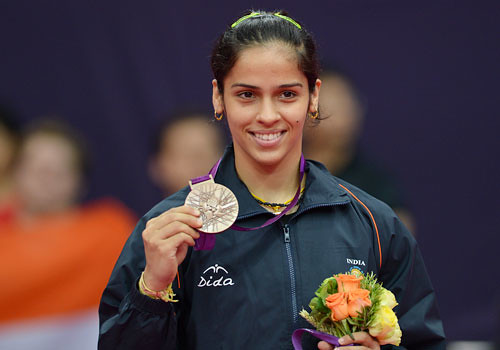
 Ace shuttler Saina Nehwal earned India its third medal at the London Games, clinching a bronze under fortuitous circumstances as her opponent and world number 2 Xin Wang of China conceded the third-place play off match due to a knee injury after winning the first game. The fourth seeded Indian had saved four game points in a dramatic fightback and was 18-20 when left-handed Xin twisted her knee while going for an acrobatic smash
 the Olympic Games. She had reached the quarterfinals in Beijing Games four years ago and lost in the semifinals yesterday to gain a chance to play for the bronze today at the Wembley Arena. This was the second day running that India have won a medal, following pistol shooter Vijay Kumar's silver medal yesterday.
  London: Saina Nehwal today created history as she became the first Indian shuttler to reach the semifinals of the Olympics after notching up a hard-fought straight-game victory over Tine Baun of Denmark in the women's singles quarterfinals at the London Games, here today. Fourth seeded Saina edged past fifth seed Tine 21-15 22-20 in a 39-minute match at the Wembley Areana to set up a clash with the current world No 1 and World champion Yihan Wang of China in the semifinals, whom she hasn't beaten once in her last five encounters. With this win, Saina bettered her quarterfinal finish at the Beijing Games four years ago and also excorcised the demons of that painful defeat to Maria Kristin Yulianti of Indonesia. The world No 5 Indian had to toil hard against the two-time All England Champion Tine, who matched her strokes but was a tad erratic, which proved to be her bane in the quarterfinal match. Saina was very precise with her strokes, while Tine was erratic initially and it allowed the Indian to lead 11-7 at the break. After the breather, Saina slowly mixed her strokes to move into the game point at 20-12 with a short smash but she committed some unforced errors and a few judgemental mistakes on her part allowed the Dane to save three game points. Saina finally pocketed the first game with a smash which Tine netted. In the second game, Tine opened up a slender 3-0 lead and extended it to 10-7 but Saina reeled off four straight points to lead 11-10 at the break once again. Saina tried to exploit the length of the court and started combining lifts and clears with drops and net-shots but Tine was up for the job as she caught up with Saina at 15-15 and even managed to earn three game points at 20-17. But Super Saina was not the one to take it lying low as she executed a cross court smash to move to 18-20. She also pocketed the next point when her stroke was judged 'in' by the line umpire, much to chagrin of Tine, who thought it was out and was celebrating her comeback by pumping her fists. After that, Tine committed to three unforced errors as Saina burst into celebration.


