Wednesday, 28 August 2024
Classical Music Lifts Our Mood by ‘Synchronizing’ Parts of the Brain, Says Study of Patients with Depression

Friday, 3 May 2024
How cleaning product chemicals called ‘quats’ may affect the brain
Friday, 22 March 2024
As we move into Spring: How To Spring Clean Your Mind
- Brush away negative thoughts and phrases with positive ones – Say things like ‘I can do this’ instead of ‘I can’t do this’ or ‘I will do my best and that is good enough’ or ‘I will give it a go’ instead of ‘I won’t try as I know I can’t do it’
- Engaging in physical health has been proven to play a vital role in sustaining good mental health. The longer lighter days means going outside in the fresh air for a walk can really help to blow away the winter cobwebs.
- Writing a Journal or Diary – By writing down your worries, thoughts, feelings and fears, it helps to release them from your mind.
- Let go of any past drama – drama and all the negative thoughts and feelings that come with it has a way of sticking with us. And whilst it may be tempting to hang onto it, it does not have any long-term benefits. By letting go, your mind will have a more positive space and will be able to handle the future with a lot less stress and anxiety.
- Drop a bad habit – Most if not all of us have an area in their life that can have a negative impact on their mental health. For many it may be diet, exercise or even spending too long on our phones. Make an effort to change the habit. Instead of lazy Sundays on your phone, make an effort to put it away, cook something nice, go for a walk or visit a friend and then come back and have a lazy afternoon instead
- Practice gratitude – A really good way to promote a happy and healthy mind is to look at what you do have and not what you do not! This can be achieved in many ways, either by writing down daily the things you are thankful for or taking a few moments to mentally check all the things you are grateful for.
- Be creative – I am a huge advocate of using creativity to help clear the mind, whether it is doing a jigsaw, knitting, painting or colouring it will definitely help you to lose yourself.
- Accept you are not perfect. Accepting that life is not perfect and probably never will be as is the world around us, it helps to ease that added pressure we put on ourselves everyday which in turn will help us to relax a bit more As we move into Spring: How To Spring Clean Your Mind
Monday, 18 March 2024
Multivitamins may help slow memory loss in older adults, study shows
Friday, 23 February 2024
How exercise increases brain volume — and may slow memory decline
Wednesday, 7 February 2024
A novel look at how stories may change the brain
“We already knew that good stories can put you in someone else’s shoes in a figurative sense. Now we’re seeing that something may also be happening biologically," says neuroscientist Gregory Berns.Tuesday, 3 October 2023
What do people think about when they go to sleep?
You’re lying in bed, trying to fall asleep but the racing thoughts won’t stop. Instead, your brain is busy making detailed plans for the next day, replaying embarrassing moments (“why did I say that?”), or producing seemingly random thoughts (“where is my birth certificate?”).
Many social media users have shared videos on how to fall asleep faster by conjuring up “fake scenarios”, such as a romance storyline where you’re the main character.
But what does the research say? Does what we think about before bed influence how we sleep?
How you think in bed affects how you sleep
It turns out people who sleep well and those who sleep poorly have different kinds of thoughts before bed.
Good sleepers report experiencing mostly visual sensory images as they drift to sleep – seeing people and objects, and having dream-like experiences.
They may have less ordered thoughts and more hallucinatory experiences, such as imagining you’re participating in events in the real world.
For people with insomnia, pre-sleep thoughts tend to be less visual and more focused on planning and problem-solving. These thoughts are also generally more unpleasant and less random than those of good sleepers.
People with insomnia are also more likely to stress about sleep as they’re trying to sleep, leading to a vicious cycle; putting effort into sleep actually wakes you up more.
People with insomnia often report worrying, planning, or thinking about important things at bedtime, or focusing on problems or noises in the environment and having a general preoccupation with not sleeping.
Unfortunately, all this pre-sleep mental activity can prevent you drifting off.
One study found even people who are normally good sleepers can have sleep problems if they’re stressed about something at bedtime (such as the prospect of having to give a speech when they wake up). Even moderate levels of stress at bedtime could affect sleep that night.
Another study of 400 young adults looked at how binge viewing might affect sleep. The researchers found higher levels of binge viewing were associated with poorer sleep quality, more fatigue, and increased insomnia symptoms. “Cognitive arousal”, or mental activation, caused by an interesting narrative and identifying with characters, could play a role.
Cognitive refocusing, developed by US psychology researcher Les Gellis, involves distracting yourself with pleasant thoughts before bed. It’s like the “fake scenarios” social media users post about – but the trick is to think of a scenario that’s not too interesting.
Decide before you go to bed what you’ll focus on as you lie there waiting for sleep to come.
Pick an engaging cognitive task with enough scope and breadth to maintain your interest and attention – without causing emotional or physical arousal. So, nothing too scary, thrilling or stressful.
For example, if you like interior decorating, you might imagine redesigning a room in your house.
If you’re a football fan, you might mentally replay a passage of play or imagine a game plan.
A music fan might mentally recite lyrics from their favourite album. A knitter might imagine knitting a blanket.
Whatever you choose, make sure it’s suited to you and your interests. The task needs to feel pleasant, without being overstimulating.
Cognitive refocusing is not a silver bullet, but it can help.
One study of people with insomnia found those who tried cognitive refocusing had significant improvements in insomnia symptoms compared to a control group.
How ancient wisdom can help us sleep
Another age-old technique is mindfulness meditation.
Meditation practice can increase our self-awareness and make us more aware of our thoughts. This can be useful for helping with rumination; often when we try to block or stop thoughts, it can make matters worse.
Mindfulness training can help us recognise when we’re getting into a rumination spiral and allow us to sit back, almost like a passive observer.
Try just watching the thoughts, without judgement. You might even like to say “hello” to your thoughts and just let them come and go. Allow them to be there and see them for what they are: just thoughts, nothing more.
Good sleep starts the moment you wake up. To give yourself your best shot at a good night’s sleep, start by getting up at the same time each day and getting some morning light exposure (regardless of how much sleep you had the night before).
Have a consistent bedtime, reduce technology use in the evening, and do regular exercise during the day.
If your mind is busy at bedtime, try cognitive refocusing. Pick a “fake scenario” that will hold your attention but not be too scary or exciting. Rehearse this scenario in your mind at bedtime and enjoy the experience.
You might also like to try:
keeping a consistent bedtime routine, so your brain can wind down
writing down worries earlier in the day (so you don’t think about them at bedtime)
adopting a more self-compassionate mindset (don’t beat yourself up at bedtime over your imagined shortcomings!).

Melinda Jackson, Associate Professor at Turner Institute for Brain and Mental Health, School of Psychological Sciences, Monash University and Hailey Meaklim, Sleep Psychologist and Researcher, The University of Melbourne
This article is republished from The Conversation under a Creative Commons license. Read the original article.
Tuesday, 26 September 2023
From stock markets to brain scans, new research harmonises hundreds of scientific methods to understand complex systems
University of SydneyComplexity is all around us, from the daily fluctuations of financial markets to the intricate web of neurons in our brains.
Understanding how the different components of these systems interact with each other is a fundamental challenge for scientists trying to predict their behaviour. Piecing together these interactions is like deciphering a code from an intricate set of clues.
Scientists have developed hundreds of different methods for doing this, from engineers studying noisy radio channels to neuroscientists studying firing patterns in networks of interacting neurons. Each method captures a unique aspect of the interactions within a complex system – but how do we know which method is right for any given system sitting right in front of us?
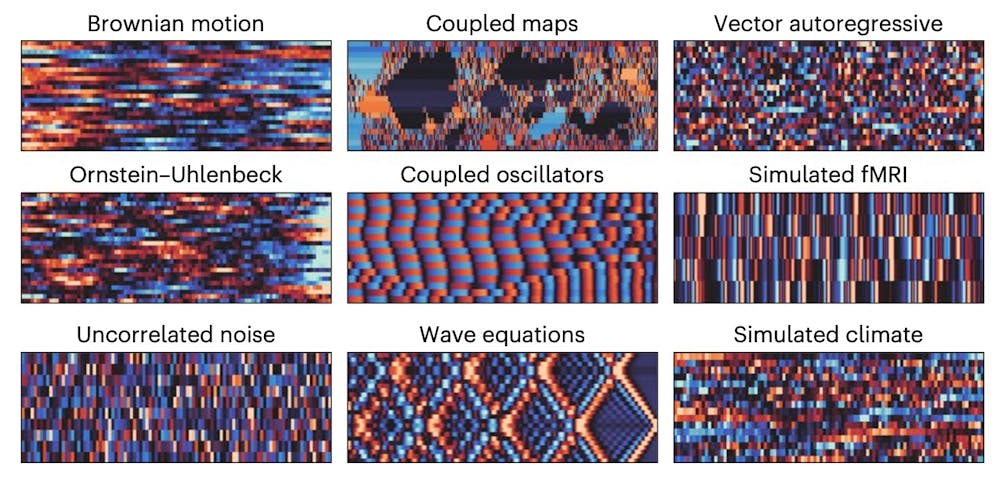
In new research published in Nature Computational Science, we have developed a unified way to look at hundreds of different methods for measuring interaction patterns in complex systems – and working out which ones are most useful for understanding a given system.
A scientific orchestra
The science of complex systems can be, well, complex. And the science of comparing and combining different ways of studying these systems even more so.
But one way to think about what we’ve done is to imagine each scientific method is a different musical instrument playing in a scientific orchestra. Different instruments are playing different melodies with different tones and in different styles.
We wanted to understand which of our scientific instruments are best suited to solving which types of problems. We also wanted to know whether we could conduct all of the instruments to form a harmonious whole.
By presenting these methods as a full orchestra for the first time, we hoped we would find new ways of deciphering patterns in the world around us.
Hundreds of methods, more than 1,000 datasets
To develop our orchestra, we undertook the mammoth task of analysing more than 200 methods for computing interactions from as many datasets as we could get our hands on. These covered a huge range of subjects, from stock markets and climate to brain activity and earthquakes to river flow and heart beats.
In total, we applied our 237 methods to more than 1,000 datasets. By analysing how these methods behave when applied to such diverse scientific systems, we found a way for them to “play in harmony” for the first time.
In the same way that instruments in an orchestra are usually organised as strings, brass, woodwind and percussion, scientific methods from areas like engineering, statistics and biophysics also have their traditional groupings.
Applying different methods to more than 1,000 datasets from a wide range of fields revealed surprising similarities and differences. Cliff et al. / Nature Computational Science, CC BY-SABut when we organised our scientific orchestra, we found that the scientific instruments grouped together in a strikingly different way to this traditional organisation. Some very different methods behaved in surprisingly similar ways to one another.
This was a bit like discovering that the tuba player’s melody was surprisingly similar to that of the flute, but no one had noticed it before.
Our weird and wonderful new orchestral layout (which sometimes places cello and trumpet players next to the piccolo player), represents a more “natural” way of grouping methods from all across science. This opens exciting new avenues for cross-disciplinary research.
The orchestra in the real world
We also put our full scientific orchestra to work on some real-world problems to see how it would work. One of these problems was using motion data from a smartwatch to classify activities like “badminton playing” and “running”; another was distinguishing different activities from brain-scan data.
Properly orchestrated, the full ensemble of scientific methods demonstrated improved performance over any single method on its own.
To put it another way, virtuosic solos are not always the best approach! You can get better results when different scientific methods work cooperatively as an ensemble.
The scientific ensemble introduced in this work provides a deeper understanding of the interacting systems that shape our complex world. And its implications are widespread – from understanding how brain communication patterns break down in disease, to developing improved detection algorithms for smartwatch sensor data.
Time will tell what new music scientists will make as they step up to conduct our new scientific orchestra that simultaneously incorporates diverse ways of thinking about the world.![]()
Ben Fulcher, Senior Lecturer, School of Physics, University of Sydney
This article is republished from The Conversation under a Creative Commons license. Read the original article.
Monday, 21 August 2023
What happens in our brain and body when we’re in love?
Love is difficult to define, but can be described as an intense feeling of deep affection. At the most basic level, science sees love as a cocktail of chemicals released by the brain.
From an evolutionary perspective, romantic love evolved from the primitive animal drive to find and keep preferred mates. Love keeps people bonded and committed to one another, to raise children through infancy. This ensures our species will continue to reproduce, survive and thrive.
However, romantic love is not just about reproduction. Some argue we should consider love a motivation, like hunger, thirst, sleep or sex.
There are many benefits of loving others and being loved. These include better mental health, wellbeing and immune function, and reduced chronic stress and disease.
What happens when someone initially falls in love?
Falling in love typically begins when someone starts to see another person as special and unique.
The initial phase of falling in love is an extreme neurobiological state, characterised by heightened responses and high passion. Lust and attraction are driven by the sex hormones, estrogen and testosterone, as motivations for sex.
Specific areas of the brain are activated when you fall in love, in particular the limbic system and the reward centres. The limbic system has key roles in emotion and memory. This causes a positive mood and explains why the memories associated with new love are so strong.
There is also an increase in dopamine and noradrenaline. Dopamine stimulates the reward pathways and increases motivation and obsessive thoughts and behaviours to pursue the love interest. Noradrenaline causes the feelings of euphoria, and the physiological responses of a faster heart rate, butterflies in the stomach and increased energy.
At the same time, other brain areas are deactivated. Reduced activity in the frontal cortex reduces negative emotions and judgements. This explains why initially people may be blind to faults in the person they are in love with.
But while you might be feeling less judgement, there is also increased cortisol, stress and feelings of insecurity in the early phase of falling in love.
How does romantic love change over time?
The initial phase of falling in love and intense infatuation lasts for several months.
During the next phase, there is increased intimacy, commitment and attachment. This is driven by the hormones oxytocin and vasopressin. Oxytocin helps us feel safe and secure after the initial high cortisol and stress of the uncertainty and risk of falling in love. Vasopressin promotes behaviours of vigilance and being territorial and self-protective.
Between oxytocin and vasopressin there is a balance of connecting with others while also protecting the person you are in love with and yourself.
Oxytocin is often called the “hormone of love” because it facilitates the formation of social bonds and connections. However, new research in animal models suggests oxytocin is not essential for life-long pair-bonding as previously thought.
Sexual activity is distinct from love, but it does reinforce attachment. When we touch, kiss or have sex, oxytocin and vasopressin are released, which promotes love and commitment between a couple.
Years into a romantic relationship, there is often a period of transition from passionate love to companion love. High intimacy and commitment help to sustain this love. Some relationships end at this time because of the reduced passion, while other couples remain in the passionate love phase for decades.
What about non-romantic love?
Beyond its role in romantic love, oxytocin is important in all forms of love, including with family, friends and even pets. Positive social relationships and oxytocin have many benefits on human health, wellbeing and longevity.
So, for the love of your favourite person, people or pet(s), whoever they are, however long you love them for, and however many times you fall in love, relish loving and being loved.
Love might just be nature’s best chemical cocktail. But all the intricacies of the complex behaviour and emotion of love continue to elude science.![]()
Theresa Larkin, Associate professor of Medical Sciences, University of Wollongong and Susan J Thomas, Associate professor, University of Wollongong
This article is republished from The Conversation under a Creative Commons license. Read the original article.
Saturday, 11 July 2020
Transistor mimics the activities of a brain neuron
- An international research team has designed a neurotransistor that mimics the activities of a brain neuron1. The team merged the learning and memory functions of a neuron in this device, making it act as an artificial neuron.
- The device could potentially be used for artificial intelligence systems that can process information using a network.
- Transistors, according to recent studies, could potentially be used to emulate the functions of neurons.
- The scientists, including an Indian researcher from the University of Calcutta in Kolkata, India,, invented the neurotransistor using silicon nanowires on an eight-inch insulated silicon wafer. They then covered the transistor with a metal-ion-doped sol-gel-derived silicate film that has multiple input gates and output channels.
- Experiments and simulation studies show that the transistor functions like a random-access-memory device. It doesn’t need an extra device that stores electrical charge, such as a capacitor.
- The film that covers the transistor mimics the local or global ion movement through the ion channels of neuronal membrane. This allows mobility of metal and non-metal ions in the film.
- Unlike existing devices, which have a fixed memory, the transistor’s memory can be tuned by varying its charging capacity in response to various voltages. The mobile ions in the film aid in this process.
- The researchers say that it is possible to scale up the production of the transistor using a conventional transistor-making process. Such a possibility means that this device could be used to make complex computing devices, they add.
- References: 1. Baek, E. et al. Intrinsic plasticity of silicon nanowire neurotransistors for dynamic memory and learning functions. Nat. Electron.(2020) doi: 10.1038/s41928-020-0412-1 Source: https://www.natureasia.com/
Thursday, 12 April 2018
Thin, flexible polymers record 'conversations' deeper in the brain with less injury-risk
- Science has yet to unravel a complete understanding of the brain and all its intricate workings. It's not for lack of effort.
- Over many decades, multiple research studies have sought to understand the dizzying "talk," or interconnectivity, between thousands of microscopic entities in the brain, in particular, neurons. The goal: to one day arrive at a complete brain "mapping" — a feat that could unlock tremendous therapeutic potential.
- Researchers at the University of Southern California Viterbi School of Engineering have developed thin, flexible polymer-based materials for use in microelectrode arrays that record activity more deeply in the brain and with more specific placement than ever before. What's more is that each microelectrode array is made up of eight "tines," each with eight microelectrodes which can record from a total 64 subregions of the brain at once.
- In addition, the polymer-based material, called Parylene C, is less invasive and damaging to surrounding cells and tissue than previous microelectrode arrays comprised of silicon or microwires. However, the long and thin probes can easily buckle upon insertion, making it necessary to add a self-dissolving brace made up of polyethylene glycol (PEG) that shortens the array and prevents it from bending.
- Professor Ellis Meng of the USC Viterbi Department of Biomedical Engineering and Michelson Center for Convergent Bioscience said that the performance of the new polymer-based material is on par with microwires in terms of recording fidelity and sensitivity.
- "The information that we can get out is equivalent, but the damage is much less," Meng says. "Polymers are gentler on the brain, and because of that, these devices get recordings of neuronal communication over long periods of time."
- As with any prosthetic implant, caution must be exercised in terms of the body's natural immune response to a foreign element. In addition to inflammation, previous microelectrode brain implants made of silicon or microwire have caused neuronal death and glial scarring, which is damage to connective tissue in the nervous system.
- However, Parylene C is biocompatible and can be microfabricated in extremely thin form that molds well to specific sub-regions of the brain, allowing for exploration with minimal tissue displacement and cell damage.
- So far, these arrays have been used to record electrophysiological responses of individual neurons within the hippocampus, a subregion of the brain responsible for memory formation. If injured, the hippocampus may be compromised, resulting in a patient's inability to form new memories.
- Meng says that the polymer-based material can conform to a specific location in the hippocampus and "listen in on a conversation" between neurons and because there are many such "eavesdroppers" (the microelectrodes), much more information about neural interconnectivity can be gleaned.
- "I can pick where I want my electrodes to be, so I can match up to the anatomy of the brain," Meng says. "Along the length of a tine, I can put a group of electrodes here and a group of electrodes there, so if we plant to a certain depth, it's going to be near the neurons I want to record from."
- Future research will determine the recording lifetime of polymer-based arrays and their long-term "signal-to-noise" (SNR) stability. Also, the team plans to create devices with even higher density, including a double-sided microelectrode array with 64 electrodes per tine instead of eight -- making for a total of around 4,000 electrodes placed in the brain at once. Source: https://www.domain-b.com/
Saturday, 4 October 2014
Pearl Academy on a mission to develop creative minds
Monday, 10 March 2014
Mathematics: Why the brain sees maths as beauty
Thursday, 23 January 2014
4 Benefits of Soaking Bath
Tuesday, 12 November 2013
Human brain reaches its limits
Friday, 8 March 2013
Patients in vegetative state are often misdiagnosed: study
Sunday, 13 January 2013
Blink, and Your Brain Takes a Nap
London: Blinking not only keeps your eyes lubricated, but also gives time for the brain to take a little nap, according to a new study. The human brain uses that tiny moment of shut-eye to power down, researchers from Japan's Osaka University found. In a new study, they found that the mental break can last anywhere from a split second to a few seconds before attention is fully restored. Scans that track the ebb and flow of blood within the brain revealed that regions associated with paying close attention momentarily go offline. The brain then goes into a 'default mode network', or idle setting. The same setting is engaged when our attention is not required by a cognitive task such as reading or speaking and our thoughts wander freely. During this mode people tend to contemplate their feelings. They wonder what a friend meant by a recent comment. They consider something they did last week, or imagine what they'll do tomorrow. While listening to another person or reading, that usually comes at the end of a sentence and while watching a film, people are most likely to blink when an actor leaves the scene or when the camera shifts. Most people take between 15 and 20 such moments of downtime per minute. Researchers studied 20 healthy young subjects in a brain scanner as they watched snippets from the British comedy Mr. Bean. When subjects blinked, the researchers detected a momentary stand-down within the brain's visual cortex and somatosensory cortex, both involved with processing visual stimuli, and in areas that govern attention. Separate studies on blinking have shown that while telling a lie, people have been found to blink less. In the seconds after telling a lie, however, the liar will blink far more frequently than a truth-teller. The new research was published in the journal Proceedings of the National Academies of Science. Source: iTVnews
Friday, 11 January 2013
Saturday, 29 December 2012
Chinese scientists create brain cells from urine
Saturday, 22 December 2012
Ramanujan - A Genius Mathematician
The celebration of the 125th birth anniversary of mathematician Srinivasa Ramanujan was kicked off at Delhi University in India on Monday. The university is holding a six-day international conference - The Legacy of Srinivasa Ramanujan - which will see a number of renowned mathematicians give lectures on Ramanujan and his work. Ramanujan was a prodigious Indian mathematician who, despite having no formal training in advanced mathematical concepts, mastered trigonometry at the age of 12 and went on to make great contributions to mathematical concepts such as number theory, infinite series and continued fractions. The conference was inaugurated by the Minister of Human Resource Development, MM Pallam Raju. During the conference's first day there were lectures on the life and notebook of Ramanujan. There were also lectures on topics such as Quantum Modular Forms and Holomorphic Projection. The university is also holding a competition on encryption for its undergraduate students. The winning teams will get to visit those places where Ramanujan worked in Chennai and Trinity College, Cambridge. The last day of the conference will also see the conferment of the SASTRA Ramanujan Prize, an annual prize that is given to a mathematician under the age of 32 who has contributed in a field influences by Ramanujan. The Ramanujan Journal, an international publication, was launched to publish work in all areas of mathematics influenced by his work. On the 125th anniversary of his birth, India declared the birthday of Ramanujan, December 22, as “National Mathematics Day.” The declaration was made last year by Dr. Manmohan Singh in Chennai, who stated this year, 2012, as the National Mathematics Year. Source: Vedic Views