bloggggg

Home  |  Live  |  Science  |  Lifestyle  |  Entertainment  |  Broadcast  |  Games  |  eBooks  |  Astounds  |  Adbite  |  Cricbell  |  Cyber  |  Idea  |  Digital  |  Privacy  |  Publish  |  ePaper  |  Contact  .Subscribe.Subscribe.Subscribe.Subscribe.Subscribe.Subscribe.Subscribe.Subscribe.Subscribe
Subscribe

Wednesday, 10 December 2025

Reinvigorating India’s ghost shopping centres can unlock Rs 357 crore in annual rentals

IANS File Photo

New Delhi, (IANS): Nearly one-fifth of India’s operational shopping centres fall into the category of 'ghost malls' and reinvigorating just 15 such centres with 4.8 million square feet space can unlock Rs 357 crore in annual rentals, a report said on Tuesday.

These 'ghost malls' are assets marked by high vacancies, weak tenant curation, ageing infrastructure and declining relevance.

Across 365 shopping centres, 74 have been classified as ghost assets, representing 15.5 mn sq ft of dormant retail potential.

"Within this pool, 15 centres with a combined area of 4.8 mn sq ft have been identified as high-potential assets that could deliver as much as Rs 357 crore in annual rental revenues if reinvigorated effectively," Knight Frank India said in its recent report surveying retail real estate across 32 cities in the nation.

According to the report, of the 15 shortlisted assets with clear reinvigoration potential, tier 1 cities hold an opportunity of Rs 236 crore in annual rentals, while tier 2 cities add another Rs 121 crore to the reinvigoration landscape.

India’s retail sector is entering a defining phase of growth, supported by strong consumption and a clear shift toward high-quality organised retail formats, said Shishir Baijal, Chairman and Managing Director, Knight Frank India.

"Our analysis shows that reinvigorating 4.8 mn sq ft of dormant mall stock could unlock Rs 357 crore in annual rentals, which is a substantial opportunity for developers and investors. With Grade A malls operating at only 5.7 per cent vacancy and several tier 2 cities demonstrating strong absorption trends, the sector is exceptionally well placed for future expansion," he added.

The study revealed that the ghost mall challenge is not confined to smaller cities or emerging markets. Tier 1 cities account for 11.9 mn sq ft of this dormant stock, Tier 2 cities contribute the remaining 3.6 mn sq ft.

However, Tier 1 cities are beginning to see a decline in ghost shopping centres as redevelopment, new ownership models, design upgrades, and alternate-use conversions bring ageing assets back to life.

"With rising flexible workspace demand and evolving retail formats, dormant centres are finding renewed relevance. While Grade A malls continue to outperform and lower-grade assets struggle, tightening quality supply is shifting attention to these revitalise-able centres," the report highlighted.Tier 1 cities account for 73 per cent of India’s shopping centre stock, but several tier 2 cities such as Mysuru, Vijayawada, Vadodara, Thiruvananthapuram, and Visakhapatnam have performed remarkably with near-full occupancy and balanced tenant mixes, highlighting a growing appetite for organised retail beyond metros. Reinvigorating India’s ghost shopping centres can unlock Rs 357 crore in annual rentals | MorungExpress | morungexpress.com

Tuesday, 25 November 2025

'Sweet Revolution': India becomes world’s 2nd largest honey exporter

IANS Photo

New Delhi, November 2 (IANS): India has emerged as the second-largest exporter of honey globally with shipments of around 1.07 lakh metric tonnes (MT) of natural honey worth $177.55 million in FY 2023-24, rising steadily from the 9th rank in 2020, an official statement said on Sunday.

The National Beekeeping and Honey Mission (NBHM) is a Central Sector Scheme launched by the government for the overall promotion and development of scientific beekeeping and the production of quality honey and other beehive products.

Implemented through the National Bee Board (NBB), the scheme was announced under the banner of Atmanirbhar Bharat with a total budget outlay of Rs 500 crore for three years (FY 2020–21 to 2022–23). It has since been extended for another three years (FY 2023–24 to 2025–26) with a remaining budget of ₹370 crore from the original allocation, according to the statement.

The Madhukranti portal has been launched for the online registration and traceability of the source of honey and other bee products.

India’s diverse agro-climatic conditions offer vast potential for beekeeping, honey production, and export. Recognising its importance in rural development and agricultural sustainability, the Centre launched the NBHM as part of the “Sweet Revolution”, an ambitious initiative aimed at promoting apiculture to accelerate the production of quality honey and boost farmers’ income through scientific and organised beekeeping.

Beekeeping, an agro-based activity undertaken by farmers and landless labourers in rural areas, forms an integral part of the Integrated Farming System. It plays a crucial role in pollination, thereby enhancing crop yields and farmers’ income while providing honey and other high-value beehive products such as beeswax, bee pollen, propolis, royal jelly, bee venom, etc., all of which serve as important sources of livelihood for rural communities.The NBHM is being implemented through 3 Mini Missions. Under Mini Mission-I, the thrust is being given on production & productivity improvement of various crops through pollination assisted by the adoption of scientific beekeeping. Mini Mission-II concentrates on post-harvest management of beekeeping/beehive products, including collection, processing, storage, marketing, value addition, etc., with a thrust to develop requisite infrastructural facilities for these activities, while Mini Mission-III focuses on research & technology generation for different regions, the statement added. 'Sweet Revolution': India becomes world’s 2nd largest honey exporter | MorungExpress | morungexpress.com

Friday, 31 October 2025

HSBC launches Innovation Banking in India, allocates $1 billion to support startups

IANS Photo

New Delhi, (IANS): HSBC India on Thursday announced the launch of its 'Innovation Banking' in India, which offers banking and financing solutions to support entrepreneurial businesses throughout their lifecycle, from seed to IPO, as well as their investors.

The bank plans to allocate $1 billion in non-dilutive debt capital to support Indian startups. The funding targets growth companies in early- to late-stage growth companies to scale their operations without diluting equity, helping founders and investors to retain greater control over their businesses, a release from the bank said.

HSBC India said that it already has a substantial balance sheet allocation for fund financing across venture capital and domestic private equity funds. With the launch of Innovation Banking, the bank aims to expand this offering, encompassing a broader range of funds and propositions, the release said.

The bank announced that its launch in India expands its global Innovation Banking platform, providing tailored financing and connectivity through over 900 experts worldwide.

David Sabow, Global Head of HSBC Innovation Banking, said that the $1 billion allocation signals a long-term commitment to India's innovation economy, job creation, and skills development.

“With the launch of HSBC Innovation Banking in India, we are deepening our support for the vibrant startup ecosystem, where we have a proven track record of partnering with clients on their growth journeys,” said Ajay Sharma, Head of Banking, HSBC India.

Through the combined strength of our global connectivity and significant venture network, HSBC Innovation Banking is well placed to support Indian startups to scale internationally and access new markets, he added.As India is the fastest-growing major economy and a tech and talent hub, Indian start-ups are expected to contribute $1 trillion to the domestic economy and generate 50 million new jobs by 2030, HSBC India said. HSBC launches Innovation Banking in India, allocates $1 billion to support startups | MorungExpress | morungexpress.com

Thursday, 30 October 2025

India’s electronics production reaches $133 billion in a decade, exports surge

IANS Photo

New Delhi, (IANS: In a major fillip to the 'Make in India’ initiative, India’s electronics production has surged from $31 billion to $133 billion in a decade beginning 2014-15, Commerce Minister Piyush Goyal has said.

The electronics exports have also seen a surge of over 47 per cent in Q1 of 2025-26 over the same quarter in 2024-25, the minister informed via an X post.

“Our government has created several enablers for making India Aatmanirbhar in manufacturing. As a result, we have moved from having 2 mobile manufacturing units in 2014 to over 300 today,” he added.

One of the greatest journeys has been the transformation from a mobile importer to becoming the world's second-largest mobile phone manufacturer.

“The electronics sector has also generated large-scale employment opportunities with solar modules, networking devices, charger adapters, and electronic parts, also playing a key role in strengthening our exports,” said Goyal.

According to latest data compiled by the India Cellular and Electronics Association (ICEA), electronics exports reached $12.4 billion in Q1 FY26, up from $8.43 billion in the same period last year. With this momentum, the industry body projects that electronics exports are expected to touch $46–50 billion by the end of the fiscal year.

The standout performer was the mobile phone segment, which grew by 55 per cent, from $4.9 billion in Q1 FY25 to estimated $7.6 billion in Q1 FY26.

Non-mobile electronics exports also posted solid growth, rising from $3.53 billion to estimated $4.8 billion, an increase of 36 per cent. These include key product segments such as solar modules, switching and routing apparatus, charger adapters and parts, and components.The electronics manufacturing sector has undergone a historic transformation over the past decade. This growth was enabled by well-calibrated policy interventions such as the Phased Manufacturing Programme (PMP), Production Linked Incentive (PLI) schemes, and strong state-industry collaboration. India’s electronics production reaches $133 billion in a decade, exports surge | MorungExpress | morungexpress.com

Sunday, 19 October 2025

From Classroom to Commerce: Growing My Father’s Business with University Insights

Image source - AI generated

Manshika Jain

The first time I saw a customer leave my father’s store empty-handed, it hit me hard. Even though I was just a kid back then, I was mature enough to understand that it wasn’t just a lost sale; it was the feeling that we weren’t doing enough, that we were somehow falling short despite our best efforts.

Our garment showroom in Rupnagar, a town in Punjab, is nestled in a busy market, surrounded by competition and an ever-evolving customer base. There were days when the sales felt like a rollercoaster—some good, some not so much—and I couldn’t help but wonder: what made people leave without buying anything?

Growing up watching my father struggle with the ups and downs of the business, I always saw him as a hard-working man, deeply committed to keeping the family business afloat. But I never truly understood the complexities of it until I started my journey at university. Here, I began connecting the dots and realised that there wasn’t just one factor influencing a business’s success. It wasn’t as simple as the price of the product or the quality alone.

The challenges we faced at my father’s showroom were far more complex than I had initially thought. Suppose you walk into a store and see a beautiful dress you love, but realise it’s priced just a little beyond what you’re willing—or able—to spend. It’s not that you didn’t like the dress; it’s just that, in that moment, it didn’t feel justifiable.

Maybe the same thing was happening in our showroom too. Maybe our prices were fair, but the customer’s income, their current priorities, or even their mood made the purchase feel out of reach. Or perhaps it wasn’t about the product or pricing at all—it could have been the attitude of our employees. If they weren’t fully committed, it would show, and stock isn’t going to sell itself right.

And even if we managed to address all these factors, there was still the looming challenge of online shopping. The ease and convenience of shopping online had started taking customers away from our store. We were caught in a whirlwind of issues, and at the time, I didn’t know how to tackle them all. But what I realised through my studies was that no single factor existed in isolation. The challenges we faced were interconnected, and to solve them, we needed to address each one thoughtfully and systematically.

The knowledge I gained at university set me on a transformative journey in how I viewed the challenges at the showroom. I didn’t just look at problems as roadblocks anymore; I began to see them as opportunities—opportunities to rethink strategies, to innovate, and most importantly, to act.

What earlier felt like an endless maze of problems now seemed surprisingly solvable once I started applying the insights I had picked up at university.

For instance, the drop in sales during seasonal dips used to feel inevitable, something we just had to accept. But after learning about Ryanair’s pricing model, I realised we didn’t have to sit back—we could attract more customers by offering bigger discounts on certain products while maintaining margins on others.

I suggested we try something similar at the showroom. Although my father was a little hesitant at first—after all, I was still a student, and he had years of real-world experience—I managed to convince him after many conversations and by sharing real-world examples.

At first, he smiled politely but brushed it off. It took a lot of discussions before he finally agreed to experiment with my ideas. When we implemented these changes, there were noticeable results.

Similarly, by paying closer attention to patterns, I noticed that most of our sales happened right after salary days. It hit me that we had been missing an opportunity all along—we needed to prepare our best stock early and roll out special deals during that window, instead of letting it pass quietly. Again, small adjustments made a visible difference.

When it came to managing our sales staff, what once felt like an unfixable human problem became clearer too. Having seen during college projects how people's efforts shifted when rewards were tied to performance, I realised we could motivate our employees better.

We started experimenting with performance-linked incentives, and slowly, there was a visible boost in energy and ownership on the floor.

As for competing with online shopping, I stopped seeing it as a battle we were destined to lose. Instead, I began to see our advantage—real trust, genuine conversations, and personal connection—things no flashy online discount could replicate. Sometimes, the answer wasn’t to shout louder but to connect deeper, and that became a principle I kept close to my heart as we moved forward.

Reflecting on this journey, I realise how my education didn’t just teach me theories or frameworks—it transformed how I thought. It shifted my mindset from a place of helplessness to one of empowerment. I stopped viewing challenges as insurmountable obstacles and started seeing them as opportunities to improve and grow.

This change in perspective that led to me helping my father has been my biggest achievement. Not only did it help our business move from merely surviving to truly thriving, but it also changed me as a person. I now approach problems with a mindset of innovation and growth, knowing that every challenge can be turned into an opportunity for success.
Education gave me the tools to look at problems from different angles, to question the status quo, and to act.

And it’s not just about our family business—it’s a lesson for any small business out there, whether it’s struggling or well-established. With the right mindset, any business can thrive. The power of knowledge doesn’t just lie in understanding concepts—it lies in how you apply them, how you adapt, and how you turn every setback into a stepping stone.

With the growing use of educational tools and fresh ways of thinking, many small businesses can find new paths to grow and succeed. And it’s the young minds of today, like mine, who will shape a future where innovation, resilience, and knowledge drive not just individual success, but the success of entire communities.

Manshika Jain, a first-year student at Plaksha University from Ropar with a commerce background, is aspiring to pursue a major in Data Science, Economics, and Business (DSEB) as part of the B.Tech program at Plaksha University, Mohali. She has a passion for reasoning through real-world situations and connecting them to economics and business concepts. From Classroom to Commerce: Growing My Father’s Business with University Insights | MorungExpress | morungexpress.com

Monday, 6 October 2025

Hyundai India slashes car prices by up to Rs 2.4 lakh after GST cut, effective Sep 22


New Delhi: Hyundai Motor unveils the Creta Electric at the Bharat Mobility Global Expo 2025 in New Delhi on Friday, January 17, 2025. (Photo: IANS/Wasim Sarvar)

New Delhi, (IANS) Hyundai Motor India on Sunday announced that it will pass on the full benefit of the recent GST reforms to its customers, offering significant price cuts across its passenger vehicle range.

The new prices will come into effect from September 22, just ahead of the festive season.

With the revised pricing, Hyundai cars and SUVs will become cheaper by up to Rs 2.4 lakh.

The biggest reduction will be on the Hyundai Tucson, which will see a price cut of Rs 2,40,303.

Other popular models such as the Grand i10 Nios, Aura, Exter, i20, Venue, Verna, Creta, and Alcazar will also see substantial reductions ranging from around Rs 60,000 to over Rs 1.2 lakh.

Unsoo Kim, Managing Director of Hyundai Motor India Limited, said the company welcomes the government’s move to reduce GST on passenger vehicles.

“We sincerely appreciate the progressive and far-sighted move by the Government of India to reduce GST on passenger vehicles,” Kim added.

He described the reform as a boost for the auto industry and a step that makes personal mobility more affordable and accessible for millions of Indians.

He added that Hyundai is committed to supporting India’s growth journey by offering cars and SUVs that deliver value, innovation, and the joy of driving.

As part of the GST changes announced during the 56th GST Council meeting, small cars -- defined as vehicles under four metres in length with petrol engines up to 1,200cc or diesel engines up to 1,500cc -- will now attract 18 per cent GST, down from 28 per cent earlier.

Larger cars with bigger engines will face a higher GST of 40 per cent but without the additional cess that existed earlier.

Hyundai said that these reforms, described as GST 2.0, will not only reduce the cost of owning a car but also boost demand in the auto sector.The company expects the new pricing to strengthen customer sentiment and accelerate sales during the festive season. Hyundai India slashes car prices by up to Rs 2.4 lakh after GST cut, effective Sep 22 | MorungExpress | morungexpress.com

Thursday, 25 September 2025

India’s smartphone market grows 2 pc in 1H25: Report


IANS Photo

New Delhi, (IANS): India’s smartphone market grew by 2 per cent year-on-year (YoY) in the first half of 2025, with 60 million units shipped, a new report said on Friday.

Apple emerged as the fastest-growing brand with a strong 35 per cent jump in shipments, according to data compiled by International Data Corporation (IDC).

The report said that premium smartphones priced above Rs 50,000 played a big role in driving growth, while the mid-range segment of Rs 10,000–20,000 remained the largest in terms of overall volumes.

“Regionally, the northern states led the market with 33 per cent share, while the southern region grew the fastest,” the report said.

Smaller Tier-4 cities, including Mysore and Shimla, also recorded strong double-digit growth, showing rising demand beyond metros and big towns.

Meanwhile, another report by CyberMedia Research (CMR) said India’s premium smartphone market is set to grow by 18 per cent in sales and 24 per cent in value during the upcoming festive season.

Within this, super-premium devices in the Rs 50,000–1,00,000 category are expected to grow 15 per cent, while the uber-premium segment priced above Rs 1,00,000 could see a massive 167 per cent surge.

According to Prabhu Ram, VP–Industry Research Group at CMR, aspirational buyers, especially Gen Z and millennials, are driving the premium segment as they seek powerful devices that match their digital lifestyles.

“With increasing accessibility and affordability initiatives, more consumers are now looking to buy the latest premium devices,” he said.

Samsung, Apple and OPPO led the premium smartphone market in July with 28 per cent, 23 per cent and 11 per cent share, respectively.

Apple, backed by its latest iPhone 17 series and steady demand for older iPhones, is well placed for a strong festive season, the report added.

Consumers are also giving more importance to chipsets that power smartphones. Features such as seamless multitasking, high-end gaming, advanced cameras and AI-driven experiences are becoming top priorities for buyers.Analysts said that while overall smartphone market growth remains modest, strong demand in the premium segment and intensifying competition among brands will give Indian buyers more options this festive season. India’s smartphone market grows 2 pc in 1H25: Report | MorungExpress | morungexpress.com

Friday, 19 September 2025

India’s fruit and vegetable exports surge 47.3 pc in last 5 years


IANS Photo

New Delhi, (IANS): The financial assistance schemes of Agricultural and Processed Food Products Export Development Authority (APEDA) have helped India’s fruit and vegetable exports surge by 47.3 per cent in the last five years, according to the government.

According to the Ministry of Commerce and Industry, the exports of fresh fruits and vegetables reached 123 countries in FY2023-24.

In the last three years, Indian fresh produce entered 17 new markets, some of which are Brazil, Georgia, Uganda, Papua New Guinea, Czech Republic, Uganda and Ghana, etc.

This has been achieved through a host of measures such as participation in international trade fairs, actively pursuing market access negotiations and organising buyer seller meets, etc, according to the ministry.

The Department of Commerce, through APEDA, provides financial assistance to its member exporters of APEDA from across the country, for export promotion of its Scheduled products, including for fruits and vegetables, under Agriculture and Processed Foods Export Promotion Scheme of APEDA for the 15th Finance Commission Cycle (2021-22 to 2025-26).

“As a result of these initiatives, there has been a growth of 47.3 per cent in the volume of exports of fruits and vegetables between the period 2019-20 to 2023-24,” the ministry informed.

The growth in terms of value in the last five years stands at 41.50 per cent.

The major states producing fruits and vegetables are Uttar Pradesh, Madhya Pradesh, West Bengal, Maharashtra, Andhra Pradesh, Gujarat, Bihar, Tamil Nadu, Odisha and Karnataka.

The Department of Commerce is working in close coordination with the Ministry of Agriculture and Farmers' Welfare in prioritising agriculture products for market access negotiations to reach new markets. As a result, India has achieved new market access in several commodities in the last three years.There are Indian potatoes and onions in Serbia; baby corn and fresh banana in Canada; pomegranate arils in Australia, USA, Serbia and New Zealand; and whole pomegranates in Australia via irradiation treatment. India’s fruit and vegetable exports surge 47.3 pc in last 5 years | MorungExpress | morungexpress.com

Wednesday, 30 July 2025

India moves from mobile phone assembler to global manufacturing hub: Industry

New Delhi, (IANS) Indian mobile exports beat domestic demand to become the primary driver of production, as the country moved from an import-reliant mobile market in 2014-15 to a global production and export hub in 2024-25, a study showed on Wednesday.Military tourism packages Since 2018-19, mobile phone net exports have been strong, as exports rising from $0.2 billion in 2017-18 to $24.1 billion in 2024-25. India is moving beyond just assembling imported parts to a deeper industrial base where complex components are manufactured locally. "India's mobile phone production saw a significant rise in Domestic Value Addition (DVA), both directly and through supporting industries. This suggests a maturing ecosystem with stronger domestic participation," said the study by the Centre for Development Studies (CDS), a social science research centre. The total DVA (direct + indirect) increased to 23 per cent, amounting to more than $10 billion in 2022-23. The country is now the world’s 3rd-largest exporter of mobile phones clocking $20.5 billion (CY2024) worth of exports. Government support since 2017 and strategic integration into global value chains (GVCs) after the launch of the Production Linked Incentive (PLI) scheme drive Indian success, the findings showed.Military tourism packages Mobile phone production industry employs 17 lakh workers in 2022-23. Jobs linked to exporting of mobile phones surged by over 33 times, the study found. “India’s success mirrors the path taken by other Asian economies — achieving scale first and deepening value addition over time. Continued government support in this space will remain critical over the next decade,” said Professor C. Veeramani, CDS Director and RBI Chair Professor. “With mobile phone manufacturing providing a blueprint for growth, India can replicate similar strategies across the electronics sector to position the country as a global manufacturing leader,” he added. On the findings of the study, Pankaj Mohindroo, Chairman, India Cellular and Electronics Association (ICEA), said, “This study reaffirms what ICEA has consistently advocated that strategic integration into global value chains is critical for scaling exports, enhancing domestic value addition, and creating jobs”. “The evidence clearly validates our position that India’s participation in backward-linked GVCs has delivered substantial gains to the country,” he added. India moves from mobile phone assembler to global manufacturing hub: Industry | MorungExpress | morungexpress.com

Tuesday, 6 May 2025

India’s mineral production surges to all-time high in 2024-25


New Delhi, (IANS): The production of key minerals such as iron ore, manganese ore, bauxite and lead in the country have recorded a robust growth in financial year 2024-25 after reaching record production levels in FY 2023-24, according to a statement issued by the Ministry of Mines on Monday.

The output of iron ore, which accounts for 70 per cent of the total mineral production by value, increased to 289 million metric tonnes (MMT) in FY 2024-25, breaking the earlier production record of 277 MMT achieved in FY 2023-24, registering a 4.3 per cent growth.

Similarly, the production of manganese ore has also surpassed the production record of 3.4 MMT achieved in FY 2023-24, with an 11.8 per cent jump to 3.8 MMT in FY 2024-25.

The production of bauxite has risen by 2.9 per cent to 24.7 MMT in FY 2024-25 from 24 MMT in FY 2023-24. During the same period, lead concentrate production rose from 381 thousand tonnes (THT) to 393 THT, with a 3.1 per cent growth.

In the non-ferrous metal sector, primary aluminum production in FY 2024-25 has also broken the production record of FY 2023-24. Primary aluminium production increased from 41.6 lakh ton (LT) in FY 2023-24 to 42 LT during FY 2024-25. Besides, refined copper production saw a robust growth of 12.6 per cent, increasing from 5.09 LT in FY 2023-24 to 5.73 LT in FY 2024-25.

India is the second largest Aluminium producer in the world, among the top-10 producers of refined copper and the fourth largest iron ore producer in the world. Continued growth in production of iron ore in the current financial year reflects the robust demand conditions in steel which is the user industry for these metals.Coupled with growth in aluminium and copper, these growth trends point towards continued strong economic activity in user sectors such as energy, infrastructure, construction, automotive and machinery, the statement added. India’s mineral production surges to all-time high in 2024-25 | MorungExpress | morungexpress.com

Wednesday, 9 April 2025

Centre exploring new markets to boost fruit exports after robust growth


New Delhi, (IANS): After witnessing a tremendous growth in fruit exports in the last five years, the government is now exploring new markets for fruit exports.

According to Minister of State for Commerce and Industry, Jitin Prasada, the free trade agreements (FTAs) with the UAE and Australia have helped increase exports of fruits to the UAE and Australia by 27 per cent and six per cent, respectively.

“The free trade agreement has helped increase exports to the UAE, where there has been a 27 per cent increase in fruits export and with Australia where there has been a 6 per cent increase in export of fruits,” the minister informed the Rajya Sabha.

India’s fruit exports have surged by 47.5 per cent over the last five years.

The minister said the government is focused on quality assurance and exploring new markets while developing cold chain infrastructure to boost these exports.

"Because, any product that goes from India is brand India and the name of India and no stone has been left unturned to ensure the quality of our products and fruits sent abroad," he said.

The Department of Commerce, through APEDA, collaborates with respective state governments for supporting the fresh fruits trade include development of post-harvest handling facilities and developing cold chain network in the form of integrated pack houses, reefer vehicles and in-house testing facilities to maintain quality and longevity of fruits and treatment facilities.

India currently exports fresh fruits to more than 85 countries. APEDA works in close collaboration with the National Plant Protection Organization (NPPO) of the Ministry of Agriculture and Farmer's Welfare for entering new markets like Australia, Europe, USA and emerging markets.

The government is also focusing on development of the sea protocols for perishable products particularly fresh fruits which will enable export of higher volumes particularly to long distance markets at more competitive prices enabling higher realisations to all stakeholders in the export supply chain including farmers.

India’s agricultural exports have broken new ground under the Prime Minister Narendra Modi government with shipments of the country’s fruits entering lucrative markets in the west for the first time and exports of rice posting a record growth, enabling farmers to earn higher incomes.

India pomegranates have proved successful among Western customers after the country took a big step toward expanding its presence in the American market by exporting its first-ever trial shipment of fresh pomegranates via air to the US in 2023.

Bhagwa pomegranate from Maharashtra has substantial export potential and almost 50 per cent of the fruit's export from the country is from the state's Solapur district.The government’s GI tagging of fruits has helped augment the market for India’s special fruits. Centre exploring new markets to boost fruit exports after robust growth | MorungExpress | morungexpress.com

Monday, 6 January 2025

Women-led startup funding in India increases to $930 million in 2024


New Delhi, (IANS) The Indian startup ecosystem has seen major changes in the last few years and there has been an unprecedented rise in the participation of women entrepreneurs as the funding of female-led startups increased by over 90 per cent in 2024.

Women entrepreneurs are not only becoming founders and co-founders, but a large number of investors are also investing in women-led startups.

According to the Indian Startup Funding Report 2024 by Inc42, women-led startups raised around $930 million across 136 deals in 2024. This figure was $480 million across 118 deals in 2023, showing a growth of 93.75 per cent year-on-year.

The fintech sector topped the funding received by women-led startups. It had a share of 28.7 per cent or $266.91 million in the total funding. It was followed by the e-commerce sector with a share of 22.8 per cent or $212 million and enterprise tech at third place with a share of 14 per cent or $130 million in total funding.

The fintech sector has received this funding in only 17 deals. Meanwhile, E-commerce has received $212 million in funding in 53 deals.

Apart from this, the share of health tech and cleantech in the total funding was 11 per cent ($ 102.3 million) and 14.1 per cent ($ 130.93 million) respectively.

Additionally, in 2024, a total of 13 new-age companies launched their initial public offerings (IPOs), as startups cumulatively raised more than Rs 29,200 crore from the stock market.

The 13 startups cumulatively raised Rs 29,247 crore from the cash market. Out of this, the fresh issue was nearly Rs 14,672 crore and Rs 14,574 crore Offer for Sale (OFS).

Among these startup IPOs, 10 were mainboard and three were SME IPOs.The startup IPOs include TAC Security, Unicommerce, MobiKwik, TBO Tek, Ixigo, Trust Fintech, FirstCry, Menhood, Awfis, Swiggy, Digit Insurance, Blackbuck and Ola Electric. Women-led startup funding in India increases to $930 million in 2024 | MorungExpress | morungexpress.com

Friday, 8 November 2024

India Shines at Record-Breaking Gulfood Manufacturing 2024 in Dubai

Gulfood Manufacturing and GulfHost 2024, the world’s largest food and beverage industry event, opened its doors today at the Dubai World Trade Centre, with India’s participation reaching a new high.

The co-located events, which run until November 7, are the biggest editions ever, with nearly 3,000 exhibitors from over 100 countries across 21 halls. The exhibitions will showcase cutting-edge processing, packaging, ingredients, supply chain solutions, and automation technologies from industry leaders.

The Indian pavilion at Gulfood Manufacturing and GulfHost 2024, which opened its doors today, has set a new record with the participation of 198 Indian companies. The event, which runs until November 7 at the Dubai World Trade Centre, is the largest edition ever, with nearly 3,000 exhibitors from over 100 countries across 21 halls.

The Indian contingent, organized by the Spices Board of India and the Engineering Export Promotion Council of India, has brought a diverse array of value-added agro-producers, packaging, and manufacturing companies to the event. This strong presence underscores India’s growing role in the global food and beverage industry. The Indian pavilion was inaugurated today by Shri Satish Kumar Sivan, Consul General of India in Dubai.

The Indian presence at Gulfood Manufacturing and GulfHost 2024 aims to showcase its advancements in food processing technologies and packaging solutions, promote the high quality and diversity of its food products to international markets, strengthen trade ties and create new business opportunities for Indian food manufacturers, attract foreign investments into the Indian food processing sector, and engage in knowledge-sharing with industry experts and promote sustainable manufacturing practices.Key themes highlighted by India at the event include technological innovation, sustainability and eco-friendly practices, diverse and high-quality product portfolios, and investment and partnership opportunities.

To commemorate the 10th anniversary of Gulfood Manufacturing, the event will also host the Gulfood Manufacturing Awards, recognizing the most innovative products and technologies of the past decade that have redefined industry standards and driven sustainable development. India Shines at Record-Breaking Gulfood Manufacturing 2024 in Dubai

Tuesday, 1 October 2024

Indian nuclear joint venture gets go-ahead

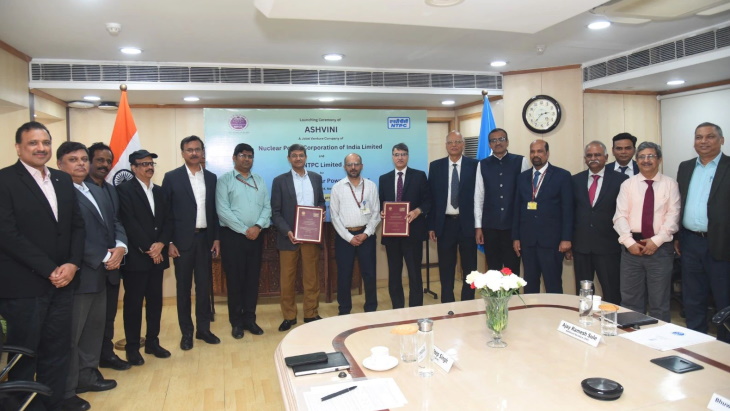
Representatives from NTPC and NPCIL mark the formation of the Ashvini joint venture (Image: NTPC))

The Indian government has approved the creation of a joint venture between Nuclear Power Corporation of India Limited and National Thermal Power Corporation to construct, own and operate nuclear power plants in India.

Under Indian legislation, only two companies - Nuclear Power Corporation of India Ltd (NPCIL) and Bharatiya Nabhikiya Vidyut Nigam Limited (Bhavini, set up to build and operate fast reactors) - are legally allowed to own and operate nuclear power plants in India, but a 2016 amendment to the 1962 Atomic Energy Act allows public sector joint ventures.

State-owned National Thermal Power Corporation (NTPC) agreed with NPCIL to form a joint venture for nuclear power plant construction as long ago as 2011, and last year signed a supplementary joint venture agreement for the development of six 700 MWe Indian-designed pressurised heavy water reactors (PHWRs), including the four earmarked for construction at Mahi Banswara in the state of Rajasthan. These units are amongst a list of ten PHWRs already accorded administrative approval and financial sanction to be built in "fleet mode".

On 11 September, the government approved the formation of Anushakti Vidhyut Nigam Ltd (Ashvini), a joint venture between NPCIL (51%) and NTPC Ltd (49%). The companies were informed of that decision on 17 September.

In addition, the government has approved the transfer of the project to build four 700 MWe PHWRs at Mahi Banswara from NPCIL to Ashvini.

NTPC said that, in addition to the Mahi Banswara project, "Ashvini shall also pursue other nuclear power projects in different parts of the country".

The government also approved exemption to NPCIL to invest more than INR5 billion (USD59.7 million) and exemption to NTPC to invest more than INR50 billion in a single joint venture or subsidiary company.

"This will enable adequate financing for accelerated nuclear power capacity addition in India," the two companies said.

Welcoming approval for the joint venture, NPCIL and NTPC said: "This will pave the way for pooling of resources from both NTPC and NPCIL, in terms of finances, technology and project expertise, for the rapid expansion of nuclear power productivity in the country to meet the target of net-zero by 2070."

Last month, NTPC - India's largest power company - confirmed it intends to set up a 100% nuclear power subsidiary, called NTPC Nuclear Power Company, with NTPC Chairman and Managing Director Gurdeep Singh saying the utility sees nuclear capacity - including small modular reactors - as central to its plans. Singh said the company is actively looking for locations for nuclear power plants, including in Gujarat, Tamil Nadu, Chhattisgarh, Odisha and Karnataka.

According to a Reuters report in February, government sources said India was planning to invite private firms to invest some USD26 billion in its nuclear energy sector, and is in talks with "at least" five private firms including Reliance Industries, Tata Power, Adani Power and Vedanta Ltd to invest around INR440 billion (USD5.30 billion) each.

Plans are not yet finalised, but the government hopes to use the investments to build 11,000 MWe of new nuclear capacity by 2040, the sources said. The plants would be built and operated by NPCIL, with the investing companies earning revenue from electricity sales from the plants. This hybrid plan would not require any amendment to India's Atomic Energy Act of 1962 - which prohibits private control of nuclear power generation - but would need to be approved by the Department of Atomic Energy, they said.As well as further 700 MWe PHWRs, Indian plans envisage the construction of large reactors from overseas vendors, including further Russian-designed VVER reactors in addition to those already in operation and under construction at Kudankulam in Tamil Nadu. In August 2023, Minister of State Jitendra Singh also told the country's parliament that the government was considering options for small modular reactors, and looking at ways to allow the participation of the private sector and start-ups in such projects. Indian nuclear joint venture gets go-ahead

Tuesday, 24 September 2024

EVs can drive Indian automotive industry reach Rs 134 lakh crore by 2047

New Delhi, (IANS): The domestic automotive industry has crossed Rs 20 lakh crore mark in FY24 and has the potential to be worth $1.6 trillion (about Rs 134 lakh crore) by 2047, driven by electric vehicles (EVs), according to industry leaders.

The automotive industry in the country is poised to be one of the key growth engines in towards achieving a $32-trillion GDP by 2047, according to Pawan Goenka, Chairman of IN-SPACe at the Department of Space.

Addressing the Automotive Component Manufacturers Association (ACMA) event in the national capital, he said that the automotive industry has the potential to contribute $1.6 trillion by 2047.

The auto sector also contributes significantly to the direct and indirect employment generation in the country, Goenka further said, adding that the auto industry will contribute more and more to the GDP of the country from the current level of around 6.8 per cent. Over the last two decades or so, the industry has grown by 17 per cent CAGR.

The Society of Indian Automobile Manufacturers (SIAM) President Vinod Aggarwal said that the domestic auto industry has identified 50 critical components for local production in order to reduce import dependence.

As most of these items are electrical or electronics, there is a need to develop capabilities and capacities in India for such high tech items, he added.

Aggarwal told the gathering that the Indian automotive industry has crossed a landmark figure of Rs 20 lakh crore in FY24 and is contributing almost 14-15 per cent of the total GST collected in the country.

SIAM, along with ACMA, has voluntarily set targets for increasing localisation. The industry bodies are committed to reduce import content by 60 per cent to 20 per cent by 2025 from the base 2019-20 levels, thereby targeting the reduced reports to the tune of Rs 20,000 to Rs 25,000 crore in five years.

The country has become the third largest passenger vehicle market, the largest two and three wheeler market and third largest commercial vehicle market.As the adoption of EVs increase in the country, the cost of EVs will almost match petrol and diesel vehicles within the next two years, Union Minister for Road Transport and Highways, Nitin Gadkari, earlier said at the event. EVs can drive Indian automotive industry reach Rs 134 lakh crore by 2047 | MorungExpress | morungexpress.com

Wednesday, 11 September 2024

India’s pharma exports continue to grow at brisk pace

New Delhi, (IANS): India’s drugs and pharmaceuticals exports are continuing to maintain their steady growth with an 8.36 per cent increase to $2.31 billion during July this year as the country’s cost-effective generic medicines continue to gain popularity in advanced western nations.

The country's drugs and pharmaceuticals exports increased 9.67 per cent year-on-year to $27.9 billion in 2023-24 and the growth is continuing in the current financial year as well.

The US accounts for over 31 per cent of India's total pharma exports, followed by the UK and Netherlands (about 3 per cent each).

Apart from Brazil and South Africa, Ireland and Sweden are new additions to the Indian export market.

India’s pharmaceutical sector’s export share increased to 6.4 per cent in the fiscal year 2023-2024 (FY24) from 5.8 per cent in 2018-2019 (FY19), and an uptick in export value to $27.9 billion from $19.1 billion, according to the latest Economic Survey.

“India’s pharmaceutical sector has strengthened its position on the global stage. The market, currently valued at $50 billion, is the third-largest worldwide by volume. Known as the ‘pharmacy of the world’, India offers approximately 60,000 generic brands across 60 therapeutic categories, contributing 20 per cent to global generic drug exports. Eight of the top 20 global generic companies are based in India,” according to the Economic Survey.

The pharmaceutical industry in India is expected to reach $65 billion by 2024 and to $130 billion by 2030.

The survey pointed out that the sector maintains high compliance standards with 703 United States Food and Drug Administration (US FDA)-approved facilities, 386 European Good Manufacturing Practice (GMP)-compliant plants, and 241 World Health Organisation Good Manufacturing Practice (WHO-GMP)-approved plants.

In December 2023, revised manufacturing rules under Schedule-M were introduced to align with global standards and enhance quality control.

The survey also found that the PLI scheme for medical devices has a beneficial impact, narrowing the gap between imports and exports.

Domestic production now includes computed tomography (CT) scan machines, magnetic resonance imaging (MRI) machines and other medical devices.

The PLI scheme for bulk drugs has approved 48 projects with a committed investment of Rs 3,938.6 crore to bolster local manufacturing.Financial assistance through Pharmexcil, an Export Promotion Council, is also provided under Market Development Assistance and Market Access Initiative Schemes to exporters of pharmaceutical products particularly small and medium size exporters to promote their exports in various countries. India’s pharma exports continue to grow at brisk pace | MorungExpress | morungexpress.com

Thursday, 30 May 2024

Mahindra launches new variant for 'XUV700' starting at Rs 16.89 lakh

New Delhi, May 22 (IANS): Leading SUV manufacturer Mahindra & Mahindra on Wednesday launched a new variant for the XUV700 -- AX5 Select (AX5 S), starting at Rs 16.89 lakh (ex-showroom).

The new AX5 Select variant comes with various features, including a Skyroof, Dual 26.03cm HD Superscreen, Push-Button Start/Stop, and a roomy 7-seater configuration.

"These features, typically associated with higher-end models, make the AX5 Select an excellent choice for customers looking for luxury at a more affordable price point," the company said.

In addition, the new car comes with in-built navigation with native maps, personalised greeting and safety alerts, Amazon Alexa built-in, wireless Android Auto, six speakers with sound staging, and speed-sensitive door locks, among others.

"The AX5 Select variant represents an unparalleled blend of luxury, performance, and affordability, making it the perfect choice for the next generation of achievers," the company stated.

Mahindra continues to innovate with fresh offerings, consistently introducing multiple variants to meet the growing needs of customers.

Among the recent launches, it includes the 7-seater in the MX variant and the limited Blaze edition on the AX7L trim featuring a Blaze Red colour, dual-tone black exterior elements, and an all-black interior with red accents, delivering a bold and unique look.According to the company, the XUV700 has been very well received in Mahindra’s international markets such as South Africa, Australia, Nepal and New Zealand since its launch in 2022, making it a truly global SUV. Mahindra launches new variant for 'XUV700' starting at Rs 16.89 lakh | MorungExpress | morungexpress.com

Thursday, 29 February 2024

India slowly taking export market share from China, study shows

Smartphone with Chinese applications is seen in front of a displayed Indian flag and a “Banned app” sign in this illustration picture taken July 2, 2020. REUTERS/Dado Ruvic/Illustration/File Photo
  • 28 February 2024, (Bloomberg) — India is chipping away at China’s dominance in electronics exports in some key markets as manufacturers diversify supply chains away from the world’s factory to other parts of Asia, a new study shows.
  • The impact is most pronounced in the UK and US, where geopolitical tensions with China have increased in recent years.
  • India’s electronics exports to the US as a ratio of China’s increased to 7.65% in November last year from 2.51% in November 2021, according to London-based Fathom Financial Consulting. In the UK, the share rose to 10% from 4.79%.
  • India’s government is luring electronics manufacturers to the country with heavy incentives, such as tax cuts, rebates, easier land acquisition and capital support. The aim is to expand the domestic manufacturing industry in order to export more, and help businesses grow to global scale through partnerships.
  • India houses Samsung Electronics Co.’s biggest mobile phone factory, while Apple Inc. makes at least 7% of all its iPhones in India through its contract manufacturer Foxconn Technology Group and Pegatron Corp.
  • The rise in electronic exports is “likely the result of Foxconn’s increasing investment in India,” Andrew Harris, an economist at Fathom Financial Consulting, wrote in a note last week.
  • India’s progress in gaining market share has been more limited in Europe and Japan, “suggesting a move towards dual supply chains (China plus one) rather than a complete abandonment of China-based production, at least for now,” Harris said. The report shows that India’s electronics exports as a ratio of China’s was 3.38% in Germany and 3.52% globally.
  • Indian companies have been touting their role in multinationals’ ‘China plus one’ strategy, which sees manufacturers developing back-up capacity in other countries.India’s rising market share is a boost for Prime Minister Narendra Modi, who has touted his ‘Make in India’ plan as a way of creating jobs, expanding exports and making the economy more self reliant by reducing the need for imports. He’s widely expected to win a third term in office in elections due within a few months. India slowly taking export market share from China, study shows

Friday, 10 November 2023

India’s festival season to bring some cheer to economy, say economists – Reuters Poll

People shop for gold ornaments at a jewellery showroom during Dhanteras, a Hindu festival associated with Lakshmi, the goddess of wealth, in Mumbai, India, October 22, 2022. REUTERS/Niharika Kulkarni/File Photo
BENGALURU (Reuters) – Indian consumer spending during this year’s festival season will be slightly better than in 2022, said economists polled by Reuters, but probably not enough to ramp up the speed of what is already the world’s fastest-growing major economy. The broadly optimistic survey data, taken together with expectations for 6.3% growth this fiscal year and next, suggest even with a dip in inflation, prospects for a Reserve Bank of India interest rate cut are still a long way off. Battered during the pandemic, consumption, which makes up for about 60% of Asia’s third-largest economy has been slow to reach its pre-COVID levels. While consumer spending in the current quarter was predicted to provide some lift to the economy, the overall growth outlook for the year has remained largely unchanged. Nearly 75% of economists, 25 of 33, said spending during this year’s festival season, which lasts from October through December, will be higher compared to last year. Among those, 21 said slightly higher and four said significantly higher. The remaining eight said
People shop for lanterns at a market ahead of the Hindu festival of Diwali in Mumbai, India, October 22, 2022. REUTERS/Niharika Kulkarni/File photo
slightly lower. GDP growth will average 6.3% this fiscal year and next, based on the median forecasts of a wider sample of 63 economists in the Oct. 16-25 survey. The median forecast was almost exactly the same in a September poll, 6.2% and 6.3%, respectively. “Festive demand could be substantial this time, and I think that bodes well for private consumption expenditure in Q4, and I hope it delivers that extra kick it does every year,” said Dhiraj Nim, an economist at ANZ Research. “From a year-on-year growth rate perspective, it may not be a substantial upside so to speak.” Economists generally agree India needs an even higher growth rate to generate enough jobs for millions of young people who enter the workforce every year. The RBI’s bulletin early this year said India needs to grow 7.6% annually for the next 25 years to become a developed nation. No economist in the poll expects India to grow at that rate this year or next. “India’s long-term success will ultimately depend on whether it can create enough adequate jobs to leverage its huge demographic dividend. At the moment, employment is largely concentrated in the low-productivity agricultural sector,” said Alexandra Hermann at Oxford Economics. “In the current services-based model, achieving sustainable and inclusive growth will be challenging, though not inconceivable.” When asked what was India’s potential economic growth rate over the next 2-3 years, economists returned a median range of 6.0%-7.0%. The survey also showed inflation averaging 5.5% this year and 4.8% in 2024, higher than the mid-point of the RBI’s 2-6% target range.The RBI was expected to leave its repo rate unchanged at 6.50% until at least end-June of next year, with the first 25 basis point cut forecast to come in the July-September quarter, poll medians showed.India’s festival season to bring some cheer to economy, say economists – Reuters Poll

Monday, 6 November 2023

Reliance to invest $122 million in Brookfield JV for data center projects in India

FILE PHOTO: Labourers rest in front of an advertisement for Reliance Industries at a construction site in Mumbai, India, March 2, 2016. REUTERS/Shailesh Andrade/File Photo
BENGALURU -India’s Reliance Industries said on Monday it would invest up to 10 billion Indian rupees ($122.24 million) in building data centers in the country along with Canada-based Brookfield Infrastructure. The announcement comes at a time when data center capacity in India is expected to rise exponentially as more people go online. Reliance will initially invest about 3.78 billion rupees in units of Mercury Holdings SG Pte, which is a joint venture (JV) between Brookfield Infrastructure and U.S.-based real estate investment trust Digital Realty. The JV is currently building data centers in Chennai and Mumbai. The Mukesh Ambani-owned company has committed to invest the remaining 6.22 billion rupees in equity and debt securities of the JV’s units, when needed. Reliance will hold a 33.33% stake in each of the Indian units of the JV and become an equal partner, it said, adding that the venture will be branded as Digital Connexion. India’s data centers market is expected to grow 40% a year and draw $5 billion in investments by 2025 according to a report from investment bank Avendus Capital. Indian data center space is also heating up with Reliance’s entry as Adani Enterprises’ JV had already raised $213 million to fund under-construction data centers.($1 = 81.8060 Indian rupees)Reliance to invest $122 million in Brookfield JV for data center projects in India