bloggggg

Home  |  Live  |  Science  |  Lifestyle  |  Entertainment  |  Broadcast  |  Games  |  eBooks  |  Astounds  |  Adbite  |  Cricbell  |  Cyber  |  Idea  |  Digital  |  Privacy  |  Publish  |  ePaper  |  Contact  .Subscribe.Subscribe.Subscribe.Subscribe.Subscribe.Subscribe.Subscribe.Subscribe.Subscribe
Subscribe

Wednesday, 1 November 2023

Royal romances have always been fantasies of transformation. How does new-generation teen fiction reflect queer and diverse desires?

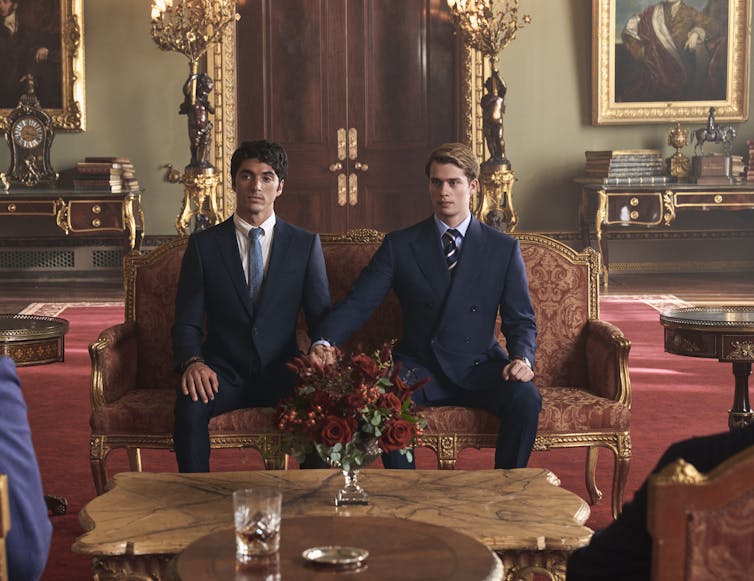
Alex (Taylor Zakhar Perez) and Henry (Nicholas Galitzine) in the film of Casey McQuiston’s Red, White and Royal Blue. Amazon Prime Elizabeth Little, Deakin University

A royal romance is once again trending on social media.

This time, it’s a queer royal romance. And it even has its own hashtag: #firstprince

Casey McQuiston’s beloved, bestselling 2019 young adult novel, Red, White and Royal Blue, has just launched as a movie, on Amazon Prime. And fans are excited. The story follows Alex Claremont-Diaz, son of the first female American president, and his developing relationship with Henry, the Prince of Wales.

As a genre, “royal romance” follows many of the regular romance conventions, but must include a member of a royal family or peerage as one of the love interests. Book blogs and Goodreads are full of suggestions for getting your Prince (or Princess) Charming fix.

Until recent years, the royal romance hasn’t reflected the desires of LGBTQIA+ youth. But that is changing.

The queer injection into the young adult royal romance reflects a broader shift in what’s being published and read. Last year, research showed LGBTQ fiction sales in the US jumped 39% from the same period in the previous year. And young adult fiction grew in particular, with 1.3 million more books sold than the previous year.

Alice Oseman’s Heartstopper, a queer teen (graphic novel) love story, adapted for Netflix, is reported to have sold more than eight million copies to date – and even to have “helped keep bookshops afloat” in recent hard times.

A book industry analyst said the young adult queer fiction growth “mirrors a generational shift toward a more open and inclusive attitude toward gender diversity and sexual orientation”.

The popularity – and acceptance – of texts like Red, White and Royal Blue means the desires and fantasies of queer youth are being normalised.

Royal romance tropes

The key to royal romance is it offers readers possibility and transformation on a grand scale: by getting that crown, the main character does not just become royal, they become their best selves – on the world stage.


It’s been more than 20 years since Anne Hathaway graced our screens in the film adaptation of Meg Cabot’s young adult royal romance The Princess Diaries (2001).

The book follows a familiar narrative, where a girl who discovers she is in fact royalty has to be transformed into a princess. Princess Mia grows into herself as she prepares to lead Genovia.

Other familiar tropes of the royal romance include the “surprise reveal”, where one half of a couple’s royal identity is uncovered, like in Netflix’s The Princess Switch.

A viral success

Released in 2019, Casey McQuiston’s book quickly went viral, becoming an instant New York Times bestseller, winning awards and making best books lists. The classic “enemies-to-lovers” romance trope takes on international significance with the offspring of two world leaders involved.

Alex and Henry’s initial dislike for each other boils over and catches media attention after they ruin the cake at a royal wedding. To try to limit the diplomatic and media fall-out, the two have to pretend to be friends – which leads to their budding romance, and discovering their sexuality together. (Alex is bisexual and Henry is gay.)
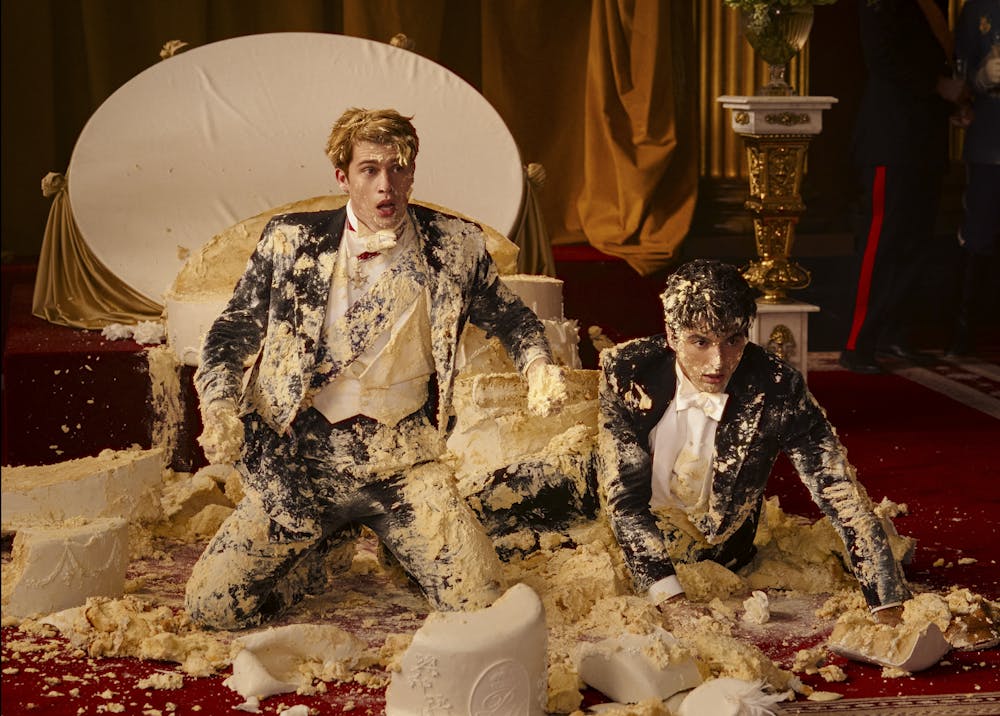
Alex and Henry’s ‘enemies’ stage climaxes when they ruin a cake at a royal wedding. Prime

Casey McQuiston, who identifies as nonbinary, has talked about how straight literature has suggested it’s statistically unlikely for more than one queer person to exist in a story. In Red, White and Royal Blue, multiple queer people not only exist: they include the children of the most powerful people of the world, and become romantically involved.

The social media response to Red, White and Royal Blue clearly demonstrates young people want to see queer romance that reflects their own lives, and their own desires for transformation.

Just in the past week, Prime launched individual Instagram accounts for Prince Henry and Alex. The comments sections have thousands of interactions already.


  
Historically in romance, queer characters have been unhappy, or even killed off. But in Red White and Royal Blue, queerness leads to happiness.

“Alex you bisexual icon,” wrote one Goodreads reviewer, who described it as “comforting” to read the book while “having my own bisexual panic”. “It has meant so much to me as a queer individual,” wrote another, cited in the same study.

Interestingly, that study found many readers were willing to forgive the book for other things they didn’t like, because they were so excited by the queer representation.

More royal romances that explore difference

Other popular young adult royal romances explore queer relationships, too. Her Royal Highness, by Rachel Hawkins, is set in a university in Scotland, where American Millie discovers her roommate Flora is a Scottish princess. The trope of “surprise royal” gets its queer retelling when Millie falls for Princess Flora.

Her Royal Highness is a companion story to Hawkins’ first (heteronormative) royal romance novel, Prince Charming (originally titled “Royals”). Hawkins’ choice to explore queer romance was, she says, a response to what fans wanted. And she was keen to “restore balance” and write a tropey rom-com, but with lesbians.

Other young adult royal romances have maintained the focus on boy-girl couples, but engaged with contemporary audiences in other ways, by exploring concerns around class, wealth and gendered expectations.

In Katharine McGee’s American Royals, the House of Washington are the royal family, with Princess Beatrice the heir to the throne. Beatrice, who is in love with her personal bodyguard, goes on a journey of transformation that ends with her choosing her royal duties of love, and seemingly growing up. An important aspect of American Royals is how Beatrice will cope with being the first female monarch, introducing feminist concerns about leadership.

In Kiera Cass’s The Selection, the young adult royal romance meets a dystopian setting, where in a post-apocalyptic world, girls (and boys) vie for the attention of royals, so they can escape rigid caste systems and live in a palace. It’s been described as The Bachelor meets The Hunger Games. In texts like The Selection, the concerns of young people are not limited to romantic tensions, but include body image and status, conflict and poverty.

Even as young adult romances have shifted to include queer perspectives, one key aspect remains the same – teenage love, in all its forms, has the possibility of bringing about true individual transformation.

The young adult royal romance is about so much more than just love-interests-meet-and-get-crown. It’s about young people desiring to be something more, and undergoing a clear transformative journey.

While Mia Thermopolis lost her bushy eyebrows and gained a sleek tiara, her journey was about discovering her true worth.

In Red, White and Royal Blue, Alex and Henry don’t just avoid an international diplomatic disaster by falling in love: they give voice to the desires of queer and diverse youth who want to see a happily-ever-after that looks like them represented on the page, and the screen.

Luckily, these days, there are increasingly more options to choose from.The Conversation

Elizabeth Little, Early Career Researcher, Deakin University

This article is republished from The Conversation under a Creative Commons license. Read the original article.

Wednesday, 9 August 2023

Insects in Textiles

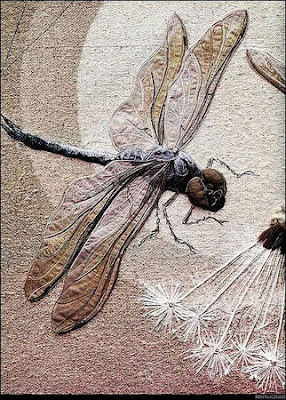
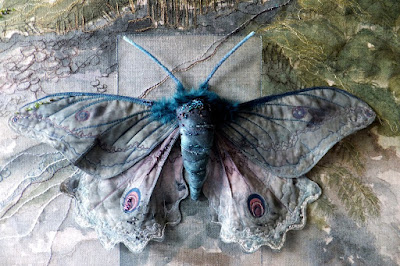
Insects have been used as adornment and recreated in textiles for centuries. sharing a smattering here of some beautiful contemporary textile art of insects. Check out the sensitive textile nature art of Dutch-born Australian artist Annemieke Mein here. She works in various media including textiles, and the textile art includes these beautiful insects:
Textile insects by Annemieke Mein
Born in England and based in Kenya, artist Sophie Standing uses textile art to portray the wildlife she sees. I absolutely love this bee:
Bee textile art by Sophie Standing
She does a lot of the African megafauna, but this dung beetle is charming:
Dung Beetle textile art by Sophie Standing
Michele Carragher is a London costume embroidery for film and TV who has done extraordinary work (for shows like Game of Thrones). Some of her insect-themed work:
Detail of Game of Thrones costume embroidery by Michele Carragher
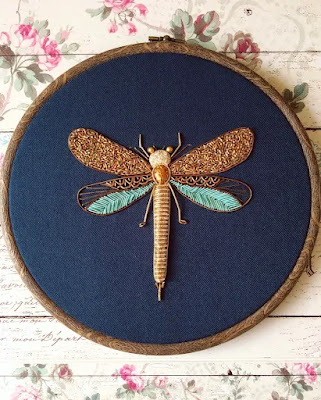
You can find the delightful work of UK embroiderer Humayrah Bint Altaf on instagram and Etsy as The Olde Sewing Room.

Thursday, 28 February 2013

Nexus S from Google: Robotic Charm

The Nexus S is a smartphone co-developed by Google and Samsung and manufactured by Samsung Electronics for release in 2010. It was the first smartphone to use the Android 2.3 "Gingerbread" operating system, and the first Android device to support Near Field Communication (NFC) in both hardware and software.[4] This was the third time that Google worked with a
manufacturer to produce a phone, the first  and second being the GoogleG1 and the Nexus One, both by HTC. Following the Nexus S, the next Android Developer phone was the Galaxy Nexus, released the following year. The Nexus S is produced with four variations. The GT-I9020 (Super AMOLED) and GT-I9023 (Super Clear LCD), each aimed at different markets. The SPH-D720 is the newer 4G version of the phone available in the US. A variant of the GT-I9020, SHW-M200, was released specifically for the Korean market.Source: Wiki, Image: Screen Shot On Video

Thursday, 14 February 2013

Zara’s charm in Asia boosts Inditex sales by 12%

Zara's owner Inditex SA benefited from its flagship brand’s charm in Asian markets and saw a 12 per cent increase for its full year sales. Net income rose to 1.93 billion euros ($2.56 billion or Rs 13,216 crores) in the 12 months ended Jan. 31, the Spanish retail giant said Wednesday. Largest apparel retailer beat all estimates, as per instance, the average of 15 estimates compiled by Bloomberg was 1.92 billion euros (US$ 2.54 billion or Rs 13,112 crores), as opposed to the actual 1.93 billion euros ($2.56 billion or Rs 13,099 crores) Inditex reported. Zara plans to start online sales in China in the fall, according to Inditex, which gets about two-thirds of revenue from Europe. As of September, all of the retailer’s brands had online stores, and it offered e-commerce in 18 European markets, as well as the U.S. and Japan. The retailer said it plans to open 480 to 520 stores in 2012, including its first Massimo Dutti stores in the US The expansion will lead to an increase in capital spending to about 950 million euros (US$ 1.26 billion or Rs 6,504 crores) from 864 million euros (US$1.14 billion or Rs 5,885 crores) a year earlier. Net sales last year rose to 13.79 billion euros (US$18.29 billion or Rs 94,422 crores), representing growth of 10 per cent, or 11 per cent at local currency rates, Inditex said. Store revenue at constant exchange rates climbed 11 per cent from Feb. 1 to March 14, it said. Earnings before interest, tax, depreciation and amortization climbed 9.8 per cent to 3.26 billion euros (US$ 4.32 billion or Rs 22,302 crores) as the company’s gross margin remained at 59.3 per cent of sales. "Like-for-like sales and gross margin seem healthier than expected in the final quarter. On every level of the high-quality indicators, it is a beat," Société Générale analyst Anne Critchlow said for The Guardian. Inditex rose 0.3 per cent to 71.94 euros (US$95.43 or Rs 4,926) right after publishing its full year figures, extending a seven-day winning streak. “Inditex 2011 earnings were really strong and sales performance at the beginning of this year is pretty good too,” said Jose Rito, an analyst at Banco BPI in Porto, Portugal, published Bloomberg. Source: Fashion United

Saturday, 18 August 2012

The art of making monsters

News photo
Creature feature: "Kyoshin Heizo" ("God Soldier") by Takayuki Takeya is on display at the Museum of Contemporary Art Tokyo . © 2012 NIBARIKI·G
By MATT ALT: Good news for monster fans: Not one, not two, but three separate tokusatsuexhibitions are stomping their way through downtown Tokyo as you read these words.  While you may never have heard the word "tokusatsu," you are likely familiar with what it is. A contraction of the Japanese words tokushuand satsuei, it means "special effects." Although it can be used to refer to any effects-heavy production, in common usage it refers to the decidedly analog, handmade "rubber suit" effects seen in "Godzilla" movies, the "Ultraman" series, and "Power Rangers"-style shows. Long pooh-poohed by  Westerners used to higher  budget fare, it's easy to forget that Japanese tokusatsu once represented the cutting edge of special-effects technology worldwide. In fact, in the early 1970s director George Lucas reportedly visited Japan to brush up on the then-latest techniques before launching a franchise Western audiences still revere: "Star Wars." Computer graphics long ago supplanted the miniatures and
Baltan Seijin rough sketch, Shoji Otomo, 1966. © TSUBURAYA PRO
rubber-suited actors once used to create effects for science-fiction and fantasy movies. But there's a certain charm to the idea of tricking the eye using skillfully crafted props and camera tricks rather than computer techniques. With few chances to exercise their talents in the digital era, though, aging tokusatsu craftsmen are finding it hard to pass along their skills to the next generation. For all the monsters they've slayed over the years, could tokusatsu techniques be in danger of going extinct? Not if the people behind these exhibitions have anything to say about it. It's the sound that first hits you, walking into the Museum of Contemporary Art Tokyo's "Tokusatsu Hakubutsukan" ("Special Effects Museum"). A swirling, never-ending audio loop of lasers, monster shrieks and heroic shouts from the shows of yesteryear fills the air. Culled from the climactic scenes of '60s and '70s sci-fi productions, the soundscape lends a strangely intense atmosphere to the exhibition, as though a pitched battle between the Self-Defense Forces and some fearsome creature is unfolding just around the corner. Which it is, in a matter of speaking. The biggest and boldest of the three exhibitions now showing in and around the capital, "Tokusatsu Hakubutsukan" features room upon room of carefully restored props and
Ring the alarm: Three exhibitions in and around Tokyo are celebrating Japan's tokusatsu (special effects) films. A model from "Return of Ultraman" (above) is one of the items on display at the Museum of Contemporary Art Tokyo's "Tokusatsu Hakubutsukan" ("Special Effects Museum") along with a miniature model of Tokyo. © TSUBURAYA PRODUCTIONS CO., ALL RIGHTS RESERVED
monster suits. "Talented craftsmen made each and every one of these. It costs a lot of money and takes a long time to build things like this," explains display coordinator Tomoo Haraguchi, a tokusatsu expert who restored the vast majority of the pieces on display in the show with his own hands. "That's why tokusatsu has been replaced by CG (computer graphics). But the difference is, props actually exist. They have a physical presence that can be experienced. Data doesn't. And it's my hope that the people who come to the show will realize how much effort went into making these objects. To me, they're more than movie props. They're pieces of history. They're art." The show's centerpiece is a retro sci-fi short film produced especially for the exhibition and screened every 10 minutes in a small theater. Produced by Hideaki Anno of "Evangelion" fame, directed by special-effects master Shinji Higuchi and based upon a character from legendary animator Hayao Miyazaki's feature "Nausicaa," it comes with serious otaku (fanboy) credentials. The topic, of course, is a fearsome monster destroying a startlingly detailed model set of downtown Tokyo. Featuring everything from scale-model skyscrapers to playground equipment, the nine-minute short unfolds as a homage to the climax of every kaiju eiga(giant monster movie) ever made in Japan. Unfortunately for the monolingual, it isn't subtitled, but you'll be able to follow the plot, such as it is, without too much trouble. That said, even being able to understand it in Japanese, I found myself wishing for a poorly synched English dub like those shows I grew up watching as a kid. As well done as the short is, the highlight comes once the lights are back on. In an amusing twist, the entire set used in the film has been moved into the museum, and visitors are allowed to stroll amid the miniaturized cityscape. You'll have to control your inner giant monster as no actual building-stomping is allowed, but it's still a treat. In comparison to Museum of Contemporary Art Tokyo's holistic approach to tokusatsu studies, The Museum of Modern Art, Saitama, laser-focuses on a single series in its "Ultraman Art!" exhibition. For those not in the know, Ultraman is the star of a long-running series of television shows, the first of which debuted in 1967. When giant monsters threaten Japan, the heroic Shin Hayata uses the power of an alien Beta Capsule to grow to titanic proportions and fight them on their own terms. The sleek red-and-silver countenance of the titular hero is as much a part of the Japanese collective consciousness as Superman is in that of the average North American's. "Ultraman" is also notable for being the first show to spark a toy craze; decades before the similar "Pokemon" fad, Japanese kids begged their parents for figures of the heroes and monsters of "Ultraman." The series has continued in fits and starts to this very day, more than 40 years later. Aired in the United States and other countries, it enjoys a popular reputation abroad as well. The "Ultraman Art!" exhibition is a one-stop shop for information about how the series was made. It features original concept art, props (complete with scuffing and damage from hard days' filming), and even monster-costume-fitting dioramas. Ever wondered how those suits were made? Chicken wire wrapped around an actor's body created the foundation. You learn something new every day. One of the highlights of the show comes at the very end, with a display featuring a close up of Ultraman flying through the clouds. The setup shows how a relatively simple arrangement of models, cotton batting and a cloud backdrop results in a captivating trompe l'oeil when seen through the camera lens. Curious as to what makes Godzilla tick? The "Otomo Shoji no Daizukai Ten" ("Shoji Otomo Diagram Exhibition," which is tucked away in the charming Yayoi Museum in the backstreets of Tokyo's Nezu district, is your chance to find out. You'll be forgiven for not knowing his name, but Shoji Otomo singlehandedly changed how monster movies were viewed in Japan. Dubbed the kaiju hakase(monster professor), his attempts to quantify the inner workings of imaginary things made him an otaku pioneer. Toiling as the editor of the kids' manga weekly Shonen Magazine in the late '60s, he hit on the idea of commissioning cutaway views that revealed the mysterious inner workings of giant monsters. Although not an artist himself, he conducted the research, prepared obsessive rough sketches and suggested the page layouts for the magazine's freelance illustrators. Otomo's efforts to bring a certain degree of reality to the monster world earned him legions of fans in the late '60s and early '70s. Most notable among them was Crown Prince Naruhito, who famously used his very first allowance to procure Otomo's "Kaiju Zukan" — "A Giant Monster Field Guide." (It's somewhat reassuring to know that a text like this sits on the bookshelves of the Imperial Household — you know, just in case.) Unfortunately, Otomo passed away in his prime, collapsing from an unexpected prescription-drug reaction at the age of 36 in 1973. The legacy he left behind lives on, though, inspiring legions of young fans and industry professionals to take monsters more seriously. His detailed explanations of the inner workings of strange beasts, futuristic vehicles and fantastic secret bases formed a cornerstone of the otaku culture that would eventually take Japan by storm. The Yayoi Museum collaborated with Otomo's mother, Ai Shishimoto, who is still going strong at the age of 102, to prepare the exhibition. (In fact, one of the more touching aspects of the show is a small photo, off in a corner, of Otomo's bedroom in her home, left all but untouched for close to 40 years.) The show features two floors jam-packed with original sketches, vintage books, photographs and expanded views of the finalized page layouts from the magazines. If there's any downside, it's that the materials are entirely in Japanese, but there's plenty to appreciate visually. "The era of handmade tokusatsu is essentially over," Haraguchi says. "But that doesn't mean it will never come back." Whatever the case, these shows are a step toward preserving some of the building blocks of postwar Japan's pop-culture aesthetic — and a lot of fun to boot. Or should that be claw? "Tokusatsu Hakubutsukan" ("Special Effects Museum") runs through Oct. 8 at the Museum of Contemporary Art Tokyo in Koto-ku (¥1,400 for adults, ¥900 for children; closed Mon., except holidays; [03] 5245-4111). For more information, visit www.mot-art-museum.jp. "Ultraman Art!" runs through Sept. 2 at The Museum of Modern Art, Saitama (¥1,100 for adults, ¥880 for students; closed Mon., except holidays; [048] 824-0111). For more information, visitwww.momas.jp/3.htm. "Otomo Shoji no Daizukai Ten" ("Shoji Otomo Diagram Exhibition") runs through Sept. 30 at the Yayoi Art Musem in Bunkyo-ku, Tokyo (¥900 for adults, ¥800 for children; closed Mon., except holidays; [03] 5689-0462). For more information, visit www.yayoi-yumeji-museum.jpSource: The Japan Times Online

Thursday, 2 August 2012

Kangna brushes up her dancing skills to match steps with Madhuri

Director Abhishek Choubey is said to have asked actress Kangna Ranaut to brush up her dancing skills as they gear up to start shooting for "Dedh Ishqiya" with dancing diva Madhuri Dixit. Both the actresses will be seen matching steps in plenty of dance sequences in the movie. "Dedh Ishqiya" is the sequel to 2010 film "Ishqiya", which featured Arshad Warsi, Naseeruddin Shah and Vidya Balan. While Naseer and Arshad will be reprising their roles, the female lead will be played by Madhuri. "Music was very important to 'Ishqiya' and so it will remain in 'Dedh Ishqiya', though this times the songs and music would be very different. Yes, Madhuri would be doing a lot of singing and dancing," told Choubey. The sequel will see Arshad and Naseer moving from Gorakhpur to Lucknow, where they will meet a highly cultured Muslim family, including Madhuri and Kangna. While Naseer will be seen romancing Madhuri, Arshad has been cast opposite Kangna. Choubey told the idea was to place Naseer and Arshad's characters in a completely different milieu. "Repetition is death for me. I was against doing a sequel in the first place, because no matter how one looks at it, a sequel is an extension of the first film. But then when I finally decided on doing 'Dedh Ishqiya', I decided to put the characters in a totally different ambience," he told. With the film, Choubey hopes to revive the near-extinct genre of Indian cinema, known as the Muslim social. "I want to revitalize that old-world Nawabi charm of ornate architecture, the tehzeeb and the adaas that we saw in Muslim socials like 'Mere Mehboob', 'Mere Huzoor', 'Chaudhvin Ka Chand' and 'Nikaah'," told the director. "Of course, the genre would be contemporized. But the essence of the genre, the flavour of the period, its essence and grace and, most important, the decadence of that Nawabi culture would remain," he further added. Source: GaramGossips

Friday, 27 July 2012

On the trail of treasures at Toji Temple

By ALON ADIKA, The man unfurled the scroll and hung it on the wall of the makeshift tent to reveal a majestic mountain soaring to the heights in bold black brush strokes. It was a scene showing nature in all its grandeur dwarfing a lone human figure halfway up the mountain.  I spent a few moments losing myself in the  scene. It was just what I had been looking 
Market day: Stalls at Toji Temple in Kyoto. ALON ADIKA
for. "How much is it?" I asked. "¥7,000," the man replied. Some months earlier in New York City, a friend I was talking with about scroll paintings mentioned the flea market at Toji Temple in Kyoto. He said I really must go there next time I was in Japan — adding that it was huge and I ought to allow at least half a day to spend there Later that year, the oppressive heat and humidity of late July did not deter me from achieving my goal of visiting the flea market and, if the Buddhist deities favored, buying myself a nice scroll painting. Arriving in Kyoto by shinkansen from Tokyo is a most unremarkable experience; you suddenly find yourself in avant-garde Kyoto Station surrounded by the sprawl of the modern city — and wondering what is so special about it. If you approach from the west, however, you are in for a delightful treat. Slightly before arriving, if you happen to turn your head and look out the window to the south, you are rewarded with a view of the great pagoda of Toji Temple soaring high above its surroundings and reminding you in spectacular fashion that you are about to detrain in the old Imperial capital. When Heian Kyo (Kyoto), the "capital of peace and tranquility," was established in 794, only two Buddhist temples were allowed inside the city limits. Those were Toji and Saiji, which flanked the great Rashomon Gate and were established for the protection of the nation and the new capital. Heian Kyo remained the Imperial capital for more than 1,000 years and, as many would argue, it is still Japan's cultural heart. At first sight, the flea market in the temple's precincts appears like a sea of tents extending as far as the eye can see, with stalls selling everything from vintage kimonos, straw sandals, hair ornaments and bamboo charcoal to all manner of old junk that reminded me of the old adage that one man's junk is another's treasure. I was quietly optimistic about finding my own little treasure. The historical figure most strongly associated with Toji Temple is Kukai (774-835), known posthumously as Kobo Daishi, who was the founder of Shingon Buddhism. As a young man he roamed the rugged mountains of Shikoku practicing Buddhist austerities. Later in life, he secured a place on a mission to China, where he became the eighth patriarch of Esoteric Buddhism. He is also well known as a calligrapher, poet, engineer and teacher. In 823, Kobo Daishi became the head of Toji Temple and made it the capital's center of Shingon Buddhism. As I made my way through the market, I couldn't help pausing from time to time to behold the dazzling array of items on sale. I stopped at a colorful stall selling dried fruit. There was yellow mango, green kiwi, orange papaya and more. The salesman motioned for me to try some. I opted for the bright-red sun-dried cherry tomatoes and, when I popped one into my mouth,
Part of my (slightly creased) scroll scoop. ALON ADIKA
my face lit up as I savored its sweet taste. The flea market is affectionately known as "Kobo san," in honorable reference to Kobo Daishi. After all, he is the main reason that it exists. Since his death occurred on the 21st day of the month, it has become a tradition to hold a memorial service for him on the 21st day of every month. Eventually, merchants appeared to cater to the many pilgrims who flocked to the temple at these times and before long this evolved into the flea market we see today. I continued browsing the stalls and noticed a couple sitting behind a fold-up table displaying calligraphy brushes. Several people were watching a man trying one of the brushes. He dipped it into some water and paused for a moment before drawing graceful kanji characters on a piece of the special paper that's used for calligraphy practice. As I got closer, one of the vendors held out a brush for me to try. I attempted to write a few kanji, but the results were less than flattering. I was glad that as soon as the water would dry, my poorly written graphics would disappear. The scent of incense wafting through the air reminded me that this was not simply a market day, but also a religious one, since thousands of pilgrims show up every month to attend memorial services for Kobo Daishi. I followed my nose and found myself in a small courtyard with a statue of Kobo Daishi enveloped in smoke from incense sticks lit by pilgrims paying their respects to the great teacher. My ears also picked up the sound of Buddhist chanting. I turned my head and noticed a line of pilgrims waiting to enter one of the temple's halls to offer prayers. I next passed a stall selling various kinds of Korean kimchi: cabbage, stuffed cucumber and radish. Next, there was a stall selling kakigōri, shaved ice in flavors including green tea, pineapple, melon and cola. I felt my stomach growl; I wanted something to snack on. Then, as chance would have it, I noticed a stall selling taiyaki, the fish-shaped Japanese cakes filled with sweet red bean paste, and immediately got one right off the burner. It was great. Toji Temple, which is a UNESCO World Heritage Site, is literally a treasure trove of Japanese Buddhist art, culture and history. Many of the structures in its grounds are designated national treasures, including the famous five-story pagoda which burnt down no fewer than four times and was most recently rebuilt in 1644 under the third Tokugawa Shogun, Iemitsu. The pagoda, standing nearly 55 meters, is the tallest in Japan and a symbol of Kyoto. Equally impressive, many items in the temple's possession are also national treasures or important cultural assets. Among them there are calligraphy in Kobo Daishi's hand, scriptures and statutes brought by him from China, ink paintings
Best feet forward: Lucky clog charms make colorful eye candy on a stall. ALON ADIKA
attributed to the great swordsman Miyamoto Musashi, and much more. While browsing the countless stalls, I chanced upon a few selling scroll paintings. Some of them had photo albums filled with pictures of the different scrolls for sale and you just had to choose. Others had the scrolls in bins and you had to unroll them and see what the paintings were like. I spent almost an hour going through a bin of scrolls at one shop. I never managed to roll the scrolls back up properly and I noticed the vendor watching me. I saw a number of nice scrolls, but did not feel compelled to purchase any of them. So, I continued searching. I finally found myself looking at the scroll with the mountain scene. I knew immediately it was the one I wanted. The salesman had just named his price of ¥7,000. I had heard somewhere that this kind of market is one of the few places in Japan where you can bargain for a better price. I looked at the man and asked if he could make it a little cheaper. He nodded and said, "¥5,000." Most agreeably surprised, I smiled and told him to please wrap it up for me.trave Source: The Japan Times Online

Thursday, 21 June 2012

At 50, witty Amul girl captured in charming book

Over the past four decades she provided a running commentary on the state of affairs of India and on her 50th anniversary, the cheeky, impish 'Amul' girl, has got a birthday present! The likes of megastar Amitabh Bachchan, cricketers Sunil Gavaskar and Rahul Dravid, veteran filmmaker Shyam Benegal, novelist Shobhaa De among other prominent public figures have chronicled the story of the 'little girl in polka dots' in a book now. Titled Amul's India the book captures a selection of iconic wisecracks lampooning personalites as well as popular social and political events that have been part of the diary giant's running advertising campaign over the last four decades. Be it a scam or a blockbuster film, the endearing moppet fleshed out in 1966 by cartoonist Eustace Fernandes as part of an ad campaign for Amul's butter brand, told the stories of India, using tongue-in-cheek humour with clever wordplay, one hoarding at a time. At the launch of the book , Rahul daCunha, managing director and creative head of daCunha Communications, attributed the success of the book to Amul which has never interfered with the creatives of the advertisement campaign. "With India's vast diversity most of our campaigns are specifically targeted to the regions it influences and impacts the most. So, the South has Rajnikanth and other actors, IPL team Chennai Super Kings and its politicos as the stars. Northern belt has flair of leaders like Lalu Prasad Yadav and Mayawati among others..." he said. The internet and the world of Facebook has opened up a totally new segment of audience, he points out. "There are special campaigns which are made specially for the online audience, like when Hollywood's Ashton Kutcher potrayed as a Bollywood producer which I believe wasn't well known outside the net world." "There is an instant reaction on the net, with comments and "likes" which helps us in knowing the pulse of the audience," said Rahul daCunha. At a time when cartoons in textbooks have kicked up furore, the 'utterly butterly delicious' mascot of the butter brand manages to get away with her childlike humour. "Amul has no-axe to grind, the campaign doesn't come from any fixed vantage point and that is the beauty of it," said Swapan Dasgupta, senior journalist who was participating in a discussion after the book launch here late last evenning. "It's the freshness which we bring in, which is kept simple through minimum, or no, research into the topic," said Rahul on being asked the reason behind the rich creativity. Product-specific campaigns run mostly in print and radio also began to appear on billboards with the first in 1966 - the Amul moppet kneeling in prayer, with one eye closed and another on the pack of butter with the words, Give us this day our daily bread with Amul Butter. Amul's campaigns and brand continue to outlive expectations with close to 6,000 billboards across India being produced till now. The paperback priced at Rs299 has been published by Harper Collins. Source: Deccan Chronicle, ***

Monday, 5 March 2012

Kate Middleton makes first solo public appearances while prince william is away

Kate Middleton
.Subscribe
Starpulse: Less than a year since Kate Middleton became the Duchess of Cambridge, she's winning hearts – and heartfelt admiration – as she steps confidently out into the royal spotlight for the first time withoutPrince William's steady guidance. In this week's issue of PEOPLE, Kate makes her first solo royal appearances, where she charms and impresses, proving to be a bright new jewel in the royal crown. The warm smile; the quick laugh; the steady, connected gaze – this commoner turned princess is showing that she's better than good at her job. While William serves a six-week stint with the Royal Air Force search-and-rescue helicopter crew in the Falkland Islands, Kate has made six solo appearances in two weeks, including attending the opening of a Lucian Freud exhibit in London, visiting an alcohol-free bar (where she talked to recovering addicts), a children's hospital in Liverpool, and an art program for kids with special needs at a school in Oxford. Everywhere she goes she wins rave reviews for the seamless ease with which she has embraced her regal role. "She is genuine," says a Palace source, "both in private and in public."Click Here To Read Full Story At Starpulse

Tuesday, 28 February 2012

Kidnap Victim Elizabeth Smart's Fairy Tale Wedding Details

Elizabeth Smart People Magazine
Starpulse: Surrounded by family and friends, a jubilant Elizabeth Smart marries Matthew Gilmour in a beautiful Hawaiian paradise just a month after the two were engaged. The 24-year-old kidnap survivor shares details of her romance with her Scottish Prince Charming, her dress, and their big day exclusively in this week's issue of PEOPLE. This fairy-tale ending could not have been foreseen 10 years ago, when Smart, just 14, was kidnapped from her bedroom in Salt Lake City. Miraculously rescued nine months later, she grew into a confident young woman who bravely faced down her captor in court and vowed not only to forgive him, but to move on with her own life despite her horrific ordeal. And now that same young woman – who works as a child-abuse advocate – inspires her friends and family as she enters this bright new chapter of her life. "It's who she is now that is the important thing," her new mother-in-law, Kay Gilmour, 49, tells PEOPLE. "She's a most gracious, very brave, very strong young woman." Healing and happiness are so intertwined for Smart that she chose to celebrate her wedding in the place she visited in 2003 during her recovery from her kidnapping, when the then-traumatized teen was first reunited with her family. "Oahu is a very special place for me, very different than what I was used to," Smart tells PEOPLE. "I guess you could say it was kind of a refuge." Perhaps as much of a relief to Smart was Gilmour's saying he had never heard of her when the two met in Paris in January 2009. "I got to know her as she truly is," says Gilmour, 22, from Aberdeen, Scotland. Both were in France to perform their Mormon missions, and a quiet friendship quickly sparked. "The thing that attracted me the most to her – at the beginning and now – is how confident she is, especially considering everything she has been through," he says. "As soon as we were together, I felt he was my best friend," Smart tells PEOPLE. "I couldn't imagine life without him." A few months later Gilmour asked her to marry him, and the two began to plan a summer wedding in Salt Lake City, where he plans to attend college. They moved up the date to escape intense interest from the media and plan a larger party back in Utah in the spring. Once they changed their plans, the race was on for a dress, and after trying on "just about every dress in Utah," Smart scored a coveted appointment slot – and a gown – at New York's historic Kleinfeld's bridal salon while on a weekend trip with a girlfriend. She had the white, dotted tulle Alita Graham retrofitted with lace sleeves and a sweetheart neckline to conform to Mormon standards for her temple wedding ceremony. Happily finalizing the remaining details for the reception with the Turtle Bay Resort, she flew from Salt Lake City with her parents, Ed and Lois, 54, and Gilmour two days early.  On the morning of her wedding day, Smart looked every bit the radiant – and ready – bride. Her younger sister Mary Katherine, 19, at her side, Smart calmly snacked on dried mangoes as her family helped her fix her hair and makeup and put on her dress. Gilmour, wearing the kilt of his late father, Stewart (who died of cancer in 2008), was driven to the Laie Hawaii Temple by his uncle Neville Henderson, who assured him, "Your father is going to be here in spirit." After the ceremony, witnessed only by the immediate family and a few friends, they returned to Turtle Bay Resort for a luncheon with the entire wedding party of family and friends (including Smart's siblings Charles, 25; Andrew, 21; and William, 14). Source: Starpulse.com

Sunday, 19 February 2012

Designers go on a world trip


The Asian Age, Nivi Shrivastava: Exotic attracts more than indigenous, and when it comes to influences and inspirations, outlandish charms can play a big role. At the ongoing Wills Lifestyle India Fashion Week 2012, many of our desi designers too have taken the foreign route this time and created collections that draw on cross-cultural influences. Right from the rugged terrains of Uzbekistan and Afghanistan to the blazing deserts of Africa and classically beautiful cities of Europe, Indian designers are drawing inspiration from different corners of the world. For Autumn-Winter ’12, designers Kartikeya and Isha presented Dozakh’s collection  titled “Mystic old town — Prague”, which was inspired by the duo’s long holiday in this beautiful European city. Speaking about the collection, Isha Kapoor said, “We tried to re-create the heritage, myth and superstition of the past centuries that dances slowly with the faded opulence and magnificence of Prague’s baroque era.” For designer Anju Modi, the rich colours and crafts from Uzbekistan, Afghanistan and Pakistan was the inspiration. She says, “My collection ‘Nomadic Wanderlust’ is about the evolution of rich traditional handicrafts from these ancient cultures. This belt more or less evolved from the same heritage and so you can find so many unique things that are familiar.” Designer Nachiket Barve too has used a lot of cross-cultural influences in his collection “Caravan”. He says, “Centuries ago, gypsies were the only medium of exchanging cultures among various civilisations. The multitude of textile and aesthetic influences across Asia, Arabian lands and Sahara deserts is incorporated in my collection. I have used lattices and jaalis inspired from Islamic culture, motifs from Istanbul, 3-D patterns from Turkey and Persian carpet inspired patchworks.” Designer Payal Jain found inspiration in Africa for her collection “Black Ice”. Payal says, “My  friend who visited Africa sent me some beautiful pictures. The sharp contrast of black and white with minimal hints of colours is something that one can only find in Africa. The beautiful patterns and shades were my main influence.” Designer Tarun Tahiliani’s A\W ’12 collection too is a modern twist to the Ottoman empire where he depicted the art, architecture, textiles, armour and culture of Istanbul. He also used oversized motifs of tulips, dog roses, hyacinths, carnations and elongated cypress in tones of pomegranate, artichoke and acanthus as a reminiscent of Islamic architecture to create a chic feminine line. Source: The Asian Age

Wednesday, 25 January 2012

They're young, and they're good

China: It wasn't a time for champions. It was a time for  youth. With  the  stars
They're young, and they're goodof the Vancouver Olympics sitting out, China's 12th National Winter Games - which wrapped up on Friday in Changchun, Jilin province - became a stage for the next generation to showcase itself. Nineteen-year-old short track speed skater Liang Wenhao distinguished himself with six gold medals and one silver at the tournament. He set himself up to be a centerpiece of the national team after four-time Winter Olympic champion Wang Meng was kicked off the squad following a drunken brawl with a team manager during a camp in QingdaoThey're young, and they're good
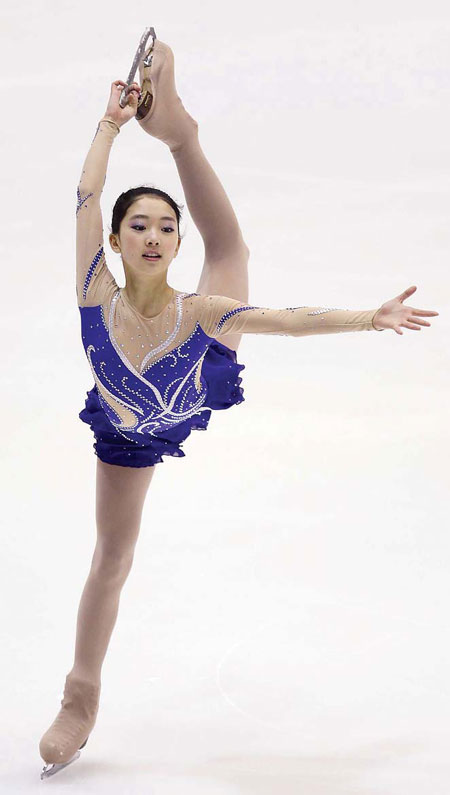
Li Zijun, 15, performs during the China Winter Games last week. Li claimed all three women's singles gold medals and is aiming to contend for a medal at the 2014 Sochi Olympics. Fang Xinwu for China Daily
in July. Also absent was Zhou Yang, who won gold medals in the women's 1,500m and 3,000m relay in Vancouver. "It's hard to predict results in short track matches, and I didn't expect to win six gold and one silver before the tournament, but this is also the charming side of athletics," said Liang, who won the men's 500m at the 2010 World Short Track Speed Skating Championships in Bulgaria to become China's youngest male world champion. Zhao Yinggang, director of China's Winter Sports Administrative Center, also praised Liang as a potential leader of the short track speed skating team and encouraged Liang to achieve a breakthrough at the Sochi Winter Olympics. "I hardly deserve to be the leader, and I only hope to motivate my teammates with my performance and push the whole team forward," said Liang, who is expected to surpass Li Jiajun to become the greatest Chinese short track skater. "Our team experienced a lot of unpleasant things earlier, which hurt the image of our team, and I hope we will do our best from every detail to rebuild our image," he said. With Sochi still two years away, Liang said he is working on both short and long events to become a better all-round skater. "Chinese still have a certain gap with the world's top athletes, but we have made a lot of efforts to catch up with them," Liang said. "The Winter Games is a good chance for me to accumulate more experience, and I won't stop trying to improve myself in pursuit of a satisfying finish with my teammates in 2014." In figure skating, 15-year-old Li Zijun claimed all three women's singles gold medals. Li was selected by national coach Li Mingzhu in 2008 to train in the US, together with peers Geng Bingwa and Zhang Kexin. Li grabbed a silver medal at the 11th National Games at the age of 11. She grew up fast, placing third at the 2010-11 ISU Junior Grand Prix Final and fourth the following year. She is expected to return China's women's singles figure skaters to elite status, following in the steps of the retired Chen Lu, who became the first Asian skater to win medals in two Olympics. "I'm very happy to see my years of effort pay off," said Li. "I really enjoy the whole process of competitions, and I can feel the happiness of success from each well completed jump. Whether I can stand on the podium or not, I love to play."Read Full: They're young, and they're good - China.org.cn

Sunday, 25 December 2011

Cricketers charm Melbourne

Cricketer Rahul Dravid hits a delivery bowled by a young fan as members of the Indian and Australian teams meet a large crowd at a public event in Melbourne. AFP Photo/William West Cricketers charm Melbourne
.Subscribe.Subscribe
Rahul Dravid | Cricketers charm Melbourne | Photos IndiaVSAustralia2011 | - hindustantimes.com
Cricketer Rahul Dravid hits a delivery bowled by a young fan as members of the Indian and Australian teams meet a large crowd at a public event in Melbourne. AFP Photo/William West 

Monday, 19 December 2011

Korea charms Imphal youths

.Subscribe
E-Pao: The visit of 11-member team from Seoul has come down to dispense free medical treatment through acupuncture, medicines, haircuts and gifts have been a boon to many Korean followers in Imphal. The Telegraph's Korea charms Imphal youths carried a report on the visit which reminds us of the various other impacts Korean has on our youths and society. Anjulika Thingnam wrote in her article 'Soaps, songs, stars: Manipur's Korea wave' that when Jeong Seok, 35, came to Imphal from the South Korean capital of Seoul recently to take part in a food festival, he feltFree Korean Medical Treatment at Imphal :: August 09 - 15, 2011
completely at home. It happens this time too. The article says that Pai Hyee Jou, a Korean painter, was stunned when Mapui, a young Manipuri girl, addressed her in fluent Korean. From dress to hairstyles youths of Imphal are a diehard fan of Korean styles. Another article at Taipei Times writes, "Hairdressing salons are covered with headshots of Korean celebrities and offer a wide range of spiky, "Korean-style" cuts, which are hugely popular with young Manipuris of both sexes. Korean culture has entered deep into the life of Manipuris now. Even films nowadays are influenced by Korean films and dramas. Oliver in his article 'The influence of Korean TV dramas' writes in length about it. The article from The Telegraph writes, "Korean culture has always fascinated youths in Imphal. It has become fashionable Free Korean Medical Treatment at Imphal :: August 09 - 15, 2011
for Manipuri boys and girls to sport Korean haircuts and dresses. Most video parlours in the city have more Koreans films than Hollywood or Manipuri films and the youths are more familiar with Korean actor Rain than Shah Rukh Khan". Many youths are happy and overwhelmed by this visit and hope this would provide a good relation between the two people. The article reports Cho Tae Soo saying that this is their first visit. They are happy with the response. Their trip and the people's response would improve the relationship between Manipur and Korea. Source: E-Pao

Friday, 18 November 2011

Nargis Fakhri to endorse women appare

NEW DELHI: Czech Pakistani model Nargis Fakhri, who has just made her Bollywood debut with "Rockstar", has been named the brand ambassador for apparel major .Van Heusen Woman The 32-year-old has been a New York-based supermodel, and choosing her as the face of the brand has been a careful decision by the company. "The brand is on the cusp of a steep growth and is well poised to extend its appeal to a large western-wear sporting audience, while Nargis's career is set to take off equally well. The elegance and confidence she brings to the table is highly desirable and aspirational for today's women," a Van Heusen statement said. "The brand offers clothes that are in vogue, comfortable and refreshing - while always being faithful to its core philosophy of clean lines, traditional soft and solid pastel tones, with shapes and forms that breathe easy. And Nargis Fakhri blends closely with this chic factor of the brand with her refined beauty and flawless style. The spirited personality and ­­­­impeccable charm she exudes thoroughly reflect the brand's values," the statement added.Read Full: Nargis Fakhri to endorse women apparel brand |Nargis Fakhri|Van Heusen Woman | The New Indian Express

Saturday, 22 October 2011

“Madhuri” The Actress Of Millennium

Madhuri the 'Goddess'
.Subscribe.Subscribe.Subscribe.Subscribe .Subscribe.Subscribe
Image Link Flickr
“Madhuri “The actress of millennium equipped with the most gorgeous smile, looks like a lady with natural ornament which whispers the beauty with   charm   and   expression,   forever  offers   an  Incredible  composition. 
madhuri-dixit-wallpaper
Image Link Flickr
She Was born on 15 May 1967 at Mumbai in India, her initial Name was Madhuri Shankar Dixit as well Pet Name was Bubbly, inborn in a Marathi-speaking Hindu Brahmin family, enclose with dad, Shankar, mom, Snehlata, sisters, Rupa and Bharati, and brother, Ajit, attended Divine Child High School and Mumbai university, studied to be at last as microbiologist. On 17th October 1999, Madhuri Dixit married Shriram Madhav Nene, a ULCA -trained cardiovascular surgeon  who practiced  in  Denver.  Nene is also  from  a   Marathi    Brahmin  family. They 
Aaja Nachle
Image Link Flickr
have two sons, Arin (born in March 2003 and Raayan born in March 2005) in Colorado. After marriage, Dixit had relocated at Denver in USA for almost a decade. In October 2011, Dixit again shifted her base back to Mumbai, India, along with her family. Late Maqbool Fida Husain, an eminent painter, widely regarded as the "Picasso” of India was the Heartiest admirer of the beauty and talent of Madhuri. he watched “Hum Aapke Hain Kaun” 67 times and booked an entire  theatre  to see  her  comeback  movie  Aaja  Nachle  in  2007.  He made a  film  named 
Bollywood Queen Madhuri Dixit New HQ Scan - www.Bollyfame.com
Gaja Gamini in 2000, starring her, which was intended as a tribute to Dixit herself .She has appeared in Hindi films during the belatedly 1980s and 1990s,  she    recognized    herself   as   one  of  Hindi   cinema's    foremost 
Madhuri dixt PR
Image Link Flickr
actresses and most accomplished dancers. She emerged in plentiful commercially successful films was recognized for several of her performances. Dixit is frequently quoted by the media as one of the best actresses in Bollywood , won five Film Fare Awards, four for Best Actress and one for Best Supporting Actress. She holds the trace for the maximum number of Best Actress nominations at the Film fare, by 13. In 2008, she was awarded the Padma Shri, which is India's fourth-highest civilian award. On Women's International Day in 2007, Dixit topped Rediff's list of the Best Bollywood  Actresses  Ever.  The  Economic  Times   named   Madhuri 
madhuri_dixit
Image Link Flickr
Dixit in the list of the "33 women who made India proud". Madhuri Dixit made her acting debut in Rajshri Production' movie Abodh in 1984. given several blockbuster movies like Tezaab, Ram Lakhan, Parinda, Tridev, Dil, Saajan, Beta, Khalnayak, Hum Aapake Hai Kaun, Raja, Dil To Pagal Hai, Devdas Etc. during the first inning of her career she was maintaining her status as lady Amitabh as she was quite capable to triumph the movie by her own talent now she is starting the 2nd inning of her career lets hold your breath and get ready to whisper the magic of the great lady calls like "Madhuri" as gold is always gold but she is platinum. Author: Ashish Bordiya