bloggggg

Home  |  Live  |  Science  |  Lifestyle  |  Entertainment  |  Broadcast  |  Games  |  eBooks  |  Astounds  |  Adbite  |  Cricbell  |  Cyber  |  Idea  |  Digital  |  Privacy  |  Publish  |  ePaper  |  Contact  .Subscribe.Subscribe.Subscribe.Subscribe.Subscribe.Subscribe.Subscribe.Subscribe.Subscribe
Subscribe

Tuesday, 18 November 2025

US leaders view China as a ‘pacing threat’ − has Washington enough stamina to last the race?

Andrew Latham, Macalester CollegeWhen Donald Trump meets with Xi Jinping on Oct. 30, 2025, he won’t just be chatting with any run-of-the-mill leader of a rival nation. Rather, he will be sitting down the with the chief representative of the United States’ “pacing threat.”

In the Pentagon’s lexicon, China has increasingly been presented as a “pacing challenge” or “pacing threat” − that is, a great-power rival against which a nation measures its strength, shapes its strategy and directs its resources across every domain of national power.

The phrase and concept has risen in military and academic circles since the turn of the 21st century. Its use in Washington to describe China dates to at least 2020, when Trump’s then–Secretary of Defense Mark Esper used it in a speech in Honolulu.

But what does it mean? For a country to be seen as a pacing threat, it must be a rising yet already near-peer whose capabilities and ambitions directly challenge the dominant country’s global position. A pacing threat doesn’t merely aspire to catch up; it sets the tempo of competition.

Esper’s successor in the Biden administration, Lloyd J. Austin III, continued to call China a “pacing threat,” explaining: “It means that China is the only country that can pose a systemic challenge to the United States in the sense of challenging us economically, technologically, politically and militarily.”

Use of “pacing threat/challenge” has grown since 2009 (Ngram)

The significance goes beyond rhetoric. By defining China in these terms, Washington reorients its entire defense establishment around a new strategic benchmark. The U.S.’s defense planning, industrial policy and global posture now revolve around a single question − how to keep up with and, if necessary, outpace Beijing.

When the United States government signals to its military leaders and industrial partners that a specific country is a “pacing threat,” it is giving them a yardstick by which to judge every dollar spent, every sailor or pilot assigned and every hour of training and preparation.

Pacing threats, increasing risks

The risk of focusing so intently on one foe is, of course, that there is more than one potential adversary out there. And the concept of a pacing challenge shouldn’t imply that China is Washington’s only competitor or potential enemy.

Other rivals remain in the mix, including Russia, Iran, North Korea and a range of smaller militant groups, that could cause major problems for Washington with or without China’s involvement.

The danger for the U.S. is that in designating China its only pacing threat, it could leave blind spots elsewhere. And the objective for a U.S. leader is not simply to be ready for a potential war with China but to be ready for the next crisis wherever it may emerge.

This goal is complicated by a second risk: the urge to plan for the future at the expense of the present. It is one thing for the U.S. Navy to build a fleet and the Air Force to design a missile for 2035 to ensure that it “outpaces” Chinese innovation. But it is another to have the capability to deter or address, if necessary, a crisis or conflict in 2025.

Developing a long-term force to match or surpass China is an important objective to U.S. political and military leaders, but not at the expense of current capabilities.

If the United States is intent on remaining the world’s predominant economic, diplomatic and military force, then it must focus on both – but that is easier said than done.

Is China already ahead?

There are some who believe that America’s pacing threat has already outpaced its rival.

The United States already lags behind China in the scale and output of its defense-industrial base – particularly in the quantity of ships, missiles and other military hardware it can produce and field at speed.

China is building warships at a rate unseen in the U.S. for decades. And it has an industrial ecosystem that can deliver on new programs and scale up in a crisis.

By contrast, American factories face labor shortages, a lack of modern shipyards and glacial acquisition timelines.

If the U.S. is intent on fielding better military assets in the future, it needs them to upscale at a speed that can deter China. In other words, America’s deterrence to any pacing threat needs to start at the factory gate.

A contest of speed, not size

Facing China as a pacing threat will start with an honest U.S. accounting of the type of competition in which it is engaged. This is not merely a rivalry of fleets or firepower but a contest of tempo − who can innovate faster, build smarter and field more flexibly to shape a world in motion.

If the U.S. is to outpace China, it will likely need to reconnect its economic and industrial base to its defense posture and regenerate the productive capacity that made America the world’s arsenal.

But that task is far harder for democracies, where political cycles, fiscal constraints and public skepticism about militarization often slow the mobilization of national power.

Complicating the matter is the fact that the next great arsenal will be defined not just in steel but in data, design and decision. Here, too, China at present appears to be gaining an upper hand. A September report by the Washington-based Information Technology and Innovation Foundation assessed that China was now “dramatically outperforming the United States in the vast majority of critical technological fields.”

The U.S. will not stay ahead of its pacing threat by meeting China ship for ship or system for system. The real edge is in responsiveness − the ability to outthink, outproduce and outmaneuver its competitor.

This article is part of a series explaining foreign policy terms commonly used but rarely explained.The Conversation

Andrew Latham, Professor of Political Science, Macalester College

This article is republished from The Conversation under a Creative Commons license. Read the original article.

Sunday, 2 November 2025

Two-Headed Wind Turbine Could Solve Every Challenge in the Offshore Industry

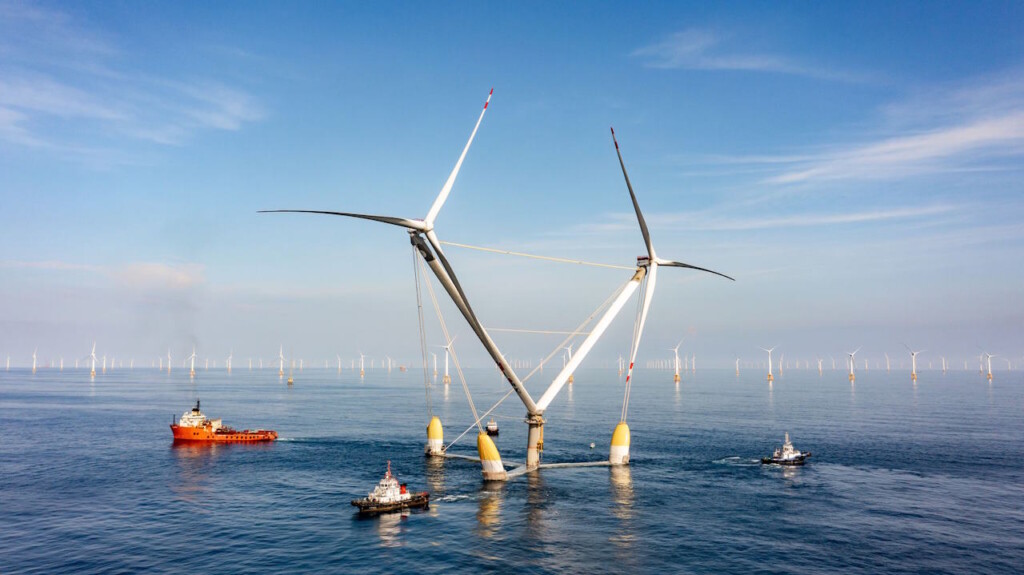
Ming Yang OceanX in operation – credit, Ming Yang Smart Energy

As the global leader in offshore wind development, a Chinese turbine manufacturer has designed a two-headed behemoth that will generate 50 megawatts on its own.

Blazing past renewable energy targets, the wind lobby in Beijing are serious players, unlike in Europe and North America where investment and R&D has lagged behind solar power.

Ming Yang Smart Energy already makes one of these two-headed turbines, but is planning to debut one that’s double the size of its existing model in 2026.

This Fortune 500 China-edition company is the undisputed world leader in wind turbines, particularly offshore ones, but not exclusively. It lays claim to both the most powerful land and offshore wind turbines in service today.

It developed the first typhoon-resistant floating turbine mooring, which was tested in September when Super Typhoon Ragasa passed over the entire 1,345-unit offshore fleet, and not one was upended. Every single one remained operational.

In 2024, the company debuted the previously mentioned double-rotor turbine—called the OceanX—consisting of two 8.3 MW turbines installed on 219-meter towers at an angle atop a floating platform. For comparison, the top-end turbines in the Moresea 1 wind farm in Great Britain generate 9 megawatts.

Just one OceanX in ideal conditions is boasted as having the capacity to power 30,000 homes annually. The counter rotating blades increase each turbine’s output beyond what the wind can do alone, but during testing the blades broke off from the force.

Nevertheless, the company managed to find buyers, and the OceanX was soon installed at the Yangjiang Qingzhou IV offshore wind farm, off the southeast China coast.

Marketing for the 50MW leviathan has already begun, with production slated for next year according to company boss Zhang Qiying who spoke at a Beijing conference recently. Such a turbine would drop the cost-per-kilowatt for wind energy in the Guangzhou area to around one-fifth of the current price for offshore wind energy in Europe.

Offshore wind power comes in for more criticism from environmentalists than land-based turbines, and so has been subjected to more research into its effects. However, with most of the world’s largest offshore wind farms coming online within the last decade, the body of evidence is limited.

Regarding collisions with birds, one 2022 study found that it was “unlikely that small-scale displacement by single wind farms would have an impact at the population level,” of migratory seabirds, which the study team found were at a 75-92% lower abundance inside the boundaries of the wind farm than out of it.

Concerns over disturbances among whales and the seabed sediment have also been raised, as well as offshore farms’ impact on coastal tourism, and their susceptibility to sabotage.

One surefire way to reduce these eco-impacts would be to reduce the number of turbine units in a given wind farm, and the best way to do that would be find a way for turbines to generate more electricity. 50 MW would be a truly astonishing operational achievement, and represent as much as a 15-fold increase in per-unit power generation compared to some turbines deployed in the North Atlantic.With such an abundance of energy, farms in sensitive environmental areas like whale or migratory seabird routes could substantially reduce their turbine counts if the Ocean’XL’ was part of the farm’s fleet. Two-Headed Wind Turbine Could Solve Every Challenge in the Offshore Industry

Wednesday, 24 September 2025

China’s electric vehicle influence expands nearly everywhere – except the US and Canada

A Wall Street Journal video explores a Chinese ‘dark factory’ – one so automated that it doesn’t need lights inside.

In 2025, 1 in 4 new automotive vehicle sales globally are expected to be an electric vehicle – either fully electric or a plug-in hybrid.

That is a significant rise from just five years ago, when EV sales amounted to fewer than 1 in 20 new car sales, according to the International Energy Agency, an intergovernmental organization examining energy use around the world.

In the U.S., however, EV sales have lagged, only reaching 1 in 10 in 2024. By contrast, in China, the world’s largest car market, more than half of all new vehicle sales are electric.

The International Energy Agency has reported that two-thirds of fully electric cars in China are now cheaper to buy than their gasoline equivalents. With operating and maintenance costs already cheaper than gasoline models, EVs are attractive purchases.

Most EVs purchased in China are made there as well, by a range of different companies. NIO, Xpeng, Xiaomi, Zeekr, Geely, Chery, Great Wall Motor, Leapmotor and especially BYD are household names in China. As someone who has followed and published on the topic of EVs for over 15 years, I expect they will soon become as widely known in the rest of the world.

What kinds of EVs is China producing?

China’s automakers are producing a full range of electric vehicles, from the subcompact, like the BYD Seagull, to full-size SUVs, like the Xpeng G9, and luxury cars, like the Zeekr 009.

Recent European crash-test evaluations have given top safety ratings to Chinese EVs, and many of them cost less than similar models made by other companies in other countries.

What’s behind Chinese EV success?

There are several factors behind Chinese companies’ success in producing and selling EVs. To be sure, relatively low labor costs are part of the explanation. So are generous government subsidies, as EVs were one of several advanced technologies selected by the Chinese government to propel the nation’s global technological profile.

But Chinese EV makers are also making other advances. They make significant use of industrial robotics, even to the point of building so-called “dark factories” that can operate with minimal human intervention. For passengers, they have reimagined vehicles’ interiors, with large touchscreens for information and entertainment, and even added a refrigerator, bed or karaoke system.

Competition among Chinese EV makers is fierce, which drives additional innovation. BYD is the largest seller of EVs, both domestically and globally. Yet the company says it employs over 100,000 scientists and engineers seeking continual improvement.

From initial concept models to actual rollout of factory-made cars, BYD takes 18 months – half as long as U.S. and other global automakers take for their product development processes, Reuters reported.

BYD is also the world’s second-largest EV battery seller and has developed a new battery that can recharge in just five minutes, roughly the same time it takes to fill a gas-powered car’s tank.

Exports

The real test of how well Chinese vehicles appeal to consumers will come from export sales. Chinese EV manufacturers are eager to sell abroad because their factories can produce far more than the 25 million vehicles they can sell within China each year – perhaps twice as much.

China already exports more cars than any other nation, though primarily gas-powered ones at the moment. Export markets for Chinese EVs are developing in Western Europe, Southeast Asia, Latin America, Australia and elsewhere.

The largest market where Chinese vehicles, whether gasoline or electric, are not being sold is North America. Both the U.S. and Canadian governments have created what some have called a “tariff fortress” protecting their domestic automakers, by imposing tariffs of 100% on the import of Chinese EVs – literally doubling their cost to consumers.

Customers’ budgets matter too. The average price of a new electric vehicle in the U.S. is approximately $55,000. Less expensive vehicles make up part of this average, but without tax credits, which the Trump administration is eliminating after September 2025, nothing gets close to $25,000. By contrast, Chinese companies produce several sub-$25,000 EVs, including the Xpeng M03, the BYD Dolphin and the MG4 without tax credits. If sold in America, however, the 100% tariffs would remove the price advantage.

Tesla, Ford and General Motors all claim they are working on inexpensive EVs. More expensive vehicles, however, generate higher profits, and with the protection of the “tariff fortress,” their incentive to develop cheaper EVs is not as high as it might be.

In the 1970s and 1980s, there was considerable U.S. opposition to importing Japanese vehicles. But ultimately, a combination of consumer sentiment and the willingness of Japanese companies to open factories in the U.S. overcame that opposition, and Japanese brands like Toyota, Honda and Nissan are common on North American roads. The same process may play out for Chinese automakers, though it’s not clear how long that might take.The Conversation

Jack Barkenbus, Visiting Scholar, Vanderbilt University

This article is republished from The Conversation under a Creative Commons license. Read the original article.

Friday, 22 August 2025

The World’s Tallest Bridge Will Open in China This Summer to Slash ‘Grand Canyon’ Crossing to Just 2 Minutes

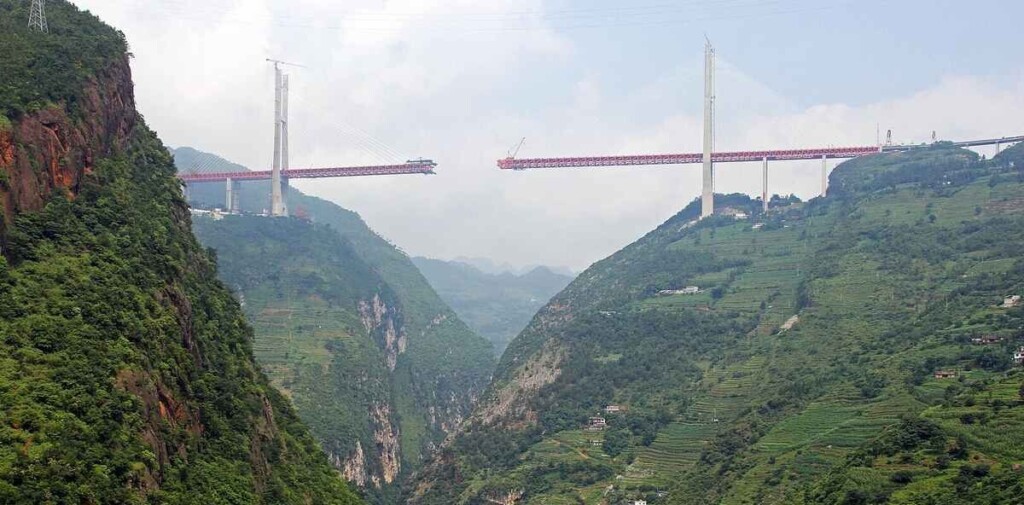
Duge Bridge, the current tallest bridge in the world just 120 miles from the Huajiang Grand Canyon Bridge – credit, Highest Bridges CC BY-SA 4.0

In a mountainous region of China, workers are less than 3 months away from opening a stunning new bridge that will become the world’s tallest.

Spanning the Huajiang Grand Canyon, the bridge bearing the same name will tower 2,051 feet above the level of the river below, some 947 feet higher than the famous Milau Viaduct in France, the highest bridge in Europe.

But the Huajiang Canyon Bridge isn’t about breaking records. The southwestern Chinese province of Guizhou is riddled with karst rock mountains, and includes about half of the world’s 100 highest bridges. Here, these concrete and steel spans are a necessity of getting around rather than a demonstration of infrastructural excellence.

With a total length of 9,776 feet, (2,980 meters) and a main span of 4,658 feet (1,420) meters, it’s longer than the Golden Gate Bridge by both measurements, and has a similar towering nature as well.

As a key component of the Liuzhi-Anlong expressway, the bridge will cut travel time across the canyon from about 70 minutes to just 2. This improved connectivity is expected to boost local tourism by attracting more visitors to nearby sites such as the famous Huangguoshu Waterfall, said the local government website.

“Witnessing my work become something tangible—watching the bridge grow day by day and finally stand tall above the canyon—gives me a profound sense of achievement and pride,” said Li Zhao, chief engineer of the project.

Made up of 93 individual steel trusses lowered into place by a giant, sophisticated, automated and GPS-guided cable car mounted above the span during construction, the whole structure weighs about 22,000 tons.

One of the major challenges would be ensuring there was enough accuracy to lower the truss segments down into perfect alignment. Foreseeing this, the construction firm employed 3D scanning technology and ran virtual simulations in advance of truss placement to ensure they knew that what they were putting into place would fit.

Sure enough, all of the placements were made without issue. Early renderings suggest that section of the bridge’s main span will host a 1,500-foot long enclosed pedestrian walkway complete with restaurant and bungee jump area, because why not?Expected to open on June 30th, it will take the title of tallest bridge from, perhaps unsurprisingly, the Duge Bridge which crosses the same river just 120 miles from the Huajiang Canyon Bridge. The World’s Tallest Bridge Will Open in China This Summer to Slash ‘Grand Canyon’ Crossing to Just 2 Minutes

Thursday, 31 July 2025

5G Advanced powers world’s largest fleet of driverless coal mining trucks in China


The 100-strong fleet of autonomous electric mining trucks are set to improve both safety and efficiency at the Yimin open-pit coal mine in Inner Mongolia

This month marked a significant step in the development of intelligent mining, with Chinese energy giant Huaneng Group deploying the world’s largest fleet of unmanned electric mining trucks.

The 100 cabinless vehicles have begun operations at the Yimin open-pit coal mine in Inner Mongolia, China, each capable of loading and hauling up to 90 tonnes of material across the site.

Powered by electric batteries, this new fleet is carbon neutral and can operate continuously for 24 hours a day without human intervention.

Perhaps most importantly, these autonomous vehicles remove the need to expose human workers to the mine’s inhospitable environment, where temperatures can reach as low as -48.5°C and hazardous road conditions making driving dangerous.

According to Li Shuxue, Chairman of Huaneng Inner Mongolia Eastern Energy, the truck fleet has already demonstrated operational benefits over its human-operated predecessors, increasing their overall transport efficiency by 20%.

The deployment comes as part of a joint innovation project between China Huaneng Group Co., Ltd. (China Huaneng), Xuzhou Construction Machinery Group, Huawei, and State Grid Smart Internet of Vehicles. The partners intend to further expand the truck fleet in the coming years, aiming for 300 of the vehicles to be operational over the next three years.

5G Advanced to underpin more efficient mining operations

This rollout of the autonomous vehicle fleet would not have been possible without the deployment of a 5G Advanced network, providing uplink speeds of up to 500 Mbps and latency of just 20 milliseconds, both of which are crucial for enabling autonomous vehicles to make driving decisions in real-time.

5G Advanced, sometimes known as 5.5G, boasts significant improvements in performance compared to 5G, including better efficiency, faster uplink speeds, and greater capacity.

The benefits of 5G Advanced networks for industrial operations are becoming increasingly well known. Huaneng Group itself said it first identified the need for a 5G network in 2022 and quickly began working with China Mobile Inner Mongolia to explore its deployment. By April 2023, initial autonomous vehicle tests were underway, with the first vehicles working commercial shifts in March this year.

In addition to the 5G Advanced network itself, Huaneng Ruichi’s truck fleet is also supported by a range of cloud infrastructure solutions, including Huawei’s Commercial Vehicle Autonomous Driving Cloud Service (CVADCS). This solution combines data from each vehicle and across the mining site to provide precise, real-time location information to the fleet, enabling route optimisation and increased efficiency, even in low-visibility conditions that would pose a challenge to human drivers.

Modernising China’s coal industry

The launch of this electric fleet – the world’s largest at an open pit mine – marks a significant step in China’s drive towards building a greener energy base for the nation.

Despite a surge in renewable energy projects in recent years, coal undeniably remains the backbone of China’s industrial strategy. In 2023, China announced that work was underway to build new coal power plants with a combined capacity of 70.2 GW – more than 19-times that of the rest of the world combined. As a result, in 2024 China produced 476,896 million metric tons of coal, accounting for 52.6% of the world’s total.

This rise in coal production, however, coincides with a government drive to modernise the industry, aiming to make mining more intelligent, safer, more efficient, and more sustainable. To this end, last year China’s National Energy Administration (NEA) provided guidelines for the intelligent transformation of coal mines, promoting the use of AI and the latest wireless technologies. Looking ahead, the NEA is aiming to create a series of standards for the design, well construction, production, management, O&M, and evaluation of intelligent coal mines by 2030.

These efforts are already beginning to bear fruit. According to data from the 2025 National Energy Work Conference, intelligent production capacity now accounts for over half of China’s total coal production capacity, with nearly 1,000 mines having begun their ‘intelligent construction’ transformation.

A more intelligent futureThe launch of China’s largest fleet of autonomous electric mining trucks, powered by 5G Advanced, is a significant milestone in the country’s journey towards smarter, safer, and greener coal mining. As intelligent mining becomes the norm, this initiative sets a powerful example of how traditional energy sectors can evolve for a more sustainable future. 5G Advanced powers world’s largest fleet of driverless coal mining trucks in China

Tuesday, 24 June 2025

China Achieves ‘Excellent’ Water Quality in 90% of Rivers and Lakes, Now Looks to Improve Whole Ecosystems

The Yulong River – credit, Qeqertaq, CC 3.0. BY-SA

Having achieved incredible results in improving water quality across the nation, China is embarking on a ten-year project to ensure the ecosystem beyond the shoreline meets similar standards.

The plan, unveiled recently by China’s Ministry of Ecology and Environment aims to match improvements in water quality seen in 2,573 rivers and lakes across the country with improvements to the overall ecosystem in which the fresh water is found, including those which humans rely on, and the cultural artifacts located there as well.

It could be said that the protagonist of China’s 4,000 year history isn’t the Chinese people themselves, but fresh water.

From the moment that humans began cultivating rice in the central and northern Chinese plains, control and manipulation of water became the unifying feature of Chinese society, transcending social status, and imbedding itself into the lore of the first emperor who supposedly tamed the Yellow River floods in 2,700 BCE.

As centuries passed, traveler after traveler remarked upon the inexhaustible supply of fresh water for irrigation, and of a network of irrigation canals that spread like a spider’s web as far as the eye could see. The Qin Dynasty completed the ancient world’s largest landscape engineering project when it constructed the Grand Canal, while 2,000 years later, the vast breadth of the Yangtze and Pearl rivers, following industrialization, allowed the Chinese manufacturing market to provide for every corner of the Earth.

Beyond economization and production, the lake and river were the subjects of countless poems and songs across the ages, and the constructions of bridges, pagodas, temples, palaces, and scenic villages where canals replace streets, on and around China’s vast freshwater resources, flourished whenever money was available.

In 2015, China completed an action plan for the prevention and control of water pollution, and in 2024, the proportion of surface-water sections nationwide classified as having excellent water quality reached 90.4%.

In this new action plan, the whole ecology of the riverine ecosystems is being addressed, and will include in its scope projects for restoring spawning grounds, ensuring migratory birds have access to food resources in areas where they alight, enhancing habitat connectivity and fish passage where obstructions are found, strengthening flood control and drainage systems where present, and measuring eutrophication in lakes and reservoirs.

“The document marks another comprehensive initiative to protect China’s water ecosystems following the action plan for prevention and control of water pollutions in 2015,” said Liu Jing, deputy director of the environment ministry’s Department of Water Ecology and Environment.

“A beautiful river or lake is one where the ecological flow is maintained so that it never runs dry. Besides, the ecological functions of the water bodies and their surrounding buffer zones are preserved or restored, and biodiversity is effectively protected,” said Liu.

“Moreover, pollutant emissions within the watershed are well-managed, and the water quality has fundamentally improved or maintained excellent levels. And the public’s needs for scenic views and recreational activities by the water are met,” she added.“Significant progress” is expected by 2030, by which time it’s hoped the project will have also begun to reverse the current declining trend in aquatic wildlife in the Yellow River, and to accelerate the current improving trends for wildlife in the Yangtze. China Achieves ‘Excellent’ Water Quality in 90% of Rivers and Lakes, Now Looks to Improve Whole Ecosystems

Friday, 30 May 2025

Yu Zidi (12) set for world stage after stunning swims


SHENZHEN - Chinese 12-year-old swimming sensation Yu Zidi could be the brightest young star at this year's world championships after producing a string of eye-popping performances this week.

Yu, in her striking "doggy" swim cap, rounded off a sensational China national swimming championships in Shenzhen by winning the women's 400m individual medley by almost two seconds on Saturday.

Roared on by packed crowds in the southern city which borders Hong Kong, Yu crushed a quality field in a lifetime best 4min 35.53sec.

Yu's time was comfortably inside the world qualifying standard of 4:43.06, the fifth fastest time of the year and would have been good enough for fourth place at the Paris Olympics.

Second was Chang Mohan, who touched more than a body length adrift in 4:37.33, followed by Li Bingjie in 4:38.66.

It came just a few days after the 12-year-old's 200m butterfly gold in a scarcely believable 2:06.83, also fifth fastest in the world this year and another time that would have garnered a fourth place in Paris.

"My lungs were about to explode!" Yu said after that win, according to state news agency Xinhua. "I didn't know my time. I just focused on my pace, stroke-by-stroke."

Yu started the week-long China championships by taking second in the 200m individual medley behind Paris Olympian Yu Yiting, with another world-qualifying time of 2:10.63.

That prompted the global governing body, World Aquatics, to post: "12-year-old sensation alert!" on X.

The China meet serves as trials for the world championships, which take place in Singapore from July 27 to August 3, with the top two in each event eligible for selection, provided they have met the qualifying standard.

Yu said it would be "cool... to compete internationally in a swimsuit adorned with the national flag and my doggy cap", reported Xinhua, giving a nod to her black-and-white swim cap emblazoned with a cartoon puppy.

China's swimming association told AFP it would finalise its team for the worlds after the national championships concluded on Saturday, without confirming if Yu would be included or giving a date for a squad announcement.Yu, who turns 13 in October, trains in the northern province of Hebei and has been earmarked as a "prodigy" by Chinese state media since first making national headlines last year. Yu Zidi (12) set for world stage after stunning swims

Wednesday, 14 May 2025

Zhao makes history as China's first World Snooker champion

BEIJING - Zhao Xintong became the first Chinese player to win the World Snooker Championship as the qualifier completed his stunning march to the title with a 18-12 victory against Mark Williams in the final on Monday.

Zhao made history at Sheffield's Crucible Theatre by taking the seven frames he required to clinch the trophy after building a dominant 11-6 lead in Sunday's sessions.

The 28-year-old was only China's second World Championship finalist, emulating Ding Junhui's run to the 2016 showpiece.

But while Ding was beaten by Mark Selby in the final nine years ago, Zhao produced a nerveless display to defeat three-time champion Williams.

He banked £500,000 ($663,000) in prize money, earning immortality as Asia's first World Championship winner.

"I can't believe what I've done. It's very exciting," Zhao said.

"I was so nervous tonight. Mark is still a top player and put me under so much pressure. He's the best."

Zhao, who won the 2021 UK Championship, is one of the sport's most unexpected world champions.

He has been playing as an amateur since September as he continues his comeback after a 20-month ban for involvement in a 2023 betting scandal.

Zhao accepted charges of being a party to another player fixing two matches and betting on matches himself in a controversy that led to 10 Chinese players being punished, with life bans for Liang Wenbo and Li Hang.

Zhao's enforced amateur status meant he had to battle through four qualifying rounds just to reach the World Championship main draw at the Crucible, which is walking distance from his Sheffield home.

Due to return to the main professional tour next season, Zhao is just the third player after Terry Griffiths and Shaun Murphy to win the title as a qualifier in the 48-year Crucible era.

While Zhao's story is startling, Asian snooker has been on the rise for several years.The sport is hugely popular in China, with a national snooker academy in Beijing training the country's best young players. Zhao makes history as China's first World Snooker champion

Wednesday, 26 February 2025

AI regulation around the world


Countries and economic blocs around the world are at different stages of regulating artificial intelligence, from a relative "Wild West" in the United States to highly complex rules in the European Union.

Here are some key points about regulation in major jurisdictions, ahead of the Paris AI summit on February 10-11:

- United States -

Returning President Donald Trump last month rescinded Joe Biden's October 2023 executive order on AI oversight.

Largely voluntary, it required major AI developers like OpenAI to share safety assessments and vital information with the federal government.

Backed by major tech companies, it was aimed at protecting privacy and preventing civil rights violations, and called for safeguards on national security.

Home to top developers, the United States now has no formal AI guidelines -- although some existing privacy protections do still apply.

Under Trump, the United States has "picked up their cowboy hat again, it's a complete Wild West", said Yael Cohen-Hadria, a digital lawyer at consultancy EY.

The administration has effectively said that "we're not doing this law anymore... we're setting all our algorithms running and going for it", she added.

- China -

China's government is still developing a formal law on generative AI.

A set of "Interim Measures" requires that AI respects personal and business interests, does not use personal information without consent, signposts AI-generated images and videos, and protects users' physical and mental health.

AI must also "adhere to core socialist values" -- effectively banning AI language models from criticising the ruling Communist Party or undermining China's national security.

DeepSeek, whose frugal yet powerful R1 model shocked the world last month, is an example, resisting questions about President Xi Jinping or the 1989 crushing of pro-democracy demonstrations in Tiananmen Square.

While regulating businesses closely, especially foreign-owned ones, China's government will grant itself "strong exceptions" to its own rules, Cohen-Hadria predicted.

- European Union -

In contrast to both the United States and China, "the ethical philosophy of respecting citizens is at the heart of European regulation", Cohen-Hadria said.

"Everyone has their share of responsibility: the provider, whoever deploys (AI), even the final consumer."

The "AI Act" passed in March 2024 -- some of whose provisions apply from this week -- is the most comprehensive regulation in the world.

Using AI for predictive policing based on profiling and systems that use biometric information to infer an individual's race, religion or sexual orientation are banned.

The law takes a risk-based approach: if a system is high-risk, a company has a stricter set of obligations to fulfil.

EU leaders have argued that clear, comprehensive rules will make life easier for businesses.

Cohen-Hadria pointed to strong protections for intellectual property and efforts to allow data to circulate more freely while granting citizens control.

"If I can access a lot of data easily, I can create better things faster," she said.

- India -

Like China, India -- co-host of next week's summit -- has a law on personal data but no specific text governing AI.

Cases of harm originating from generative AI have been tackled with existing legislation on defamation, privacy, copyright infringement and cybercrime.

New Delhi knows the value of its high-tech sector and "if they make a law, it will be because it has some economic return", Cohen-Hadria said.

Occasional media reports and government statements about AI regulation have yet to be followed up with concrete action.

Top AI firms including Perplexity blasted the government in March 2024 when the IT ministry issued an "advisory" saying firms would require government permission before deploying "unreliable" or "under-testing" AI models.

It came days after Google's Gemini in some responses accused Prime Minister Narendra Modi of implementing fascist policies.

Hastily-updated rules called only for disclaimers on AI-generated content.

- Britain -

Britain's centre-left Labour government has included AI in its agenda to boost economic growth.

The island nation boasts the world's third-largest AI sector after the United States and China.

Prime Minister Keir Starmer in January unveiled an "AI opportunities action plan" that called for London to chart its own path.

AI should be "tested" before it is regulated, Starmer said.

"Well-designed and implemented regulation... can fuel fast, wide and safe development and adoption of AI," the action plan document read.

By contrast, "ineffective regulation could hold back adoption in crucial sectors", it added.

A consultation is under way to clarify copyright law's application to AI, aiming to protect the creative industry.

- International efforts -

The Global Partnership on Artificial Intelligence (GPAI) brings together more than 40 countries, aiming to encourage responsible use of the technology.

Members will meet on Sunday "in a broader format" to lay out an "action plan for 2025", the French presidency has said.

The Council of Europe in May last year adopted the first-ever binding international treaty governing the use of AI, with the US, Britain and European Union joining the signatories.

Of 193 UN member countries, just seven belong to seven major AI governance initiatives, while 119 belong to none -- mostly in the Global South.By Tom Barfield With Afp Bureaus AI regulation around the world

Tuesday, 19 November 2024

Ruthless Japan beat China to move to brink of World Cup qualification

A ruthless Japan moved to the brink of qualifying for their eighth straight World Cup after beating old rivals China 3-1 away on Tuesday.

Headers from Koki Ogawa and Ko Itakura put runaway group leaders Japan two goals up at half time before Lin Liangming pulled one back for China early in the second half.

Ogawa snuffed out China's hopes of a comeback with his second of the game six minutes later to silence the crowd of 45,000 in Xiamen.

Loud booing greeted the Japanese national anthem before kick-off and the game was briefly stopped in the first half when a fan invaded the pitch.

"It was tough at times and we knew that the opening goal was going to be key," said Dutch-based striker Ogawa.

Japan were playing their first senior international in China in nine years and there is a long history of rivalry between the two countries.

There was a heavy police presence outside the Xiamen Egret Stadium, where about 750 Japan fans were expected to be in attendance.

"All the players got us this win today," said Japan coach Hajime Moriyasu.

"The players on the pitch, the players on the bench and those that weren't on the bench today -- it was down to their energy that we won."

The convincing victory gave Japan five wins and a draw in Asian qualifying Group C and took them to within touching distance of a place at the 2026 World Cup.

The top two teams in each of the three groups will reach the showpiece in the United States, Canada and Mexico.

Second place in Group C is wide open after Indonesia stunned Saudi Arabia 2-0 in Jakarta with Marselino Ferdinan scoring either side of half time.

It left Australia, Indonesia, Saudi Arabia and China all on six points ahead of the Socceroos' visit later Tuesday to Bahrain, who have five.

- Short-lived joy -

Japan made several changes to the team that beat Indonesia 4-0 on Friday with Brighton's Kaoru Mitoma and Crystal Palace's Daichi Kamada among those dropping to the bench.

Ogawa opened the scoring in the 39th minute, planting a firm header past goalkeeper Wang Dalei direct from a corner.

Japan doubled their lead just before the half-time whistle and again it came from a corner.

Koki Machida flicked on Junya Ito's delivery and Itakura was unmarked at the back post to nod the ball home.

Despite being behind China gave a much-improved performance after losing 7-0 to Japan in Saitama in their opening group game.

The hosts pulled a goal back three minutes after the break.

Xie Wenneng cleverly dummied Wei Shihao's pass and Lin slotted the ball past goalkeeper Zion Suzuki.

China's joy lasted just six minutes before Ogawa headed in another Ito cross to restore Japan's two-goal cushion.

Japan are home to Bahrain and Saudi Arabia in their next fixtures in March, with the World Cup within grasp.

"These last two games were difficult as we expected, but it was really positive to get two wins," said Itakura."There are lots of things we need to improve but it was positive and we'll get ready for the next games." Ruthless Japan beat China to move to brink of World Cup qualification

Thursday, 5 September 2024

IANS Analysis: Why no one trusts Chinese?

New Delhi, (IANS): Recently, Microsoft has reportedly banned its employees in China from using Android devices for work, requiring them to switch to Apple devices in September.

The move aims to mitigate cyberattacks and prevent data leaks of corporate resources. The unavailability of Google Play in China, leading to reliance on operating platforms from Chinese companies like Huawei and Xiaomi, is a key factor.

This decision follows Microsoft's earlier offer to around 800 local employees in China, working in artificial intelligence and cloud business, to relocate to other countries. This relocation is in line with the US administration's efforts to restrict Beijing’s access to advanced sensitive technologies due to cybersecurity concerns.

While Microsoft describes this as a “regular part of its global operations,” their February report highlights state-sponsored cyberattack concerns, including hackers from China using Microsoft’s AI tools for intelligence gathering and influencing narratives.

The precautionary measures taken by Microsoft are underscored by criticism from the U.S. Department of Homeland Security’s Cyber Safety Review Board, which cited “a cascade of errors” in Microsoft's failure to prevent security breaches by the Chinese state-backed hacking group Storm-0558. This group targeted email accounts of approximately 22 organisations, including US government officials, and accessed about 60,000 emails from the US State Department.

Cyber espionage is undeniably the most significant national security threat facing the international community today. Recently, China's involvement in cyber espionage has been exposed, despite its covert activities since 2019.

In March, the US and the UK filed charges against Beijing and imposed sanctions, accusing it of using both artificial intelligence and Chinese nationals for malicious cyber hacking operations. These activities compromised the private data of millions worldwide, including businesspeople, lawyers, journalists, academics, politicians, bureaucrats, and critics of the Chinese government.

Similarly, New Zealand and Dutch intelligence agencies have accused China of state-backed espionage campaigns targeting the Wellington Parliament and Dutch military industries.

Beijing’s cyber hacking activities have also extended to neighbouring countries in Asia. This was evidenced in the February document leak from i-Soon, a Shanghai-based cybersecurity company, which revealed the Chinese government’s collaboration with i-Soon’s private hackers for intelligence gathering from foreign governments and organisations.

China's state-supported intelligence operations targeting other nations through cyber espionage are primarily aimed at intellectual property theft (IPT), particularly from Western countries. Due to the lesser emphasis on innovation, Chinese firms, especially those with political connections, have little incentive to pursue innovative paths. This policy effectively promotes IPT theft.

To surpass Western companies in global market competition, Chinese policies permit the acquisition of foreign technology know-how through both legitimate and illegitimate means, with the latter involving cyber espionage.

In 2022, Chinese-affiliated Advanced Persistent Threat (APT) 41 was suspected of conducting cyber operations that resulted in millions of dollars worth of IPT theft from approximately 30 multinational companies across the energy, manufacturing, and pharmaceutical sectors.

Additionally, intelligence gathering has heavily targeted security sectors that possess knowledge of modern warfare's technical capabilities. Emerging Chinese-affiliated APT groups, such as APT 40, have expanded their efforts to gather information for intellectual theft from both government institutions and private companies.

Telecommunication companies like Huawei and ZTE have been controversial due to Beijing's potential use of 5G infrastructure for cyber espionage and IPR theft, posing a significant national security threat.

In October last year, the Five Eyes; intelligence chiefs from the US, UK, Canada, Australia, and New Zealand accused Beijing of intellectual property theft through artificial intelligence in its hacking operations, which was seen as an "unprecedented threat" posed by China globally.

China's espionage activities extend beyond digital platforms to physical infiltration in target nations. Utilising its diasporic population as part of human intelligence exemplifies this approach.

A 2022 report revealed Beijing's long-term strategy of recruiting prominent scientists of Chinese descent who formerly worked at the US Department of Energy's Los Alamos National Laboratory in New Mexico.

At least 162 such scientists with prior experience at this lab have reportedly been recruited to serve the Chinese government. This represents a broader, time-intensive, unconventional tactic of intelligence gathering, where Chinese researchers and academics are incentivised to advance their expertise abroad and subsequently share their knowledge with Beijing.

Notably, China's Counter-Terrorism Law (2015) and National Intelligence Law (2017) mandate Chinese nationals, institutions, and organisations to support and promote state intelligence activities by acting as informants.

Additionally, the United Front's political role in managing the diaspora abroad aims to extend Beijing's global influence and maintain a favourable narrative about China, highlighting another facet of its influence operations.

China's venture capital (VC) investments in foreign nations have also come under scrutiny for their alleged involvement in human rights abuses and surveillance activities. The policies requiring organisational compliance and intelligence cooperation with the government extend to Chinese entities operating overseas as well.

Earlier this year, a US congressional panel accused five American VC firms of investing over $3 billion in Chinese companies with suspected links to the Chinese government and military. The collaboration between Chinese companies and state-owned enterprises, particularly those engaged in developing advanced and critical technologies, thus serves as a cautionary example.

China's involvement in global cyber espionage, influence operations, and intellectual property theft has faced widespread criticism, particularly from Western nations. This negative perception recently escalated with accusations against China for foreign interference aimed at election meddling.

These hostile tactics have had significant repercussions for China, leading to bans on TikTok and 5G telecommunications networks in multiple countries over national security concerns.

Even among its allies, reports of poor performance and a lack of transparency and accountability in China's defence equipment have contributed to a decline in its global arms exports in recent years.The global view of China is further illustrated by the 2023 Pew Research survey conducted across 24 countries, where 67 per cent expressed a negative opinion of China, and 57 per cent regarded its foreign policy as interventionist. Thus, it can be concluded that trust in China is significantly lacking. IANS Analysis: Why no one trusts Chinese? | MorungExpress | morungexpress.com

Monday, 17 June 2024

Meet Bao Li and Qing Bao–the National Zoo's Returning Pandas After a Panda-less Year in D.C.

Qing Bao, the female giant panda soon to grace the National Zoo – credit, Smithsonian National Zoo, and Conservation Biology Institute.

In an elaborate announcement video, First Lady Jill Biden broke the news that she’s expecting—the return of giant pandas to the National Zoo.

Following a prolonged period of diplomatic tension with China, all but one zoo in the country was panda-less, but after signing a new 10-year lease agreement for the purpose of scientific research, improving relations, and delighting visitors, D.C. is set to have a new pair of pandas by the end of this year.

2-year-old Bao Li is the son of Bao Bao, the female panda born at the zoo in 2013 to parents who left last year after tensions between the US and China reached a fever pitch.

Bao Li will be joined by Qing Bao, a 2-year-old female who is believed to be a possible breeding partner.

Arriving via FedEx’s special ‘Panda Express’ airline which has been transporting pandas across the world for 15 years, Chinese ambassador Xie Feng dubbed the duo “our new envoys of friendship.”

Washingtonians and visitors to our nation’s capital from across the country will have 10 years to see them under an agreement that will see the National Zoo pay a $1 million per annum lease fee—100% of which goes to panda conservation in China.

“We’ll have a few years just to enjoy these two, and then people can start asking about cubs,” National Zoo and Conservation Biology Institute director Brandie Smith told Axios.

‘Panda Diplomacy’ by China dates back to late Maoist rule in China, when First Lady Pat Nixon told the country of the arrival of the first giant pandas in an American zoo in 1972 after she and her husband’s historic visit to Beijing.Far from being just a method of warming relations, China’s cooperation with zoos across the world has yielded some of the most important discoveries in panda biology, that have informed conservation and captivity strategies at home.Meet Bao Li and Qing Bao–the National Zoo's Returning Pandas After a Panda-less Year in D.C

Thursday, 6 June 2024

Chongqing Airlines to resume services to Colombo from 24 June

  • Returns after four year hiatus with three weekly flights
China’s Chongqing Airlines will resume its services to Colombo from 24 June with three weekly flights after a four year hiatus.

The three services are on Monday, Wednesday and Friday with a stopover in Malè.

As Chongqing is the largest commercial and industrial centre in Southwest China, more cultural, investment and tourism exchanges are expected to be brought to Sri Lanka via the scheduled three weekly services between Chongqing Jiangbei International Airport and Bandaranaike International Airport.

China remains the fifth top source market for Sri Lanka with 52,498 tourists’ year-to-date.

The airline last operated services to Colombo in 2020. In December 2018, Chongqing Airlines commenced direct flights to take advantage of non-stop scheduled three weekly services between Chongqing and Colombo.

The flights were operated by modern Airbus A320 neo with three-class cabin configuration – Business Class, Premium Economy and Economy Class.

Chongqing Airlines is represented by Acorn Aviation Ltd Chongqing Airlines to resume services to Colombo from 24 June | Daily FT

Thursday, 16 May 2024

US President Joe Biden imposes heavy tariff on Chinese electric vehicles and batteries

US President Joe Biden has imposed heavy tariffs on Chinese electric vehicles, batteries, steel, solar cells, and aluminium, saying it would ensure that American workers are not held back by unfair trade practices. These include a 100 per cent tariff on electric vehicles, a 50 per cent tariff on semiconductors, and a 25 per cent tariff each on electric vehicle batteries from China. In his address to the nation from the Rose Garden of the White House, Mr Biden said the US can continue to buy any kind of car they want, but it will never allow China to unfairly control the market for these cars. He said the US wants fair competition with China, not conflict. He said Washington is in a stronger position to win that economic competition of the 21st century against China than anyone else.  

Mr Biden alleged that for years, the Chinese government has poured state money into Chinese companies across a whole range of industries: steel and aluminium, semiconductors, electric vehicles, solar panels, and even critical health equipment, like gloves and masks.

The tariff increase will cover 18 billion dollars in Chinese products. Tariffs on EVs, steel and aluminum, and solar cells will take effect this year, and next year for chips.

United States Trade Representative Katherine Tai said the administration has provided pre-notification to Beijing.US President Joe Biden imposes heavy tariff on Chinese electric vehicles and batteries

Friday, 10 May 2024

Electric cars pile up at European ports as Chinese firms struggle to find buyers

China’s automotive industry has revolutionised over the past decade, from producing basic western clones to making cars that equal the world’s best. As the manufacturing powerhouse of the world, China is also producing them in huge volumes.

However, Chinese cars are facing difficulties in finding buyers in Europe. Imported cars, many of which are Chinese electric vehicles, are piling up at European ports, with some spending up to 18 months in port car parks as manufacturers struggle to get them onto people’s driveways.

Why is this, though? Chinese electric vehicles in particular are getting positive reviews. Having driven them myself, I can attest to them matching, or even exceeding, the well-known European brands in range, quality and technology.

But entering an established market as a challenger is a complex operation. Chinese makers will have to contend with buyer wariness, a lack of brand image, trade protectionism and rapid outdatedness.

Lack of buyer faith

China’s automotive expansion programme draws parallels with the moves made by Japan in the 1960s and 70s. At that time, the product coming from Japan was commendable but lacked the finesse, design and longevity of their western counterparts. Japanese cars were thought of as tinny, underpowered and susceptible to rusting, as well as looking very generic compared to stylish European designs.

Memories of Japan’s involvement in the second world war were also fresh in (particularly American) buyer’s minds, who were slow to forgive a nation that launched the Pearl Harbour attacks. However, by constantly focusing on a reliable, relatively cheap and increasingly stylish product, Japan slowly turned this around to become the automotive powerhouse of the 1990s and 2000s.

China is viewed with suspicion by many westerners, and its carmakers are similarly hampered by their recent legacy of producing both endorsed and illegal clones of European cars. But with the lessons of the Japanese to learn from, Chinese cars are rapidly advancing to match and exceed existing alternatives.

Strategic purchases of brands like Volvo, Lotus and MG have also given China existing brands that are respected and, more importantly, have some of the best engineering knowledge in the world.

Yet, even after buying up western brands, Chinese automakers have proven unable to buy loyalty from existing customers of brands like BMW, Porsche, Ferrari and Ford. For these buyers, the history of the brand in terms of known reliability and even things like motor sport success is something that Chinese makers, like the Japanese, will have to build up over time.

It was Ford dealers who, in the 1960s, coined the phrase: “Win on Sunday, Sell on Monday”. The phrase is as an adage to attest the fact that if buyers see a car winning a race, they’ll be motivated to go out and buy one.

Existing manufacturers also have a legacy of reliability that buyers have experienced for themselves, giving a huge brand loyalty benefit. Add to this a lack of an established dealer network outside of China and you see how Chinese makers struggle against the established competition.

A challenging trade environment

China has a price advantage compared to Europe or the US. Economies of scale, excellent shipping links and cheap labour mean that Chinese cars are cheaper both to make and buy.

However, in many countries they are subject to high import tariffs. The EU currently imposes a 10% import tariff on each car brought in. And in the US, car imports from China are subject to a 27.5% tariff.

These tariffs may well rise further. The EU is conducting an investigation into whether its tariff is too low. If it concludes this later this year, higher duties will be applied retrospectively to imported cars.

Cars, and specifically electric vehicles, are also in a phase of their development where they see rapid changes and updates. Traditionally, vehicle models would see a market life of between four and seven years, perhaps with small updates in trim, colour palette or feature availability.

But Tesla has turned this on its head. The Tesla Model S, for example, has seen almost continuous product updates that make it barely recognisable in terms of hardware from a car released in 2012. Chinese automakers have taken note. They are bringing out new models around 30% faster than in most other nations.

Tesla is supporting owners of older cars with upgrades, at extra expense, to bring them in line with the latest hardware. Without guaranteed software support like this, the rate at which Chinese automakers are bringing out new models could make buyers wary that the product they have bought will soon become outdated compared to buying a car on a more traditional update cycle.

How to succeed

Many of these factors can be fixed. They also chime more with private buyers than business buyers, who are more concerned with cost. Chinese makers would be well-advised to push harder into this market.

In the UK, the fleet market dwarfs the private market, and the situation is similar in Europe. Selling en masse to fleets and rental companies gets more cars on the road and allows more data about reliability to feed into the market.

The road to succeeding in a new market such as the EU will be slow and bumpy. But it’s clear that China is laser focused on its global push. It remains to be seen whether this lack of buyers can be turned around.

This article is republished from The Conversation under a Creative Commons license. Read the original article.
Sunday, 5 May 2024

China Mobile’s three-pronged strategy to boost the 5G-A ecosystem


Viewpoint:

The world’s largest service provider in terms of network scale, number of subscribers and revenues, China Mobile has taken a leadership position in the evolving 5G-A (abbreviation of 5G-Advanced) space. It plans to focus on a three-pronged strategy to accelerate the development of the 5G-A ecosystem.

The first part of the three-pronged strategy is to work on 5G-A innovation to develop cutting-edge technology. Second, to jointly promote a mature 5G-A industry value chain to encourage collaboration. Lastly, to jointly create innovative 5G-A business models to fast-track commercial success. China Mobile’s Executive Vice President, Gao Tongqing, elaborated on the service provider’s strategy during a recent event.

The service provider is all set to emerge as the first service provider to launch commercial 5G-A services and aims to bring the services to 300 cities by the end of this year. By accelerating the development of the 5G-A ecosystem, China Mobile will play a crucial role in the country’s efforts to build a Digital China.

China Mobile’s commitment to 5G-A is sure to inspire other telcos to adopt and promote the technology. The service provider announced plans to develop over 20 million 5G-A device users and more than 20 million phone models this year. China Mobile also plans to create 100 benchmark 5G-A industry applications within a year to speed up the development and deployment of 5G-A.

It will also offer 5G-A users improved speeds, tiered experience assurance, and multi-metric charging models. China Mobile’s commitment to 5G-A will play a critical role in building global momentum for the technology.

Compelling features of 5G-A

China Mobile’s thrust on 5G-A is based on the advanced features of the technology. 5G-A is a critical phase in 5G’s evolution towards 6G, which provides better speeds, more connections, and significantly lower latency than 5G.

By incorporating new-age technologies like integrated communications, computing, and intelligence, and space-air-ground integration, 5G-A expands the boundaries of 5G capabilities to take our digital lives to the next level and enables the intelligent digital transformation of enterprises.

There are some crucial features of 5G-A that make it a compelling technology for the telcos:

  • Greater Speeds: 5G-A offers improved peak rates of 10 times more than that of 5G.
  • Improved Services: With 5G-A, the end users will have access to tiered key service assurance that meets the communication service requirements of specific forms or customer groups.
  • Innovative Products: 5G-A enables accelerated real-time 3D rendering, game loading and cloud collaboration, which is known to improve the performance of 5G New Calling, cloud phones and cloud computers.
  • Massive Connections: Passive IoT technology enables a transformation from single-point communications to ultra-long-distance and ultra-large-scale passive connections of things, meeting customers’ requirements for efficient management of modern assets.
  • Improved Control: 5G-A’s deterministic networks ensure highly reliable and low-latency transmission of key data, meeting customer needs for superior network performance that supports precision control and collaborative operations.

These capabilities make it imperative for the telcos across all geographies to fast-track their plans to deploy 5G-A so they are able to delight their enterprise and retail customers by bringing innovative use cases.

China Mobile’s strategies to accelerate the 5G-A ecosystem

China Mobile has emerged as a global technology leader and innovator. The operator has taken several initiatives to boost innovation in 5G-A, including leading the formulation of 60 international 5G-A standards.

A crucial component of the development of 5G-A is to collaborate with several partners to build a vibrant ecosystem. To this end, the service provider is partnering with several industry partners. It has established the 5G-A Innovation Industry Alliance and Glasses-free 3D Industry Alliance. These collaborations have led to the development of several glasses-free 3D devices, including mobile phones, tablets, car screens, laptop PCs, and monitors, as well as many more achievements in content applications, technical platforms, and ecosystem capabilities. The service provider plans to focus on many more such collaborations to develop innovative 5G-A applications and services.

To enhance the adoption of 5G-A, China Mobile has created showcase service centers where end users can experience innovative 5G-A applications and use cases. The service provider is also offering exciting value propositions to the users to explore 5G-A. For instance, China Mobile’s customers can apply for commercial 5G-A gift packages free of charge through its app to join the experience program. Around 10,000 users can experience 5G-A as part of this initiative.

In closing

The last two to three years have seen China Mobile transform into a true technology leader. Over the coming years, China Mobile will continue to maintain its momentum and take several significant and crucial steps to advance the development of the 5G-A ecosystem in China and other geographies

Thursday, 2 May 2024

Five Things Chinese Investment Means for Zimbabwe

  • By Fani Zvomuya Correspondent: President Mnangagwa recently toured the Manhize Steel Plant, a bustling investment near Mvuma that is the face of steel manufacturing revival in Zimbabwe; and the lofty position the country will attain as Africa's giant.
  • The Manhize Steel Plant is owned by Chinese company Tsingshan Holding's local subsidiary, DINSON Iron and Steel. The steel plant has just begun production of pig iron and will in the course of the year manufacture steel billets and bars, all necessary for the steel industry which supports various sectors of the economy such as construction, agriculture, mining and so on.
  • Dinson's Manhize plant will be the biggest in Africa at its peak, according to its projected phases; and this fact bears quite some symbolism, as China helps Zimbabwe to rise from the ashes and become a shining example.
  • The country's own steel manufacturing had been battered because of the collapse of a State entity, Ziscosteel; and massive de-industrialisation that has taken place in the past two decades, mostly due to sanctions imposed on Zimbabwe by Western countries. Zisco was among entities initially put under the embargo.
  • While addressing stakeholders during the Manhize Steel Plant, the President underlined the importance of Chinese investments in the southern African nation.
  • He said: "I applaud companies from the People's Republic of China for the continued investments in our economy. This investment through Dinson Iron and Steel Company signifies more than just financial support; it represents a shared vision for a brighter future between Zimbabwe and China."
  • This article unpacks the significance of Chinese investments in Zimbabwe, and the benefits of greater cooperation between the two countries.
  • In particular, there are five key attributes of Chinese investments that underline the importance of Chinese foreign direct investment as a function of the comprehensive strategic partnership between the two sides.
  • From size and speed, to spreading tentacles in Africa
  • The first key attribute of Chinese investments in Zimbabwe, which Manhize steel project signifies is size.
  • China is one of Zimbabwe's major source of Foreign Direct Investment, and it is no surprise that the biggest projects that the country has set up have come from China to the Manhize steel project is worth US$1.5 billion.
  • What is important to note is that it is at the apex of a value chain comprising of production of ferrochrome and coking coal, which means that Dinson is the only company with such a well-knit business concept, worth close to US$3 billion.
  • Dinson sister companies, Afrochine (ferrochrome) and Dinson Colliery (coking coal) have been the major producers and exporters of their respective products in Zimbabwe.
  • The Dinson group also owns Gwanda Lithium as it pivots to new energy materials as part of its investment portfolio, which may include other minerals such as copper.
  • Size matters. The Tsingshan group, the largest steelmaker and a Fortune 500 company, is showing the extent of Chinese investments in the country.
  • There are a number of investments that are also big in size and scale.
  • These include two major mining projects in the lithium sector through Sinomine Bikita Lithium, and Zhejiang Huayou Cobalt's Prospect Lithium Zimbabwe which have opened over the past two years.
  • The projects were worth close to US$2 billion combined in investments.
  • The biggest future and prospective investments in Zimbabwe will likely to be Chinese.
  • These include a battery manufacturing plant in Mapinga, Mashonaland West; as well as the US$1 billion floating solar farm in Kariba.
  • The second key attribute of Chinese investments in Zimbabwe is speed.
  • Many projects done by Chinese companies have been completed in record time, as they have breezed through construction to begin operations quickly and efficiently.
  • Rapid progress seen on Chinese projects has been seen by many locals as a thing of marvel.
  • It is China speed. Projects such as Prospect Lithium Zimbabwe's Arcadia lithium plant, which was constructed in under one year, when ordinarily it would take at least 18 months, have attested to the sense of urgency and purpose as well as unmatched work ethic of the Chinese.
  • The third attribute is that Chinese investments are impactful.
  • The impact of Chinese investments has been huge. Zimbabwe has over 100 large and medium scale companies involved in various significant economic endeavours.
  • China has also become an employer across various sectors. Apart from providing jobs and steering the economy through revenue streams to the fiscus, Chinese investments have come with social impact through corporate social responsibility assisting communities with education, health and other social needs.
  • Sinomine Bikita Minerals has in the past year drilled nearly 40 boreholes in Masvingo Province, as well as upgrading roads. The company will also build a bridge in Manicaland.
  • Bikita Minerals has also brought electricity to local businesses and homesteads, which are benefiting from its investment in power infrastructure valued at millions, something similar to what Dinson Iron and Steel has also done through a 90 kilometre 400kva power line from Sherwood in Kwekwe to the plant.
  • Bikita Minerals has a football team that won promotion into Zimbabwe's top flight, the Premier Soccer League, underlining the diversity of its impact portfolio, as football is not just a social force but also an employer in itself.
  • Chinese companies have also had impact on activities that have enhanced local value chains, becoming a key cog in running Zimbabwe's economy. Add to this, the transfer of skills and technologies that are benefiting local people.
  • Fourth, Chinese companies are transformative. Chinese companies are assisting Zimbabwe modernise its economy and pushing industrialisation, with Manhize steel being the metaphor for the industrialisation drive as steel is at the centre of development.
  • Historically, steel is a key driver of industrialisation and a Chinese company is at the centre of it all.
  • Dinson Iron and Steel managing director, Mr Benson Xui -- captured it succinctly when he described the transformation power of the company's investment, relating that: "I saw mountains of iron ore and saw an opportunity for us to achieve the steel project in Zimbabwe and for Zimbabwe." (This was corroborated by President Mnangagwa stating that, "Over the years, the full potential of our iron ore resources and value chains have remained largely untapped.
  • "However, under the Second Republic, the milestones we are realising through exceptional teamwork, focus and determination from both public and private sector have seen the establishment of this national strategic project."
  • He also said it was pleasing that Zimbabwe's iron ore will be fully exploited, value added and beneficiated locally so as to realise maximum benefits from local natural resources, while also capitalising on the value chains including processing, manufacturing and the supply of high-value finished steel goods and products.)
  • Value addition is key to economic transformation and this is being driven by Tsingshan investments in Zimbabwe, which has lots of natural resources and a yet to be realised value of unmined assets, added to vast human resources, a perfect climate and a huge repository of human capital.
  • In this process, there is massive development of infrastructure and support services, which are set to impact on the whole of southern Africa, particularly in the south and south east where a value addition park will be established and attracting interest globally.
  • Lastly, Chinese investments in Africa and in Zimbabwe particularly are stimulating and diffusional. Zimbabwe is thus positioned to become a nodal country, placing it firmly at the centre of the region, and becoming the gateway to Africa for investors attracted to opportunities linked to the exploitation and utilisation of natural resources.
  • Zimbabwe and Africa are rising, and this fits neatly into the global economic matrices espoused in concepts such as China's Belt and Road Initiative and Global Development Initiative.
  • Read the original article on The Herald.Five Things Chinese Investment Means for Zimbabwe