bloggggg

Home  |  Live  |  Science  |  Lifestyle  |  Entertainment  |  Broadcast  |  Games  |  eBooks  |  Astounds  |  Adbite  |  Cricbell  |  Cyber  |  Idea  |  Digital  |  Privacy  |  Publish  |  ePaper  |  Contact  .Subscribe.Subscribe.Subscribe.Subscribe.Subscribe.Subscribe.Subscribe.Subscribe.Subscribe
Subscribe

Friday, 4 April 2014

The Mind-Boggling Numbers Behind India's Election

Sansad Bhavan
By The Associated Press: With more than 800 million eligible voters and close to a million polling stations across the country, everything about India's general elections promises to be huge. For six weeks beginning Monday, Indians will head to the polls in nine phases for parliamentary elections in the world's biggest democracy.
Some of the mind-boggling numbers:
  • 1.2 billion: India's population.
  • 814.5 million: Eligible voters.
  • 543: Constituencies where elections are being held.
  • 11 million: Election officials, paramilitary officers and police who will preside over the voting process.
  • 1.4 million: Electronic voting machines set up for the election.
  • $600 million: What the government will spend to conduct the election.
  • $72,800 to $113,250: What each political candidate is allowed to spend on his or her election campaign.
  • 935,000: Polling stations.
  • 28,000: Transgender voters who registered. For the first time, India offered a third gender choice — "other" on voter registration forms.

Saturday, 30 November 2013

Young guns lead China's rout of India

Wang Zhelin leads China with 18 points and nine rebounds.
Defending champions China defeated India 79-45 to win back-to-back games in Group F at the 27th Asian Men's Basketball Championship on Tuesday. But the match didn't go easy for China as the result indicated as China lost two key players. Former NBA player Yi Jianlian strained his thigh muscle before the tournament and only played China's opening match against South Korea and point guard Liu Xiaoyu injured his back in Monday's match against Kazakhstan. Young players came out to play the key role in China's second victory in the second stage. Wang Zhelin and Guo Ailun, both 19-year-old, combined 34 points to lead China. Guo scored nine of his 16 points in the final quarter, while Wang led China with 18 points and nine rebounds. "We fought for the win and played as we wanted," said Wang. "I only did what the coaches told me to." China outscored India 23-6 in the second quarter to set a lead of 25 points by halftime and enlarged it to 31 before the final period. Veteran Wang Zhizhi had 13 points in his nine minutes and 12 seconds playing time. Amjyot Singh led India with 16 points but was the only Indian to score in double digits. China beat India in all fields except free throw percentages. India made in 10 of their 14 free throw attempts while China missed 11 out of 31. "We're missing two important players but we controlled the situation," said Chinese head coach Panagiotis Giannakis. "We got better after the sixth minute and my players performed with good focus. It's good for young players." "We want to keep make Yi fresh and healthy. Maybe he will play in tomorrow's match. He needs to go on court before the knockout stage," added Giannakis. China evened its group record at 2-2 after the match while India is still winless at 0-4. China will take on Bahrain on Wednesday. Source: China.org.cn

Tuesday, 19 March 2013

Capitol Hill outraged over China-made Olympic outfits

Capitol Hill outraged over China-made Olympic outfits
.Subscribe
By Rob Sachs: On Capitol Hill a number of lawmakers have spoken out against Ralph Lauren and the outfit he designed for American athletes to wear at the Olympic Games in London. Not for the design, but because they were made in China! Here is Senate majority leader Harry Reid: “I think, they should take all the uniforms, put them in a big pile and burn them!” Since the controversy erupted last week Ralph Lauren has committed to making 2014 team uniforms in the US. Here to talk about this is Robert Ross, he’s a professor of sociology at Clark University, he’s also a member of the Board of Directors of Sweatfree Purchasing Consortium. Professor Ross, welcome! What do you make of this back and forth of those on Capitol Hill saying it's a disgrace that American athletes are going to London wearing uniforms made in China?Well, on one hand it's gratifying that the sourcing of apparel for what should be a high-minded activity like the Olympics is gaining some public attention. On the other hand, Rob, the problem here is that the focus is on where they are made, rather than on conditions under which these uniforms are made. I think that if one's concerned about American workers - then the question should be: what are the labor standards that the Lauren contractor factories are operating under? And does this drive down international standards or is Lauren making things in China because they can get 7-day workweeks out of the workers at under a dollar an hour? And the answer is: basically yes. Those are the conditions of Chinese apparel workers. And if that's the case - then this drives down labor standards in the garment marketplace around the world. So the conditions issue for working people is more important than where-question. Source: Voice of Russia

Cnooc making China's largest acquisition with Canada's Nexen for $15.1 bn

China National Offshore Oil Corp (Cnooc), the country's largest offshore oil producer, yesterday struck a deal to acquire Canada's sixth-largest oil producer Nexen Inc for about $15.1 billion in cash. If the deal goes through, it would mark the largest ever overseas hydrocarbon acquisition by a Chinese entity. Beijing-based Cnooc will pay $27.50 per share in cash, representing a premium of 61 per cent to the Calgary-based company's 20 July closing price on the New York Stock Exchange. The deal value of approximately $15.1 billion will be paid by Cnooc through existing cash resources and external financing. Nexen's current debt of around $4.3 billion will remain outstanding, and both companies expect the transaction to close in the fourth quarter of 2012, subject to government approvals. The agreement provides Cnooc to match a superior proposal and a break-up fee of $425 million if Nexen withdraws or modifies the agreed deal, while Cnooc will the pay the same amount if Chinese regulators turn down the deal. The transaction has to be approved by regulators in Canada, the US, the EU (if required) and China. However, the deal could fall through as the Canadian government can block any investment worth over C$330 million if it thinks the deal is not in Canada's best interests. Highlighting the transaction benefits to Canada and to soothe its regulators, Cnooc said that it will establish Calgary as its North and Central American headquarters, which will manage Nexen's global operations and Cnooc's $8 billion worth of existing operations in the region. It will continue with Nexen's current management team and employees, enhance capital expenditures on Nexen's assets, and plans to list Cnooc on the Toronto Stock Exchange. The acquisition of Nexen expands Cnooc's overseas businesses and complements its large offshore production footprint in China. It also extends its global presence with a high-quality asset base in many of the world's most significant producing regions focused on conventional oil and gas, oil sands and shale gas, Cnooc said in a statement. Wang Yilin, chairman of Cnooc said, "The acquisition reflects our strong belief in Nexen's rich and diverse portfolio of assets and world-class management and employees. This is an exciting opportunity for us to build on our existing joint venture relationship with Nexen in Canada, and to acquire a leading international platform in the process. We strongly believe that this acquisition will create long-term value for CNOOC Limited's shareholders." Both companies are familiar with each other, having formed a joint venture late last year, which gave Cnooc a stake in up to six deepwater exploration wells in the Gulf of Mexico. Nexen currently produces approximately 20,000 barrels of oil equivalent per day in the Gulf of Mexico and is one of the top leaseholders in the deepwater Gulf. It also has a significant discovery at Appomattox, 2,200 meters of water in Mississippi Canyon blocks 391 and 392, containing at least 250 million barrels of contingent recoverable resource. It has a 20-per cent interest in Appomattox, while the remaining is held by Shell - the operator of the blocks. Shell and Nexen had made an initial discovery in the deepwater eastern Gulf of Mexico in 2003 with the Shiloh discovery. A second discovery followed in 2007 at Vicksburg located about 10km east of Appomattox. Nexen has recently been looking for partners to fund the development of its oil and gas assets. Late last year, it sold a 40-per cent stake in its northeast British Columbia shale gas assets to Japan's Inpex Corp led consortium, for C$700 million ($678.7 million). (See: Canada's Nexen to sell 40-% stake in shale gas assets to Japan's Inpex for C$700 mn). Nexen has global operations in the oilsands, natural gas region of Western Canada and in the Gulf of Mexico, North Sea, Africa and the Middle East. The company had 900 mmboe of proved reserves and 1,122 mmboe of probable reserves as of 31 December, 2011, and produced an average of 213,000 barrels of oil equivalent a day in the second quarter of this year. Analysts expected Cnooc to make a move on Nexen after the Chinese oil giant in November 2011 acquired bankrupt oil sands developer Opti Canada for C$2.1-billion ($2.04 billion). The deal gave Cnooc a 35-per cent stake in the Long Lake oil sands project, which can produce 58,500 barrels of oil per day, and three other oil sands leases located in the Athabasca region of Alberta. The Long Lake project and three other oil sands leases are jointly owned by Opti and Nexen, where Nexen is the sole operator of the Long Lake project. Oil sands are deposits of heavy oil, or bitumen, found in sand and clay, which requires treating and upgrading for use in refineries to produce gasoline and diesel fuels. Cnooc has already invested C$2.8 billion in Canada since 2005, which includes a stake in MEG Energy, OPTI Canada, and a 60 per cent interest in Northern Cross (Yukon) Ltd. China has been scouting for oil and mineral assets around the globe and its oil companes have recently invested more than C$18 billion through joint ventures and partial stakes in the Alberta oil sands region, the largest known crude deposit outside the Middle East. Source: domain-b

Friday, 18 January 2013

Apple halts iPhone retail sales in China after store hit with eggs

   Scuffles broke out before daybreak at Apple Inc’s flagship Beijing store after customers were told the store would not begin sales of the popular iPhone 4S as scheduled, Enraged Chinese shoppers pelted Apple Inc’s flagship Beijing store with eggs and shoving matches with police broke out when customers were told the store would not begin sales of the popular iPhone 4S as scheduled. Apple said later Friday after the botched launch at its store in Beijing’s trendy Sanlitun district that it would halt all retail sales of the latest iPhone in China for the time being, but said the phones would be available online, through its partner China Unicom or at official Apple resellers. Scuffles broke out before daybreak between security staff and shoppers, many of whom had waited in line overnight in sub-freezing weather, after an announcer with a bullhorn told the restless crowd around 7am that the phones would not go on sale as planned and that they should go home. Police dragged some people away and photos appeared on the Chinese blogosphere of a man who had brought raw eggs in a plastic bag handing them out before people heaved them at the store’s tall glass windows. "We’re suffering from cold and hunger," a man in his 20s shouted to Reuters Television. "They said they’re not going to sell to us. Why? Why?" "I got in line around 11pm, and beyond the line the plaza was chock full with people," said Huang Xiantong, 26, outside the store. "Around 5am. the crowds in the plaza broke through and the line disappeared entirely. Everyone was fighting, several people were hurt," said Huang, who wanted to buy a new iPhone for his girlfriend. "The police just started hitting people. They were just brawling." Apple’s latest iPhone, with a number of new features including responding to commands with a voice of its own, was introduced in China and 21 other countries on Friday to great anticipation. "The demand for iPhone 4S has been incredible and our stores in China have already sold out," Apple said in a statement. "Unfortunately we were unable to open our store at Sanlitun due to the large crowd and to ensure the safety of our customers and employees, the iPhone will not be available in our retail stores in Beijing and Shanghai for the time being," Apple said. Apple's CEO, Tim Cook, said in a Jan. 4 statement that "customer response to our products in China has been off the charts. With the launch in China...iPhone 4S will be available in over 90 countries making this our fastest iPhone rollout ever." The snafu lit up China's vibrant microblog community with one commentator likening the line at the store to the country's annual Spring Festival rush to buy cherished train tickets home. "If people had to make a choice, I think iPhone fans would rather buy an iPhone 4S than go home," said the blogger, using the online name Zhang Xinchun Daqi. LEGIONS OF FANS AND SCALPERS: Apple's products are wildly popular with Chinese customers, who are eager to be early adopters and get the latest technology first. Many of the customers in Beijing Friday appeared to be scalpers hoping to scoop up iPhones to resell. Scalpers are a common sight outside Apple's stores in China, selling genuine Apple products, usually iPhones, at a markup for people who don't want to wait in line or find that stores are out of stock. At the Sanlitun store, people who appeared to be working on behalf of scalpers were in line in groups of 50, wearing the same hats or gloves, said Huang, the Liaoning shopper. "The police talked with their leaders," he said. At least 1000 people were hired by scalpers to stand in line for them at the Sanlitun store, the government-run news agency Xinhua said. At Apple's other store in Beijing's Xidan district, iPhone 4S sales proceeded briskly with the store selling its entire stock of 2000 by 9am, one shopper at the store was told. Official resellers, including one next to the Xidan store, continued to sell the iPhone 4S. At the Sanlitun store the crowd had mostly left by 10:00 but the store remained closed and was ringed by about 50 police at lunchtime. At one of Shanghai's three Apple stores, 24-year-old Jin Long said he had been in line since 2 pm Thursday afternoon, receiving a coveted ticket allowing him to buy a new iPhone. "After waiting all and getting the card, my relative didn't bring cash for the transaction and security guards and store workers tore up our tickets," he told Reuters TV. "With this kind of attitude, who wants to buy their machines in the future?" Source: BusinessDay

Friday, 9 November 2012

Zhejiang University Week kicks off in Germany

Prestigious Zhejiang University of China launched week-long activities here on Wednesday to present its disciplinary advantages and latest achievements. "Zhejiang University Week" was jointly organized by Zhejiang University, Berlin Institute of Technology (TUB), Free University of Berlin (FUB) and Humboldt University of Berlin. The event, held during the 2012 EU-China Year of Intercultural Dialogue, aims to further promote China's education and culture in Europe and enhance substantive cooperation between Zhejiang University and its counterparts in Germany and Europe as a whole. "We hope this year's activities, with the participation of the younger generation of scholars and students, would contribute remarkably to the bilateral friendship and close ties between Chinese and German universities," said Yang Wei, president of the Zhejiang University. "Universities cannot solve the society's problems by themselves and within their own framework. They have to expand their cooperation," said TUB President Dr.-Ing. Joerg Steinbach in an interview with Xinhua. "So the need for internationalization is absolutely assisting. Therefore, it is helpful to work with the most distinguished and most famous universities worldwide," he said. "We have 30 years' experience in cooperating with Zhejiang University, and their projects always proceed very well. We are looking forward to pursuing this kind of cooperation with great expectation," he said. In Berlin, Zhejiang University formally launched a scholarship for foreign students which aims to attract more outstanding students from Europe and other parts of the world to study in Zhejiang University. Source: SAM Daily Times

Tuesday, 30 October 2012

Is American Space Plane the X-37B spying on China?

A new report indicates that the X-37B - a top-secret space plane operated by the US Air Force - may be spying on China.

 The X-37B was lofted into orbit some 10 months ago. Although the Pentagon has understandably remained tight-lipped over its mission, Spaceflight editor David Bakee speculates the plane could in fact be monitoring Beijing’s new space station/lab, the Tiangong-1. 
"Space-to-space surveillance is a whole new ball game made possible by a finessed group of sensors and sensor suites, which we think the X-37B may be using to maintain a close watch on China's nascent space station," Baker told the BBC. "The parallels with X-37B are clear. With a period differential of about 19 seconds, the two vehicles will migrate toward or against each other, converging or diverging, roughly every 170 orbits." According to Baker, monitoring the space lab might not be such a bad idea for the United States and its NATO allies. "As with the Cold War, the proliferation of space surveillance systems enabled us to get arms agreements that would not have been possible without each side knowing fully what the other side was doing,” he added. 

However, Brian Weeden, a technical adviser to the Secure World Foundation and a former orbital analyst with the USAF, believes the X-37B is more likelytracking ongoing events in the volatile Middle East and Afghanistan. "A typical spy satellite is in a polar orbit, which gives you access to the whole Earth. [Now], the X-37B is in a much lower inclination which means it can only see a very narrow band of latitudes, and the only thing that's of real interest in that band is the Middle East and Afghanistan. "Is it spying on Tiangong-1? I really don't think so. I think the fact that their orbits intersect every now and again - that's just a co-incidence. If the US really wanted to observe Tiangong, it has enough assets to do that without using X-37B." The Boeing X-37 (also known as the Orbital Test Vehicle) is typically described as an unmanned vertical-takeoff, horizontal-landing (VTHL) spaceplane. The X-37B variant is capable of remaining in orbit for up to 270 days at a time. Source: Ananta-Tec

Wednesday, 19 September 2012

Great, Greater, the Greatest: Wall of China proves king-size

Less is more is definitely not the principle behind the Great Wall of China. Not content with being the world’s largest manmade structure, the mammoth landmark has… just got even bigger! The first formal measurement of the Wall, built to fend off invaders between 475 BC and 1644 AD, has shown that it’s more than twice as long as previous estimates. Stretched out along the Equator, the Wall would in fact go halfway round the globe. Xinhua agency reports that partial results of the survey announced back in 2009 put the wall systems built during the Ming Dynasty at 8,851 kilometers long. Archeologists then worked to establish the length of the pre-Ming Dynasty wall systems across the country. China’s State Administration of Cultural Heritage has now finally announced that the wall in fact stretches for 21,196 kilometers. This figure includes the Ming and pre-Ming stretches of the Great Wall. The archaeological survey reportedly took five years to carry out. Visible from space, the Great Wall of China was put on UNESCO's World Heritage list in 1987. Many of the walls are in bad shape, according to Xinhua. In some sections, only 8% of the walls from the Ming Dynasty are in good condition. (rt.com) Source: Sam Daily Times

Monday, 20 August 2012

Miss China wins 2012 Miss World


It's a much coveted moment. The crowning glory of being named Miss World. And 2012's title goes to Miss China, who triumphed on home soil in northern China's mining city of Ordos. Yu Wenxia is from Northeast China's Heilongjiang province, and a music school graduate. She is the second Miss China to win the Miss  World pageant, after Chinese 
model Zhang Zilin was crowned in 2007. A total of 116 contestants, the highest  number ever, took to the contest stage. This year’s final on Saturday was watched by an estimated one billion people around the globe.    Source: China.org.cn

Sunday, 5 August 2012

US, China arms race has begun: academic

An arms race between the United States and China - reminiscent of the former Soviet Union Cold War - has already begun, a leading Australian academic says. While Defence Minister Stephen Smith quickly ruled out a proposed US aircraft carrier battle group base near Perth, Australian National University (ANU) Associate Professor Ron Huisken said the fact the Americans were considering it was proof they were already locked in an arms race with rising superpower China. Prof Huisken, attached to ANU's Strategic and Defence Studies Centre, told AAP on Thursday both nations were making military decisions exclusively to counter each other. This was borne out in China's decision to build its own aircraft carrier fleet, and the US's increasing presence in the Asia-Pacific. Mr Smith said in April it was "impossible to contain China" and denied his announced increase in military co-operation between Australia and the US was a response to China. Prof Huisken said it was clear the US was targeting China. Source: The Coming Crisis

Sunday, 22 July 2012

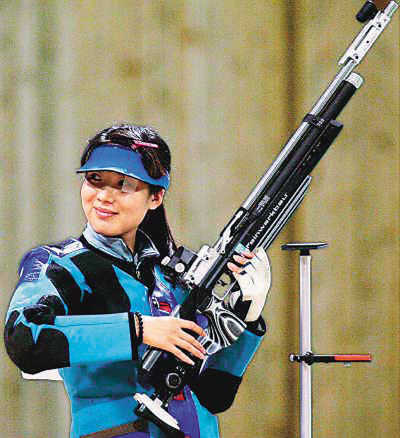
China set to remain top guns in London

Veteran Du Li could still be among the gold medal contenders at the Games. 
If the presence of five Olympic champions in their ranks is anything to go by, China's supremacy in pistol and rifle events is unlikely to wane in London. Since rising to the top of the shooting medal table in Athens 12 years ago, China have cemented their status as a shooting superpower, securing five of the 10 gold medals on offer in the pistol and rifle events in Beijing four years ago. Four Beijing gold medallists - Du Li (women's 50m rifle three position), husband Pang Wei (10m air pistol), Guo Wenjun (women's 10m air pistol) and Chen Ying (women's 25m pistol) - will defend their titles at London's Royal Artillary Barracks. They will be joined by Zhu Qinan, who won the 10m air rifle in Athens but had to settle for a silver in Beijing, while Yi Siling, who equalled the 10m air rifle world record for the third time in May, will be expected to deliver China's first Olympic gold in London. "The first gold is always difficult to get. However, the pressure is the same with other teams," head coach Wang Yifu was quoted as saying by Xinhua news agency. "I hope all our athletes can get their satisfactory result, and the shooters are also trying hard for the goal." South Korea's hopes of a shooting gold will rest on Beijing champion Jing Jong-oh, who signalled he was in form after winning the 50m pistol event at the Munich World Cup in May. India will pin their hopes on Beijing 10m air rifle champion Abhinav Bindra while Ronjon Sodhi's consistency makes him a double trap medal contender. Niccolo Campriani will spearhead Italy's campaign in London, having won three 50m rifle three positions gold in this year's World Cup series. However, no other shooter will have more at stake than American Kim Rhode who is gunning for her fifth successive Olympic medal. Rhode won the double trap golds in 1996 and 2004 and a bronze in between. After women's double trap was discontinued, she moved to skeet and won a silver in Beijing. Source: China.org.cn

China's Quest for Arctic Access & Resources

 Coming Crisis: China has become increasingly interested in the Arctic in recent years due to the melting of the polar ice-cap, and its own desperate need for energy resources and raw materials for its growing economy. Access to natural resources and shortened shipping routes has prompted China to look at what Arctic might provide. China is not an Arctic littoral state, has no Arctic coast, and as such neither sovereign rights over region’s continental shelves nor the resources that lay beneath them. Regardless as an emerging global power and permanent member of United Nations Security Council, it is expected to seek a role in determining this framework and legal foundations for the region’s future management. The changing situation in the Arctic has raised many questions and uncertainties about its future and could lead to new geopolitical challenges for both Arctic littoral states and non-Arctic countries. These issues are primarily related to free passage and resource extraction rights. To this end, countries across Asia, including China, Europe and North America are concerned with this transformation and its economic, territorial and geopolitical implications Source: The Coming Crisis

Sunday, 15 July 2012

China, India to produce 40pc of graduates by 2020


Emerging powerhouses China and India will lead the way in churning out university graduates by the end of the decade, the OECD has said. Forty percent of the over 200 million university graduates aged 25 to 34 in 2020 will come from the two countries, according to the Organisation for Economic Cooperation and Development (OECD). "By contrast, the United States and the European Union countries are expected to account for just over a quarter of young people with tertiary degrees in OECD and G20 countries," the OECD said in a new education report. China alone will account for 29 per cent of graduates in 2020, after quintupling its numbers in the last decade, while India will account for 12 and the United State for 11 per cent. The latest report from the Education in Focus series highlights the strides emerging economies like China and India and other non-OECD nations have made in higher education since 2000. By gradually shifting the focus from mass production jobs to knowledge-based work, the top developing nations have nearly caught up to developed nations in terms of college graduates. "If this trend continues, the number of 25- to 34-year-olds from Argentina, Brazil, China, India, Indonesia, the Russian Federation, Saudia Arabia and South Africa with a higher education degree will be almost 40 per cent higher than the number from all OECD countries by the year 2020," OECD press officer Spencer Wilson said. The United States, for example, has seen its share fall, from 17 per cent in 2000 to 14 percent in 2010, and to the expected 11 per cent in 2020. OECD also found that between 1998 and 2008, employment in science and technology grew at a higher rate in both developed and developing nations than total employment. Source: Sam Daily Times

Sunday, 1 July 2012

China's astronaut trio returns to Earth

Chinese female astronaut Liu YangAgencies : Beijing, China's first woman cosmonaut and two of her colleagues returned to Earth today after successfully accomplishing the country's first-ever manual space docking during a two-week mission, giving a boost to Beijing's efforts to build a space station by 2020. The spacecraft Shenzhou-9 carrying the three astronauts landed at the designated spot at Inner Mongolia region. The landing, which was shown live on the television was a bit bumpy as the module turned upside down as it hit the ground. Ground stations declared that the landing wassuccessful. The first Chinese woman astronaut Liu Yang, and her two male colleagues Mission commander Jing Haipeng and Liu Wang were safe. The return capsule of Shenzhou-9 spacecraft touched down this morning, after China fulfilled its first manned space docking, state run Xinhua news agency reported. The two-week space mission was a key step towards building a space station, which China aims to do by 2020. The touch down monitored by various ground stations took place at 10 AM Beijing time as was announced earlier. The module aided by a huge parachute was seen landing almost at the designated site in the grass lands of inner Mongolia. The ground search and rescue team moved toward the landing site as soon as the capsule landed.Source: Indian Express

Wednesday, 29 February 2012

China far ahead of India in science, PM tells US magazine


Washington: Prime Minister Manmohan Singh, who vowed last month to more than double India's R&D spending to $8 billion a year by 2017, has expressed concern over countries like China overtaking India in the field of science. "Over the past few decades, India's relative position in the world of science had been declining, and we have been overtaken by countries like China," Singh declared in an interview with America's top 'Science' magazine. "China is in many ways far ahead of India," he is quoted as saying in the Feb 24 issue of Science which carries a special package of news focusing on the state of 'Science in India,' and how it has evolved over the past few decades. Manmohan Singh had expressed similar concern at the Indian Science Congress earlier this year. Image Source: Deccan ChronicleImage: flickr.com

Monday, 27 February 2012

Research misconduct “widespread” in Chinese science: comment

BioEdge, By Jared Yee: Research misconduct is “serious and widespread” among Chinese scientists, according to an editorial published in the China Daily. The report was written byCong Cao, of the China Policy Institute and the University of Nottingham. Cao cited “conservative estimates” that one-third of Chinese researchers have engaged in practices such as plagiarism and falsifying data. According 
to the editorial, the rise in misconduct can be partly attributed to “the pursuit of promotion, a hypercompetitive funding environment and the mounting pressure on scientists to produce outcomes with ‘visibility’”. Cao continued: “the institutional watchdog responsible for exposing, investigating and punishing scientific misconduct exists merely on paper because of a lack of autonomy in science and vigorous peer review.” He criticised the Chinese government for “creating a government agency under political control to police scientists, while denying scientists the autonomy to set up an independent regulatory body”, saying it represents a “failure of governance”. He concluded: “China's pursuit of science and innovation has reached another critical juncture where any institutional misstep could trap China in a bigger and deeper gap, and jeopardize its potential to become a global scientific superpower.” Source: BioEdge

Friday, 24 February 2012

Top 10 universities of traditional Chinese medicine

Hunan University of Traditional Chinese Medicine,one of the 'Top 10 TCM universities' by China.org.cn.
Previous   1   2   3   4   5   6   Next  
China, By Lin Liyao: Established in 1960 in Changsha, Hunan University of Traditional Chinese Medicine (HNUTCM) was developed from Hunan Chinese Medicine Specialization School founded in 1934 and Hunan Traditional Chinese Medicine Vocational School established in 1953. Now it's a primarily teaching-oriented college emphasizing Traditional Chinese Medicine and Chinese Pharmacology. HNUTCM has about 16,000 students, of which about 450 are overseas students from over 20 countries and regions, including the US, UK and Japan. There are 18 disciplines in the undergraduate school, 17 master degree programs and 13 doctoral programs. Website: http://www.hnzyxx.com/En/, Source: China.org.cn

Monday, 20 February 2012

Chinese theaters to screen more US films

China: China will allow more U.S. films to be screened in Chinese movie theaters and widen market access to the fast-growing Chinese audience for Hollywood, a move that has annoyed domestic filmmakers. The agreement with the U.S. concerning issues related to films after their World Trade Organization dispute last year came during Vice President Xi Jinping's five-day U.S. visit last week. "This agreement with China will make it easier than ever before for U.S. studios and independent filmmakers to reach the fast-growing Chinese
audience, supporting thousands of American jobs in and around the film industry," U.S. Vice President Joe Biden said in a statement. According to the agreement, the annual quota of 20 revenue-sharing foreign films in Chinese theaters will remain unchanged, but it allows 14 premium format films, such as 3-D and IMAX movies and similar enhanced format films, which will be exempt from the quota. Also, the U.S. studios' share of their films' grosses in the Chinese market will rise to 25 percent from the previous 13.5 to 17.5 percent. Chris Dodd, president of the Motion Picture Association of America, called the pact "tremendous news for the millions of American workers and businesses whose jobs depend on the entertainment industry." China's box office has been growing at an annual rate of 30 percent since 2003, reaching $2.1 billion last year. It has become the highest-grossing overseas market for many Hollywood blockbusters, such as "Transformers 3" and "Avatar." Source: China.org.cn

Wednesday, 8 February 2012

Monk who self-immolated 'called for Dalai Lama return

DalaiIndian Express: A senior Tibetan monk who self-immolated last month urged Tibetans to unite and called for the return of the Dalai Lama in a message recorded before his death, advocacy groups said today. Lama Sobha, also known as Sonam Wangyal, was the most senior of 16 Tibetan clerics and former monks to have set themselves alight in the past year in protest against China's policies in Tibetan-inhabited areas. In the nine-minute audio recording, Lama Sobha said his sacrifice was in solidarity with "heroes" who have died seeking to protect Tibetan culture, the Washington-based International Campaign for Tibet (ICT) said in a statement. The people of Tibet "must unite and work together to build a strong and prosperous Tibetan nation in the future," the group quoted him as saying. "I pray that His Holiness the Dalai Lama will return to Tibet and remain as Tibet's temporal and spiritual leader." Tibet's spiritual leader, winner of the Nobel Peace Prize, fled into exile in 1959 following a failed uprising, and is a considered a separatist by Beijing -- a charge he has repeatedly denied. The ICT also posted images of Lama Sobha's charred body, which it said were obtained by exiled Tibetans after the self-immolation in Qinghai province, northwest China, on its website. Lama Sabha's recording was obtained by the US government-run Radio Free Asia, the campaign said. AFP has been unable to independently verify the authenticity of the recording. Tibetans have long chafed at China's rule over the vast Tibetan plateau, accusing Beijing of curbing religious freedoms and eroding their culture and language. Source: Indian Express

Sunday, 5 February 2012

New Year temple fair in Ditan

1   2   3   4   5   Next  
China: The Ditan Temple Fair is open from Jan, 23 to 29 at the Ditan (Temple of Earth) Park.This fair is one of Beijing's most popular and long standing. There will also be a range of folk performances, children's puppet shows and fashion shows, art exhibitions, ice lanterns and snow sculptures, and traditional Beijing snacks. [China.org.cn] Source: China.org.cn
China: The Ditan Temple Fair is open from Jan, 23 to 29 at the Ditan (Temple of Earth) Park.This fair is one of Beijing's most popular and long standing. There will also be a range of folk performances, children's puppet shows and fashion shows, art exhibitions, ice lanterns and snow sculptures, and traditional Beijing snacks. [China.org.cn] Source: China.org.cn