Monday, 26 January 2026
3rd T20I: Abhishek, Suryakumar shine as India clinch series with 3-0 lead
Friday, 19 December 2025
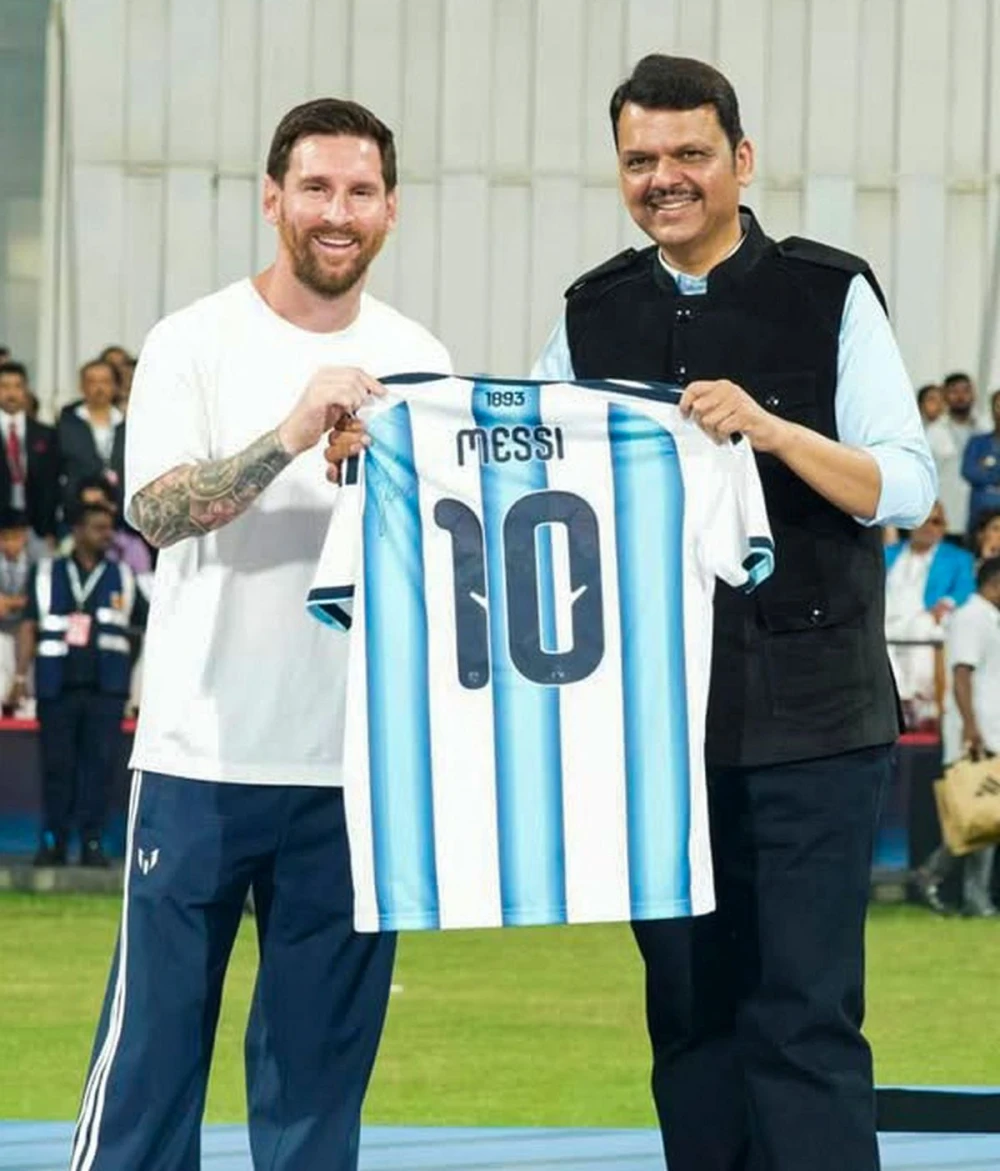
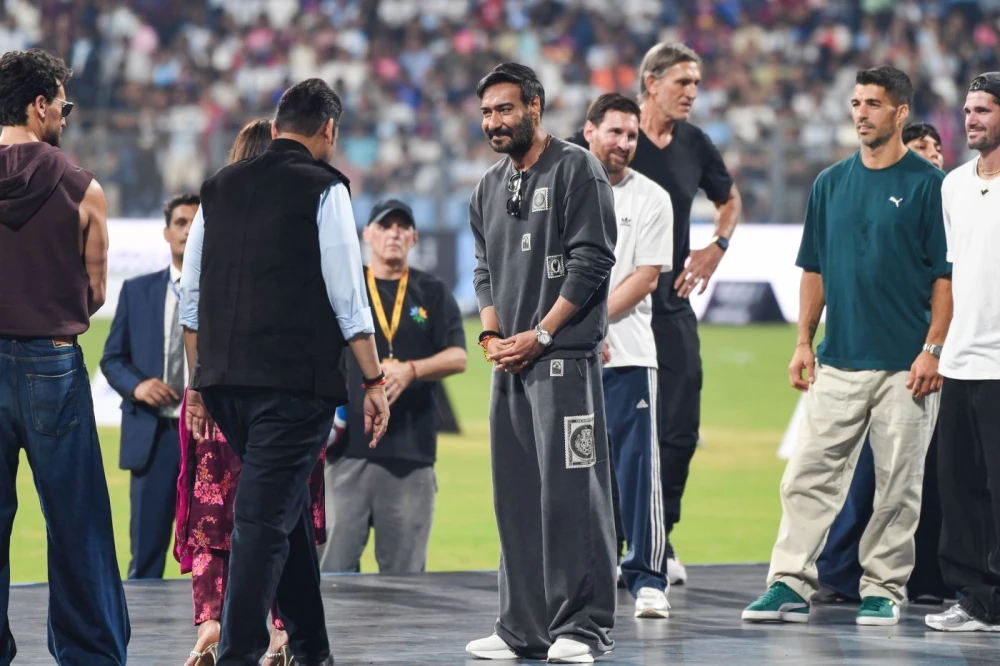
GOAT India Tour: Messi leaves fans, celebrities mesmerised; gets signed India jersey from Tendulkar
Mumbai: Maharashtra Chief Minister Devendra Fadnavis with Argentine football icon Lionel Messi during an event held as part of the latter’s ‘G.O.A.T. India Tour 2025’ at the Wankhede Stadium, in Mumbai on Sunday, December 14, 2025. (Photo: IANS/CMO)
Mumbai: Former cricketer Harbhajan Singh with Argentine football icon Lionel Messi during an event held as part of the latter’s ‘G.O.A.T. India Tour 2025’ at the Wankhede Stadium, in Mumbai on Sunday, December 14, 2025. (Photo: IANS/instagram/@harbhajan3)
Mumbai: Argentine football icon Lionel Messi with Maharashtra Chief Minister Devendra Fadnavis and actors Ajay Devgn, Tiger Shroff and others during an event held as part of his ‘G.O.A.T. India Tour 2025’ at the Wankhede Stadium, in Mumbai on Sunday, December 14, 2025. (Photo: IANS)Monday, 3 November 2025
India clinch maiden Women’s World Cup; BCCI announces Rs 51 cr reward for team, support staff
Saturday, 1 November 2025
Virat Kohli becomes second-highest run-getter in ODIs
Thursday, 30 October 2025
Rohit, Kohli will be big assets for India in 2027 WC: MSK Prasad
Tuesday, 9 September 2025
"Vaibhav Suryavanshi" A Young cricketer of India Promising Something And deserves to get a chance to play in Indian International cricket Team
Saturday, 30 August 2025
What does Steve Smith’s Stateside signing mean for cricket in the US – and Australia?
Steve Smith, one of this generation’s finest batters, has conquered much of the cricketing world during his career, and he now has set his sights on a new frontier: the United States.
Yes, Smith has signed to play Twenty 20 (T20) cricket for the Washington Freedom, which happens to be coached by former Australian great Ricky Ponting.
Washington is one of six teams in Major League Cricket (MLC), which began in 2023. The Freedom finished third in the inaugural season, won by New York.
The 2024 season will begin in July before the US co-hosts the T20 World Cup with the West Indies.
A number of established cricket stars have already played in the US league, including Quinton de Kock of South Africa, Nicholas Pooran from the West Indies, Trent Boult from New Zealand and Australians Marcus Stoinis and Aaron Finch.
Looking ahead, T20 cricket has been included for the Los Angeles 2028 Olympic Games.
So, why is cricket suddenly interested in the US – and does this interest go both ways?
Cricket in the US: what’s the go?
Cricket is slowly becoming better known in the US.
Firstly, it is because of the rising South Asian population who mostly love their cricket.
It is a growing and affluent professional community – the South Asian diaspora is growing at a rapid rate across North America to the point that when you fly into most large US cities, you can spot cricket pitches.
Many South Asian immigrants to the US (and Canada) are engineers, doctors and entrepreneurs with good educations and professional jobs – Indian-Americans are the most affluent group in America by median household income, while Sri Lankans and Pakistanis are two of the eight wealthiest segments.
In terms of education, 70% of Indian-Americans have at least a Bachelor’s degree, compared to the US average of 28%.
A lot of this affluence is ploughed into supporting local cricket leagues in the US and watching the MLC.
In terms of participation, cricket is still very much a niche sport in the US, with about 200,000 registered players. However, this has grown from around 30,000 registered players in 2006, with emigration from South Asia driving the lion’s share of growth.
Consuming cricket anytime, anywhere
Secondly, live streaming has taken off worldwide in recent years, allowing Indians in the US to watch India Premier League (IPL) games back home, and Indians in India to live stream MLC matches.
According to Chris Muldoon, chief strategy officer of Cricket NSW, there are more than 4 million subscribers to Willow TV’s cricket-only streaming service throughout North America.
This means it is easy for most cricket fans can consume what they want, when they want it.
The growth of cricket franchises
Thirdly, IPL franchises are launching clubs and leagues around the world – in South Africa, the UAE and the US – to grow the sport and to attract talent and revenue to their respective franchises.
There is a strong IPL presence across many of the domestic T20 competitions that have launched in recent years, including in MLS where four IPL franchises are involved with the foundation clubs in New York, Dallas, Los Angeles and Seattle.
This is a big shift in cricket governance, as it is not just the cricket boards of Australia, England & Wales and India calling the shots on schedules – it is now the IPL franchises too.
What does this mean for Australian cricket?
So, how does all of this affect elite cricket in Australia?
Australian cricketers have been competing in T20 competitions around the world for years now, with Cricket Australia occasionally having to step in to reduce the workloads of some of its best players.
Now the MLC will force governing bodies and players to react to another competition in a packed cricket calendar.
According to Muldoon, the opportunity in the US is too big to ignore. He says:
The US is the world’s most sophisticated and competitive sports and media market and Major League Cricket presents the most exciting and challenging opportunity in world cricket.
The proliferation of franchise T20 cricket around the globe, much of it driven by the commercial success of the IPL as well as changing preferences of consumers, is changing the way cricket is consumed. And it is bringing new revenue into the sport – which in turn is making it increasingly attractive to the world’s best players and coaches to be a part of these growing franchise leagues around the world on an almost full-time basis.
Will cricket really take hold in the US?
So does Smith’s signing indicate a cricket revolution? Does the US aspire to be a cricket nation?
Probably not in terms of Test cricket, but in the US, the shortened format of T20 is possibly appealing.
This is largely driven by the South Asian diaspora who have migrated to North America, and T20 is the format that has the consumer appeal to attract eyeballs – and broadcast partners. The addition of cricket as an Olympic sport for Los Angeles in 2028 may also add to the sport’s exposure.![]()
Tim Harcourt, Industry Professor and Chief Economist, University of Technology Sydney
This article is republished from The Conversation under a Creative Commons license. Read the original article.
Tuesday, 20 May 2025
Ferocity, fitness and fast bowling: how Virat Kohli revolutionised Indian cricket
Vaughan Cruickshank, University of Tasmania and Brendon Hyndman, Charles Sturt University
Virat Kohli announced his retirement from Test cricket on Monday.
While his Instagram message just said this was the “right time”, his poor recent Test form, mental fatigue and desire to spend more time with his family, charity foundation and expanding business empire have been suggested as other influential factors.
During his 14-year Test career “King Kohli” has been the backbone of the Indian batting line-up, and his absence is a huge blow as the Indians prepare to tour England next month.
The megastar scored 9,230 runs in 123 Tests at an average of 46.85, including 30 centuries.
These numbers put him in the top five Indian test batsmen of all time, but his legacy extends far beyond his batting achievements.
Kohli, 36, quit Twenty20 Internationals last year (after India won its second world title). He may continue to play one-day internationals.
Rising to the top of Test cricket
Kohli has been the greatest Indian batsman of his generation.
He made his Test debut in 2011 against the West Indies and played his final match against Australia in January.
He scored centuries against every country he played against, with more than half of these coming overseas.
His seven Test centuries in Australia is the second most by an overseas batsman.
He was at his peak between 2014 and 2019, when he averaged more than 60 in Test cricket and became one of the “fab four” (the world’s best Test batsmen) alongside Steve Smith, Kane Williamson and Joe Root.
This period also included six double-hundreds in 18 months, and 13 months as the number one ranked Test batsman in the world.
Kohli the leader
Kohli is India’s greatest ever Test captain.
His tenure from 2014 to 2022 was a golden age for Indian Test cricket.
India won 40 of 68 Tests (59%) in this period and did not lose a Test series at home. India was the number one ranked Test team in the world from 2016–20 and won its first Test series in Australia in 2018–19.
These statistics make Kohli one of the most successful Test captains of all time.
Beyond these numbers, he was a charismatic and aggressive captain who redefined India’s approach to Test cricket by bringing a more competitive edge to the team.
He drove higher expectations around fitness, training intensity and fast bowling that continue to shape Indian cricket.
Mandatory fitness testing and improved dieting and recovery practices, which redefined the team’s standards, are attributed to Kohli’s leadership.
Similarly, Indian success was strongly contributed to by Kohli encouraging the development of a world-class pace bowling attack, which marked a significant shift from the spin-heavy approach of Indian cricket.
Controversies
While Kohli’s energy, passion and intensity contributed to his success as batsman and captain, they also led to numerous confrontations with opposition players, which some believed to be disrespectful and arrogant.
His intense celebrations and assertive body language also drew criticism from conservative cricketing audiences.
Kohli’s collision with Sam Konstas during the Boxing Day Test versus Australia.
Many of these controversies have occurred in Australia, where Kohli enjoyed a love-hate relationship with Australian players and crowds.
Examples include flipping the bird to the crowd, making sandpaper gestures (in reference to the 2018 Australian ball tampering scandal, also known as Sandpapergate) and shoulder-barging young Australian batsman Sam Konstas.
What will his Test legacy be?
For more than a decade, Kohli has been the heartbeat of the Indian Test team, and his retirement marks the end of an era.
He reshaped the mindset of Indian cricket and cultivated a faster, fitter, fiercer, more successful team.
Kohli was also one of the greatest ambassadors of Test cricket, and has played a significant role in ensuring the game remains relevant in an era increasingly dominated by T20 cricket.
He made Test cricket aspirational again because he wanted it to thrive. He knew India needed to dominate the hardest format to be respected.
His social media reach (272 million followers on Instagram and 67.8 million on X) is more than Tiger Woods, LeBron James and Tom Brady combined, and was even referred to by LA2028 Olympics organisers when they announced cricket’s entry into the games.
In recent days, Kohli has been described as “a modern-day giant”, a “provocateur in chief”, and “his generation’s most profound figure”.
Love him or hate him, he elevated the spectacle of Test cricket. His electric energy brought the best out of India and its opponents and made him impossible to ignore when batting or fielding.
As respected cricket writer Peter Lalor noted recently:
Nobody is irreplaceable, but nobody can replace Virat.
Vaughan Cruickshank, Senior Lecturer in Health and Physical Education, University of Tasmania and Brendon Hyndman, Associate Dean (Academic), Charles Sturt University
This article is republished from The Conversation under a Creative Commons license. Read the original article.
Saturday, 20 July 2024
Hardik Pandya and Natasa Stankovic announce separation
Monday, 15 July 2024
'My confidant, my coach and my friend': Rohit pens special note for Dravid
Sunday, 30 June 2024
India are T20 Cricket World Cup Champions!!
Cricket – ICC T20 World Cup 2024 – Final – India v South Africa – Kensington Oval, Bridgetown, Barbados – June 29, 2024 General view of India fans in the stands before the match REUTERS/Ash Allen
Screaming with joy at India’s victory in T20 World Cup, June 29, 2024, in Barbados. PHOTO; X @ICC
Hugging the T20 World Cup, June 29, 2024, as India emerged victors by a slim margin. PHOTO: X @ICCThursday, 20 June 2024
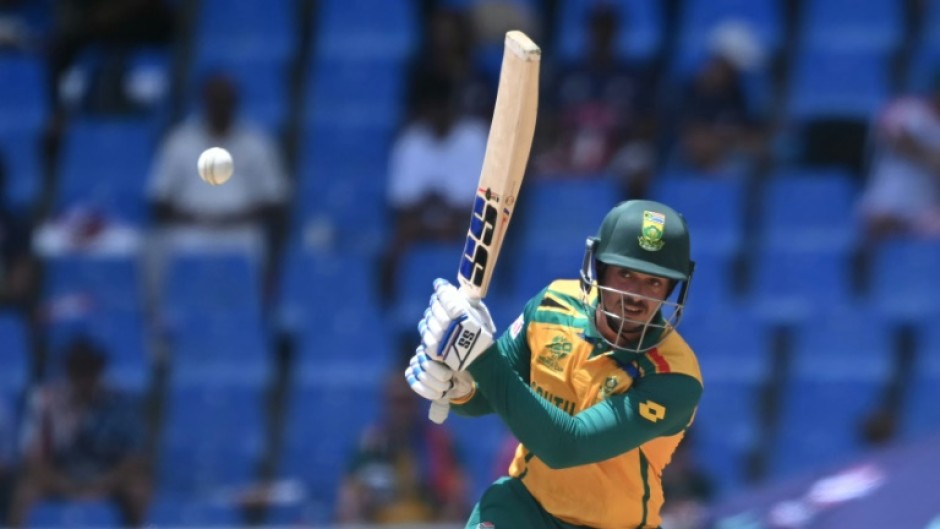
De Kock leads South Africa to 194-4 against USA at T20 World Cup

Thursday, 13 June 2024
Mahi is always emotional about cricket, it's his love: Sakshi
Monday, 10 June 2024
T20 World Cup: Bumrah, Hardik, Pant star as India beat Pakistan by six runs
Saturday, 8 June 2024
Why India and Pakistan’s T20 cricket showdown in New York is such a big deal
The U.S. national cricket team pulled off a shocking upset on June 6, 2024, by defeating Pakistan at the T20 World Cup.
The success of Team USA couldn’t have come at a better time for American promoters of the game.
Americans might be surprised to learn that cricket – not baseball, nor football – holds the title of the nation’s first modern team sport. European immigration fueled the sport’s popularity in the first half of the 19th century, and Abraham Lincoln reportedly watched a cricket match in 1859.
Cricket’s popularity waned after the Civil War. Troops had taken to the new sport of baseball, which was easier to play on makeshift fields, and the sport eventually emerged as the national pastime.
Nevertheless, cricket is the second-most-watched sport in the world after soccer. And with the U.S. and the West Indies cohosting the T20 World Cup, organizers hope the sport can gain some traction among American audiences.
The tournament kicked off on June 1, 2024, with a victory for the U.S. against neighboring Canada. But it’s a match yet to be played that’s generating the most buzz, especially among those of South Asian descent: the India-Pakistan showdown.
Matches between the two nations usually attract massive audiences. More than 400 million people around the world watched the India-Pakistan 2011 World Cup game. By comparison, about 125 million people tuned into Super Bowl LVIII in 2024.
Set to take place on June 9, 2024, on Long Island, the match is the next chapter in one of the most intense rivalries in sports, one that’s deeply entangled with the two nations’ complex geopolitical history.
The roots of a rivalry
Cricket became popular in India during the British Raj, the period of the United Kingdom’s direct rule of the subcontinent that lasted from 1858 to 1947.
British sailors introduced the sport, with the first recorded match taking place in western India in 1721.
Scholars argue that the British promoted cricket in India as part of an Anglicization policy, which encouraged Indians to adopt English customs and values. Promoting cricket was one way for the British to instill loyalty to the British Empire among Indians, thus aiding their colonial governance.
Following the partition of India in 1947 and the creation of Pakistan, both nations formed their own national cricket teams.
Pakistan was created as a separate nation for Muslims, who feared religious persecution and sought political and cultural autonomy. But the partition was deeply painful, marked by a violent and traumatic division based largely on religious lines, with Hindus and Sikhs migrating to India and Muslims resettling in Pakistan.
The process left a deep wound in both nations’ memories. In the largest population transfer in history, about 10 million people became refugees, and up to a million were killed in border massacres and riots.
The first cricket series between the nations, which India won, was a poignant reminder of the painful partition. Many of the Pakistani team officials, fans and players who made the journey from Pakistan to Amritsar, India, retraced the route they had taken just five years prior.
India and Pakistan’s postcolonial relationship remains tense. There have been several wars, most of which have taken place over the disputed Kashmir region, a strategically important area that each nuclear-armed nation has claimed as its own.
Cricket diplomacy
Despite a shared border, culture and history, India and Pakistan each maintain strict trade and travel restrictions on the other country. Yet citizens of each nation share a passion for cricket that transcends political divides.
Both countries have engaged in what scholars call “cricket diplomacy.”
For example, in 1987, then-President Mohammed Zia-Ul-Haq of Pakistan visited India under the auspices of attending a cricket match. But he also met with Indian officials in order to ease rising tensions between the two nations. Similarly, in the early 2000s, the Indian cricket team toured Pakistan twice as then-Prime Minister Manmohan Singh of India tried to foster peace with his neighbor. And in 2005, then-President Pervez Musharraf of Pakistan visited New Delhi to watch a cricket match between the two countries.
Following the 2008 Mumbai attacks, however, when terrorists allegedly linked to Pakistan killed over 160 people in Mumbai, the Indian government barred its cricket team from touring Pakistan, even for international tournaments. Since 2009, Pakistani players have also been excluded from participating in the hugely popular Indian Premier League, which draws star cricketers from England, the West Indies and Australia.
All eyes on Nassau County
Nassau County, just east of New York City on Long Island, was selected to host T20 matches for a reason.
Hundreds of thousands within the South Asian diaspora call the New York City metro area home, including more than 700,000 people of Indian heritage.
South Asian immigrants and their descendants, long mocked and stereotyped in U.S. media, increasingly hold positions of influence, whether it’s Vice President Kamala Harris, Google CEO Sundar Pichai or actor Kal Penn.
Because cricket matches between India and Pakistan are few and far between, the cheapest tickets are being sold for between US$600 and $1,200 on the secondary market. VIP tickets are going for as much as $40,000 apiece; with additional fees of nearly $10,000, the total cost exceeds $50,000.
Clearly, there’s an appetite for cricket in the U.S. As sports broadcasters and sponsors seek new audiences, the cricket-obsessed South Asian diaspora represents an untapped market. In 2023, Major League Cricket, the sport’s first American professional league, held its first season. One of its six teams is based in New York City. Another is in Dallas, a metro area that is also experiencing a surge of South Asian immigrants.
For now, cricket advocates could not have written a better script: a raucous crowd cheering on a rare matchup between cricket’s biggest rivals, taking place in the biggest media market in the U.S.
This article has been updated with the addition of the U.S. victory against Pakistan.![]()
Umer Hussain, Assistant Professor of Sports Management, Wilkes University; M. Fahad Humayun, Assistant Professor of Communication, University of Evansville; Simran Kaur Sethi, Graduate Research Assistant, University of Oklahoma, and Steve Bien-Aime, Assistant Professor of Journalism and Mass Communications, University of Kansas
This article is republished from The Conversation under a Creative Commons license. Read the original article.