bloggggg

Home  |  Live  |  Science  |  Lifestyle  |  Entertainment  |  Broadcast  |  Games  |  eBooks  |  Astounds  |  Adbite  |  Cricbell  |  Cyber  |  Idea  |  Digital  |  Privacy  |  Publish  |  ePaper  |  Contact  .Subscribe.Subscribe.Subscribe.Subscribe.Subscribe.Subscribe.Subscribe.Subscribe.Subscribe
Subscribe

Wednesday, 22 October 2025

Naga Designer Asenla Jamir to launch ‘Otsüverse’ cultural showcase in Mumbai


When Asenla Jamir left Nagaland with a dream of telling stories through fabric, she did not imagine that her clothing label would one day expand into an immersive cultural experience. But on September 7, that dream will take shape in Mumbai at Otsüverse – Northeast Re-imagined, a one-day pop-up showcasing the region’s heritage through fashion, food, art and music.

Jamir, the founder of Otsü Clothing Co., describes her brand as a “love for storytelling through fabric, culture, and community.” What began as a small collection of one-of-a-kind pieces has now become the platform for the launch of her first ready-to-wear line, alongside a larger cultural initiative.

“Otsüverse isn’t just an event — it’s a piece of home I’ve carried with me for years,” Jamir said. “Growing up in the Northeast, I’ve always dreamed of creating a space where our food, stories, sounds, and craft could come alive — not just for us, but for anyone curious enough to experience it.”
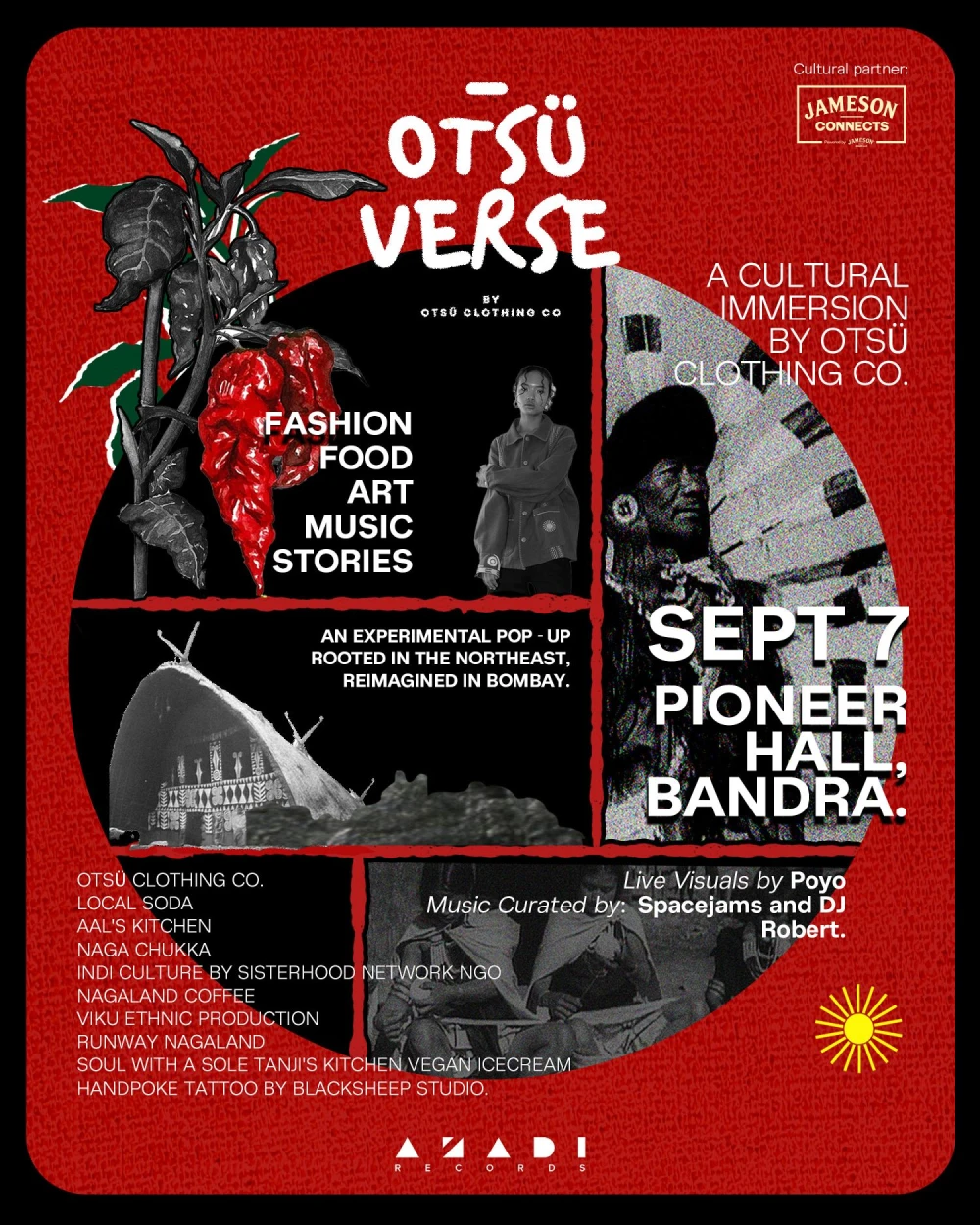

The pop-up, scheduled for Pioneer Hall in Bandra from 3:00 p.m. to midnight, brings together handwoven textiles, curated food experiences, visual art and live DJ sets. Organizers describe it as a bridge between tradition and contemporary culture. “From handwoven textiles and ready-to-wear collections that honour traditional craftsmanship, to flavours that tell stories of our homeland, to DJs and artists creating a new soundscape — Otsüverse is a bridge between heritage and now,” Jamir said.

The project is supported by Jameson, a brand Jamir calls “a champion of community, creativity, and shared moments,” and produced in collaboration with Azadi Records, one of India’s leading independent music collectives. Azadi has built a reputation for pushing cultural boundaries, and its presence signals that Otsüverse is as much about contemporary experimentation as it is about heritage.

For Jamir, who identifies foremost as a storyteller, the event is both professional milestone and personal journey. “I’m a storyteller at heart from Nagaland, I’ve spent the last few years building Otsü as a way to keep our roots alive while inviting everyone to experience them in a fresh, modern light,” she said.

Otsü Clothing Co. began as an exploration of textiles, upcycled garments and memory-driven design. Over the years, it has grown into a brand that seeks to embody cultural identity in wearable form. The Mumbai pop-up reflects that evolution. “We’re not only launching our first ready-to-wear collection after our collections of our one-of-a-kind upcycled pieces, but also creating a platform that celebrates incredible creators, homegrown brands, and the cultural stories we’re proud to share — all made possible with the support of Jameson and Azadi Records,” Jamir said.

Beyond the launch of a clothing line, the event promises a sensory experience: live art installations, textile-based exhibits, experimental soundscapes and food rooted in the flavours of the Northeast. “This one-day pop-up is a meeting point of flavours, textures, music, and conversations — a living snapshot of the Northeast in the heart of Mumbai,” Jamir said.

The founder is clear that this is not meant to be a fleeting showcase but a step toward deeper cultural connections. “If you join us, you’re not just attending an event — you’re becoming part of a moment that’s been built with countless hours, heartfelt collaboration, and a vision to make Northeast feel a little closer to home for everyone,” she said.For Jamir and her team, Otsüverse is both celebration and invitation — an effort to place the Northeast at the center of India’s cultural conversation, interpreted through fashion, sound and shared experiences. Naga Designer Asenla Jamir to launch ‘Otsüverse’ cultural showcase in Mumbai | MorungExpress | morungexpress.com

Saturday, 13 July 2024

Contest Winner Turns Bridge into the Longest Walking Art Gallery in South Korea

Arch Mist wins contest to revitalize the Jamsu Bridge in Seoul for pedestrians

The metropolitan government of Seoul, South Korea, has just concluded a contest to redesign the lower deck of a famous city bridge, awarding first prize to a Dutch firm that wants to turn it into an art gallery and cultural space.

Firm Arch Mist provided the most “innovative” proposal for remodeling the semi-submersible Jamsu pedestrian bridge over the Han River, with their vision of fushia metal ribbons winding between the piles of the bridge structure.

The design will offer multiple balconies and decks for the hosting of art displays and cultural events without impeding pedestrian flow.

The bridge is already a famous sight in the city—with the upper deck, called the Banpo Bridge, holding the Guinness World Record for being the longest “fountain bridge.”

It has 38 water pumps and 380 nozzles installed. It also has speakers, lights, and projectors that make it a marvel to see at night.

Arch Mist’s 8,650m2 project will transform the 795 meter-long Jamsu Bridge into the ‘longest art gallery’ that will benefit from the shade and rain cover of the Banpo Bridge above.

“We have put lots of efforts into this project, since the beginning of this competition, and we are determined to see through to the end in order to create a ‘bridge of culture’ that citizens can enjoy,” said Chang-Soo Lim, Seoul Metropolitan Government’s Future Space Planning Officer. “It will also be the first pedestrian bridge and the first waterfront cultural space over the Han River.”

Arch Mist at night

Built in 1979, the Jamsu Bridge occasionally floods, but for decades it has also hosted events including food trucks and shows, weather permitting.

It was eventually arched in the middle to allow boat traffic to pass underneath, and now combined with the fountain and light show, promises to be a center of attention in the glittering metropolis of 10 million people Contest Winner Turns Bridge into the Longest Walking Art Gallery in South Korea:

Wednesday, 13 March 2024

Holi: what the clouds of colour in the Hindu festival mean

Holi is one of the most vibrant and fun festivals in the Hindu calendar. It’s practised across India (though mainly in the north), Nepal and throughout south Asian diasporic communities.

The date of Holi varies in accordance with the lunar calendar but the festival often takes place in February or March. In 2024, it’s celebrated on March 25.

People gather together to throw and smear gulal or coloured powders over each other in a symbolic celebration of spring, the harvest, new life and the triumph of good over evil. As with many Hindu festivals, there is more than one narrative explaining its symbolism, but it is the visual splendour of this festival that explains its appeal.

My research focuses, in part, on the religious and material culture of Hinduism, especially in relation to its practice in contemporary culture. One of the most uplifting aspects of Holi is the way people from all walks of life come together. It is an expression of the dynamism of Hinduism and the power of fellowship.

An explosion of colour

Holi conveys the exuberance and multisensory character of many Hindu festivals. The coloured powders are typically red, yellow and green, representing the colours of spring but each also carrying more individual significance.

Red, which is popularly used in marriage celebrations, is the colour of fertility. Yellow is regarded as an auspicious colour. Green symbolises new beginnings.

Traditionally, the coloured powders used in Holi festivities were organically sourced from dried flowers and herbs. Today they are synthetic. Celebrants throw or smear handfuls on each other, or use water-filled balloons or pichkaris (water pistols) to disperse coloured waster, adding to the carnivalesque feel of the event.

It is an immersive experience. Everyone comes together and merges in the magic of the crowd. Traditional hierarchies are suspended. Spontaneity and excitement take over. People talk about “playing” Holi in the powdered clouds of colour.

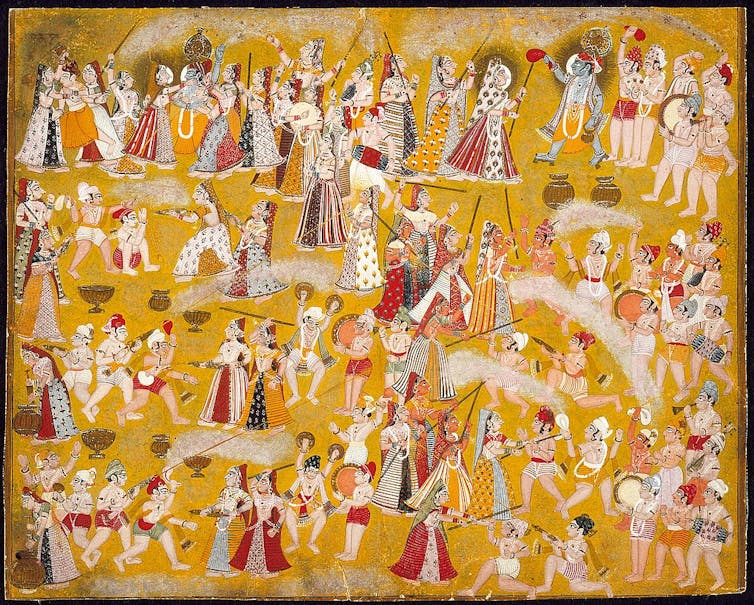
As an ancient tradition with multiple regional variations, Holi is underpinned by two prevailing narratives. The first is the eternal divine love between Lord Krishna (the incarnation of the Hindu deity, Vishnu) and the goddess Radha.

A watercolour depicting Krishna and Radha celebrating Holi from 1750. LACMA|Wikimedia

The other tells of the demon king Hiranyakashipu’s attempt to force his subjects to worship him. When his son, Prahlad, persisted in worshipping Lord Vishnu instead, Hiranyakashipu instructed his sister, Holika, to kill Prahlad.

Holika, who was invulnerable to fire, made the boy sit on her lap, on a pyre. Onlookers were astonished to see, however, that Prahlad’s devotion to Lord Vishnu saved him while Holika burned to death.

The event of playing with colour, now synonymous with Holi, is actually part of a larger series of rituals. The first night of festival, known as Holika Dahan, involves lighting bonfires and throwing on food such as grains. As a re-enactment of the death of the mythical demoness Holika, this ritual marks the end of winter and the overthrow of evil.

The next day, Rangwali Holi, sees people venturing out on to the streets to exchange colour. In the final part of this festival, in the evening, after washing off the colours and donning clean clothes, people gather with family and friends to eat traditional dishes including gujiya (a North Indian sweet fried dumpling).

Like Diwali (the “festival of lights” as it is often known) and the Hindu new year, Holi is celebrated by the Hindu diaspora in the UK, the US, Fiji, Mauritius and beyond. Temple organisations host Holi in their venues. Unlike in India where festivities are public and widespread, diasporic celebrations are more regulated to specific spaces and times.

Parties for Holi are not uncommon. You can routinely find events organised each year on platforms such as Eventbrite where ticket sales often include the prior purchase of non-toxic powders.

Some of these events are targeted at south Asian communities. They include renactments of plays, dance performances and further heritage elements.

Others capitalise on the spirit of revelry embodied by commercially driven colour marathons. These have elicited claims of cultural appropriation for their largely secular tone.The Conversation

Rina Arya, Professor of Critical and Cultural Theory and Head of the School of the Arts, University of Hull

This article is republished from The Conversation under a Creative Commons license. Read the original article.

Wednesday, 6 December 2023

Garba of Gujarat added on UNESCO representative list of the Intangible Cultural Heritage of Humanity

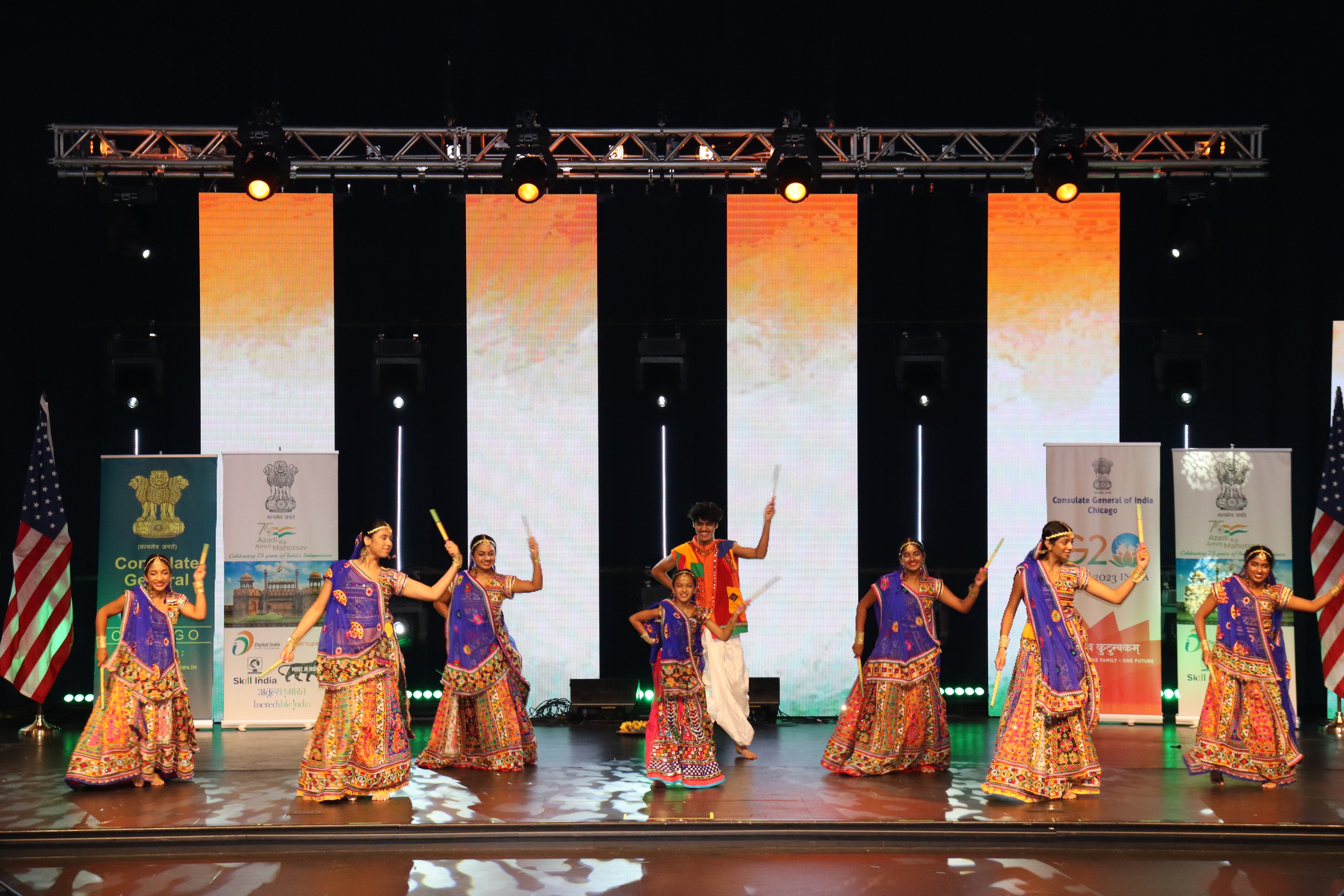
Garba by Shirlzar Dance Co. at Naperville, Illinois Kala Utsav 2023 event, Aug. 7, hosted by the Indian Consulate in Chicago. PHOTO: Indian Consulate

Dec. 6, 2023: Today, the Intergovernmental Committee for the Safeguarding of the Intangible Cultural Heritage inscribed ‘Garba of Gujarat’ on the Representative List of the Intangible Cultural Heritage of Humanity during its 18th session, taking place in Kasane, Botswana from 5 to 9 December 2023.

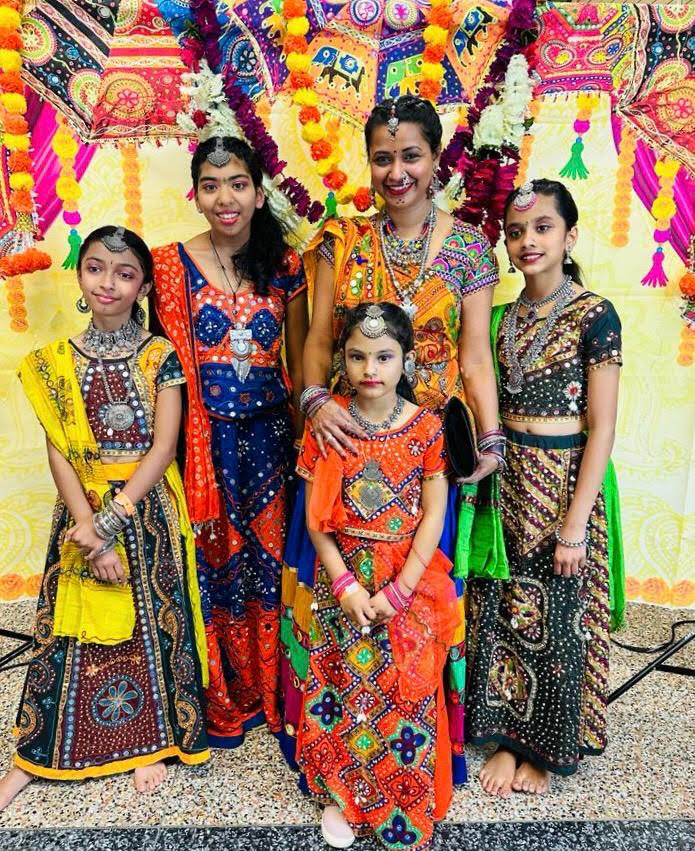
The inclusion of Garba now makes it India’s 15th inscription on the List.Montgomery Hindi School, NJ girls, dressed in traditional clothes, at the garba celebrations Oct. 13, 2023. PHOTO: Courtesy Montgomery Hindi School.

A ritualistic and devotional dance performed throughout the State of Gujarat, and across India, Garba is celebrated for nine days during the festival of Navaratri. The festival is dedicated to the worship of the feminine energy or Shakti. The cultural, performative, and visual expressions of this feminine energy are expressed through the Garba dance. The performative and visual celebration of Garba takes place within homes and temple courtyards, public spaces in villages, urban squares, streets, and large open grounds. Garba thus becomes an all-encompassing participatory community event.

“I offer my sincere congratulations to India, its people and the teams that worked on the nomination dossier. I hope this inscription helps ensure the viability of this tradition and inspires the community, particularly young people, to continue with the knowledge, skills and oral traditions associated with Garba,” said Tim Curtis, Director of UNESCO New Delhi Regional Office for South Asia and UNESCO Representative for Bhutan, India, the Maldives, and Sri Lanka.

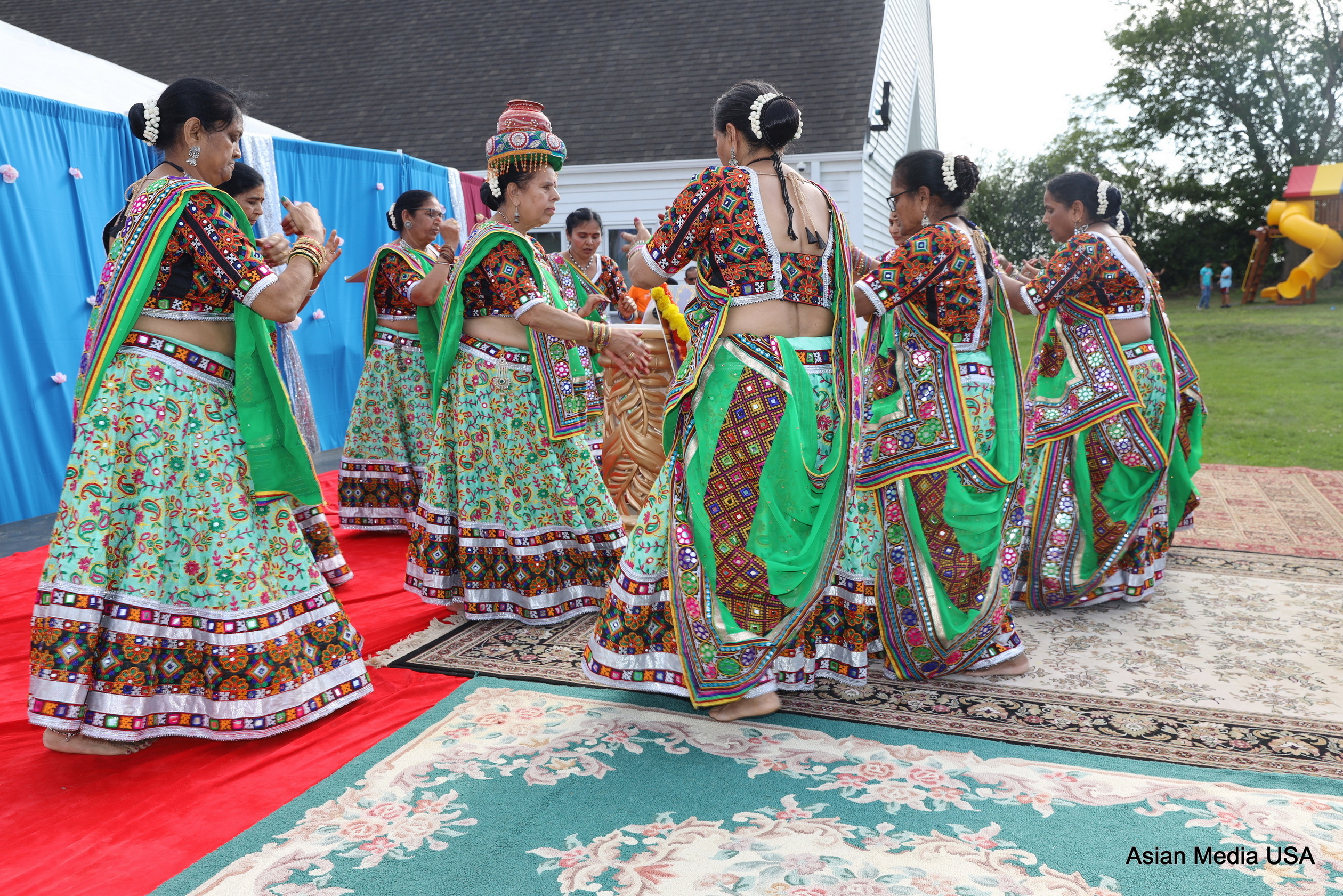
Over the decades Garba has been an integral, multivalent component of Gujarati culture in India and among the Indian diaspora across the globe. Garba continues to be a vibrant living tradition. In addition to being a religious ritual, Garba fosters social equality by diluting socio-economic, gender, and rigid sect structures. It continues to be inclusive and participative by diverse and marginalized communities, strengthening community bonds.Women took part and performed garba at cultural program of the Umiya Mataji Sanstha Chicago Midwest (UMSCM) 3rd Annual Patotsav, held at Umiya Mata Mandir in West Chicago, IL, from August 11 to August 14, 2022. Photo: Asian Media USA

The 18th session of the Intergovernmental Committee for the Safeguarding of the Intangible Cultural Heritage, hosted by the Republic of Botswana, is evaluating nominations submitted by States Parties for inscription on the Lists of the Convention, that include 45 elements for inscription on the Representative List of the Intangible Cultural Heritage of Humanity, 6 elements for inscription on the List of Intangible Cultural Heritage in Need of Urgent Safeguarding, 4 proposals for the Register of Good Safeguarding Practices and 1 International Assistance request.

Apart from ‘Garba of Gujarat,’ some of the new inscriptions include Rickshaws and Rickshaw painting in Dhaka from Bangladesh, Songkran in Thailand, traditional Thai New Year festival from Thailand, Hiragasy, a performing art of the Central Highlands of Madagascar, Junkanoo from the Bahamas, and the Procession and celebrations of Prophet Mohammed’s birthday in Sudan, among others.The Representative List of the Intangible Cultural Heritage of Humanity of the 2003 UNESCO Convention for the Safeguarding of the Intangible Cultural Heritage currently has some 704 elements corresponding to 5 regions and 143 countries. It includes forms of expression that testify to the diversity of intangible heritage and raises awareness of its importance. By enhancing the viability of communities’ cultural practices and know-how, UNESCO aims to safeguard the intangible cultural heritage of communities globally. Garba of Gujarat added on UNESCO representative list of the Intangible Cultural Heritage of Humanity

Thursday, 19 October 2023

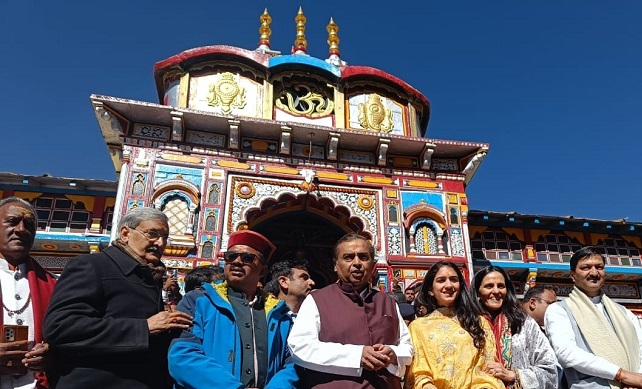
RIL chairman Mukesh Ambani visits Badrinath Dham with Radhika Merchant, donates Rs 5 cr

  • Reliance Industries (RIL) chairman Mukesh Ambani on Thursday reached the Badrinath Dham in Uttarakhand to offer prayers at the Badrinarayan Temple.
  • He was also accompanied his son Anant Ambani's fiance Radhika Merchant during the visit.
  • Badrinath Kedarnath Temple Committee (BKTC) vice president Kishore Pawar welcomed Ambani.
  • Ambani also donated an amount of Rs 5 crore to the Badrinath Kedarnath Temple Committee (BKTC). RIL chairman Mukesh Ambani visits Badrinath Dham with Radhika Merchant, donates Rs 5 cr

Wednesday, 6 September 2023

From the Easel: Artist Tara Sabharwal’s journey from inner focus to worldly reality

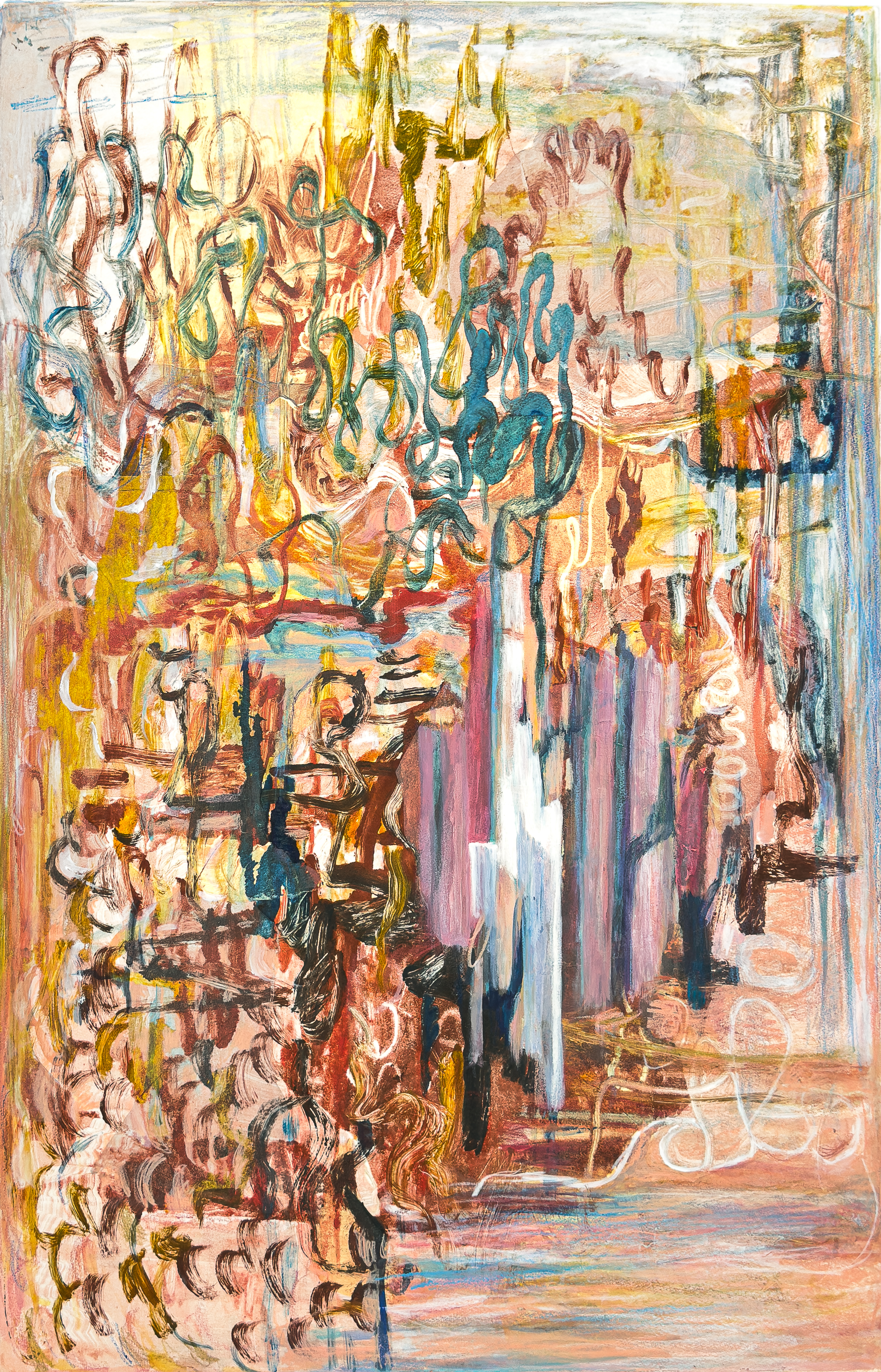
Tara Sabharwal’s etching ink watercolor and pastel on monoprinted paper. 2022. PHOTO: courtesy Tara Sabharwal, via Sandy Levine

In this edition of “From the Easel” we spoke with artist Ela Shah’s colleague Tara Sabharwal. Sabharwal’s early work reflected an inner focus on her dreams, and memories. For the past six years, she’s turned outwards, working with other artists to address the migration crisis and the rise of populism and xenophobia. Below are excerpts from her interview with writer Sandy Levine.

Sandy Levine: Could you tell us your backstory?

Tara Sabharwal: “I was born in New Delhi in 1957. I have a clear memory of drawing a glass of water one afternoon, when I was thirteen years old, and being transported into myself in an eternal moment of beauty. It was like waking up from a deep sleep. I knew instantly that painting was my path, and I have been on it since.”

SL: Did you study art academically?

TS: “My formal art education started in 1975 at MS University Baroda, an art institute that shaped the course of Indian art history, both modern and contemporary. While the curriculum was grounded in Indian art and philosophy, the teachers exposed us to international contemporary art practices.”

SL: Who and what were your major influences and why?

TS: “Nasreen Mohammedi, an influential teacher seeped in minimalism, Zen, and Sufi, became a close mentor and ally, and taught me at an impressionable age to look within myself. She insisted that I was already grounded in who I really am, it is just a matter of removing veils of illusion and ignorance. During these six years at Baroda, I battled blinding fogs of confusion. Drawing from life and nature, while digging into the dense psycho-spiritual forest within, I gradually built the foundation of my art practice…

“In 1982, I won a British Council grant to do my master’s degree in Painting at the Royal College of Art in London. I expanded in new directions… It was stimulating being out of India suddenly and to be looking at a range of original Western art for the first time…Using the language of Indian miniatures, I wove European influences into my work. I did not want to fuse the two, but rather, let them coexist to form a distinct identity.”

SL: Tell us about your early career—the difficulties, hurdles, and triumphs.

TS: “I returned to India in 1985 for three productive years…I made small watercolors on wasli (Indian miniature paper) with watercolor and pigment. Using emotive color and simple figures in an intimate space, I sought to explore regions of enchantment, reverie, alienation, and uncertainty…

“In 1990, I visited New York City. Several exciting opportunities opened, and I have been here since. I started working at the Robert Blackburn Printmaking Workshop where Bob became a friend and mentor. I continue to work there and have served on its board. Chester Herwitz, a collector of contemporary Indian art, purchased paintings, and financed my stay…These were vibrant years, enjoying the city’s rich cultural diversity and artist communities…The lithographs and paintings of this period, developed a raw spontaneity, embodying the fleeting emotions of uprootedness and transition in a charged city.”

SL: What have been the major influences or motivators in your work. How do you express those influences in your work?

TS: “I have an abiding interest in the unconscious, and in evoking a specific mood related to a place or event…In the 2000s I imagined a world under my skin: in a landscape of organs, cells, blood vessels, activity, and order. From these images of the body emerged an awareness of myself as a freer being yet trapped within the body. It led to a series about enclosures (home, body, vessel, bottle, womb) exploring our concurrent drive to be contained and to be free. I also made two portfolios, ‘Life Journeys’ and ‘Homes and Paths’ exploring homes left, lost, remembered, revisited, and continually reinvented. They narrate the story of my migration and a search for myself through it.

“From 2013 to 2017, my paintings began to move away from figuration, becoming larger, freer, and more painterly. I began them in the print shop, developing marks and movements on large paper and complete them in my home studio, gently layering collage, acrylic and watercolor washes. In a residency in Kassel, Germany, I printed some on canvas and experimented with developing them as oil paintings and I began working on large oil paintings.

“My work took a big turn in 2017 while I was in NY…What started as a meditation on my own displacement, morphed into a plea for the refugees fleeing war and poverty. In their journey, while so much harder and complex, I saw my triangulation between homes and cultures, and our essential human condition.”

SL: What has been your greatest career achievement…and your life’s greatest satisfaction?

TS: “Since 2017, my paintings, drawings and prints have been addressing the migration crisis and the rise of populism and xenophobia around me. Alongside, I have been curating shows with artists that I met in national and international residencies. With these diverse and inspiring artists, I was able to form ‘inBEtween,’ an ever-expanding group of 30-plus artists from the United States, South America, Germany and India, whose work addresses intersectionality, displacement, and immigration/migration. All the artists in the group create work about the ‘other’…

“In January 2020, I curated ‘YOU WILL KNOW ME, Migration Stories,’ at Art Alive gallery, New Delhi. The large multimedia show was accompanied by a seminar featuring Ashis Nandy, my collaborators at the Jawaharlal Nehru University, and prominent intellectuals, activists, and artists. At the time, India was ablaze with sectarian conflict…It was an inspiring moment of resistance and solidarity, and our show and seminar was timely.

“During the COVID years my work has taken on new directions. Eco feminism embraces this tyranny of patriarchy, capitalism, and colonialism and its exploitation of women, poor and marginalized communities, animals and the Earth and its resources. I am looking forward to my solo show in Dec. 2023 with Art Alive gallery at Bikaner house, New Delhi. This will be the biggest show of my life to date and will include work in a variety of media and styles from the last decade.”

SL: What advice would you give to young artists who want to pursue art—in all its iterations—as a career?TS: “Carry on. Follow only yourself and your true nature. Only you know where you are going and what choices you need to make. Live life to the fullest, be kind to yourself and others around you.” Source: https://www.newsindiatimes.com/

Sunday, 25 December 2022

How Santa Claus delivers toys around the world in just 1 night

Lord Jesus
   Blogspot
News Track India: Washington, (ANI): Scientists have explained how Santa Claus is able to deliver toys to good girls and boys around the world in one night. According to Larry Silverberg and his team at the Carolina State University, with his cherubic smile and twinkling eyes,Santa may appear to be merely a right jolly old elf, but he and his NPL staff have a lot going on under the funny-looking hats. Their advanced knowledge of electromagnetic waves, the space and time continuum, nanotechnology, genetic engineering and computer science easily trumps the know-how of contemporary scientists. "Children shouldn't put too much credence in the opinions of those who say it's not possible to deliver presents all over the world in one night," Silverberg said. Silverberg also said that Santa has a personal pipeline to children's thoughts, via a listening antenna that combines technologies currently used in cell phones and EKGs, which informs him that Mary in Miami hopes for a surfboard, while Michael from Minneapolis
   Image Link Photobucket
wants a snowboard. A sophisticated signal processing system filters the data, giving Santa clues on who wants what, where children live, and even who's been bad or good. Later, all this information will be processed in an onboard sleigh guidance system, which will provide Santa with the most efficient delivery route. However, he adds that letters to Santa via snail mail still get the job done. "While he takes advantage of emerging technologies, Santa is, in many ways, a traditionalist," he said. Silverberg is not so naive as to think that Santa and his reindeer can travel approximately 200 million square miles, making stops in some 80 million homes, in one night Instead, he posits that Santa uses his knowledge of the space/time continuum to form what he calls "relativity clouds." "Based on his advanced knowledge of the theory of relativity, Santa recognizes that time can be stretched like a rubber band, space can be squeezed like an orange and light can be bent. "Relativity clouds are controllable domains - rips in time - that allow him months to deliver presents while only a few minutes pass on Earth. The presents are truly delivered in a wink of an eye," Silverberg said.
   Image Link Photobucket
With a detailed route prepared and his list checked twice through the onboard computer on the technologically advanced sleigh, Santa is ready to deliver presents. His reindeer, genetically bred to fly, balance on rooftops and see well in the dark, don't actually pull a sleigh loaded down with toys. Instead, each house becomes Santa's workshop as he utilizes his "magic bag of toys", a nano-toymaker that is able to fabricate toys inside the children's homes. The presents are grown on the spot, as the nano-toymaker creates, atom by atom, toys out of snow and soot, much like DNA can command the growth of organic material like tissues and body parts. Therefore, there's really no need for Santa to enter the house via chimney, although Silverberg says he enjoys doing that every so often. Rather, the same relativity cloud that allows Santa to deliver presents in what seems like a wink of an eye is also used to "morph" Santa into people's homes. (ANI) Source: News Track India

Wednesday, 8 September 2021

Samvatsari - Micchami Dukkadam Jain Festival

Lord Mahavir

    Animation                    Movies                    Pratikraman
.Subscribe
.Subscribe
Music
.Subscribe
Vision
.Subscribe
Exclusive
.Subscribe.Subscribe.Subscribe.Subscribe
Donate
This is the last day of Paryushan of Jain devotees and is celebrated as Samvatsari. Paryushan starting from 12th day of Shravan Vad, and ending on 4th day of bright half of Bhadrapad month is considered the most important festival of Jains.These eight days of Paryushan are considered the most auspicious days. Jains begin their day with Pratikraman in early morning followed by various poojs and prayers. Pratikraman means turning back. It is a form of meditation called Samyika where one reflects his spiritual journey and renews his faith.On the day of Samvatsari annual Pratikraman ( literally introspection) is performed and all Jains seek forgiveness from all creatures of the world whom they may have harmed knowingly or unknowingly by uttering the words Micchâmi dukkaḍam. िम��छामी दुक्कादम, Source: 4gaam.comImage: photobucket.com

Saturday, 28 April 2018

China, Japan discuss cooperation in 1st cultural talks in 9 years

Senior officials have discussed cooperation at the 14th meeting of the China-Japan Intergovernmental Consultation Mechanism on Cultural Exchange on Monday.

It was the first meeting of the intergovernmental consultation mechanism after a nine-year hiatus.

Representatives of the related ministries and agencies and cultural institutions of the two countries held frank discussions on the current situation and problems of cultural exchanges and cooperation between China and Japan during the meeting.

The two sides fully affirmed the supporting functions of the intergovernmental consultation mechanism for promoting the development of bilateral cultural relationship and decided to hold the consultations alternately in the two countries on a regular basis.

They also decided to promote institutionalized people-to-people exchanges at various levels in the next 10 years, discuss setting up information sharing mechanism and platform and conduct extensive cultural industry cooperation and Olympic cultural cooperation.

The Chinese side also invited Japanese cultural institutions and enterprises to take part in international exhibitions in China, such as the first China International Import Expo to be held in Shaghai in November.

Xie Jinying, director general of the bureau for external cultural relations in China's Ministry of Culture and Tourism, and Manabu Miyagawa, the Japanese Foreign Ministry's director general for cultural affairs, co-hosted the meeting. Source: China.org.cn

Sunday, 27 December 2015

Merry (Western) Christmas from Siberia (where Santa is not always red!)

Best known across Russia is Grandfather Frost - or Ded Moroz - often carries a magical staff. Picture: Anna Permyakova
By The Siberian Times reporter, Seasonal greetings from the east of Russia where there are no less than seven different Father Christmas figures to bring joy to children in winter. All of them look old, with flowing white beards, and mostly have long histories, possibly reaching back to pagan times, but each is distinct, covering their own territory. Intriguingly, most are accompanied by glamorous snow maidens. Quite often at this time of year, some of these colourful Russian figures meet for friendly Santa summits, occasionally in a real ice cave hewn in permafrost, as our picture show. Their expressions maybe serious, and the cold daunting, but all of them aim to bring happiness and - more often than not - gifts to children who are well behaved. Best known across Russia is Grandfather Frost - or Ded Moroz - who often carries a magical staff and is frequently accompanied by his Snow Maiden - Snegurochka - assistant. He is the one who looks most like the Father Christmas so familiar to Western children, yet there are also key differences. 
Grandfather Frost dressed in red or blue is frequently accompanied by his Snow Maiden - Snegurochka. Pictures: AiF, MR7, Pikabu
For example, his busiest night is New Year's Eve with presents arriving at midnight as the clock strikes. He often visits excited children in their homes or at parties before New Year's Eve, and since the end of Soviet times, he also appears in some flats and houses to mark Orthodox Christmas Eve and Christmas Day on January 6 and 7. Usually he is dressed in red but he is sometimes seen in blue or very occasionally white. His traditional mode of transport is a sleigh pulled not by reindeer but white horses. Over the years, he has also resorted to the Metro, trams, helicopters and Ladas in extremis. Clambering down chimneys, though, is not for him. His appearance in blue is believed by some to be the work of Stalin, who deep in the Soviet era felt he needed the winter tradition of Santa - abandoned with the Bolshevik Revolution - but wanted to distinguish it from the bourgeois Western variant, who was unkindly branded 'an ally of the priest and the kulak'. 
Some of these colourful Russian figures meet for friendly Santa summits, occasionally in a real ice cave hewn in permafrost, as our picture show. Pictures: Planeta Yakutia, Satal Tour
Traditionally, in deep history Ded Moroz wandered around the forest, controlling the frost, bringing presents to the good, and punishments to the bad. Unlike Santa, Grandfather Frost gives his gifts openly when he arrives with a big sack of presents. Typically, children need to show him how good they are, often reciting a poem or singing a song before he hands over the gifts, assisted by Snegurochka.  He lives not at the North Pole but in the town of Veliky Ustyug, in northern Russia, well shy of the Arctic. It is here the Russian Post Office delivers his mail, but with this being such a large country, he has regional residences, for example at Royev Ruchey Zoo in Krasnoyarsk, Siberia. Grandfather Frost's birthday is November 18, the coldest day ever recorded in Veliky Ustyug. The glamorous Snogruchka was originally a character from ancient fairy tales who became part of the Christmas ritual in the late nineteenth century. She remained when Stalin permitted Grandfather Frost to return two decades after the Russian Revolution. 
Magnificent blue-coated Chyskhaan, aka the King of the Cold and his Sow Maiden Khaarchana. Pictures: strana.ru, Victor Li-Fu
Children in Russia's largest region, the vast Sakha Republic in Siberia, are also familiar with the magnificent blue-coated Chyskhaan, aka the King of the Cold. Every year, in late September and early October, he makes his way south from the Arctic Ocean to the diamond region of Sakha, also known Yakutia. 'And with his every step comes cold,' tells native Yakutian, Olga Stepanova. The region can sink below minus 60C. At an annual conclave with Grandfather Frost, he hands over the cold each winter. He has two horns, by legend one from a bull, the other from a woolly mammoth.  'Then at the end January his first horn falls off, and in middle February his second horn,' she explained. As the snow melts, he floats back to the Arctic in the Lena River before the ritual is repeated the following winter. Yet another Santa-like figure is also seen in this region, the coldest in Russia. This is Ekhe Dyyl, who shares a granddaughter Khaarchana with Chyskhaan. She likes to play with children but can only do so around New Year - the time when presents are exchanged. At other periods, she wears a hat that makes her invisible. The bearded Ekhe Dyyl rides a bull, and carries a sack of presents, while Khaarchana goes around on a reindeer called Buur. 
Sagaan Ubugul or White Elder who has a white beard, and carries a stick with a dragon's head. Pictures: The Siberian Times
Another of the Siberian 'Santa's' is Sagaan Ubugul or White Elder who is seen in the Buddhist republic of Buryatia. He has a white beard, and carries a stick with a dragon's head. His duties fall later than the others since the New Year is celebrated according to the lunar calendar in late January or early February. He invites children and adults to Lake Baikal - the oldest lake in the world - and the gifts he bestows are health, love, family and wealth to the deserving. To children he gives candles and sweets. In the southern Siberian republic of Tyva is a Santa who - like our own - is able to fly over the rooftops. There is no sleigh nor any reindeer but Sook Irey flies to houses and yurts bringing gifts to children at New Year.
Sook Irey from Tuva can be accompanied by Tugeni Eneken - Mother Winter from Evenkia. Pictures: Sergey Tarasenko
'His body, arms, legs consist of ice,' according to one description. 'He looks cold and tired. His hair, eyebrows, and beard covered with white frost like all the trees and bushes. His clothes are white, blue, reminiscent of the ice.' His head wear has 'solar and lunar colours' and signs indicating his extraterrestrial origins.' Yet while he looks old and worn, he can turn into a young man or beautiful girl, as the mood takes him. 'But he can not warm anyone. He can only freeze,' according to the Tyva Legend of Creation. He can be accompanied by Tugeni Eneken - Mother Winter from Evenkia.
Kysh Babayi from Tatarstan is often accompanied by Kar Kyzy - his Snow Maiden. Picture: Kysh Babayi residence
On the Western fringes of Siberia, in the largely Muslim regions of Tatarstan and Bashkiriya, is the preserve of the magical figure of Kysh Babayi, dressed in blue and seen by some as a brother to Ded Moroz. He is accompanied by Kar Kyzy - his Snow Maiden - but also by a veritable collection of others, notably golden haired Altynchech - a female warrior; Takhir and Zukhra, described as a Tatar Romeo and Juliet; Ubyrly Karchyk, an old and scary woman; Shurale, a spirit from the forest; Shaytan, the embodiment of evil; Azhdakha, a flying dragon; and Batyr, a strong man. Like Ded Moroz, he distributes presents as the New Year dawns.
Yamal Iri presents gifts to childre, spreads positive energy and brings midwinter happiness. Pictures: yamaliri.ru
While most owe their origins to old traditions, Yamal Iri - who rides a sleigh pulled by reindeer and dresses in blue - is a much newer creation. He started presiding over Christmas in the gas-rich Yamalo-Nenets Autonomous region of northern Siberia as recently as 2007. His character is, though, based on old legends and he arrives with a drum made from reindeer skin to drive away evil spirits. As well as presenting gifts to children, he spreads positive energy and brings midwinter happiness. He lives in the Arctic, at Gornoknyazevsk village, some nine miles from the city of Salekhard, on the bank of the Ob River. His traditional costume and boots are made from reindeer skins and his belt decorated with bones from woolly mammoths. Merry (Western) Christmas from Siberia (where Santa is not always red!)

Wednesday, 11 November 2015

Diwali :'The Festival of Light'


    Game                 Animation               Episodes
.Subscribe   .Subscribe  .Subscribe
Songs                      News                     Serials
.Subscribe .Subscribe.Subscribe
     Videos                      Web                      Movie   
All of us are all set to celebrate the festival of light. Not only children or youth become crazy for Diwali, even old people and partnts are also celebrate the Diwali with the children that make us happy and provide us a good time to enjoy before the advent of winter. Why we celebrate Diwali: But do you know why we celebrate Diwali? In fact, Diwali is not just the festive mood. There are various reasons behind the celebration known as theFestival of Light and victory of Light over darkness. There is a belief that the Goddess of wealth, Lakshmi incarnated on the new moon day (amaavasyaa) of the Kartik month during the churning of the ocean (samudra-manthan). It is the same day when the Diwali is being celebrated and since then we celebrate the festival. There is another myth which says that it was 'Kartik Amavashya' when the Pandavas appeared from their 12 years of banishment as a result of their defeat in the hands of the Kauravas at the game of dice (gambling). The episode is very important in the Mahabharat and one who love Pandavas, celebrate the occasion known as Diwali. The main and major thought behind the reason to celebrate Diwali is the belief that it was the new moon day of Kartik when Lord Ram, mother Sita and Lakshman returned to Ayodhya after vanquishing Ravana and conquering Lanka. As Ramayan tells, it was the occasion when they returned to Ayodhya and people of Ayodhya celebrated the occasion as Diwali. Source: ArticlePM Modi receives Diwali greeting from Obama: New Delhi, Nov 11 (ANI):
Extending his wishes on the festival of Diwali, US President Barack Obama called up Prime Minister Narendra Modi last night and reviewed joint efforts on key areas of bilateral cooperation. The US President during the telephonic conversation also previewed global issues ahead of the upcoming G-20 Summit, East Asia Summit and Paris Climate Conference.  "A short while ago @POTUS called. We exchanged Diwali greetings. This was our first conversation through the newly established hotline," tweeted Prime Minister Modi. Prime Minister Modi further said that he looked forward
to meeting the US President during the G20 Summit in Turkey. "President Obama and I discussed a wide range of other issues as well. It was good knowing how @WhiteHouse is marking Diwali," he said in another tweet. Aishwaraya to celebrate Diwali with family in Mumbai: Mumbai: Aishwarya Rai Bachchan who is currently busy shooting for Karan Johar’s ‘Ae Dil Hai Mushkil’ in London, is pulling out all stops to celebrate Diwali with the entire Bachchan and Rai family. The star has reportedly taken time off to celebrate the festival at home in Mumbai. November is a month of celebrations in the Bachchan household. The first family of Bollywood not only have grand Diwali celebrations to look forward to but also granddaughter Aaradhya’s birthday on November 16. “You’re forgetting
The actress insists that the family has to be together for the festival
my father’s birthday (Nov 20). We celebrate the entire month”, she laughs. While she was in London shooting for ‘ADHM’ on her birthday, it was still a family celebration with Aaradhya, Abhishek and her mother accompanying her to the shoot. “It was a warm wonderful birthday. My husband and my producer Karan made sure of that,” Ash said in the interview. Talking about her plans for the festive season, the star said, “Diwali has to be at home, no matter what. The family has to be together for that occasion. Or at least, we try to be. But all of us have our own crazy schedules. Sometimes it becomes impossible to fulfil family obligations. But we try our best.” Aishwarya and Aaradhya will return home next week Source: Article,