bloggggg

Home  |  Live  |  Science  |  Lifestyle  |  Entertainment  |  Broadcast  |  Games  |  eBooks  |  Astounds  |  Adbite  |  Cricbell  |  Cyber  |  Idea  |  Digital  |  Privacy  |  Publish  |  ePaper  |  Contact  .Subscribe.Subscribe.Subscribe.Subscribe.Subscribe.Subscribe.Subscribe.Subscribe.Subscribe
Subscribe

Friday, 21 November 2025

57% of young Australians say their education prepared them for the future. Others are not so sure

Lucas Walsh, Monash University

When we talk about whether the education system is working we often look at results and obvious outcomes. What marks do students get? Are they working and studying after school? Perhaps we look at whether core subjects like maths, English and science are being taught the “right” way.

But we rarely ask young people themselves about their experiences. In our new survey launched on Tuesday, we spoke to young Australians between 18 and 24 about school and university. They told us they value their education, but many felt it does not equip them with the skills, experiences and support they need for future life.

Our research

In the Australian Youth Barometer, we survey young Australians each year. In the latest report, we surveyed a nationally representative group of 527 young people, aged 18 to 24. We also did interviews with 30 young people.

We asked them about their views on the environment, health, technology and the economy. In this article, we discuss their views on their education.

‘They don’t teach you the realities’

In our survey, 57% of respondents agreed or strongly agreed their education had prepared them for their future. This means about two fifths (43%) didn’t agree or were uncertain.

Many said school made them “book smart” but didn’t teach essential life skills such as budgeting, taxes, cooking, renting or workplace readiness. As one 23-year-old from Queensland told us:

They don’t teach you the realities of life and being an adult.

This may explain why 61% of young Australians in our study had taken some form of online informal classes, such as a YouTube tutorial. Young people are looking to informal learning for acquiring practical skills such as cooking, household repairs, managing finances, driving and applying for jobs.

Some interviewees discussed how informal learning – outside of formal education places – was a key site for personal development. One interviewee (21) from Western Australia explained how they had learned how to fix computer problems online: “I’ve learnt a great deal from YouTube”. Others talked about turning to Google, TikTok and, more recently, ChatGPT.

A key question here is the reliability of these sources. This is why students need critical thinking and online literacy skills so they can evaluate what they find online.

‘This is so much money’

Young people in our survey echoed wider community concerns about the rising costs of a university education. As one South Australian man (23) told us:

I was looking at the HECS that came along with [certain courses] and I was like, this is crazy, this is so much money.

One woman (19) explained how the fees had been part of the reason why she didn’t want to go to uni.

Truthfully there was nothing at uni that interested me, any careers that it would be leading me to […] also because university is so expensive, I wouldn’t want to get myself in a HECS debt for the rest of my life.

‘Why don’t I know anyone?’

For those who did go to uni, young people spoke about how they were missing out on the social side of education – partly due to COVID lockdowns, the broader move to hybrid/online learning and changes in campus experiences. As one Queensland 19-year-old told us:

For the past year and a half I kind of just went to class and then went home again and I was like, ‘Why don’t I know anyone? Why do I have no friends?’

While some students reported online study saved time, others told us they found it impersonal and disengaging. As one Victorian (23) told us:

It’s more like I’m learning from my laptop, not by a university I’m paying thousands of dollars to.

Another 23-year-old from NSW said students would complain but learn more if they had face-to-face classes:

[online is] more flexible but it means it’s harder to turn off and on […] more traditional university would be nice.

Some young people are worried

One of the key roles of education is to provide pathways to desirable futures. But 40% of young people told us they were worried about their ability to cope with everyday tasks in the future. Almost 80% told us they thought they would be financially worse off than their parents, up from 53% in 2022.

Education alone can’t address all the challenges facing young people, but we can address some key immediate issues. Our findings suggest young people believe education in Australia needs to be more affordable, practical, social and engaging. To do this we need:

  • more personalised career counselling and up-to-date labour market information for school leavers and university graduates – so young people have clearer ideas about what study or training can lead to particular jobs and careers

  • better ways of ensuring online learning enables connections and interactions between students and students and teachers – so learning is not as impersonal and there are more opportunities to learn in person or deliberately social online ways

  • more investment in campus clubs, student wellbeing programs and peer support so young people have more opportunities to make friends and build networks.The Conversation

Lucas Walsh, Professor of Education Policy and Practice, Youth Studies, Monash University

This article is republished from The Conversation under a Creative Commons license. Read the original article.

Thursday, 13 November 2025

How to empower teachers and help students prepare for a sustainable future


Education about climate change and sustainability is a vital part of responding to a rapidly changing world, including the negative effects of climate change, biodiversity loss and pollution.

Teachers, including in Brazil and England, help young people live with futures shaped by local and global environmental challenges. However, despite expressing overwhelming concern about issues related to climate change and sustainability, many teachers do not feel equipped to teach it in schools.

Urgent action from policymakers is needed to support them.

Teachers shape how young people understand and respond to environmental crises. Without proper support, students risk leaving school unprepared for some of the most urgent challenges of our time: this is a societal risk, not just an educational issue.

Despite public demand for action in response to climate change, schools often lack the expertise and resources to realise this. Empowering teachers means building stronger communities: when well-equipped teachers foster agency and action, not just knowledge and skills.

Young people can bring ideas home, influence families and drive local change. So climate change and sustainability education becomes a catalyst for resilience and transformation, essential for preparing the next generation to thrive in a rapidly changing world.

Leaders from across the world are coming together in Brazil to discuss progress and negotiate actions in response to climate change as part of an annual UN climate summit (Cop30). This provides a vital opportunity to underline for global leaders the support that teachers and schools need.

Over the last few years, we have worked with hundreds of teachers in both England and Brazil to explore their experiences of teaching climate change and sustainability. Teachers have shared with us the barriers they experience related to climate change and sustainability education and the support they need to overcome them. While there is diversity in terms of geographical context, there are many commonalities.

Barriers

Education systems which have a rigid national curriculum with an emphasis on high-stakes examinations create barriers for teachers in both England and Brazil. Existing systems require teachers to prioritise examination content which frequently has limited focus on climate change and sustainability topics.

Teachers in both countries reported challenges in teaching climate change and sustainability in ways that underlined the real-world relevance to the lives of the young people they teach.

Another limitation is the lack of opportunities for professional learning that support teachers in integrating climate change and sustainability into their teaching. This gap exists throughout their careers, such that they frequently share they have insufficient or insecure knowledge and understanding of climate change and sustainability issues. This lowers teachers’ confidence and limits their classroom practices.

Boosts

Governments can better support teachers by ensuring that climate change and sustainability is explicitly recognised and valued in local, regional and national policies that govern schools. This could include national curricula, professional standards for teachers and school leaders and school-inspection frameworks.

Teachers in both England and Brazil recognise how important it is to have school leaders who value climate change and sustainability and how – when school leaders provide a culture of support across the school community – this is transformational for climate change and sustainability education.

All teachers can benefit from high-quality professional learning focused on climate change and sustainability education from the beginning of their careers and throughout their professional lives. When teachers have the time and support to co-design learning – with each other and with their students – which draws on different ways of understanding climate change and sustainability issues, this builds teacher confidence and provides richer learning experiences for children and young people.

Climate change and sustainability education is essential for preparing young people to navigate and shape a rapidly changing world, but teachers cannot carry this responsibility alone.

By embedding climate change and sustainability in curricula and supporting career-long professional learning for teachers, classrooms can be transformed into sites of agency and local action. This can amplify young people’s influence in their communities and reduce a wider societal risk of leaving a generation unprepared.

Cop30 offers a timely moment for leaders to commit to support for teachers so that policy matches public concern and evidence-based practice translates into real-world resilience.


Don’t have time to read about climate change as much as you’d like?
Get a weekly roundup in your inbox instead. Every Wednesday, The Conversation’s environment editor writes Imagine, a short email that goes a little deeper into just one climate issue. Join the 47,000+ readers who’ve subscribed so far.The Conversation


Nicola Walshe, Professor of Education, UCL; Denise Quiroz Martinez, Lecturer in Education at the Faculty of Social Sciences, University of Stirling, and Luciano Fernandes Silva, Professor, Institute of Chemistry and Physics

This article is republished from The Conversation under a Creative Commons license. Read the original article.

Sunday, 19 October 2025

From Classroom to Commerce: Growing My Father’s Business with University Insights

Image source - AI generated

Manshika Jain

The first time I saw a customer leave my father’s store empty-handed, it hit me hard. Even though I was just a kid back then, I was mature enough to understand that it wasn’t just a lost sale; it was the feeling that we weren’t doing enough, that we were somehow falling short despite our best efforts.

Our garment showroom in Rupnagar, a town in Punjab, is nestled in a busy market, surrounded by competition and an ever-evolving customer base. There were days when the sales felt like a rollercoaster—some good, some not so much—and I couldn’t help but wonder: what made people leave without buying anything?

Growing up watching my father struggle with the ups and downs of the business, I always saw him as a hard-working man, deeply committed to keeping the family business afloat. But I never truly understood the complexities of it until I started my journey at university. Here, I began connecting the dots and realised that there wasn’t just one factor influencing a business’s success. It wasn’t as simple as the price of the product or the quality alone.

The challenges we faced at my father’s showroom were far more complex than I had initially thought. Suppose you walk into a store and see a beautiful dress you love, but realise it’s priced just a little beyond what you’re willing—or able—to spend. It’s not that you didn’t like the dress; it’s just that, in that moment, it didn’t feel justifiable.

Maybe the same thing was happening in our showroom too. Maybe our prices were fair, but the customer’s income, their current priorities, or even their mood made the purchase feel out of reach. Or perhaps it wasn’t about the product or pricing at all—it could have been the attitude of our employees. If they weren’t fully committed, it would show, and stock isn’t going to sell itself right.

And even if we managed to address all these factors, there was still the looming challenge of online shopping. The ease and convenience of shopping online had started taking customers away from our store. We were caught in a whirlwind of issues, and at the time, I didn’t know how to tackle them all. But what I realised through my studies was that no single factor existed in isolation. The challenges we faced were interconnected, and to solve them, we needed to address each one thoughtfully and systematically.

The knowledge I gained at university set me on a transformative journey in how I viewed the challenges at the showroom. I didn’t just look at problems as roadblocks anymore; I began to see them as opportunities—opportunities to rethink strategies, to innovate, and most importantly, to act.

What earlier felt like an endless maze of problems now seemed surprisingly solvable once I started applying the insights I had picked up at university.

For instance, the drop in sales during seasonal dips used to feel inevitable, something we just had to accept. But after learning about Ryanair’s pricing model, I realised we didn’t have to sit back—we could attract more customers by offering bigger discounts on certain products while maintaining margins on others.

I suggested we try something similar at the showroom. Although my father was a little hesitant at first—after all, I was still a student, and he had years of real-world experience—I managed to convince him after many conversations and by sharing real-world examples.

At first, he smiled politely but brushed it off. It took a lot of discussions before he finally agreed to experiment with my ideas. When we implemented these changes, there were noticeable results.

Similarly, by paying closer attention to patterns, I noticed that most of our sales happened right after salary days. It hit me that we had been missing an opportunity all along—we needed to prepare our best stock early and roll out special deals during that window, instead of letting it pass quietly. Again, small adjustments made a visible difference.

When it came to managing our sales staff, what once felt like an unfixable human problem became clearer too. Having seen during college projects how people's efforts shifted when rewards were tied to performance, I realised we could motivate our employees better.

We started experimenting with performance-linked incentives, and slowly, there was a visible boost in energy and ownership on the floor.

As for competing with online shopping, I stopped seeing it as a battle we were destined to lose. Instead, I began to see our advantage—real trust, genuine conversations, and personal connection—things no flashy online discount could replicate. Sometimes, the answer wasn’t to shout louder but to connect deeper, and that became a principle I kept close to my heart as we moved forward.

Reflecting on this journey, I realise how my education didn’t just teach me theories or frameworks—it transformed how I thought. It shifted my mindset from a place of helplessness to one of empowerment. I stopped viewing challenges as insurmountable obstacles and started seeing them as opportunities to improve and grow.

This change in perspective that led to me helping my father has been my biggest achievement. Not only did it help our business move from merely surviving to truly thriving, but it also changed me as a person. I now approach problems with a mindset of innovation and growth, knowing that every challenge can be turned into an opportunity for success.
Education gave me the tools to look at problems from different angles, to question the status quo, and to act.

And it’s not just about our family business—it’s a lesson for any small business out there, whether it’s struggling or well-established. With the right mindset, any business can thrive. The power of knowledge doesn’t just lie in understanding concepts—it lies in how you apply them, how you adapt, and how you turn every setback into a stepping stone.

With the growing use of educational tools and fresh ways of thinking, many small businesses can find new paths to grow and succeed. And it’s the young minds of today, like mine, who will shape a future where innovation, resilience, and knowledge drive not just individual success, but the success of entire communities.

Manshika Jain, a first-year student at Plaksha University from Ropar with a commerce background, is aspiring to pursue a major in Data Science, Economics, and Business (DSEB) as part of the B.Tech program at Plaksha University, Mohali. She has a passion for reasoning through real-world situations and connecting them to economics and business concepts. From Classroom to Commerce: Growing My Father’s Business with University Insights | MorungExpress | morungexpress.com

Saturday, 18 October 2025

Are business schools priming students for a world that no longer exists?

Carla Liuzzo, Queensland University of Technology and Mimi Tsai, Queensland University of Technology

Endless economic expansion isn’t sustainable. Scientists are telling us our planet is already beyond its limits, with the risks to communities and the economy made clear in the federal government’s recent climate risk assessment.

Sustainability is a hot topic in Australian business schools. However, teaching about the possible need to limit economic growth – whether directly or indirectly related to sustainability – is uncommon.

Typically, business school teaching is based on concepts of sustainable development and “green growth”. Under these scenarios, we can continue to grow gross domestic product (GDP) globally without continuing to grow emissions – what is known as “decoupling”. It’s a “have your cake and eat it too” promise for sustainability.

Our new research published in the journal Futures shows business students themselves are interested in learning the skills they would need under an alternative post-growth future.

Emerging alternatives to ‘growth is good’

There is mounting evidence of the difficulty of “decoupling” economic growth from emissions growth. The United Nations goals of sustainable development are “in peril”.

This has led to increased interest in no-growth or post-growth economic models and to the movement towards degrowth. Degrowth means shrinking economic production to use less of the world’s resources and avoid climate crisis.

Explicit teaching of degrowth rejects the belief in endless growth. This presents a challenge to traditional concepts in business education, including profit maximisation, competition and the notion of “free markets”.

The issue, and one that degrowth invites students to consider, is that green growth and sustainable development are underpinned by the need for continued economic growth and development. This “growth obsession” is pushing the planet and society to its limits.

Students are keen

Our new study provides a snapshot of students’ interest in alternative systems. It reveals 90% of respondents are open to learning about different economic models.

The study found 96% of students believe business leaders must understand alternative models to continued economic growth. Yet only 15% were aware of any alternatives that may exist. Most (71%) believed viable alternatives exist, but they admitted to lacking sufficient knowledge.

The study had 61 participants currently studying a masters of business administration (MBA) in a top Australian institution.

The research raises the question: if future business leaders are not made aware of alternatives, won’t they continue to assume growth is “inherently good”, and perpetuate the business practices that have pushed humanity beyond planetary boundaries?

The trouble with endless growth

Advocates of the “beyond growth” agenda argue endless growth is not possible. They promote alternate measures of progress to GDP, such as the recent Measuring What Matters report.

Degrowth proposes scaling back the consumption of resources as part of a transition to post-growth economies. Their aim is what economist Tim Jackson calls prosperity without growth. This entails businesses sharing value with communities, and reducing production of things like fast fashion, fast food and fast tech.

It is a rejection of maximising profit in favour of maximising value, based around meeting real needs like housing, food and essential services. Some industries would grow, such as care, education, public transport and renewables. Others may shrink or vanish.

Degrowth and post-growth aren’t alien concepts. There are grassroots movements such as minimalism. Social media abounds with lists of “things I no longer buy”, social enterprises, the right-to-repair movement and community-supported agriculture.

Degrowth also invites students to debate concepts like modern monetary theory, income ratio limits and universal basic income.

The role of business schools

Business schools are doing great work teaching students about changing consumer preferences for green alternatives, new global standards for reporting environmental and social impact, and ways businesses can reduce their environmental impact.

The Australian Business Deans Council in March this year detailed these efforts in its Climate Capabilities Report. This highlighted the need for business schools to produce graduates capable of “balancing business and climate knowledge”.

Our study of Australian business school students shows they are open to learning about degrowth. It challenges the assumption that ideas critical of endless growth would be unwelcome in business schools in Australia.

There is an argument for making explicit degrowth teaching in business schools more accessible because business schools have been criticised for not doing enough to address climate change and social inequality.

Globally, degrowth is starting to be taught explicitly in business schools in Europe, the UK and even the US.

Business schools have long been criticised for a culture of greed and cutthroat competition. As one distinguished professor from the University of Michigan recently put it, “today’s business schools were designed for a world that no longer exists”.

The introduction of no growth or degrowth scenarios to business schools in Australia may go some way to ensuring they are preparing leaders for the future – not priming students for a world that no longer exists.The Conversation

Carla Liuzzo, Lecturer, Graduate School of Business, Queensland University of Technology and Mimi Tsai, Lecturer, Queensland University of Technology

This article is republished from The Conversation under a Creative Commons license. Read the original article.

Tuesday, 23 September 2025

School Invests $150,000 to Help Low Income Parents, Buying New Uniforms and Laptops for Every Student

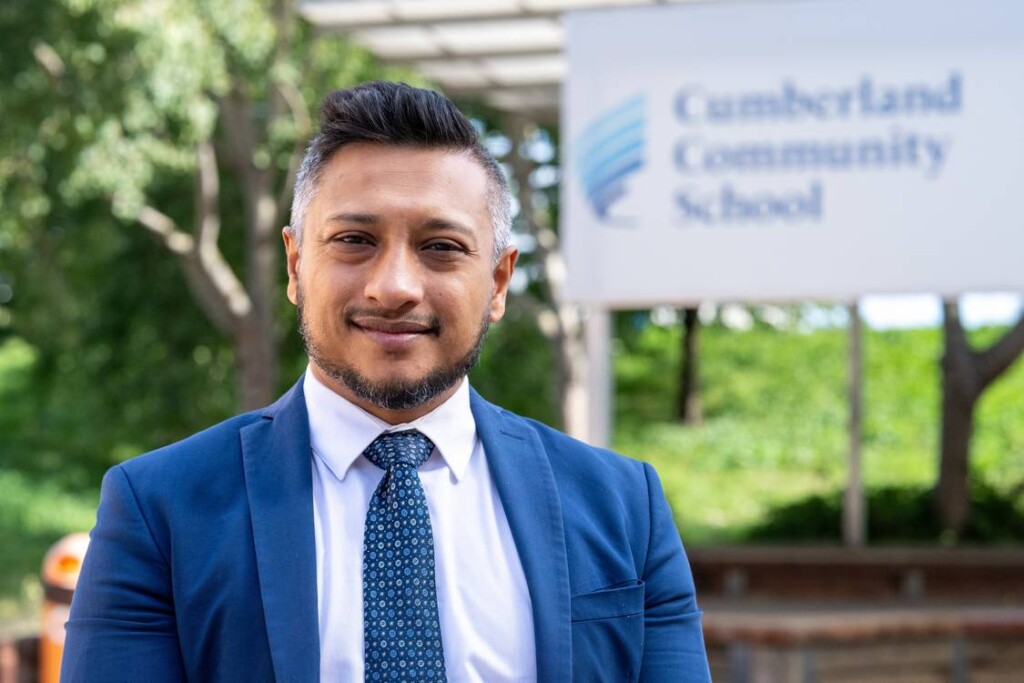
Students in Cumberland Community School – credit, Tony Kershaw / SWNS

An English school has forked over $150,000 to buy all 270 incoming students a new blazer, tie, and laptop.

Located in one of the poorest parts of London, the aid comes off the back of sustained improvements in grades and higher education attainments at the school, proving that investing in students’ futures pays off.

The headteacher of Cumberland Community School in the London borough of Newham believes the uniforms help children feel “pride” in the institution, while removing fashion-focused distractions.

According to the Children’s Society, English parents spend on average £422, about $575 a year, on school supplies. Cumberland, however, serves one of the lowest income areas of London.

“For many families at our school the cost of uniform and computer equipment is an expense they can’t afford,” said the Headteacher, Ekhlas Rahman, according to Southwest News Service.

“I have had parents in my office telling me they just can’t afford certain items. As a school we felt like we had to act. We don’t want circumstance to be prohibitive to a good education, so we decided to foot the bill for the most expensive items.”

Head Teacher Ekhlas Rahman – credit, Tony Kershaw / SWNS

Under changes to the UK’s Education Act passed last year, schools in England are meant to be helping cut costs for parents. This could be by promoting cheaper second-hand uniform options, by removing unnecessary branded items from their uniform lists, or allowing generic substitutes.

Explaining his decision to stick with the uniforms even though families could rarely afford them, Rahman said “it gives a sense of pride to the school and the students.”

“By wearing the same outfit, students can focus more on their education and less on social pressures related to fashion.”

When he first took over, he reviewed the cost of the uniform and found it prohibitive, so in observance of the changes to the Education Act, Cumberland did away with the requirements on branded items.

Additionally, for the 270 new students entering the 7th grade this scholastic year, their families were provided with a voucher for £400 ($460) for the purpose of buying uniforms and equipment.

“These are small things, but they do add up,” Rahman said. “We know families are struggling now and we want to do everything we can to help out. We are a school committed to investing in our students, so their ambitions and dreams can become a reality.”

Cumberland Community School has been ranked as the most improved in the country over a five-year period.Grades are up for 70% of all students, and many of the 15 and 16-year-olds were also awarded scholarships facilitated through the school’s Prestigious Colleges Program. School Invests $150,000 to Help Low Income Parents, Buying New Uniforms and Laptops for Every Student

Thursday, 7 August 2025

New 3D-Printed Titanium Alloy is Stronger Than the Standard – Yet 30% Cheaper

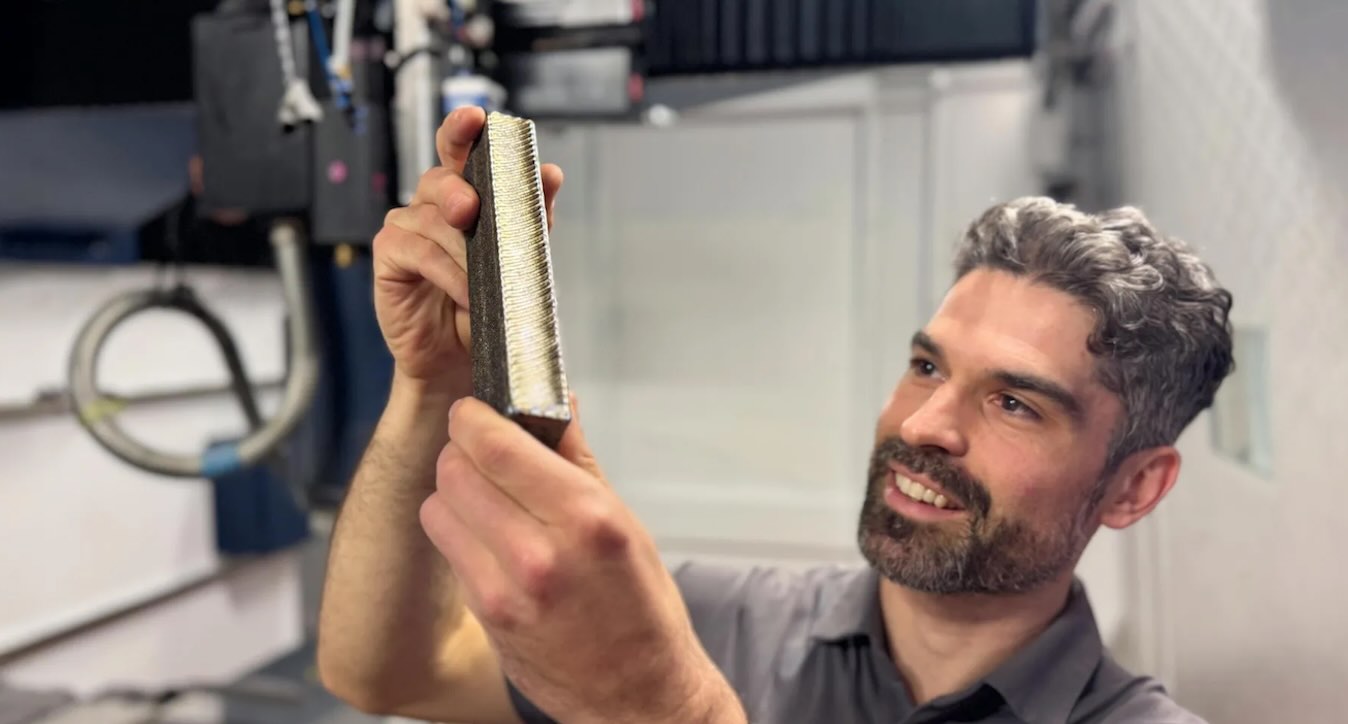
Ryan Brooke inspects a sample of the new titanium – Photo by Michael Quin (RMIT University)

Engineers from an Australian University have produced a new type of 3D-printed titanium that’s about a third cheaper than commonly used titanium alloys.

A team of engineers at the Royal Melbourne Institute of Technology (RMIT) developed the groundbreaking alloy by replacing expensive vanadium with more accessible elements. By rethinking how titanium alloys are designed, the team created a material with improved performance and more uniform microstructure—key factors for aerospace and medical applications.

The team has filed a provisional patent on their innovative approach, which has also been outlined in a paper published in Nature Communications.

The study’s lead author Ryan Brooke, working at the university’s Centre for Additive Manufacturing, will investigate the next steps of commercializing the technology, saying the field of 3D-printed titanium alloys was ripe for innovations.

“3D printing allows faster, less wasteful and more tailorable production yet we’re still relying on legacy alloys (like Ti-6Al-4V) that doesn’t allow full capitalization of this potential. It’s like we’ve created an airplane and are still just driving it around the streets,” he said in a university press release.

“New types of titanium and other alloys will allow us to really push the boundaries of what’s possible with 3D printing and the framework for designing new alloys outlined in our study is a significant step in that direction.”

Besides being nearly 30% cheaper to manufacture, the latest study outlines a time- and cost-saving method to select elements for alloying, providing a clearer path for predicting the grain structure so the metal can print more evenly, avoiding the column-shaped microstructures that lead to uneven mechanical properties in some 3D printed alloys.

Photo credit: RMIT

“By developing a more cost-effective formula that avoids this columnar microstructure, we have solved two key challenges preventing widespread adoption of 3D printing,” said Brooke, a PhD candidate.

He recently talked to aerospace, automotive, and MedTech industry representatives about their needs.

“What I heard loud and clear from end users was that to bring new alloys to market, the benefits have to not just be minor incremental steps but a full leap forward.

“That’s what we have achieved here,” he said.

“We have been able to not only produce titanium alloys with a uniform grain structure, but with reduced costs, while also making it stronger and more ductile.”[Source: RMIT University] New 3D-Printed Titanium Alloy is Stronger Than the Standard – Yet 30% Cheaper

Wednesday, 16 July 2025

IIT Delhi launches new online executive programme for AI in Healthcare


New Delhi, (IANS): In a bid to empower healthcare professionals and technologists with artificial intelligence (AI)-based skills and to revolutionise patient care in the country, the Indian Institute of Technology Delhi (IIT Delhi) has launched a new online programme -- Executive Programme for AI in Healthcare, the institute said on Monday.

The 24-week course is designed for clinicians, engineers, data professionals, and med-tech entrepreneurs, under the institute's Continuing Education Programme (CEP). It will equip participants with future-ready skills to drive innovation in patient care, diagnostics, public health, and hospital operations.

“At IIT Delhi’s CEP, our mission is to build next-gen capabilities that respond to India’s and the world’s evolving healthcare needs. AI is no longer optional -- it’s central to modern medicine. This new programme empowers professionals to lead that transformation,” said Professor Manav Bhatnagar, Head of CEP at IIT Delhi.

The online programme offers a strong academic and practical foundation in AI for healthcare. Participants gain hands-on experience with clinical datasets, explore hospital data systems, and learn to build AI models for diagnosis, risk scoring, imaging, and predictive analytics.

Starting with core AI and machine learning principles -- accessible to those without technical backgrounds -- it progresses to advanced topics like natural language processing on Electronic Health Records (EHRs), deep learning for medical imaging, healthcare automation, the Internet of Things (IoT) monitoring, and public health analytics.

The participants will also develop AI-powered dashboards and decision-support tools, culminating in a capstone project mentored by IIT Delhi faculty.

The launch comes at a pivotal time. The World Economic Forum projects AI could add over $150 billion annually to healthcare through improved outcomes and efficiency. In India, NITI Aayog and EY forecast the digital healthcare market, driven by AI diagnostics and remote care, to exceed $37 billion by 2030.

The course will be delivered via live, interactive online sessions on weekends, ensuring flexibility for working professionals.

Participants will engage with industry experts, med-tech founders, and hospital CIOs in dedicated sessions that focus on real-world deployment strategies and innovation trends.

To ensure a seamless learning experience, IIT Delhi has also partnered with TeamLease EdTech as its technology and student success partner.“Our collaboration with IIT Delhi brings a powerful AI curriculum to those at the heart of healthcare innovation. This programme will prepare professionals to bridge the gap between clinical knowledge and data intelligence, creating solutions that impact lives,” said Shantanu Rooj, Founder and CEO of TeamLease EdTech. IIT Delhi launches new online executive programme for AI in Healthcare | MorungExpress | morungexpress.com

Monday, 30 June 2025

Tripura declared India’s 3rd fully literate state after Mizoram, Goa

IANS (Photo source: Tripura CM's Facebook)

Agartala, (IANS) In a significant development, Tripura was on Monday declared fully literate, with the state's literacy rate rising to 95.6 per cent.

Addressing a function here, Director (Adult Education), Union Ministry of Education Preeti Meena said that after Mizoram and Goa, Tripura became the third in India to attain the distinction of being a fully literate state.

She said that UNESCO has defined that states which cross the 95 per cent literacy rate, would be declared as fully literate.

“According to the Periodic Labour Force Survey (PLFS) report published for the financial year 2023–24, Tripura’s literacy rate stood at 93.7 per cent. According to a previous survey, the state's non-literate population was 23,184. By successfully implementing the ‘ULLAS (Understanding Lifelong Learning for All in Society) – New India Literacy Programme', Tripura’s literacy rate has now increased to 95.6 per cent,” Meena said.

She said that as per the Sustainable Development Goals (SDGs), by 2030, India aims to be a fully literate nation.

Meena asked the neo-literates to continue their learning so that in the 2027 Census, Tripura would be recorded as a fully-literate state.

The Government of India had earlier launched the Centrally Sponsored Scheme 'ULLAS' for 2022-2027 to cover all aspects of 'Education For All' (erstwhile termed as Adult Education) to align with National Education Policy 2020.

Addressing the function, Tripura Chief Minister Manik Saha said that in 1961, the literacy rate of the state was merely 20.24 per cent. "Overcoming numerous challenges, the state’s literacy steadily rose, reaching 87.22 per cent in the 2011 Census from 73.66 per cent in 2001," he said.

“In Prime Minister Narendra Modi’s vision for 'Viksit Bharat 2047', literacy is a vital component,” said CM Saha, who also holds the education portfolio of the state.

He said that under the ULLAS programme, reading, writing and basic arithmetic are three key aspects.
Buy bestselling books online

The Chief Minister claimed that in per capita income and GDP, Tripura is the second- highest in northeastern states.

A senior official of the Education Department said that under the leadership of the School Education Department, the State Literacy Mission Authority, State Council of Educational Research and Training, retired teachers, students from schools and colleges, volunteers and trained personnel from various levels worked together tirelessly to execute the ULLAS programme.

According to the official, educational materials were prepared in Bengali, English, and tribal Kokborok languages; teachers and officials were specially trained; and students were engaged as volunteers.

Through the relentless efforts of 2,228 volunteer teachers, 943 Social Awareness Centres, and the active involvement of the Youth Literacy Corps, education has reached even the remotest corners of Tripura.

Some opened classrooms in their courtyards, while others taught the basics of literacy in hill markets. In the 2011 Census, Tripura ranked as the third-highest literate state in the country after Kerala and Mizoram.

However, earlier literacy programmes mostly focussed on basic signature skills, the official pointed out. The government has moved beyond that approach, emphasising functional literacy.

The official said that the goal was not only to impart basic literacy but also to ensure education in financial awareness, digital transactions, basic arithmetic, and various other practical skills through well-planned initiatives.Senior Tripura government officials were also present at the function. Tripura declared India’s 3rd fully literate state after Mizoram, Goa | MorungExpress | morungexpress.com

Monday, 16 June 2025

UK to Lift 100,000 Kids From Poverty With Free School Lunches for All Low Income Households

– credit Curated Lifestyle for Unsplash +

The UK government has announced that 500,000 additional children will receive a free school lunch following a major expansion in the program that provides it.

Previously, the free meal was available only to students who come from the lowest of low-income households. Following the expansion, most low and middle-class citizens will be able to qualify, and the government says it will lift 100,000 students out of poverty from the cost savings which will amount to around £500 per month, corresponding to nearly $700.

Despite having a ceiling of £7,400-per year for eligibility, last year an estimated 2.1 million students received a free school meal.

A rather arbitrary cut-off point, someone making £8,000 per year hardly possesses greater means to pay for the school meal than someone making below the cutoff point.

Under the new plan, any students from households on the UK’s universal credit will be eligible to receive one free meal a day. The universal credit replaced a number of British welfare programs, and provides a monthly cost of living assistance handout to people living in a variety of situations with a net worth of less than $20,000.

Set to begin at the outset of the 2026 scholastic year, the new expansion will also address food quality, and will be fully, rather than partially funded, to ensure there’s no delay in getting the expansion moving.

“Today’s historic step will help us to deliver excellence everywhere, for every child and give more young people the chance to get on in life,” the UK’s education secretary Bridget Phillipson said, adding “background shouldn’t mean destiny.”

The decision comes amid a record-high level of childhood poverty in one of Europe’s largest economies. The new Labor government under Prime Minister Sir Keir Starmer has vowed to drive down poverty levels in the UK, and the expansion of the student meal program was a part of that.

Free school lunches became a hot topic during the administration of Boris Johnson, when the young black Manchester United star Marcus Rashford decided to criticize Johnson for reducing the size of the free school lunch program.

While some sport pundits believed Rashford’s aim was noble, they also felt he should focus on his soccer. But he persevered and the government relented. Through this and his work with hunger charities in the city of Manchester, he was presented with an MBE, the British order of merit below a knighthood, for his advocacy work on behalf of England’s poorest students. UK to Lift 100,000 Kids From Poverty With Free School Lunches for All Low Income Households

Tuesday, 1 April 2025

Girl Joins Mensa at 13 After Scoring Higher Than Albert Einstein–Even with No Exam Prep

SWNS

A 13-year-old girl has been invited to join the Mensa society after getting the maximum score on the IQ test—higher than Albert Einstein and Stephen Hawking.

Sofia Kot Arcuri has been accepted into the club after achieving 162, the highest possible score for a girl of her age.

Proud mom Cecylia Kot Arcuri said she always knew Sofia was smart, but didn’t expect her to ace the test without any preparatory work.

“She just walks around throwing random facts at you,” Mrs. Arcuri said, adding that she has been top of her class from the moment she started school. “When you think of someone of high intelligence, you’d think they’d be quite geeky, but really, she’s a normal girl.”

“She’s got loads of friends, is bubbly, and loved by everyone.”

The Mensa High-IQ Society has been around for over 100 years, and focuses on welcoming those extremely gifted minds among us into a space of collaboration and camaraderie. The American chapter of Mensa boasts 50,000 members of the over 150,000, located in 90+ countries worldwide.

Isaac Asimov, Commander Chris Hadfield, Steve Martin, and John McAfee were all members of Mensa, along with the inventor of the mobile phone and author of The Clan of the Cave Bear novels.

Due to Sofia’s intense workload from school, she “didn’t have time to prepare” for the Mensa test in January, and hadn’t practiced any Mensa tests prior to the big day.

Her mother said she was over the moon after receiving her results on March 14th.

Sofia is top of her class in computer science and wants to pursue a career in coding when she grows up.

“She came home one day and said, ‘there was a bug the teacher didn’t even know how to solve, and I did it,” said the understandably proud Cecylia.

SWNS

“She’s also a ballet dancer and performs in shows with her dance school. She loves musical theatre and is always playing the piano.”

Cecylia’s father and Sophia’s grandfather, Antoni Kot, was a head teacher and mathematician who was very well known in his homeland of Poland, tutoring students until age 86 when he died.“His brain was sharp even in his last minutes, and we believe Sofia inherited her love of math and coding from him,” she said. Girl Joins Mensa at 13 After Scoring Higher Than Albert Einstein–Even with No Exam Prep

Sunday, 6 October 2024

Malabar Group announces $1.9 million in scholarships for more than 21,000 female students in India

India’s Minister of Commerce and Industry Piyush Goyal, holds up the check announcing a large donation by the Malabar Group, for female education, at a recent event in India. The event was held at Bharat Diamond Bourse, BKC in Mumbai, The event was graced by several key figures, including MP Ahammed (Chairman – Malabar Group), Abdul Salam K P (Vice-Chairman – Malabar Group), Asher O (MD – India Operations – Malabar Gold & Diamonds), Nishad AK (Executive Director – Malabar Group), and Shaunak Parikh (Director, Mahendra Brothers .PHOTO: Courtesy Malabar Group

The Malabar Group, a diversified Indian business conglomerate and the parent company of Malabar Gold & Diamonds, announced its “National Scholarship Programme” for 2024 at an event at Bharat Diamond Bourse, BKC, Mumbai in India recently. Malabar Gold & Diamonds is the 6th largest jewellery retailer globally. This year, the scholarship program has allocated more than $1.9 million support the education of over 21,000 female students across India.

This announcement underscores Group’s commitment to supporting female education and women’s empowerment, a press release from the Group said. The event was inaugurated by Piyush Goyal, Honourable Minister of Commerce & Industry, Government of India. MP Ahammed, (Chairman – Malabar Group), Abdul Salam K P (Vice-Chairman – Malabar Group), Asher O (MD – India operations – Malabar Gold & Diamonds), Nishad AK (Executive Director-Malabar Group) and Shaunak Parikh (Director, Mahendra Brothers) were present at the event.

Speaking about the initiative, Chairman, Malabar Group MP Ahammed, said, “Education is the most powerful tool to change the world. Our scholarship programme is a direct reflection of Malabar Group’s deep-rooted belief that education unlocks opportunities and transforms lives. We are committed to removing barriers for young girls so they can fulfil their educational aspirations and contribute meaningfully to society.”

In 1999, the Malabar Charitable Trust (MCT) was created to structure and expand charitable initiatives for which it allocates 5% of its profits in every country of operation, which spans Health, Housing, Hunger Free World, Education, Women’s Empowerment and the Environment, with a particular focus on empowering marginalized communities.

The Malabar National Scholarship Programme, launched in 2007, has to date, invested more than $7 Million, providing financial aid to more than 95,000 female students across India.

In addition to the scholarship program, the Malabar Group’s Hunger-Free World Project provides nutritious meals to the underprivileged across the country. Supported by a strong network of volunteers and partnerships with local NGOs, the initiative is committed to eradicating hunger and ensuring food security for all. Currently, 50,000 food packets are distributed daily in 80 cities across 16 states in India. Additionally, 10,000 meals are provided every day to school students in Zambia, Africa. Malabar Group aims to scale the project to serve 100,000 people daily at 200 centers, the press release said.

The Malabar Group has also launched the Grandma Home project, which provides free, fully equipped accommodation for destitute women, offering them protection and care. Currently, homes are operational in Bengaluru and Hyderabad, with plans to expand to major cities in Kerala, as well as Chennai, Kolkata, Delhi, and Mumbai.

To date, the Malabar Group has invested over $31 Million in various social responsibility projects. Malabar Group announces $1.9 million in scholarships for more than 21,000 female students in India

Tuesday, 17 September 2024

Dad Interviews Daughter on First Day of School Every Year–And the Final Video Has Gone Viral (Watch)

Photos by Ray Petelin

A dad who interviewed his daughter on the first day of school every year has now shared the final video, as she starts her final year of high school before heading off to college.

Ray Petelin came up with the idea to ask his little girl, Elizabeth, a series of questions at the start of each new school year to see how their daughter’s ambitions would change as she grows.

In 2012, while Elizabeth waited for the bus to take her to kindergarten at five-years-old, Ray sat her down and asked what she wanted to be when she grows up.

In the new compilation video, the little girl’s answer evolves over the years from doctor to teacher, magician to waitress, and from heart surgeon to physical therapist.

“She did say magician one year, but I knew that wasn’t going to last.”

Now, after the bittersweet moment of finishing their thirteenth interview, the 47-year-old TV meteorologist shared the the final video.

“I put this together late at night so no one would be around,” Ray admitted. “Because I was just bawling the whole time.”

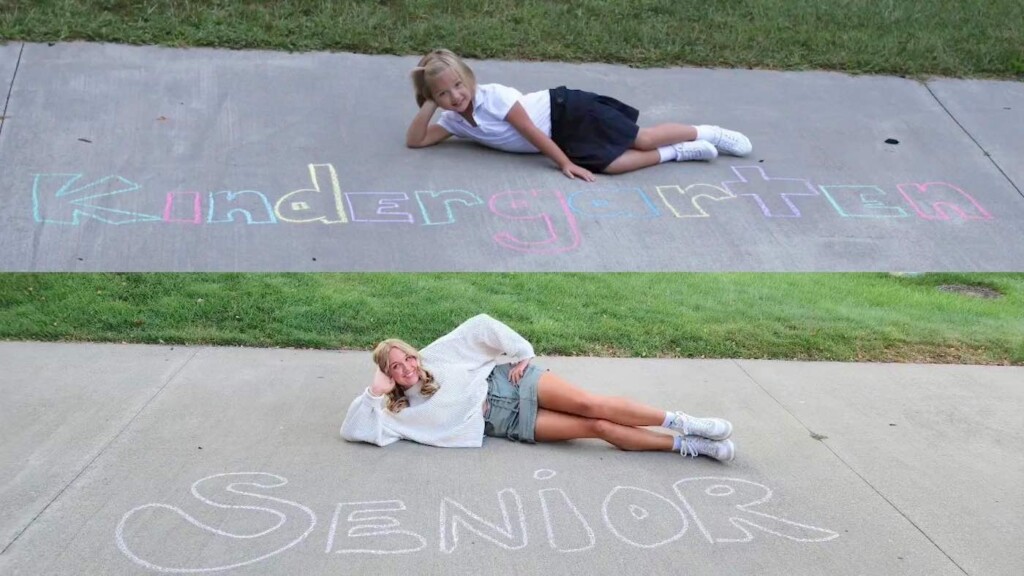
Ray Petelin’s daughter through the years

“I looked back at the first video, and it still feels like it was yesterday.

“I wanted to show her (the video) when she is a senior—and as she is now a senior, this will be the last one—but I will certainly get one when she moves into her own place.”

Ray’s video below, was posted on Facebook and Twitter/X where it tallied over 50 million views and led to multiple TV interviews broadcast on major networks and on his own station, KDKA-TV in Pittsburgh.

He’s also received many supportive comments from people all over the world, especially moms and dads.

“Parents have commented on the video saying that I should be ‘Dad of the Year’.”The idea has also inspired many parents to start doing same thing with their own school children. Dad Interviews Daughter on First Day of School Every Year–And the Final Video Has Gone Viral (Watch)

Sunday, 25 August 2024

How Parents Plan to Make Back-to-School ‘Magical’ For Their Kids


Four out of five parents are working to make the back-to-school season “magical” for their elementary school kids, according to a new poll.

A survey of 2,000 parents with children aged 12 and under found 86% are trying to bring the “magic” back to school and, for many, their goal is getting their child excited about returning to the classroom.

In order to do so, parents are allowing their child to choose their clothing and outfits (62%), purchase school supplies they liked best (62%), and help support their child’s passions and interests (56%).

19% of parents admitted they disliked school when they were their child’s age, and 96% are hoping to create more positive memories for their little ones.

Results found that 40% of kids are typically “very excited” to return to school after their summer break, which means parents are working overtime to make it match expectations.

How do parents get their kids excited about learning? 63% use hands-on learning (like teaching fractions through baking a cake). 43% said they use food or snack activities, and 25% exercise their imagination and learning with experiences, such as fantasy costume play.

Conducted by Talker Research on behalf of Keebler snacks, the survey looked into more ways parents are making the school year “magic” for their kids.

Over four in ten like to surprise their kids with their favorite snacks, three in ten slip notes into their lunchbox, and 19% have given their child a “lucky charm” to take to school for good luck. And, 70% of parents believe an after-school snack is a “magic” fix when their child has had a rough day.

According to the results, parents generally ‘keep magic alive’ by encouraging their child to use their imagination (70%), encourage a belief in the Easter Bunny, Tooth Fairy, or Santa Claus (53%), teach them to always see the best in people and their experiences (50%) and encourage them to look for the unexpected (46%).

“There’s plenty of small ways to make a new routine ‘magical’ and help instill that love of learning and school in your child,” said Alicia Mosley, Vice President of Marketing for the Keebler Brand. “Whether you’re putting notes in your child’s lunch box or surprising them with their favorite snack.”

“It’s encouraging to see parents working so hard to keep magic alive for their children and it’s those little moments of magic that their children are going to remember and cherish for the rest of their lives, How Parents Plan to Make Back-to-School ‘Magical’ For Their Kids

Sunday, 14 July 2024

Michael Bloomberg Donates $1 Billion to Provide Free Tuition for Future Doctors at Johns Hopkins

Johns Hopkins University

Bloomberg Philanthropies announced Monday a new $1 billion gift to make medical school free at Johns Hopkins University for a majority of students, while also increasing financial aid for students at its schools of nursing and public health.

The announcement was made in Michael R. Bloomberg’s (JHU ’64) annual letter on philanthropy in the Bloomberg Philanthropies 2023-2024 Annual Report released today.

Currently, nearly two-thirds of all students seeking an M.D. from Johns Hopkins qualify for financial aid, and future doctors graduate from Hopkins with an average total student loan debt of approximately $104,000.

Beginning in the fall of 2024, Johns Hopkins will offer free tuition for medical students coming from families earning less than $300,000 a year, which represents about 95% of all Americans. On top of tuition, Johns Hopkins will cover living expenses and fees for students from families who earn less than $175,000 a year.

“As the U.S. struggles to recover from a disturbing decline in life expectancy, our country faces a serious shortage of doctors, nurses, and public health professionals—and yet, the high cost of medical, nursing, and graduate school too often bars students from enrolling,” said Mr. Bloomberg.

“By reducing the financial barriers to these essential fields, we can free more students to pursue careers they’re passionate about—and enable them to serve more of the families and communities who need them the most.”

By the foundation’s reckoning, the gift will bring the average student loan debt for the Johns Hopkins School of Medicine down to $60,279 by 2029 while students from the vast majority of American families will pay nothing at all. This new gift ensures the most talented aspiring doctors representing the broadest range of socio-economic backgrounds will have the opportunity to graduate debt-free from Johns Hopkins.

And to further address recent declines in U.S. health, the gift will increase financial aid for students at its School of Nursing and the Bloomberg School of Public Health.

The gift will also increase financial aid for low and middle-income students pursuing graduate degrees at Johns Hopkins’ School of Education, Whiting School of Engineering, Carey School of Business, School of Advanced International Studies, Krieger School of Arts and Sciences, Peabody Institute, and the upcoming School of Government and Policy. This generous aid will help Johns Hopkins attract more of the nation’s brightest students to pursue the fields that most inspire them, rather than ones that will best enable them to repay graduate school loans.

This is the second of two 10-figure donations from Bloomberg Philanthropies to Johns Hopkins, having already contributed a historic $1.8 billion to Johns Hopkins in 2018 to try and ensure that undergraduate students are accepted regardless of their family’s income, permanently establishing need-blind admissions.

“That gift lowered the net cost of attendance—the actual cost that most families pay—by 40% and had a transformative impact on the makeup of the Johns Hopkins student body. Students with the greatest financial need now represent 21% of the Johns Hopkins student body, compared with 9% a decade ago, a higher percentage of high-need students than there is at Harvard, Princeton, MIT, and nearly every other Ivy League and Ivy League-adjacent institution,” the foundation claimed in a statement on the $1 billion gift.

LARGE GIFTS FOR OUR FUTURE DOCTORS: New York Medical School Surprises Students with Free Tuition in Perpetuity After $1Billion Gift–WATCH

“As Johns Hopkins has become more economically diverse, it has also become more selective, attracting and enrolling more of the nation’s top students, including many from lower-income families who might not have applied before.”

Last year, the former mayor of New York donated over $3 billion to charity, making him one of the most prolific American philanthropists that year. Michael Bloomberg Donates $1 Billion to Provide Free Tuition for Future Doctors at Johns Hopkins

Tuesday, 11 June 2024

How Two Filipinos Helped Thousands of Migrant Teachers Settle in New Zealand

Collage from Vilma Leonidas and Penny Cajipe
New Zealand enjoys the company of 72,000 Filipino migrants, many of whom are women arriving to fill the nation’s teacher shortage.

This pipeline of talented educators seeking better lives to the south has led a pair of women to start a flourishing support group to help navigate the immigration system, get teaching qualifications recognized in NZ, and find employment.

“Is there any way to expedite my teaching registration aside from emailing the teaching council?” asks one prospective teacher.

“Is there anyone here who was assessed in NZQA and then was directed to WES for verification?” asks another.

It may sound like an overly specific niche, but the Pioneering Pinoy Teachers in NZ Facebook group has 23,000 members. The group was founded by Vilma Leonidas, a teacher working in Auckland for the past two years who told Good News Pilipinas that between mastering English, standing for the teaching evaluation, and getting the teaching certificate, many immigrant teachers throw in the towel.

Leonidas and another teacher, Penny Cajipe—who also runs a Facebook group, called Filipino Teachers in NZ Support Page, both said the process is challenging, and getting clear directions from someone who’s been through it in one’s native language is of enormous benefit.

In her home country, Leonidas holds a doctorate of philosophy, which she imagined might be enough to at least guarantee a simple teaching job, but even that wasn’t straightforward.

After struggling to find work during the pandemic, with NZ instituting some of the strictest lockdowns on Earth, Leonidas received a teacher’s certificate and was later granted a scholarship in a training program for educators. She teaches seventh grade as a substitute.


It was that long process which made her think she should share all she had learned going through it—if only because it could help others settle in a new country with fewer difficulties than she endured. For Cajipe, who endured a similar path, she felt the same.

“What if other teachers in the Philippines are also aspiring to fulfill that dream of teaching here, and they’re looking for a better future for their family? What if they’re also like me and they don’t know what to do?’ So that’s how that actually made me start the page,” Cajipe told Summer Sanares, reporting for Good News Pilipinas.“Whatever it is that you have, you share it,” Leonidas said. “Not everything is about money. When you need to help, help without asking or expecting any return because God sees our heart. And that’s the legacy that we have to leave behind, especially among teachers.”How Two Filipinos Helped Thousands of Migrant Teachers Settle in New Zealand

Thursday, 30 May 2024

World Bank donates $100 Million to boost education sector

By Kei Emmanuel Duku:  Minister of General Education and Instruction, Awut Deng Acuil, confirmed on Friday that the Ministry has received a $100 million donation from the World Bank.

Dr. Jacob Korok Majiu, Deputy Minister of Information, told the media after the Council of Ministers meeting.

He said the funds would be used to improve teacher’s training and construct schools throughout the country.

“The money will be used to boost the capacity of the teachers and the construction of schools throughout the country,” Dr. Majiuk explained. He added that the Ministry is working with the World Bank to launch the initiative upon receiving the funds.
This significant donation aims to address long-standing challenges in South Sudan’s education system. By enhancing teacher training and expanding school infrastructure, the World Bank’s contribution is expected to have a positive long-term impact on the country’s education sector.World Bank donates $100 Million to boost education sector

Thursday, 23 May 2024

What is air turbulence?

You probably know the feeling: you’re sitting on a plane, happily cruising through the sky, when suddenly the seat-belt light comes on and things get a little bumpy.

Most of the time, turbulence leads to nothing worse than momentary jitters or perhaps a spilled cup of coffee. In rare cases, passengers or flight attendants might end up with some injuries.

What’s going on here? Why are flights usually so stable, but sometimes get so unsteady?

As a meteorologist and atmospheric scientist who studies air turbulence, let me explain.

What is air turbulence?

Air turbulence is when the air starts to flow in a chaotic or random way.

At high altitudes the wind usually moves in a smooth, horizontal current called “laminar flow”. This provides ideal conditions for steady flight.

Turbulence occurs when something disrupts this smooth flow, and the air starts to move up and down as well as horizontally. When this happens, conditions can change from moment to moment and place to place.

You can think of normal flying conditions as the glassy surface of the ocean on a still day. But when a wind comes up, things get choppy, or waves form and break – that’s turbulence.

What causes air turbulence?

The kind of turbulence that affects commercial passenger flights has three main causes.

The first is thunderstorms. Inside a thunderstorm, there is strong up-and-down air movement, which makes a lot of turbulence that can spread out to the surrounding region. Thunderstorms can also create “atmospheric waves”, which travel through the surrounding air and eventually break, causing turbulence.

Fortunately, pilots can usually see thunderstorms ahead (either with the naked eye or on radar) and will make efforts to go around them.

The other common causes of turbulence create what’s typically called “clear-air turbulence”. It comes out of air that looks perfectly clear, with no clouds, so it’s harder to dodge.

The second cause of turbulence is jet streams. These are high-speed winds in the upper atmosphere, at the kind of altitudes where passenger jets fly.

While air inside the jet stream moves quite smoothly, there is often turbulence near the top and bottom of the stream. That’s because there is a big difference in air speed (called “wind shear”) between the jet stream and the air outside it. High levels of wind shear create turbulence.

The third thing that makes turbulence is mountains. As air flows over a mountain range, it creates another kind of wave – called, of course, a “mountain wave” – that disrupts air flow and can create turbulence.

Can air turbulence be avoided?

Pilots do their best to avoid air turbulence – and they’re pretty good at it!

As mentioned, thunderstorms are the easiest to fly around. For clear-air turbulence, things are a little trickier.

When pilots encounter turbulence, they will change altitude to try to avoid it. They also report the turbulence to air traffic controllers, who pass the information on to other flights in the area so they can try to avoid it.

Weather forecasting centres also provide turbulence forecasts. Based on their models of what’s happening in the atmosphere, they can predict where and when clear-air turbulence is likely to occur.

Will climate change make turbulence worse?

As the globe warms and the climate changes in coming decades, we think air turbulence will also be affected.

One reason is that the jet streams which can cause turbulence are shifting and may become more intense. As Earth’s tropical climate zones spread away from the equator, the jet streams are moving with them.

This is likely to increase turbulence on at least some flight routes. Some studies also suggest the wind shear around jet streams has become more intense.

Another reason is that the most severe thunderstorms are also likely to become more intense, partly because a warmer atmosphere can hold more water vapour. This too is likely to generate more intense turbulence.

These predictions are largely based on climate models, because it is difficult to collect the data needed to identify trends in air turbulence. These data largely come from reports by aircraft, the quality and extent of which are changing over time. These measurements are quite different from the long-term, methodically gathered data usually used to detect trends in the weather and climate.

How dangerous is air turbulence?

Around the globe, air turbulence causes hundreds of injuries each year among passengers and flight attendants on commercial aircraft. But, given the hundreds of millions of people who fly each year, those are pretty good odds.

Turbulence is usually short-lived. What’s more, modern aircraft are engineered to comfortably withstand all but the most extreme air turbulence.

And among people who are injured, the great majority are those who aren’t strapped in. So if you’re concerned, the easiest way to protect yourself is to wear your seat belt. The Conversation

Todd Lane, Professor, School of Geography, Earth and Atmospheric Sciences, The University of Melbourne, The University of Melbourne

This article is republished from The Conversation under a Creative Commons license. Read the original article.

Wednesday, 22 May 2024

Will New Zealand’s school phone ban work? Let’s see what it does for students’ curiosity

With the coalition government’s ban of student mobile phones in New Zealand schools coming into effect this week, reaction has ranged from the sceptical (kids will just get sneakier) to the optimistic (most kids seem okay with it).

In a world where nearly everyone has a smartphone, it’s to be expected nearly everyone will have an opinion. The trick is to sort the valid from the kneejerk, and not rush to judgement.

Anecdotally, schools that implemented the ban ahead of the deadline have reported positive changes in attention and learning. The head girl of Hornby High School in Christchurch said the grounds are now “almost louder during intervals and lunches”. Her principal said, “I wish we had done the phone ban five years ago.”

On the other hand, hard evidence in favour of banning phones in schools has been found to be “weak and inconclusive”. But the policy’s aim to create a “positive environment where young New Zealanders can focus on what matters most” is not without merit.

Above all, the policy raises a crucial question: is an outright ban the most effective approach to addressing the problem of digital distraction and its impact on education?

Connection and distraction

Since Monday, students have had to store their phones in bags or lockers during school hours. As in the pre-digital era, parents can now only contact their children through the school office.

The aim, according to the National Party’s original election promise, is to “eliminate unnecessary disturbances or distractions” and improve student achievement, which by various measures has declined over the past three decades.

While avoiding generalised assumptions, we know many young people can’t put their devices down, as both a recent Education Review Office report and a 2021 OECD survey concluded.

In one US survey in 2022, approximately one-third of teachers asked students to put away their phones five to ten times per class, while nearly 15% asked more than 20 times.

So, it’s hard to argue phones aren’t a distraction, or that social media-fuelled bullying and isolation don’t warrant critical examination of digital habits. At the same time, phones have their constructive uses, from organising schedules for the neurodivergent, to facilitating social interactions and learning.

No phone ban advocate is arguing that limiting phone use in schools is a silver bullet for related issues around cyberbullying, mental health and behavioural challenges. But the personal device’s capacity to distract remains a legitimate concern.

Meaningful digital engagement

The heart of the debate lies in education’s evolving landscape. The push to ban phones does not extend to digital devices in general, after all. Their utility in learning environments is well recognised.

But as we embrace artificial intelligence and other technological advances in education, we must also ask: at what point does reliance on these digital tools begin to erode critical thinking skills?

The future job market, filled with roles that do not yet exist, will undoubtedly require those skills. Therefore, distinguishing between meaningful digital engagement and detrimental distraction is crucial.

Perhaps the better question is: would fewer distractions create the opportunity for young people to be more curious about their learning?

Curiosity: the engine of critical thinking

Curiosity is essential for educational success, citizenship and media literacy in the digital age. But curiosity is stifled by distractions.

Education research is heading towards treating curiosity as a “provocation” – meaning we should, in effect, “dare” young people to be more curious. This involves encouraging mistakes, exploration – even daydreaming or being creatively bored.

All of this is challenging with the current level of distractions in the classroom. On top of that, many young people struggle to cultivate curiosity when digital media can provide instant answers.

Consider the distinction between two types of curiosity: “interest curiosity” and what has been termed “deprivation curiosity”.

Interest curiosity is a mindful process that tolerates ambiguity and takes the learner on their own journey. It’s a major characteristic of critical thinking, particularly vital in a world where AI systems are competing for jobs.

Deprivation curiosity, by contrast, is characterised by impulsivity and seeking immediate answers. Misinformation and confusion fuelled by AI and digital media only exacerbate the problem.

Making room for real life

Where does this leave the phone ban in New Zealand schools? There are some promising signs from students themselves, including in the OECD’s 2022 report on global educational performance:

On average across OECD countries, students were less likely to report getting distracted using digital devices when the use of cell phones on school premises is banned.

These early indications suggest phone bans boost the less quantifiable “soft” skills and vital developmental habits of young people — social interactions, experimentation, making mistakes and laughing. These all enhance the learning environment.

Real life experiences, with their inherent trials and errors, are irreplaceable avenues for applying critical thinking. Digital experiences, while valuable, cannot fully replicate the depth of human interaction and learning.

Finding the balance is the current challenge. As a 2023 UNESCO report advised, “some technology can support some learning in some contexts, but not when it is over-used”.

In the meantime, we should all remain curious about the potential positive impacts of the phone ban policy, and allow time for educators and students to respond properly. The real tragedy would be to miss the learning opportunities afforded by a less distracted student population.The Conversation

Patrick Usmar, Lecturer in Critical Media Literacies, Auckland University of Technology

This article is republished from The Conversation under a Creative Commons license. Read the original article.