


- Indian giant ignites green revolution with 234 MW wind energy project
- In a groundbreaking stride towards a greener tomorrow, Sri Lanka Sustainable Energy Authority (SLSEA) has approved to grant the Energy Permit to Adani Green Energy (Sri Lanka) Ltd., for its monumental $ 355 million, 234MW Pooneryn Wind Energy Power Project, nestled in the picturesque Northern Province of Sri Lanka.
- This landmark endeavour not only marks Sri Lanka’s largest single location wind energy project, but also heralds a new era of renewable energy dominance, addressing critical issues like the energy crisis, economic recovery, and environmental sustainability.
- This $ 355 million, 234MW, Pooneryn Wind Energy Power Project stands tall as a testament to Adani Green Energy’s unwavering commitment to pioneering sustainable solutions. This colossal initiative not only cements its status as Sri Lanka’s largest wind energy project at a single location but also emerges as a beacon of hope, addressing critical concerns such as the energy security, economic revitalisation, and environmental stewardship.
- The Pooneryn Wind Energy Power Project is set to become a beacon of sustainable energy in the region. With a capacity of 234MW, it is poised to contribute substantially to Sri Lanka’s renewable energy capacity. The project aligns seamlessly with global efforts to combat climate change by reducing carbon emissions, as wind power is renowned for its clean and green attributes. Adani Green Energy’s commitment to environmental stewardship is evident in this endeavour, making strides towards a cleaner and more sustainable future.
- Sri Lanka has been grappling with an energy crisis, facing challenges of energy security and sustainability. The Pooneryn project emerges as a beacon of hope, offering a reliable and renewable solution to the nation’s energy woes. By harnessing the power of wind, this project promises to diversify Sri Lanka’s energy mix, reducing dependence on fossil fuels and mitigating the risks associated with fluctuating energy prices and supply shortages.
- Amid the economic turmoil wrought, the $ 355 million Pooneryn Wind Energy Power Project serves as a ray of economic optimism and a vote of confidence in Sri Lanka. Adani Green Energy’s bold investment in this transformative project not only injects vital Foreign Direct Investment (FDI) into Sri Lanka’s economy but also sends a resounding message of confidence to investors worldwide. This influx of capital is poised to catalyse economic growth, create jobs, and stimulate local businesses, laying the groundwork for a robust and resilient post economic pandemic recovery.
- The Pooneryn Wind Energy Power Project brings with it a boon of employment opportunities, particularly in the Northern Province. The construction, operation, and maintenance of the facility will create a multitude of jobs, contributing to the economic upliftment of the region. This strategic focus on the Northern Province underscores Adani Green Energy’s commitment to inclusive growth, fostering a sense of community and empowerment among the local population.
- At its core, the Pooneryn Wind Energy Power Project embodies Adani Green Energy’s unwavering commitment to environmental stewardship. By harnessing the limitless power of wind, the project is set to significantly reduce Sri Lanka’s carbon footprint, paving the way for a cleaner, greener future.
- With stringent environmental measures and best practices in place, Adani Green Energy is not only mitigating environmental impact but also setting a gold standard for responsible and sustainable development in the energy sector. The integration of sustainable practices in energy generation aligns with global efforts to preserve natural resources and protect the delicate balance of our ecosystems.
- The Pooneryn Wind Energy Power Project is much more than just a power plant; it’s a symbol of hope, progress, and possibility. As it takes shape against the backdrop of the Northern Province’s majestic landscapes, it stands as a beacon of Sri Lanka’s commitment to a brighter, more sustainable future. With Adani Green Energy leading the charge, the journey towards a greener tomorrow has never looked more promising. Sustainable Energy Authority approves permit for $ 355 m Adani Green Energy in Pooneryn | Daily FT

Wednesday, 28 February 2024
Sustainable Energy Authority approves permit for $ 355 m Adani Green Energy in Pooneryn

Saturday, 10 July 2021
India receives USD 64 bln FDI in 2020, fifth largest recipient of inflows in world: UN

JUN 21, 2021 UNITED NATIONS: India received USD 64 billion in Foreign Direct Investment in 2020, the fifth largest recipient of inflows in the world, according to a UN report which said the COVID-19 second wave in the country weighs heavily on the country's overall economic activities but its strong fundamentals provide "optimism" for the medium term. The World Investment Report 2021 by the UN Conference on Trade and Development (UNCTAD), released Monday, said global FDI flows have been severely hit by the pandemic and they plunged by 35 per cent in 2020 to USD 1 trillion from USD 1.5 trillion the previous year. Lockdowns caused by COVID-19 around the world slowed down existing investment projects, and prospects of a recession led multinational enterprises (MNEs) to reassess new projects. The report said in India, FDI increased 27 per cent to USD 64 billion in 2020 from USD 51 billion in 2019, pushed up by acquisitions in the information and communication technology (ICT) industry, making the country the fifth largest FDI recipient in the world. The pandemic boosted demand for digital infrastructure and services globally. This led to higher values of greenfield FDI project announcements targeting the ICT industry, rising by more than 22 per cent to USD 81 billion. Major project announcements in the ICT industry included a USD 2.8 billion investment by online retail giant Amazon in ICT infrastructure in India. The report noted that the second wave of the COVID-19 outbreak in India weighs heavily on the country's overall economic activities. Announced greenfield projects in India contracted by 19 per cent to USD 24 billion, "and the second wave in April 2021 is affecting economic activities, which could lead to a larger contraction in 2021," it said, adding that the outbreak in India severely hit main investment destinations such as Maharashtra, which is home to one of the biggest automotive manufacturing clusters (Mumbai-Pune-Nasik-Aurangabad) and Karnataka (home to the Bengaluru tech hub), which face another lockdown as of April 2021, exposing the country to production disruption and investment delays. "Yet India's strong fundamentals provide optimism for the medium term. FDI to India has been on a long-term growth trend and its market size will continue to attract market-seeking investments. In addition, investment into the ICT industry is expected to keep growing," the report said. The country's export-related manufacturing, a priority investment sector, will take longer to recover, but government facilitation can help. India's Production Linkage Incentive scheme, designed to attract manufacturing and export-oriented investments in priority industries including automotive and electronics can drive a rebound of investment in manufacturing. The report said FDI in South Asia rose by 20 per cent to USD 71 billion, driven mainly by strong M&As in India. "Amid India's struggle to contain the COVID-19 outbreak, robust investment through acquisitions in ICT (software and hardware) and construction bolstered FDI," it said adding that cross-border M&As surged 83 per cent to USD 27 billion, with major deals involving ICT, health, infrastructure and energy. Large transactions included the acquisition of Jio Platforms by Jaadhu, a subsidiary of Facebook for USD 5.7 billion, the acquisition of Tower Infrastructure Trust by Canada's Brookfield Infrastructure and GIC (Singapore) for USD 3.7 billion and the sale of the electrical and automation division of Larsen & Toubro India for USD 2.1 billion. Another megadeal - Unilever India's merger with GlaxoSmithKline Consumer Healthcare India, a subsidiary of GSK United Kingdom) for USD 4.6 billion - also contributed, it said. FDI outflows from South Asia fell 12 per cent to USD 12 billion, driven by a drop in investment from India. India ranked 18 out of the world's top 20 economies for FDI outflows, with 12 billion dollars of outflows recorded from the country in 2020 as compared to 13 billion dollars in 2019. "Investments from India are expected to stabilise in 2021, supported by the country's resumption of free trade agreement (FTA) talks with the European Union (EU) and its strong investment in Africa," the report said. The report cautioned that while the Asian region has managed the health crisis relatively well, the recent second wave of COVID-19 in India shows that significant uncertainties remain. "This has major impacts on prospects for South Asia. A wider resurgence of the virus in Asia could significantly lower global FDI in 2021, given that region's significant contribution to the total," the report said. FDI inflows to developing Asia grew by 4 per cent to USD 535 billion in 2020, making it the only region to record growth and increasing Asia's share of global inflows to 54 per cent. In China, FDI increased by 6 per cent to USD 149 billion. While some of the largest economies in developing Asia such as China and India recorded FDI growth in 2020, the rest recorded a contraction, it said. The report added that FDI inflows in Asia are expected to increase in 2021, outperforming other developing regions with a projected growth of 5-10 per cent. Signs of trade and industrial production recovering in the second half of 2020 provide a strong foundation for FDI growth in 2021. Yet, substantial downside risks remain for the many economies in the region that struggle to contain successive waves of COVID-19 cases and where fiscal capacity for recovery spending is limited. "Economies in East and South-East Asia, and India, will continue to attract foreign investment in high-tech industries, given their market size and their advanced digital and technology ecosystem," the report said. Copyright © Jammu Links News Source: Jammu Links News
Monday, 8 February 2021
Sitaraman budgets for wellbeing – fiscal and physical
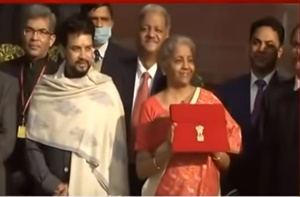
- Presenting the first ever digital Union Budget, minister of finance and corporate affairs Nirmala Sitharaman stated that India’s fight against Covid-19 continues into 2021 and that this moment in history, when the political, economic, and strategic relations in the post-Covid world are changing, is the dawn of a new era – one in which India is well-poised to truly be the land of promise and hope.
- The finance minister who had promised a "never before" budget not seen in a hundred years to repair the economic devastation caused by a once-in-a-lifetime pandemic, which rendered millions jobless, shuttered scores of small businesses and snuffed the spending power out of the bottom of pyramid populace, said the budget aims at well-being – both fiscal and physical – of the nation and its people.
- She said Budget 2021 is built on the six pillars of health and well-being, physical and financial capital and infrastructure, inclusive development for aspirational India, reinvigorating human capital, innovation and R&D, minimum government and maximum governance.
- Sitharaman, who began unveiling the Union Budget 2021 at 11 am amid heckling by opposition members in Parliament, proposed a more than doubling of government spending on health and wellbeing to Rs2,23,846 crore in 2021-22 against Rs94,452 crore in the current fiscal.
- "Only three times has the budget followed a contraction in the economy. This time, unlike before, the situation is due to a global pandemic. Budget 2021-22 provides every opportunity for the economy to capture the pace and grow sustainably," she said.
- The government stretched its resources for the benefit of the poorest of the poor. The PM Garib Kalyan Yojana, the three Aatma Nirbhar Bharat packages and subsequent announcements were like five mini-budgets in themselves, she added.
- Sitharaman said India already has 2 vaccines available and has begun safeguarding not only her own citizens against the scourge of Covd-19 but also those of 100 or more countries.
- The FM's task at hand is unenviable, as many expect the government to support the pandemic-hit economy through increased public spending even as private investments are struggling and the government’s fiscal deficit is ballooning,
- Yet, the finance minister provided relief to senior citizens in filing of income tax returns, reduced time limit for income tax proceedings announced setting up of the Dispute Resolution Committee, faceless ITAT, relaxation to NRIs, increase in exemption limit from audit and relief for dividend income.
- She also announced steps to attract foreign investment into infrastructure, relief to affordable housing and rental housing, tax incentives to IFSC, relief to small charitable trusts, and steps for incentivising start-ups in the country.
- Finance minister said that for an economy aiming to be $5 trillion strong, its manufacturing sector has to grow in double digits on a sustained basis. “Our manufacturing companies need to become an integral part of global supply chains, possess core competence and cutting-edge technology.”
- Towards this end, the government has already announced PLI schemes to create manufacturing global champions for an AatmaNirbhar Bharat in 13 sectors. For this, the government has committed nearly Rs1.97 lakh crore in the next 5 years starting FY 2021-22. This initiative will help bring scale and size in key sectors, create and nurture global champions and provide jobs to our youth, she added.
- On the infrastructure front, Sitharaman said that infrastructure needs long term debt financing. A professionally managed Development Financial Institution is necessary to act as a provider, enabler and catalyst for infrastructure finance ing. Accordingly, a bill to set up a DFI will be introduced. Government has provided a sum of Rs20,000 crore to capitalise this institution and the ambition is to have a lending portfolio of at least Rs5 lakh crore for this DFI in three years time.
- The finance minister said in the AtmaNirbhar Package, she had announced to come out with a policy of strategic disinvestment of public sector enterprises and said that the government has approved the said policy. The policy provides a clear roadmap for disinvestment in all non-strategic and strategic sectors.
- Government has kept four areas that are strategic where bare minimum CPSEs will be maintained and the rest privatized. In the non-strategic sectors, CPSEs will be privatised, or otherwise closed. She said that to fast forward the disinvestment policy, NITI Aayog will work out on the next list of central public sector companies that would be taken up for strategic disinvestment. Government has estimated Rs1,75,000 crore as receipts from disinvestment in BE 2020-21.
- Monetising operating public infrastructure assets is a very important financing option for new infrastructure construction. A “National Monetisation Pipeline” of potential brownfield infrastructure assets will be launched. An Asset Monetisation dashboard will also be created for tracking the progress and to provide visibility to investors, she said.
- Other core infrastructure assets that will be rolled out under the Asset Monetisation Programme are: NHAI’s operational toll roads, transmission assets of PGCI, oil and gas pipelines of GAIL, IOCL and HPCL; AAI airports in Tier II and III cities, other railway infrastructure assets, Warehousing assets of CPSEs such as Central Warehousing Corporation and NAFED among others and sports stadiums.
- She also proposed to amend the Insurance Act, 1938 to increase the permissible FDI limit from 49% to 74% and allow foreign ownership and control with safeguards. Under the new structure, the majority of Directors on the Board and key management persons would be resident Indians, with at least 50% of Directors being Independent Directors, and specified percentage of profits being retained as general reserve.
- Finance minister announced that more than 13,000 km length of roads, at a cost of Rs3.3 lakh crore, has already been awarded under the Rs5.35 lakh crore Bharatmala Pariyojana project, of which 3,800 km have been constructed. By March 2022, the government would be awarding another 8,500 km and complete an additional 11,000 km of national highway corridors. To further augment road infrastructure, more economic corridors are also being planned. She also provided an enhanced outlay of Rs1,18,101 lakh crore for the ministry of road transport and highways, of which Rs1,08,230 crore is for capital, the highest ever.
- Budget also provided a record sum of Rs1,10,055 crore for Railways, of which Rs1,07,100 crore is for capital expenditure.
- Indian Railways has prepared a National Rail Plan for India – 2030. The Plan is to create a ‘future ready’ Railway system by 2030. “Bringing down the logistic costs for our industry is at the core of our strategy to enable ‘Make in India’. It is expected that Western Dedicated Freight Corridor (DFC) and Eastern DFC will be commissioned by June 2022,” the finance minister stated.
- Government, she said, will work towards raising the share of public transport in urban areas through expansion of metro rail network and augmentation of city bus service. A new scheme will be launched at a cost of Rs18,000 crore to support augmentation of public bus transport services, she added.
- A total of 702 km of conventional metro is operational and another 1,016 km of metro and RRTS is under construction in 27 cities. Two new technologies, ie, ‘MetroLite’ and ‘MetroNeo’ will be deployed to provide metro rail systems at much lesser cost with same experience, convenience and safety in Tier-2 cities and peripheral areas of Tier-1 cities, Sitaraman stated.
- The finance minister proposed a public-private partnership model for major ports, with the leasing out of port operations and services on their own to a model where a private partner will manage it for them. For the purpose the budget proposes to offer more than Rs2,000 crore by major ports on public-private partnership (PPP) model in FY21-22.A scheme to promote flagging of merchant ships in India will be launched by providing subsidy support to Indian shipping companies in global tenders floated by ministries and CPSEs. An amount of Rs1,624 crore will be provided over 5 years. This initiative will enable greater training and employment opportunities for Indian seafarers besides enhancing the share of Indian companies in global shipping, she added.Source: t
Sunday, 27 December 2020
UN declares 'Invest India' the winner of Investment Promotion Award 2020
- Believe it or not, India which saw its economy contract 7,5 per cent in the second quarter of the 2020-21 financial year, also remains one of the top foreign investment destinations globally.
- The United Nations (Unctad) has declared ‘Invest India’ as winner of the 2020 United Nations Investment Promotion Award. The award was presented at a ceremony on Monday (7 December 2020) at Unctad Headquarters in Geneva.
- The award is also recognition of India receiving the highest-ever FDI during the first five months of this financial year (April-August 2020), of over $35 billion, one of the highest FDI figures for any major economy so far this year.
- India had received foreign direct investment (FDI) amounting to well over $ 500 billion in the last two decades.
- The evaluation was based on Unctad’s assessment of work undertaken by 180 national Investment Promotion Agencies across the world. This is also recognition and celebration of the outstanding achievements of `Invest India,’ one of the world’s best-practice investment promotion agencies.
- The Covid-19 pandemic had generated important challenges for investment promotion agencies (IPAs), forcing them to shift focus from routine investment promotion and facilitation towards crisis management, notification of government emergency and economic relief measures, provision of crisis support services, and contribution to national Covid-19 business response efforts.
- Several of these agencies had closed offices, moved functions online and asked staff to work from home. In March 2020, Unctad constituted a team to monitor IPAs response to the pandemic. Unctad reported best practices from investment promotion agencies in the IPA Observer publications in April 2020 and July 2020. IPAs response to the pandemic became the basis for the evaluation of the 2020 United Nations Investment Promotion Award.
- Unctad highlighted good practices followed by ‘Invest India’such as the Business Immunity Platform, Exclusive Investment Forum webinar series, its social media engagement and focus Covid response teams (such as business reconstruction, stakeholder outreach and supplier outreach) created as a response to the pandemic in its publications. Invest India has also shared long-term strategies and practices being followed for investment promotion, facilitation and retention at Unctad’s high-level brainstorming sessions.
- Unctad is the central agency which monitors performance of investment promotion agencies and identifies global best practices. Germany, South Korea, Singapore have been some of the past winners of the award.“The award is testament to the Hon’ble Prime Minister’s vision of making India a preferred investment destination with a focus on both Ease of Living and Ease of Doing Business. It bears testimony to his focus on bringing excellence within the Government. This award also recognizes the Indian Government’s effective management of the COVID pandemic,” Deepak Bagla, MD & CEO, Invest India said. Source: https://www.domain-b.com/
Friday, 10 July 2020
Cabinet approves up to 100% FDI by NRIs in Air India
- The union cabinet on Wednesday approved certain amendments in the government’s policy regarding foreign direct investment to facilitate investment of up to 100 per cent by non-resident Indians (NRIs) specially in the case of Air India Ltd.
- A meeting of the union cabinet, chaired by Prime Minister Narendra Modi has approved amendments to the extant FDI Policy to permit foreign investment in Air India Ltd by NRIs, who are Indian Nationals, up to 100 per cent under automatic route.
- As per the present FDI policy, 100 per cent FDI is permitted in scheduled air transport service/domestic scheduled passenger airline (automatic up to 49 per cent and government route beyond 49 per cent). However, for NRIs, 100 per cent FDI is permitted under automatic route in scheduled air transport service/domestic scheduled passenger airline.
- Further, FDI is subject to the condition that substantial ownership and effective control (SOEC) shall be vested in Indian nationals as per aircraft rules, 1937. However, for Air India Ltd, as per the present policy, foreign investment, including that of foreign Airline(s), shall not exceed 49 per cent, either directly or indirectly, subject to the condition that substantial ownership and effective control of Air India Ltd shall continue to be vested in Indian Nationals. Therefore, although 100 per cent FDI is permitted under automatic route for NRIs in scheduled air transport service/domestic scheduled passenger airline, it is restricted to 49 per cent in case of Air India.
- As per the proposed strategic disinvestment of 100 per cent of Air India Ltd, the government will have no residual ownership and Air India will be completely privately owned post sale. It has also0 been decided that foreign investment in Air India Ltd be brought on a level playing field with other scheduled airline operators.
- The amendment in FDI policy will permit foreign investment in Air India Ltd at par with other scheduled airline operators, ie, up to 100 per cent in Air India Ltd by those NRIs, who remain Indian Nationals. The proposed changes in FDI Policy will enable foreign investment by NRIs into Air India Ltd of up to 100 per cent, under automatic route.
- The amendment to the FDI policy is meant to liberalise and simplify the FDI policy to provide ease of doing business in the country, which would lead to largest FDI inflows and thereby contribute to growth of investment, income and employment, the release added. Source: https://www.domain-b.com
Tuesday, 31 March 2015
Lack of quality spaces, high rental deter luxe labels’ India plans

The launch of several popular global fashion labels through online shopping portals like Myntra, Jabong is proof that they are keen to enter the lucrative India market. However, despite India allowing 100 percent FDI in single brand retail, many are not yet biting the bait of opening stores in India. The reason: high rentals and scarcity of good locations or high streets in the country. For instance, niche luxury brands like Italian suit maker Kiton and British shoemaker John Lobb have begun offering their bespoke made-to-order services in India, but they are not showing any interest in opening stores immediately. Because the demand is comparatively low. High rentals – a major road-block: Despite a growing base of well-off shoppers, the presence of the world’s top 100 retailers in Indian cities is sparse compared with other Asia-Pacific countries, says a report by Jones Lang LaSalle, a real estate consultancy. High rents and restrictive investment policies hinder profitable growth in India and deter global retailers’ from investing here says the report, titled ‘A Magnet for Retail’. The report ranked 30 cities in the Asia-Pacific based on the presence of world’s top 100 luxury and mid-tier brands, where cities like Delhi, Mumbai and Bangalore ranked 24, 25 and 27, respectively. While rents for baseline retail properties in India are affordable, foreign labels are mostly interested in prime retail locations, where the rates are high compared to other cities in the Asia Pacific region. Therefore, bearing operational costs while paying high rents, these brands have to also wait for long to break even as consumer spending in India is improving only now. Even Reliance Brands, which operates stores retailing top luxury brands like Zegna and Brooks Brothers, are facing challenges on that front. However, over the past few years, foreign labels such as Zara and Massimo Dutti, H&M, Forever 21, Benetton and Marks & Spencer and now The Children’s Place and GAP are banking upon upbeat consumer sentiment in the country. High demand, low quality spaces As per a ASSOCHAM-KPMG study, India’s luxury market grew at a healthy 30 percent to reach 8.5 billion dollars (over Rs 51,000 crores) in 2013 and is likely to continue growing at about 20 percent to reach 14 billion dollars (over Rs 84,000 crores) by 2016 owing to rising number of wealthy people, growing middle class, affluent young consumers and other related factors. Though, India enjoys just 1-2 percent share in the global luxury market it is the fifth most attractive market for international retailers. No wonder several high-end foreign brands are planning to enter the country, either on their own, or through joint ventures and e-commerce. With consumers waking up to luxe brands, and established labels like Hermès, Louis Vuitton and Gucci et al they have created a niche in the market. India lacks hi-street destinations like New York's Fifth Avenue and Madison Avenue or London’s Bond Street, so they have to go the extra mile to look for a retail place that would attract footfalls. What adds to the problem is few number of high-end malls and low sales potential coupled with limited space at five-star hotels. Other hurdles like regulatory FDI norms, are issues being faced by them. Experts say luxury brands find it difficult to meet the 30 percent mandatory souring norm under FDI policy because most brands’ USP revolves around the competitive advantage of its country of origin. Source: Article
Tuesday, 8 July 2014
How to transform India from world's largest defence importer to major exporter

- The government's recent decision to deregulate manufacture of a number of items used by the defence forces will result in new players and SMEs entering the sector. Easy entry will result in an increase in the number of manufactures, with the benefit of competition that will improve both quality and cost-effectiveness. This will also encourage them to seek export markets for their products.
- Socio-economic growth and a credible defence capability achieved through self-reliance are fundamental for a nation to secure a globally respectable position. In a world where a few developed countries enforce control regimes on defence equipment and technologies, it is imperative for a country like India — a growing economy with formidable capability, to maximise indigenisation and self-reliance in defence equipment. Further, with defence exports becoming an increa-singly effective diplomatic tool in assuring regional peace and secu-rity, it is crucial for India to be-come a global defence exporter.
- A small country like Israel, which gained independence at almost the same time as India and with a population less than 1% of India's, today accounts for 10% of total global defence exports. China which until 2006 was the largest importer of defence goods, is today the fifth largest defence equipment exporter. Paradoxically, India, with its huge pool of technically qualified, globally competitive manpower, in dire need for employment for its population, has emerged as the largest importer.
- India has all the attributes of becoming a major exporter of defence equipment. Considerable investments have been made over the years in creating indigenous defence manufacturing infrastructure in the form of DRDO labs, DPSUs, ordnance factories, some highly reputed educational institutions and a few industries in the private sector. The large young population can provide skilled, cost-effective manpower for the defence industry and the huge SME base can contribute effectively, both directly as well as in collaboration with large system integrators.
- Recent amendments to the defence procurement policy have provided a new thrust for indigenisation. Introduction of major programmes in the 'make' category, allowing participation of Indian public and private industry, is a big step in the right direction towards developing cutting-edge technology. Defence offsets and the proposed liberalisation of FDI in the defence sector must be leveraged judiciously to enhance indigenous capabilities.
- The defence industry is capital intensive and characterised by a cyclical nature in order placement for domestic needs; it typically needs a large customer base to be competitive and to sustain business. This can be achieved only when both domestic and export markets are opened for industry.
- A well-defined policy to promote defence exports, complying with international agreements such as the Wassenaar Arrangement and Missile Technology Control Regime, will provide the necessary international legitimacy.
- It is time now to shed the public vs private sector mindset and consider the entire defence industrial base in India as the 'national defence sector'. It is important that domestic programmes are opened up for competition wherever possible. SMEs capable of developing niche technologies should be encouraged, while the stalled pro-posal to identify platform builders and system integrators — Raksha Udyog Ratnas, must be immediately implemented.
- To safeguard the interests of the defence industry in the private sector, and to derive the maximum benefit from synergies, it is essential to eliminate the conflict of interest inherent in the current structure of ministry of defence. The department of defence production must be made independently responsible for equitably addressing the concerns and synergising strengths of the country's defence industrial base, including the private as well as public sectors. It should also be held accountable for achieving preset time-bound targets for indigenisation and exports.
- Globally, respective governments strongly promote sales of their defence exporting firms without discriminating between private and public sectors. UK Trade and Invest and SIBAT-Israel, are good examples. It is common for heads of state of developed nations to actively promote sale of their defence products.
- In 2013, for the first time, top officials of DRDO led an Indian defence industry delegation to ADEX 2013 in Seoul. Such initiatives should be encouraged and strongly supported by the political leadership.
- Increased emphasis on R&D and innovation is vital for achieving self-reliance in defence equipment. In order to realise the untapped potential in indigenous technologies, DRDO must be authorised to form partnerships with organisations of their choice for cutting-edge technology deve-lopment, while simultaneously allowing use of their facilities on commercial terms by companies in the defence field.
- Defence exports are often used as a diplomatic tool either through supplies as goodwill gestures or through soft loans and lines of credit. This policy has been used extensively and effectively by China to expand its presence in the Indian Ocean Region, Africa and Latin America. India should evolve its own "Integrated Defence Production and Export Policy" learning from the success stories of countries like China, Israel, South Africa and South Korea.
- India's approach to defence exports will be guided by changes in the geopolitical situation, as we build stronger diplomatic ties, particularly with nations in the Indian Ocean Region. If the government and national defence industry embrace the challenge, India can not only effectively meet domestic needs but also emerge as a major exporter of defence products. We need a major thrust — a national mission on defence equipment exports. Defence news, Source: Article
Friday, 23 May 2014
Status Quo bets big on innovative tees
 Status Quo known for its knits has launched grindle yarn T-shirts that have seen good demand. “We have done checks in flannel shirts. Our styling keeps us apart from the rest. Sweat shirts are part of circular knits. We have reversible sweat shirts. We are doing jackets like biker and leather jackets Autumn/Winter season,” says Kulwant Singh Suri, VP Sales & Marketing of Status Quo says. He points out that slogan and character licensing work for T-shirts. “We are official licensees for Archie, Garfield, Mr Men Little Miss and have recently launched Comedy Central. The licensing industry is at a very interesting phase in India,” he opines. The company enjoys a strong position as a T-shirt brand. While it also manufactures and retails woven shirts and trousers. Last year, Status Quo also launched a T-shirt brand for kids called Status Quo Cubs. Emerging T-shirt trends : For Autumn/Winter, the brand has also unveiled slim jackets and a sports collection. The predominant colors are: orange, blue, red other than basic colours like white and black. In collar T-shirts, the brand is offering a rugby collection. “We are doing 65 percent fashion and 35 percent basic in knits. Fashion makes things interesting otherwise it can be boring delivering the same sample sets again and again. And the fashion element is not difficult,” says Suri. As per him polo T-shirts sell more than round neck followed by crew neck T-shirts. Moreover, innovations like linings have been introduced in tees. There are different types like reversible, mix and match in checks, use of different fabrics and so on. “For instance, we have played with circular knit and flat knit together in T-shirts. Quilting is in. We have a separate line of Lycra in our collection. We have a huge range of flat knits, where we are doing round neck and V neck,” informs Suri. Retail footprint: Status Quo is sold through 950 MBOs and 16 EBOs. The collection is available at Central, Reliance Trends, Brand Factory, Lifestyle, Shoppers Stop and Westside. While large format stores contribute 25 percent to the total sales, MBOs give 50 percent and EBOs contribute the rest. The company is now looking at expanding its reach through online media and EBOs. With a turnover of Rs 110 crores, Status Quo is looking at 25 to 30 percent growth this year. Suri says the children’s market is dominated by unorganized players but by 2017, he expects brands to contribute 50 percent to the domestic apparel market. “With FDI in retail, the industry is bound to grow. More and more people will buy original products,” he asserts, adding, “Children’s T-shirt line is similar to the adult line. People are looking for clean and neat products in kids’ Source: Article
Tuesday, 22 April 2014
Indian Government Will Need To Take A Call On Hiking FDI In Defense

India’s newly appointed Defense Minister Arun Jaitley has inherited the task of deciding whether or not to raise the foreign direct investment (FDI) level in the defence sector from 26 per cent to 49 per cent. Jaitley, who is also the Finance Minister, would find it easier to address the FDI issue which is not merely a MoD matter but one which concerns the finance and industries ministries as well. Several foreign companies who wish to partner with Indian companies have held their hand due to the cap on equity holding which would render them a minor player in the partnership. Several partnerships have collapsed due to the restrictions, most notable is the joint venture between Mahindra and Mahindra and BAE System. The FDI issue is also bogging down the implementation of offsets in India as it is preventing foreign partners from bringing in sufficient capital to kick start their JVs with Indian entities. Defense world, Source: Article
Thursday, 28 February 2013
Union Budget 2013-14: P Chidambaram presents his 8th Budget today

Union Finance Minister P Chidambaram Thursday is presenting his 8th Union Budget for Financial Year 2013-14. This budget may be the last budget of Congress led United Progressive Alliance (UPA) government budget as the next election is scheduled in April 2014 and if the election goes on before the scheduled date, it can be UPA's last budget. With this budget, Chidambaram will try to achieve the higher growth rate with reduced inflation as the current fiscal has become the most sluggish year for UPA term in which India is growing at 5% rate while in March, there is an estimation of inflation to come down to 6.2%, the lowest since last 18 months. There is also chance that Chidambaram may take some stern steps to revive the economy of the country and also he will eye on common men as this will be election budget. He began his speech by seeking the support of all parties and stakeholders to help navigate the Indian economy through the current crisis. He said getting back to the growth rates of over 8-9 percent seen some years ago was the main challenge. "We have done it before, and we can do it again," Chidambaram said, in what is his 8th national budget for the country. "Whatever may be the final outcome, growth is below potential. But there is no need for gloom." Here are some highlights: (1) Average growth during UPA-1 was 8 percent; high growth not a novelty (2) Current account deficit a worry because of high oil and gold
imports (3) Will need $75 billion to finance current account deficit (4) Need to encourage FDI in consonance with economic priorities (5) WPI inflation down to 7 percent; food inflation worrying (6) Revised budget expenditure for 2012-13 at Rs.14 lakh 30,824 crore (7) Budget expenditure for 2013-14 at Rs.16 lakh 65,297 crore; plan expenditure at 5 lakh 55,224 crore (8) Rs.41,000 crore for Scheduled Caste plan (9) Rs.97,000 crore for women's development Rs.110 crore for department of disabilities (10) Rs.37,330 crore for health ministry (11) Average growth during UPA-1 was 8 percent; high growth not a novelty (12) Current account deficit a worry because of high oil and gold imports (13) Will need $75 billion to finance current account deficit (14) Need to encourage FDI in consonance with economic priorities (15) WPI inflation down to 7 percent; food inflation worrying (16) Infrastructure debt funds to be encouraged (17) Regulator to be appointed for road projects; 3,000 km of road projects to be awarded in first six months of 2013-14 (18) Incentive allowance of 15 percent over and above permitted depreciation to those investing over Rs.100 crore in infrastructure projects (19) Rajiv Gandhi Equity Scheme to be liberalised (20) Seven new cities identified along Delhi-Mumbai Industrial Corridor Preliminary work begun on Bangalore-Mumbai Industrial corridor (21)
Foodgrain production during 2013-13 estimated at 250 million tonnes (22) Rs.500 crore allocated for promoting crop diversification (23) Rs.200 crore allocated for promoting nutrient-rich crops (24) Rs.50 crore allocated for farmer-producer organisations (25) National Livestock Mission to be launched with allocation of Rs.307 crore (26) Hope parliament will pass food security bill; Rs.10,00 crore allocated for initial expenditure on implementation (27) Human resource development ministry to get Rs.65,867 crore (28) Rs.13,250 crore allocated for midday meals scheme (29) Rs.17,700 crore allocated for Integrated Child Development Scheme (30) Drinking water and sanitation ministry allocated Rs.15,260 crore (31) Allocation of rural development ministry allocation raised by 46 percent to Rs.80,294 crore; Rs.33,000 crore for rural jobs scheme (32) Budget expenditure for 2013-14 at Rs.16 lakh 65,297 crore; plan expenditure at Rs.5 lakh 55,224 crore (33) Rs.41,000 crore for Scheduled Caste plan (34) Rs.97,000 crore for women's development (35) Rs.110 crore for department of disabilities (36) Rs.37,330 crore for health ministry (37) Average growth during UPA-1 was 8 percent; high growth not a novelty (38) Current account deficit a worry because of high oil and gold imports (39) Will need $75 billion to finance current account deficit (40) Need to encourage FDI in consonance with economic priorities (41) WPI inflation down to 7 percent; food inflation worrying. --With IANS Inputs--Source: News Track India, Budget lays roadmap for investment, says PM: New Delhi: Hailing the budget, Prime Minister
Manmohan Singh on Thursday said it would reverse the pessimistic mood and lay the roadmap for investments as he expressed confidence of returning to eight per cent growth within three years. Singh listed fiscal deficit, inflation and current account deficit as three barriers that can affect the realisation of the growth potential of the economy. "Given the formidable challenges facing our economy, the finance minister has done a commendable job," the prime minister said in an interview to Doordarshan soon after the presentation of the General Budget for 2013-14. "The Finance Minister has taken important steps to reverse pessimistic mood with regard to investment climate, with regard to the growth potential and possibilities of
our economy," he said. Singh said India needs to accelerate the tempo of growth to create jobs for its growing labour force to the extent of about 10 million persons every year. "We need, as the 12th five year plan has mentioned eloquently, a growth rate of about eight per cent. This is a growth rate which is consistent with our underlying potential," he said, adding it was a difficult task which cannot be achieved in a single year. Singh said the finance minister has laid out a roadmap which has "plenty of food for every ministry to chew there". Expressing confidence that India could return to eight per cent growth within three years, Singh said all ministries needed to work together to convert the challenges identified by the finance minister into opportunities. "It is up to the collective wisdom of my council of ministers to convert these challenges into opportunities to accelerate the tempo of growth, to make it more inclusive, to make it more sustainable," Singh said. Source: News Bullet
imports (3) Will need $75 billion to finance current account deficit (4) Need to encourage FDI in consonance with economic priorities (5) WPI inflation down to 7 percent; food inflation worrying (6) Revised budget expenditure for 2012-13 at Rs.14 lakh 30,824 crore (7) Budget expenditure for 2013-14 at Rs.16 lakh 65,297 crore; plan expenditure at 5 lakh 55,224 crore (8) Rs.41,000 crore for Scheduled Caste plan (9) Rs.97,000 crore for women's development Rs.110 crore for department of disabilities (10) Rs.37,330 crore for health ministry (11) Average growth during UPA-1 was 8 percent; high growth not a novelty (12) Current account deficit a worry because of high oil and gold imports (13) Will need $75 billion to finance current account deficit (14) Need to encourage FDI in consonance with economic priorities (15) WPI inflation down to 7 percent; food inflation worrying (16) Infrastructure debt funds to be encouraged (17) Regulator to be appointed for road projects; 3,000 km of road projects to be awarded in first six months of 2013-14 (18) Incentive allowance of 15 percent over and above permitted depreciation to those investing over Rs.100 crore in infrastructure projects (19) Rajiv Gandhi Equity Scheme to be liberalised (20) Seven new cities identified along Delhi-Mumbai Industrial Corridor Preliminary work begun on Bangalore-Mumbai Industrial corridor (21)
Foodgrain production during 2013-13 estimated at 250 million tonnes (22) Rs.500 crore allocated for promoting crop diversification (23) Rs.200 crore allocated for promoting nutrient-rich crops (24) Rs.50 crore allocated for farmer-producer organisations (25) National Livestock Mission to be launched with allocation of Rs.307 crore (26) Hope parliament will pass food security bill; Rs.10,00 crore allocated for initial expenditure on implementation (27) Human resource development ministry to get Rs.65,867 crore (28) Rs.13,250 crore allocated for midday meals scheme (29) Rs.17,700 crore allocated for Integrated Child Development Scheme (30) Drinking water and sanitation ministry allocated Rs.15,260 crore (31) Allocation of rural development ministry allocation raised by 46 percent to Rs.80,294 crore; Rs.33,000 crore for rural jobs scheme (32) Budget expenditure for 2013-14 at Rs.16 lakh 65,297 crore; plan expenditure at Rs.5 lakh 55,224 crore (33) Rs.41,000 crore for Scheduled Caste plan (34) Rs.97,000 crore for women's development (35) Rs.110 crore for department of disabilities (36) Rs.37,330 crore for health ministry (37) Average growth during UPA-1 was 8 percent; high growth not a novelty (38) Current account deficit a worry because of high oil and gold imports (39) Will need $75 billion to finance current account deficit (40) Need to encourage FDI in consonance with economic priorities (41) WPI inflation down to 7 percent; food inflation worrying. --With IANS Inputs--Source: News Track India, Budget lays roadmap for investment, says PM: New Delhi: Hailing the budget, Prime Minister
Manmohan Singh on Thursday said it would reverse the pessimistic mood and lay the roadmap for investments as he expressed confidence of returning to eight per cent growth within three years. Singh listed fiscal deficit, inflation and current account deficit as three barriers that can affect the realisation of the growth potential of the economy. "Given the formidable challenges facing our economy, the finance minister has done a commendable job," the prime minister said in an interview to Doordarshan soon after the presentation of the General Budget for 2013-14. "The Finance Minister has taken important steps to reverse pessimistic mood with regard to investment climate, with regard to the growth potential and possibilities of
our economy," he said. Singh said India needs to accelerate the tempo of growth to create jobs for its growing labour force to the extent of about 10 million persons every year. "We need, as the 12th five year plan has mentioned eloquently, a growth rate of about eight per cent. This is a growth rate which is consistent with our underlying potential," he said, adding it was a difficult task which cannot be achieved in a single year. Singh said the finance minister has laid out a roadmap which has "plenty of food for every ministry to chew there". Expressing confidence that India could return to eight per cent growth within three years, Singh said all ministries needed to work together to convert the challenges identified by the finance minister into opportunities. "It is up to the collective wisdom of my council of ministers to convert these challenges into opportunities to accelerate the tempo of growth, to make it more inclusive, to make it more sustainable," Singh said. Source: News Bullet
Wednesday, 30 January 2013
Airlines: Govt OK's 49% FDI stake buy
 Foreign airlines can now pick up 49 per cent stake in India's domestic carriers, a step that is expected to give a boost to cash-strapped aviation industry. The Cabinet Committee on Economic Affairs today approved the proposal which would pave way for much-needed equity infusion into India's airlines passing through acute turbulence as most of them are in dire need of funds for operations. "The cabinet today approved the proposal of allowing foreign airlines to pick up to 49 per cent stakes in Indian carrier. Though FDI of up to 49 per cent, 75 per cent and 100 per cent was there in aviation sector, foreign airlines were not allowed," Civil Aviation Minister Ajit Singh told reporters after the meeting. Current FDI norms allow foreign investors, not related to airline business, to directly or indirectly own an equity stake of up to 49 per cent in Indian carrier. Allowing foreign airlines to pick up stakes in Indian carriers has been a long-pending demand of the aviation sector. Most of the Indian carriers are suffering losses because of high taxes on jet fuel, rising airport fees, costlier loans, poor infrastructure and cut-throat competition. Except IndiGo, all airlines have posted losses in the financial year ending on March 31. Kingfisher Airlines, which is burdened with a debt of over Rs 7,000 crore, has been in the forefront of pushing for permission to allow foreign airlines to invest in domestic carriers. Though Kingfisher has been pushing for FDI to boost the sector, Jet Airways and IndiGo have expressed reservations saying allowing global players in would lead to cartelisation and takeovers of Indian carriers. The opening of the sector to foreign airlines may, however, bring good news for passengers who would benefit from more competitive fares, better product and services and better international connectivity. The Manmohan Singh government had initiated the process in January but key UPA constituent Trinamool Congress was opposed to it. Sensing that FDI proposals may be approved by the government, Kalanidhi Maran owned no-frill carrier – SpiceJet, had recently held "preliminary discussions" with a Gulf-based airline for potential investment in the budget carrier. Foreign carriers such as British Airways and Virgin Atlantic Airways Ltd have expressed interest in investing in Indian carriers. Stocks More on Kingfisher Air, Company INFO More on Jet Airways, Kingfisher Air says eased FDI rules to help attract funds, India's ailing Kingfisher Airlines, hungry for funds, said on Friday it will now be able to re-engage with prospective investors in a more meaningful manner, after the government allowed foreign carriers to invest in local airlines. The fortunes of Kingfisher, saddled with $1.4 billion in debt, hang on its ability to raise funds soon. It needs at least $500 million immediately to keep operating, according to the Centre for Asia Pacific Aviation consultancy. This will open up a wide range of opportunities for both Indian carriers and foreign carriers who wish to participate in the strong growth potential for civil aviation in our country, Kingfisher said in a statement. India opened up its supermarket sector to foreign direct investment and allowed foreign airlines to invest in local carriers in a spate of policy actions on Friday, a day after New Delhi raised the price of heavily subsidized diesel in a bold political move.Source: Indian Express
Saturday, 26 January 2013
Govt will aim at 4.8% fiscal deficit in FY14
Expressing India’s commitment to fiscal prudence, finance minister P Chidambaram on Tuesday said the government will contain deficit at 5.3 per cent of GDP in the current year, and bring it down to 4.8 per cent in 2013-14. “The first step is fiscal consolidation and (India is) committed to the path of fiscal prudence. At the end of this year we will achieve the target of 5.3 per cent of fiscal deficit and next year I will budget it no more than 4.8 per cent," he told PTI here. Chidambaram said the government is committed to lowering the fiscal deficit by 0.6 per cent every year for the next five years. “Under no circumstances will I agree to bridge the fiscal target of 5.3 per cent (in current fiscal)," he said. Rising expenditure on subsidies has put pressure on government finances. This has prompted the government to raise the fiscal deficit target for the current fiscal to 5.3 per cent, from 5.1 per cent announced in budget. Chidambaram said the fiscal correction measures that the government has undertaken in the recent months will help avert the threat of a ratings downgrade. Ratings agency Standard & Poor's and Fitch have threatened a downgrade of India's sovereign ratings. “I think the steps we have taken assured everybody that there will not be a rating downgrade. They were concerned about our ability to stay on course after we announced the decisions. They are happy we stayed on course after announcing FDI in multi-brand retail. “They were concerned that we will not correct fuel prices. But even the small steps we gave taken gas given them confidence that we will correct the fuel prices. I think each of the measures has boosted their confidence in the Indian economy," he said. The government has taken a host of steps to contain the outgo on subsidies, including limiting the number of subsidised LPG cylinders to 9 per family a year and partial deregulation of diesel prices. Source: Mydigitalfc
Sunday, 16 December 2012
Domestic single-brand retailers eye foreign funds

While the government is trying to resolve issues related to 100 per cent FDI in single-brand retail, single brand domestic retailers, holding more than 50 per cent stake in the company are looking at attracting FDI to carry out their retail expansion plans. Indeed while the retail sector looks lucrative for foreign PE funding, recent cases of leading domestic apparel companies reeling under debt pressures after having differences with their investors puts a question mark on the real prospects. After Lilliput Kidswear announced plans to sell off the company after a fall-out with PE investors TPG and Bain Capital, the second largest kids’ wear firm Gini & Jony too is facing problems with its investors, including Anil Ambani's Reliance Capital making an exit from the company that went through a corporate debt restructuring (CDR) last year. Though the struggling phase between the single-brand retailers and foreign PE investors continues to hamper the growth of organised retail in the country, some single brand retailers such as Fabindia, Hidesign, Nalli and Gitanjali Gems are set to access foreign funds in tune with the FDI norms of retaining a controlling stake of more than 50 per cent in the company. There have been a lot of uncertainties over the rules framed under FDI in single-brand retail regulation. The government had earlier allowed foreign investments in single brand retail with the condition that the foreign investor should be the owner of the brand. Fabindia’s proposal to induct L-Capital as an investor was kept pending by the Foreign Investment Promotion Board (FIPB) for about five months due to lack of clarity on the issue. And finally last week, the FIPB took the view that the brand ownership clause is related to foreign brands and not to Indian companies such as Fabindia. It was felt that no FIPB nod was required for change in foreign equity or for selling additional goods as long as Fabindia continued to be owned by an Indian-owned and controlled company. Of course, domestic single-brand retailers have welcomed this move since now they can look at foreign investments to carry forward their growth plans. Now that the FIPB has said Fabindia did not require its approval, it is possible that this restriction may not apply to the ethnic goods maker but it will apply to companies such as Disney if they wish to invest in India through the single-brand retail route. And on the other hand, though the government has allowed 100 per cent FDI in single brand retail, several clauses mentioned under the new regulation are proving to be a spoiler for foreign brands eyeing an entry in the country. Source: Fashion United
Single brand retail: Govt rules out easing sourcing norms
 Ruling out relaxation of the mandatory sourcing norm for global retailers who want to set up stores in India, the government today companies have to procure 30 per cent of their merchandise requirement from domestic small industries. "We are not talking of any dilution. We are talking of clarity...We are very clear that 30 per cent of the sourcing has to be from India primarily from micro, small and medium enterprises," Commerce and Industry Minister Anand Sharma told reporters here on the sidelines of a Ficci function. The minister's statement assumes significance as Swedish furniture retailer IKEA, which has proposed to invest Rs 10,500 crore up single brand retail stores in India, had sought tweaking of certain clauses related to the 30 per cent mandatory sourcing norms. Sharma, however, said that the government would issue some guidelines about 100 per cent foreign direct investment (FDI) in single brand retail. "To come up with the policy, the guidelines will follow for greater clarity. Policy is meant to attract investments. As long as the sourcing is from India, I am not going to get into any quarrel over technicalities," he said. The minister said that major retailers in the single brand are already sourcing from India. Swedish home furnishing major IKEA source products worth 1 billion euros from India and mainly from handloom and carpet clusters, he said. As per the present single brand FDI policy, global retailers would have to source 30 per cent of their requirement from Indian small industries which have a total investment in plant and machinery not exceeding USD 1 million. He also said: "Cabinet decision is taken and if there is any clarity required we will do that. If we feel that there is a need of clarity to ensure that their investments are facilitated we will do that". IKEA has asked the government that it must be allowed to continue sourcing from small units even after the vendors have crossed the mandatory USD one million investment limit. It has also proposed that the calculation of the 30 per cent norm be done for cumulative periods of 10 years of operations starting with the approval of the present application. It has said that if IKEA group were to comply with this norm, such units will very soon outgrow the stipulated valuation (of USD 1 million) and become large set-ups. Owing to the restriction contained in the FDI policy, such small industries may lose out on vast volumes of business from the Group, it has said. According to industry experts, brands like Apple and Rolex may not be able to meet the mandatory sourcing requirements.Source: Indian Express
Thursday, 15 November 2012
Denis Parkar: Making its presence felt in India & overseas

Ethnic men’s wear brand Denis Parkar from the house of Creative Edge Mens Wear is looking at expanding its retail presence across India and overseas. Moving forward, it wants to be a one stop wardrobe solution provider for men. Launched in 1994 in New Delhi, the company has built upon its initial focus of manufacturing men’s suits and coats the domestic market. “After establishing our presence in 1999, we extended Denis Parkar product profile to offer men’s formal suits and coats, shirts, trousers, Indo-westerns and sherwanis. Widening its horizons, the company also gained ground in the production and supply of world class garments for its domestic and overseas clients. The main objective of the company is to stand up to the buyer’s expectations with consistent quality backed by its R&D division equipped with the latest technology, a team of highly qualified technocrats and adhering to timely schedules,” explains Manoj Gupta, Director, Denis Parkar. Today, Denis Parkar enjoys a market share of more than 25 per cent in Indian men’s wear suits and coats segment and is available with 650 MBOs across India. Parent company, Creative Edge exports its merchandise to international markets such as the US, Canada, Dubai and Bangladesh. Elaborating on their expansion plans, Gupta says, “This year we have grown in MBOs by 25 per cent and are eyeing expansion in Tier II and Tier III cities. We have our strong dealer network across India and though we don’t have EBOs, we have two brand outlets under the name of Gagan.” “There is a great potential for Indian ethnic wear in markets outside India, we have some regular customers from outside India. People outside India are getting attracted towards Indian ethnic wear due to its styling and craftsmanship,” he adds. Optimistic about the festive and wedding seasons ahead owing to its ethnic and Indo-western offerings, Gupta opines that since Indian apparel industry is increasing on a larger scale due to the influx of international brands entering the country, domestic brands are also becoming more powerful. “In 2020, this business will be in the hands of corporate organised sectors with FDI making it customer oriented and price competitive. The ethnic market in India is wedding-based and so the market is bound to grow. The Indian wedding is a culture in itself and NRIs are further fueling its growth.”Source: Fashion United
Friday, 26 October 2012
Ohrid hosts Macedonia Global Investment Summit
 Strengthening of cooperation between the national business community and the diaspora is the goal of Macedonia Global Investment Summit, which begins in Ohrid on Thursday, organized by "Macedonia 2025". The summit, which brings together over 200 participants, is held under slogan "Discovering Opportunities: Leveraging Business Diaspora to promote trade, investments and economic growth". The plenary sessions and working panels will include businessmen from Macedonia and the diaspora, Government officials and leaders of renowned international companies. Participants will debate on global political outlook and economic prospects; doing business in Macedonia; investment climate in Macedonia: a perspective of existing FDIs; globally competitive Macedonian products: successful business models of cooperation between Macedonian and diaspora companies; financing investment projects, from micro finance to financing big projects; leveraging diaspora to create economic opportunities. Several competitive industries have been identified, such as infrastructure, energy and natural resources; information and computer technology; manufacturing, agribusiness and food processing; real estate, construction and tourism; financial services, and many more. Summit conclusions will contain recommendations and expectations from business leaders from Macedonia and the diaspora towards supporting, urging and enhancing investment efforts in the country. Organization "Macedonia 2025" was established by renowned members of the Macedonian diaspora in Crown Point, Indiana in 2007. It opened the Skopje office in 2011. Macedonia 2025's mission is to assist in positioning Macedonia as a preferred destination for foreign direct investment, promote transparency within government and corporate practices, and inspire future business leaders in Macedonia. Source: Macedonia Tourism
Friday, 5 October 2012
Gini & Jony: Looking for international footprint
Fashion United: The company that started in 1980 with just four stitching
 machines by making readymade garments has today become one of India’s most popular kids’ wear brand – Gini and Jony. It now plans to strengthen its width and depth in terms of offerings and presence as the fashion destination store for kids. What’s more it’s now looking overseas especially in Asia to spread its network. As Anil Lakhani, Executive Director of Gini & Jony explains “We deploy a shadow
strategy wherein our presence is in the high brand consumption markets that typically comprise metros, mini metros and Tier I, II cities. These being mature markets, provide us with a good customer base, which is predisposed towards brand consumption. We have more than 200 EBOs across the country and are exploring other the Asian markets like Bhutan, Bangladesh and Nepal,” Lakhani explains. The brand launched in 1994 today gives stiff competition to most foreign labels that have entered India more recently. Tracking the brand’s journey till date, Lakhani says, “We believe that children must be happy. It’s the only goal we set for ourselves. A happy, laughing child is one of the best sights of life and we believe that childhood lasts a lifetime.” The brand’s mission is to become the most trusted and desired kid’s fashion brand in the country. And it has done it well for today, Gini and Jony is available in more than 80 cities, spread across over 1,000 retail touch points collectively. What’s more it has become a Rs 500 crores brand with 30 per cent business growth year-on-year. Lakhani adds, “Even in the current time of recession, when other brands are struggling for survival, we are growing at a safer pace.” No wonder the brand has an 11 per cent market share in the organized kids’ apparel market. Gini and Jony’s trendy yet comfortable product offers a wide choice for both boys and girls. Contemporary designs maintaining the most stringent norms in terms of quality standards are the brand’s USP. “Moving ahead, we want to leverage on our strength and expertise in retail by launching chain of stores that will be a ‘fashion destination’ for kids. These would cater to the entire wardrobe needs of kids,” Lakhani elaborates. He feels FDI will help the Indian kids’ market grow, as he says, “It will help expand the category which is still underdeveloped compared to the men’s and women’s apparel category. There is still a consumer perception and a barrier towards spending on kids’ apparels since children are in their growing years. The influx of international kids wear brands will help widen and change consumer perspectives.” Source: Fashion United
Sunday, 22 April 2012
FDI in retail: Bold step, but a long way to go: Fashion United
 Ever since the Union Cabinet gave its nod on increasing the FDI limit in multi-brand retail to 51 per cent and mono brand retail to 100 per cent last week, it has triggered a heated debate both among political and industry bigwigs. In a rare show of unity Opposition parties are to move an adjournment motion in both houses of Parliament on why the government's decision on allowing FDI in retail should be revoked. Meanwhile, the Reserve Bank of India has welcomed it saying if implemented properly it will cool down inflation which has been a major cause of concern due to its double-digit mark since December, 2010. But
industry experts say retailers would take at least 12-18 months to actually enter India after the latest decision. And as far as the existing global players who are already in India are concerned, they may take up to a year to start multi-brand operations after re-negotiating with their Indian partners. The aggressive activities may not commence even in 2012 from the retail perspective due to the low economic conditions globally, so the year 2013 would see global players engaging in a tug of war to capture the retail pie in India. The issue was pending for a long time and the government did not act on it earlier since there has been resistance from the opposition and other political parties. While the Left, BJP and UPA constituents like Trinamool Congress, DMK are vehemently opposing it the Congress itself is facing criticism from within. Corporate Affairs minister Veerappa Moily said “It (FDI in multi-brand retail) will help to tame inflation and (promote) growth rate. A good, systematic supply chain will help in bringing down inflation and help farmers." Moreover, retail is a state subject and many state governments may not allow global players to open in their states. Reports suggest nearly half of the 53 cities in India may slam their doors on global chains. According to the 2011 data on the Census of India website, there are 46 cities that had a population of 10 lakh of which 25 are unlikely to allow the likes of Wal-Mart, Carrefour and Tesco to open stores since the political leadership in these states have gone on the offensive against the government's move. This inspite of the fact that on a long-term basis, opening up of FDI in retail is definitely seen as a positive move to tackle inflation as well as the Indian rupee as global retailers look to set up shop in India. Read Full: FDI in retail: Bold step, but a long way to go… - Fashion - news - Fashion News India, jobs, network, apparel, business
Monday, 19 March 2012
Budget 2012-13: FDI, GST Gets A Push, Excise Woes Continue
Fashion United: The Union Budget presented by the Finance Minister
 Pranab Mukherjee in Lok Sabha today emphasised the need to reach a consensus over allowing 51 per cent foreign direct investment (FDI) in India’s retail sector and tax reforms. However, the apparel industry’s expectations of a breakthrough on excise duty were not fulfilled. The 10 per cent excise duty on branded apparels announced in last year’s Budget continues to be the mood dampener.On tax reforms front, the FM said that
the Direct Taxes Code (DTC) Bill will be enacted at the earliest after expeditious examination of the report of the Parliamentary Standing Committee. He said drafting of model legislation for Centre and State Goods and Services Tax (GST) in consultation with states is under progress and the GST network will be set up as a National Information Utility and will become operational by August 2012. Citing GST implementation as a positive shocker, e-commerce entrepreneurs expect prices of products sold online to come down with the implementation of GST. They expect the GST to make supply-chain more cost effective. Service tax rate is being increased from 10 per cent to 12 per cent, with consequential change in rates for services that have individual tax rates. The standard rate of excise duty for non-petroleum goods is also being raised from 10 per cent to 12 per cent. No change is proposed in peak rate of customs duty of 10 per cent on non-agricultural goods.Calling for strengthening the investment environment, he said that efforts are on to arrive at a broad-based consensus on allowing FDI in multi-brand retail up to 51 per cent. He proposed to introduce a new scheme called Rajiv Gandhi Equity Savings Scheme to allow for income tax deduction of 50 per cent to new retail investors who invest up to Rs 50,000 directly in equities and whose annual income is below Rs 10 lakh. He also proposed simplifying the process of Initial Public Offer (IPO). To help modernization of the textile industry, a number of equipments are being fully exempted from basic customs duty, and lower customs duty is being proposed for some other items used by the textile industry. Source: Fashion United
Sunday, 22 January 2012
2011 FDI hits record US$116b
![China's foreign direct investment (FDI) climed 9.72 percent from a year earlier to US$116 billion in 2011. [CFP]](http://images.china.cn/attachement/jpg/site1007/20120118/001aa0ba5c851080acc818.jpg) China: Despite a fall for two straight months, foreign direct investment (FDI) in China saw a 9.72 percent increase year on year to reach a record high of 116 billion U.S. dollars in 2011, the Ministry of Commerce said Wednesday. The actual use of FDI saw another decline of 12.73 percent in December to 12.24 billion U.S. dollars after a fall of 9.76 percent in November, the ministry said. Amid the global economic gloom, investment from the
China: Despite a fall for two straight months, foreign direct investment (FDI) in China saw a 9.72 percent increase year on year to reach a record high of 116 billion U.S. dollars in 2011, the Ministry of Commerce said Wednesday. The actual use of FDI saw another decline of 12.73 percent in December to 12.24 billion U.S. dollars after a fall of 9.76 percent in November, the ministry said. Amid the global economic gloom, investment from the![China's foreign direct investment (FDI) climed 9.72 percent from a year earlier to US$116 billion in 2011. [CFP]](https://lh3.googleusercontent.com/blogger_img_proxy/AEn0k_uY6HQZH6oZIMSR2V-LVBDd8nfY2twneRPTDzh-HxEynEAS3DLlnEdr_zavy5yQNU81dRZIj01tovtRi_MQM6xge4QYvBc_fDDw8my0oHkg1gxUqHBNweMOKlJlri3SFYxpmvEDYd7DQe0Tj6JcG6U86SU1kcxz=s0-d)
European Union and the United States fell while that from other Asian countries and regions increased, said Shen Danyang, the ministry's spokesman. The service industry for the first time outweighed manufacturing in its contribution to the country's actual use of FDI, acounting for 47.62 percent of the national total. The manufacturing sector took a smaller 44.91 percent to hit 52.1 billion U.S. dollars. In 2011, the nation approved the establishment of 27,712 foreign-invested companies, up 1.12 percent year-on-year, said Shen.Source: China.org.cn