Mumbai (IANS) Actress Genelia D'Souza is setting major fitness and festive fashion goals this week. The actress, who has been attending several Diwali bashes, was recently seen hitting the gym early in the morning, balancing her festive indulgence and dedication to her health.
Saturday, 18 October 2025
Genelia D'souza sets fitness goals post attending multiple Diwali parties
Mumbai (IANS) Actress Genelia D'Souza is setting major fitness and festive fashion goals this week. The actress, who has been attending several Diwali bashes, was recently seen hitting the gym early in the morning, balancing her festive indulgence and dedication to her health.
Thursday, 2 October 2025
Happy Dussehra
Friday, 26 September 2025
Sergey Khachatryan and Pietari Inkinen to open Yerevan International Music Festival
Friday, 14 February 2025
Dealing with love, romance and rejection on Valentine’s Day
Lisa A Williams, UNSW Sydney
Take care lovers, wherever you are, as Valentine’s Day is soon upon us. Whether you’re in a relationship or want to be in a relationship, research over a number of years shows that February 14 can be a day of broken hearts and broken wallets.
A study by US psychologists in 2004 found that relationship breakups were 27% to 40% higher around Valentine’s Day than at other times of the year. Fortunately, this bleak trend was only found amongst couples on a downward trajectory who weren’t the happiest to begin with.
For stable or improving couples, Valentine’s Day thankfully didn’t serve as a catalyst for breakup. (That said, science has more to say on the predictions of any breakup in a relationship.)
But it’s hard to avoid the pressure of Valentine’s Day. This time of year, television, radio, printed publications and the internet are littered with advertisements reminding people of the upcoming celebration: Buy a gift! Make a reservation! Don’t forget the flowers! And by all means be romantic!.
Think you’re safe and single? Not so fast – ads urging those not in romantic relationships to seek one out (namely, via fee-based dating websites) are rife this time of year.
The origins of Valentine’s Day go back many centuries and it is a time of dubious repute. Originally it was a day set aside to celebrate Christian saints named Valentine (there were many). The association with romantic love was only picked up in the UK during the Middle Ages. Thank you, Chaucer and Shakespeare.
Mass-produced paper Valentines appeared on the scene in the 1800s, and it seems that the commercialisation of the day has increased ever since. Now, many refer to Valentine’s Day as a “Hallmark Holiday” – a reference to the popular producer of many Valentine’s cards.
No matter the history, or whether you are a conscientious objector to the commercialisation of love, it is difficult not to get swept up in the sentiment.
Despite the research (mentioned earlier) that Valentine’s Day can be calamitous for some, other research speaks to how to make this day a positive and beneficial one for you and your loved ones.
My funny Valentine
For those not in a romantic relationship, it’s hard to avoid the normative message that you are meant to be in one. But is it worth risking social rejection by asking someone for a date on Valentine’s Day?Unfortunately, science can’t answer that one. What we do know is that social rejection hurts –- literally – according to Professor Naomi Eisenberger, a social psychologist and director of the Social and Affective Neuroscience Laboratory at UCLA. She found that being socially rejected results in activation in the same brain areas that are active during physical pain.
Even though we may treat physical pain more seriously and regard it as the more valid ailment, the pain of social loss can be equally as distressing, as demonstrated by the activation of pain-related neural circuitry upon social disconnection.
A low dose of over-the-counter pain-killer can buffer against the sting of rejection. And, as silly as it seems, holding a teddy bear after the fact can provide relief.
If you do decide to seek a partner, dating websites and smartphone apps are a popular option. In 2013, 38% of American adults who were “single and looking” used dating websites or apps.
Dating websites such as eHarmony even claim to use scientific principles in their matching system (though this claim has been heavily critiqued by relationship researchers).
On this point, US psychology professor Eli Finkel provides a timely commentary on smartphone dating apps such as Tinder. He says he can see the benefits but he also points out that “algorithm matchmaking” is still no substitute for the real encounter.
As almost a century of research on romantic relationships has taught us, predicting whether two people are romantically compatible requires the sort of information that comes to light only after they have actually met.
The multi-billion dollar dating website industry would have you think it is a path to true-love. Though the fact of the matter is, despite several studies, we simply don’t know if dating websites are any more effective than more traditional approaches to mate-finding. So, on this point, single-and-looking payer beware.
Can’t buy me love
Speaking of money, the consumerism surrounding Valentine’s Day is undeniable. Australians last year spent upwards of A$791 million on gifts and such. Americans are estimated to spend US$19 billion (A$24 billion) this year.
Spending in and of itself, however, isn’t a bad thing. It turns out it’s how you spend that matters.
First, given the choice between buying a thing and buying an experience – ongoing research by Cornell University’s psychology professor Thomas Gilovich favours opting for the latter. Chances are, you’ll be happier.
In the case of Valentine’s Day, spending on a shared experience will make your partner happier too – research from US relationship researcher Art Aron suggests that spending on a shared experience will reap more benefit than a piece of jewelry or a gadget, especially to the extent that this shared experience is new and exciting.
Second, if you’re going to part with that cash in the end, you might as well spend it on someone else. Across numerous experiments (see here, here, here, here and here), individuals instructed to spend on others experienced greater happiness than those instructed to spend the same amount on themselves.
The effect is even stronger if you spend that money on a strong social bond, such as your Valentine.
Third, if you do give a gift, you’re best to pay heed to any dropped hints by your partner about desired gifts.
This is especially the case if your loved one is a man. In one study, men who received an undesired gift from their partners became pessimistic about the future of their relationship. Women didn’t react quite so poorly to a bad gift.
All you need is love
Of course, don’t think that love is just for lovers – even on Valentine’s Day.
Love Actually anyone?
Given the robustly supported conclusion that close non-romantic friendships can be just as rewarding (and health promoting) as romantic relationships, an alternative is to treat Valentine’s Day as an opportunity to celebrate all of your social relationships.
Scientific research supports the benefits of the following, simple (and free) acts:
a thank you note can boost relationships of all types
a hug can make both parties happier and even less stressed
simply engaging in chit-chat with those around you could be extremely rewarding
just a few minutes of loving-kindness mediation – wishing for happiness for yourself and those around you – can lead to a sense of deeper connection with others.
If all else fails on Valentine’s Day, then settle back and listen to Stephen Stills’ classic song Love The One You’re With: “If you can’t be with the one you love, love the one you’re with.”![]()
Lisa A Williams, Lecturer, School of Psychology, UNSW Sydney
This article is republished from The Conversation under a Creative Commons license. Read the original article.
Sunday, 19 January 2025
The world’s largest gathering: how India plans to keep 400 million pilgrims safe at the Maha Kumbh Mela festival
Imagine a gathering so large it dwarfs any concert, festival, or sporting event you’ve ever seen. In the Kumbh Mela, a religious festival held in India, millions of Hindu pilgrims come together to bathe in rivers considered sacred.
This year more than 400 million people are expected to attend the Kumbh Mela in the city of Prayagraj across 48 days.
How do you manage a crowd of this magnitude, in which the challenges are as colossal as the event itself?
The Kumbh Mela’s significance
The 2025 Kumbh Mela officially kicked off yesterday. Already, millions of people have taken a bath at the Triveni Sangam, the confluence of India’s most sacred river, the Ganges, with the Yamuna River and the Saraswati River.
The Kumbh Mela is one of the most important religious festivals in Hinduism and the largest human gathering on Earth. It is held periodically at one of four sacred locations – Prayagraj (formerly Allahabad), Haridwar, Nashik, and Ujjain – on a rotational basis, depending on specific astrological alignments.
There are four types of Kumbh Melas. The festival that’s currently on, the Maha (great) Kumbh Mela, takes place every 12 years at Prayagraj, in the state of Uttar Pradesh. It holds the highest significance due to its rarity, scale and profound spiritual importance.
The event draws millions of devotees, ascetics and spiritual leaders who come to bathe in sacred rivers, a ritual believed to cleanse sins and grant liberation from the cycle of life and death.
The festivals’ origins are rooted in Hindu mythology, and specifically in the story of the Samudra Manthan, or the churning of the ocean of milk. According to this legend, gods and demons churned the ocean in search of the nectar of immortality (amrita). During this struggle, drops of the nectar fell at the four sites where Kumbh Mela events are now held.
A great pilgrimage brings great risks
Mass gatherings, regardless of their purpose, carry inherent health and safety risks. The sheer scale of these events makes overcrowding and crowd crushes a constant threat, even without other risk factors.
However, religious gatherings add yet another dimension of risk. The heightened emotions and urgency associated with such events can escalate the potential for disaster.
India, with its tradition of large-scale religious festivals, has tragically become a hotspot for crowd-related catastrophes. Nearly 70% of India’s deadly crowd disasters have happened during religious mass gatherings.
This reality was underscored just last week, on January 8, when six people were killed in a crush near a temple in southern India. Similarly, last year’s Hathras crowd crush resulted in 121 deaths.
The Kumbh Mela hasn’t been immune either. Its history is marked by several tragedies.
The 1954 Kumbh Mela in Prayagraj remains one of the deadliest crowd disasters in history, with at least 400 people having been trampled to death or drowning in a single day. Some accounts suggest the actual death toll was much higher.
Subsequent festivals have also seen devastating incidents, such as:
the 2003 Nashik Kumbh Mela stampede, in which 39 people died
the 2010 Haridwar Kumbh Mela, in which seven people died
the 2013 Prayagraj Kumbh Mela, in which 36 people died.
Reports of crowd disasters during the event date back as far as 1820, showing this challenge is far from new.
How has India prepared in 2025?
Indian authorities have implemented a range of measures to manage this year’s event in Prayagraj, using modern solutions and technology to tackle an age-old safety challenge.
A temporary tent city has been erected on the riverbanks in Prayagraj, with some 160,000 tents, 150,000 toilets and temporary hospitals.
Infrastructure upgrades include 98 “special trains” introduced to ensure smooth transport, along with centralised “war rooms” to monitor the operations.
On the ground, about 40,000 police officers have been deployed to maintain security.
Authorities have also installed 2,700 CCTV cameras across the grounds, all of which are integrated into an AI-powered surveillance system.
This setup enables the real-time monitoring of crowds, with AI used to analyse live feeds from thousands of fixed and drone cameras positioned across key festival zones, including entry points, bathing areas and congregation spaces.
Algorithms are used to measure the number of people in specific areas and provide information on crowd density. If density thresholds are exceeded, authorities are alerted and can respond on the ground, mitigating the risk of overcrowding and potential crushes.
For the first time, underwater drones are also being used to monitor the riverbeds of the Ganges and Yamuna.
Smaller gatherings remain a concern
The combination of massive, dense crowds, coupled with the deep devotion and excitement inherent in religious mass gathering, creates dynamics that are prone to safety risks.
These factors introduce a level of unpredictability to crowd behaviour, which can make said crowds difficult to manage.
While it’s reassuring Indian authorities have taken proactive measures to mitigate risks associated with the Kumbh Mela, risks persist in smaller religious gatherings across the country.
Smaller events, while they often lack media attention and resources, have proven just as prone to catastrophe as major ones.
The safety measures rolled out at this year’s Maha Kumbh Mela should serve as a blueprint for managing religious and cultural gatherings across India.![]()
Milad Haghani, Senior Lecturer of Urban Risk & Resilience, UNSW Sydney
This article is republished from The Conversation under a Creative Commons license. Read the original article.
Wednesday, 15 May 2024
Aliba village celebrates cucumber festival with 22,000 kilo harvest

Monday, 25 March 2024
Celebrate this Holi with nature by making your own colors, says Hyderabad-based artist
Reuters photo from archives.Sunday, 24 March 2024
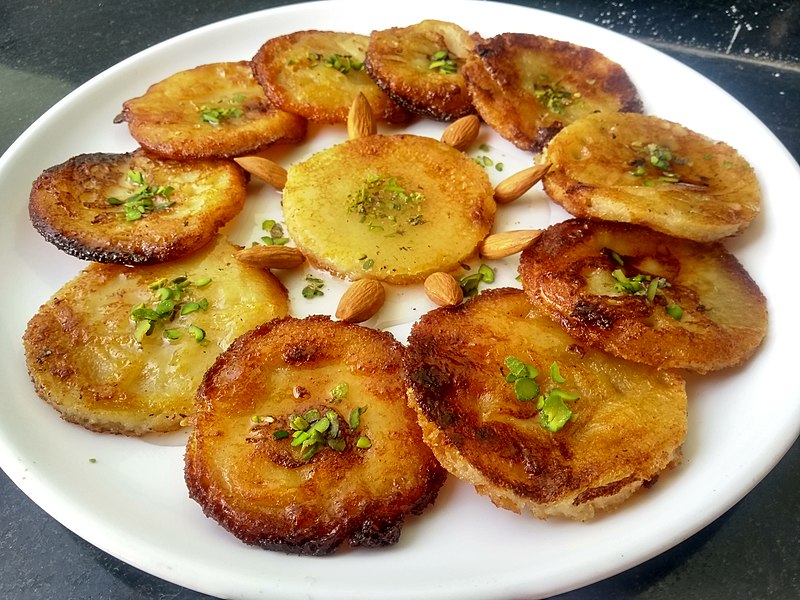
Tastes of Holi: Colorful mithaees for the Festival of Color
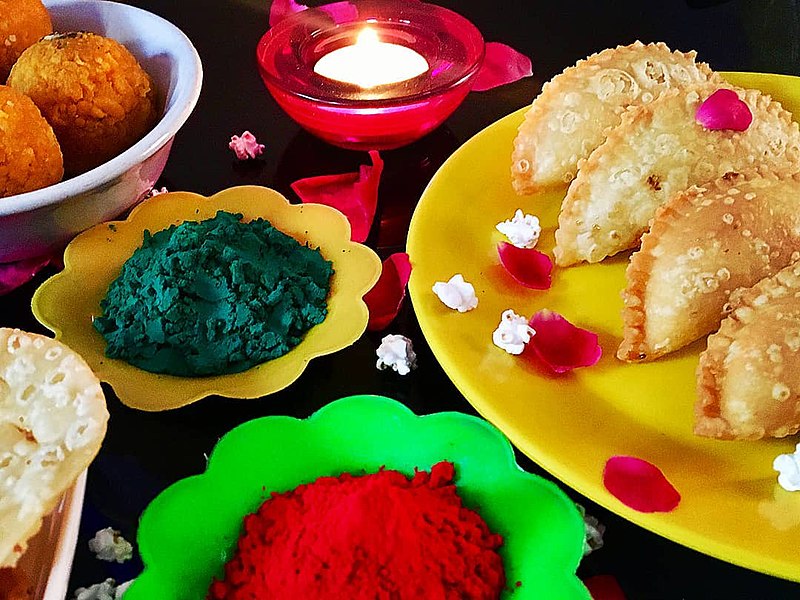
Gujjiya. Photo Courtesy Tasty Tangy @ Creative Commons Attribution-Share Alike 4.0 International license.
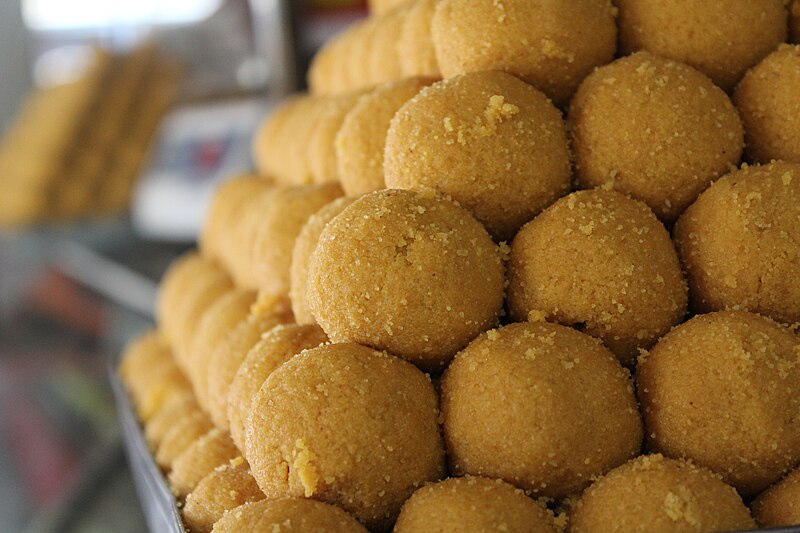
Besan Laddu. Photo Courtesy PJ Wililovesfood @ Creative Commons Attribution-Share Alike 4.0 International license.- First, before lighting the stove, a tablespoon of the ghee is added to the coarse besan flour and mixed thoroughly.
- The ‘mawa’ is crumbled properly and set aside.
- A simple syrup of 1 and a half consistency (taar) is made and kept aside to cool to lukewarm temperature after adding a few drops of lemon juice.
- Then, the besan to which ghee is added is roasted on very low fire in the remaining ghee, stirring constantly, till it feels light, and becomes aromatic and slightly pink.
- At this stage, the ‘mawa’ is added slowly, stirring all the time, and mixed properly into the besan. Both are roasted a little more till the mixture is dry and deep pink.
- The sliced nuts and raisings are added now. The mixture is then taken off the stove and allowed to cool a little.
- The cooled sugar syrup is added and mixed with the flour mixture when it can be touched by hands without burning.
- Little laddus are formed from this mix.
- First, the rice is washed thoroughly, drained and dried.
- Then the entire ghee, except a tablespoon, is added to the rice. Also are added the cardamom, cinnamon, cloves, finely chopped ginger, the bay leaf, and a pinch of turmeric powder for color. Everything is mixed well and the raw rice is then set aside to marinate for an hour.
- An hour later, plenty of water is boiled on one stove, while on another, the cashews are roasted first in the reserved spoonful of ghee and then the rice mix is added to the same pan. Both are roasted on low fire for a long time till the rice acquires a different color. The raisins are added at this point and allowed to fluff up.
- Boiling water is added to the rice now, making sure it is a little less than double the measure of rice. Then salt is added, letting the rice cook covered for about ten minutes.
- Once the rice is cooked al dente, the sugar is added along with slit green chilies, mixing everything carefully not to break the rice.
- The rice is covered again and cooked till the sugar dissolves and any water from it evaporates.
Poran Poli. Photo Courtesy Heena78624 @ Creative Commons Attribution-Share Alike 4.0 International license.Wednesday, 13 March 2024
Holi: what the clouds of colour in the Hindu festival mean
Holi is one of the most vibrant and fun festivals in the Hindu calendar. It’s practised across India (though mainly in the north), Nepal and throughout south Asian diasporic communities.
The date of Holi varies in accordance with the lunar calendar but the festival often takes place in February or March. In 2024, it’s celebrated on March 25.
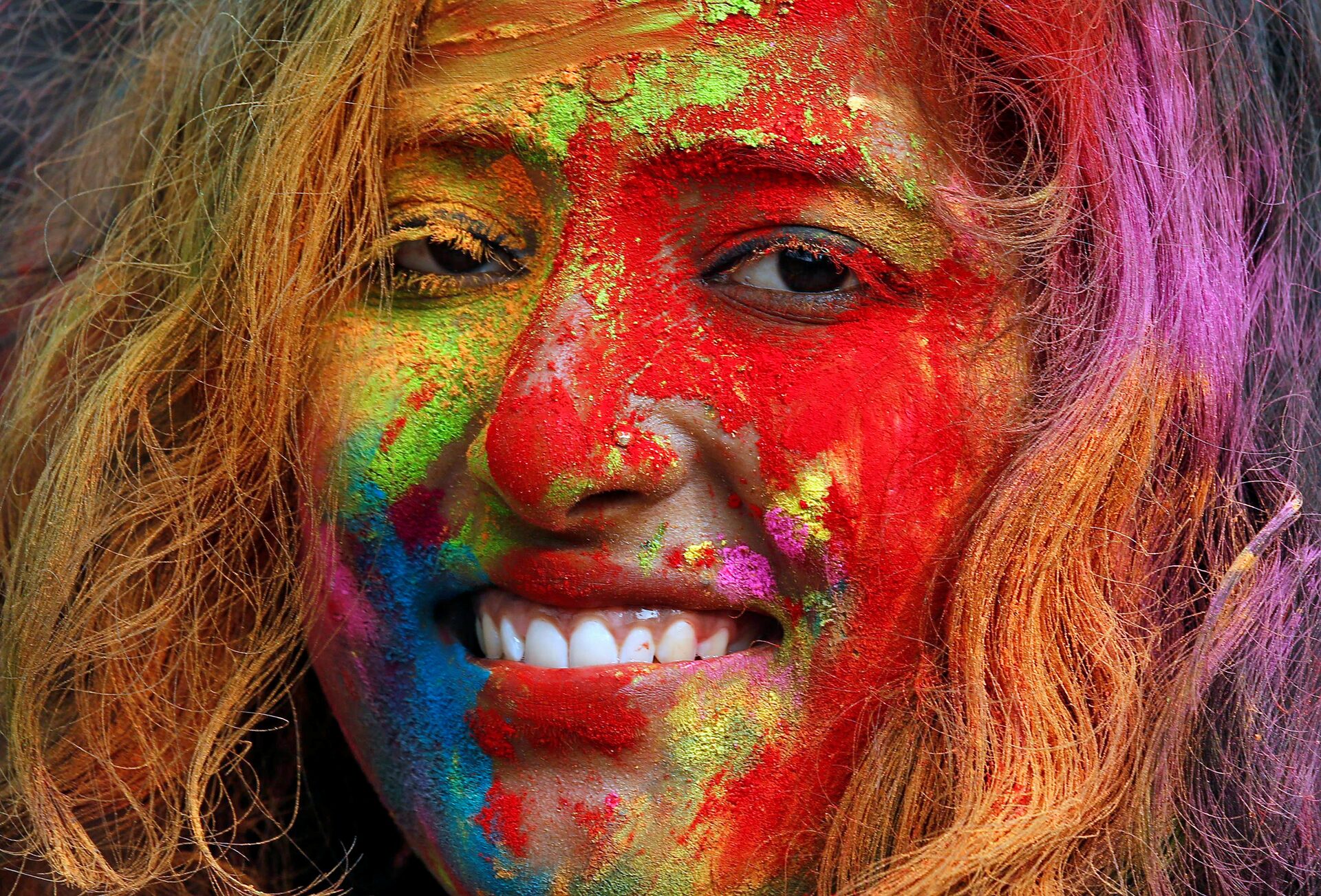
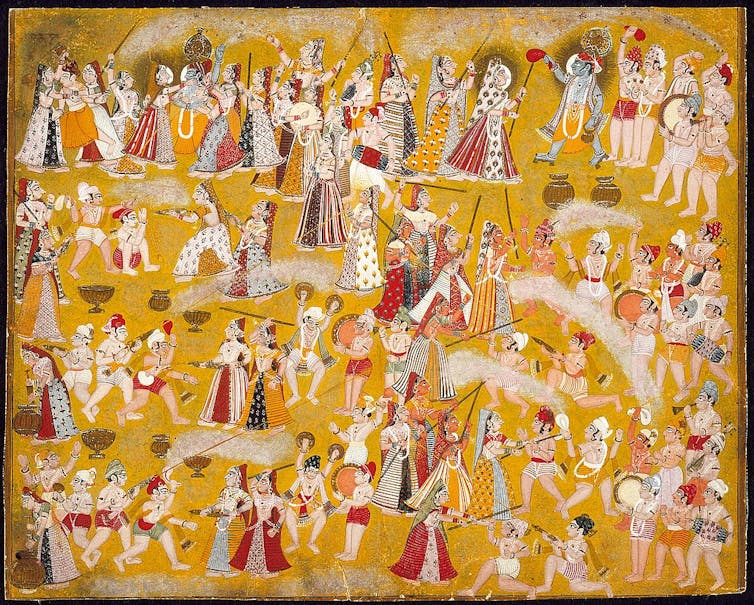
People gather together to throw and smear gulal or coloured powders over each other in a symbolic celebration of spring, the harvest, new life and the triumph of good over evil. As with many Hindu festivals, there is more than one narrative explaining its symbolism, but it is the visual splendour of this festival that explains its appeal.
My research focuses, in part, on the religious and material culture of Hinduism, especially in relation to its practice in contemporary culture. One of the most uplifting aspects of Holi is the way people from all walks of life come together. It is an expression of the dynamism of Hinduism and the power of fellowship.
An explosion of colour
Holi conveys the exuberance and multisensory character of many Hindu festivals. The coloured powders are typically red, yellow and green, representing the colours of spring but each also carrying more individual significance.
Red, which is popularly used in marriage celebrations, is the colour of fertility. Yellow is regarded as an auspicious colour. Green symbolises new beginnings.
Traditionally, the coloured powders used in Holi festivities were organically sourced from dried flowers and herbs. Today they are synthetic. Celebrants throw or smear handfuls on each other, or use water-filled balloons or pichkaris (water pistols) to disperse coloured waster, adding to the carnivalesque feel of the event.
It is an immersive experience. Everyone comes together and merges in the magic of the crowd. Traditional hierarchies are suspended. Spontaneity and excitement take over. People talk about “playing” Holi in the powdered clouds of colour.

The other tells of the demon king Hiranyakashipu’s attempt to force his subjects to worship him. When his son, Prahlad, persisted in worshipping Lord Vishnu instead, Hiranyakashipu instructed his sister, Holika, to kill Prahlad.
Holika, who was invulnerable to fire, made the boy sit on her lap, on a pyre. Onlookers were astonished to see, however, that Prahlad’s devotion to Lord Vishnu saved him while Holika burned to death.
The event of playing with colour, now synonymous with Holi, is actually part of a larger series of rituals. The first night of festival, known as Holika Dahan, involves lighting bonfires and throwing on food such as grains. As a re-enactment of the death of the mythical demoness Holika, this ritual marks the end of winter and the overthrow of evil.
The next day, Rangwali Holi, sees people venturing out on to the streets to exchange colour. In the final part of this festival, in the evening, after washing off the colours and donning clean clothes, people gather with family and friends to eat traditional dishes including gujiya (a North Indian sweet fried dumpling).
Like Diwali (the “festival of lights” as it is often known) and the Hindu new year, Holi is celebrated by the Hindu diaspora in the UK, the US, Fiji, Mauritius and beyond. Temple organisations host Holi in their venues. Unlike in India where festivities are public and widespread, diasporic celebrations are more regulated to specific spaces and times.
Parties for Holi are not uncommon. You can routinely find events organised each year on platforms such as Eventbrite where ticket sales often include the prior purchase of non-toxic powders.
Some of these events are targeted at south Asian communities. They include renactments of plays, dance performances and further heritage elements.
Others capitalise on the spirit of revelry embodied by commercially driven colour marathons. These have elicited claims of cultural appropriation for their largely secular tone.![]()
Rina Arya, Professor of Critical and Cultural Theory and Head of the School of the Arts, University of Hull
This article is republished from The Conversation under a Creative Commons license. Read the original article.
Sunday, 31 December 2023
Happy New Year 2024
Tuesday, 19 December 2023
How to deal with homesickness your first Christmas away from home
Nilufar Ahmed, University of BristolChristmas is synonymous with home, family and tradition. But not everyone can be home for Christmas. For many young people, work, school and relationships may mean you’re living far from family – and these circumstances can make it difficult to go home for the holidays. You may be finding the thought of spending Christmas away for the first time is making you feel down.
Homesickness is a normal phenomenon that will affect almost everyone at some point in their life. Important holidays can cause or intensify feelings of homesickness – especially when it feels like everyone else is going home to be with their loved ones.
Sometimes, homesickness can come as a surprise – especially if you’re otherwise enjoying where you are. This is because home is more than just a geographical location. Often, our sense of home refers to the people, the food and the sense of familiarity, safety and connection we find there.

This article is part of Quarter Life, a series about issues affecting those of us in our twenties and thirties. From the challenges of beginning a career and taking care of our mental health, to the excitement of starting a family, adopting a pet or just making friends as an adult. The articles in this series explore the questions and bring answers as we navigate this turbulent period of life.
You may be interested in:
Sex Education: a sex therapist’s advice on having a successful long-distance relationship
Want to start therapy, but not sure what type will be right for you? Here are four to consider
For some people, home is much more nuanced. Some elements of it may be positive – others less so. Still, a complex set of emotions may emerge around Christmas – and you may find yourself missing some elements of being away from home and family.
These feelings can be easy to manage for some. For others, they can be quite intense. In fact, homesickness has been described as a form of mini grief, where in order to move on, there has to be a process of working through feelings.
In extreme cases, homesickness can linger. It can cause you to ruminate over feeling out of place, which may affect your mental health and make you less willing to socialise.
But while this time of year can be difficult if you’re spending it away from family for the first time, there are many things you can do to get through it:
1. Sit with your feelings
It’s okay to feel lonely and miss home – even if you really love where you are in life.
Acknowledge your homesickness and what it means for you. Give yourself space to experience your feelings instead of cramming your schedule full to avoid discomfort.
Talk about how you’re feeling. Or, if that’s too hard, write your thoughts down. This helps challenge overthinking, which can worsen your sense of isolation and keep you focused on missing home. Writing can help clear your mind.
2. Understand why you’re homesick
Homesickness happens for a number of different reasons. For many people, homesickness is because they’re thinking about missing out on activities they enjoy doing with friends and family.
Thinking about what these feelings mean to you, and what may be triggering homesickness, may help you remedy it.
If you’re feeling homesick because you’re going to miss doing things with your family, figure out how can recreate these activities where you are. Things like going to an outdoor Christmas market or watching a classic movie are all things you can reproduce locally.
While, of course, things will be different, you’re still recreating core traditions and making new memories. This can also help you to feel less guilty about enjoying yourself even though you’re away from loved ones.
3. Plan video chats
If you can’t be with your family in person, try scheduling video calls. These can have many positive effects on wellbeing as it allows you to connect in real time and can provide a greater sense of closeness compared to other forms of communication.
It’s easy to convince ourselves that we’ll be interrupting activities. But planning ahead can mitigate against these negative thoughts. Remember, your loved ones will also be missing you. If you can, try doing something together on the call – such as opening a present or having a drink. This will help you feel more involved with the festivities at home.
Do make some Christmas plans of your own to look forward to, as seeing family could also potentially increase feelings of homesickness.
4. Stock up on familiar foods
Try to buy or make your favourite staple comfort foods from home. Eating foods that are part of your family’s traditions may help alleviate feelings of homesickness.
If you’re missing a home-cooked dinner and it feels like too much for one, consider teaming up with a friend who may also be on their own.
5. Make connections
While it may feel like everyone else is having a great time at Christmas, it’s actually a time of year when people can feel particularly alone and stressed. There are probably others in the same boat as you.
Go online or even post on social media to connect with others. Building valuable connections can help lessen feelings of homesickness and give you a sense of belonging. Building new routines is also shown to help people feel more at home in new places.
Volunteering is another great way to connect with others in your community. Volunteering is also associated with a range of benefits for wellbeing – including developing confidence and improving mental health.
6. Get outdoors
If it’s hard to be around other people this time of year, consider getting outdoors for a solo hike or walk.
Research has found that exposure to green spaces can improve feelings of homesickness. If you can’t go far, even just a stroll around a park can help as exercise is fundamental to wellbeing and mood.
It’s normal to feel homesick around the holidays if you can’t be with family. But if you find that these feelings persist beyond the holidays, it’s worth seeking help from your GP.![]()
Nilufar Ahmed, Senior Lecturer in Social Sciences, BA (Hons), MSc, PhD, CPsychol, HE Cert (Couns.), PG Dip (Couns.), FHEA, FRGS, MBACP, University of Bristol
This article is republished from The Conversation under a Creative Commons license. Read the original article.
Saturday, 16 December 2023
Santa Claus is coming to town! How to help kids manage the big build-up to Christmas
Richard Stachmann/Unsplash, CC BY Penny Van Bergen, University of Wollongong
School is out and Santa is on his way, but there’s still a bit of a wait before he wriggles down that chimney. The days before Christmas are both exciting and challenging for children and families.
How can you manage kids’ excitement in this last build-up to Christmas? What should you do if emotions run over? And how might you respond if all the focus on Santa means some kids start asking if he is real?
Help kids manage outbursts
Parents and carers may notice children are adorably ridiculous at this time of year (or maybe just ridiculous).
Each day brings a swirling mix of tears, laughter, shouts and tired panda eyes. Sleep patterns can also be disturbed across the Christmas break, with late nights and early mornings leading to extra tiredness.
For younger (and even older) children, temper tantrums may be more common.
If your child does have an outburst, give them some time to cool off. Although it can be tempting, try not to enforce harsh punishments in the moment. An angry threat to cancel Christmas (“I’m going to tell Santa not to come!”) may be matched by an equally angry response by your child.
Instead, come back when you are both calm, acknowledge how they and others might be feeling and discuss how best to manage those emotions (“If you are feeling very excited, go outside and run around instead of hitting your brother”).
Also be conscious of your own emotions. Children often model the emotions and behaviours they see from others. So, despite all the things you have to do at the moment, try and pause, relax and seek out opportunities for joy in this festive season.
You may seem more tantrums before Christmas as kids navigate their excitement. Marta Wave/Pexels, CC BY
Help children explore questions about Santa
Of course, Christmas holds a range of deeper meanings for religion and family. But a key source of excitement in the lead up to Christmas is Santa. The magical world of Santa, reindeers and elves sparks particular joy for kids.
If your child is in early primary school, you might be worrying “what happens if Stella discovers the truth”?
Try not to let this become a family stressor.
Children begin making distinctions between fantasy and reality in preschool, although often continue to believe in Santa for longer: particularly if parents promote these beliefs.
In one study, children who no-longer believed were interviewed about how they had felt when they realised Santa was not real. Some felt momentarily bad or disappointed but more than half reported feeling happy or relieved to know the truth. They had been wondering anyway.
If children are questioning their beliefs already, consider exploring this with them by asking “what do you think?” Either way, negative emotions tend to be short-lived: indeed, many children continue to pretend to believe in Santa just for fun.
Help manage holiday expectations
For those at home before Christmas, complaints of boredom may already have set in. These are particularly challenging for parents who are still working.
Some children may be happy playing with siblings. For other children, it can help to create routines to manage their expectations. This might include times you will be available to play with them, excursions and free play. Include children in the negotiations and help them to manage excitement by creating a list of activities they would like to complete.
For families already away on holidays, the challenges are different but real. An expectation of relaxing bliss can sometime contrast with a reality that is more intense.
Interviews with Danish children and their parents about their trips away reveal both joy and tension, with closer living quarters and 24/7 activities bringing social overload and frayed tempers over time.
Routines can help here too, even if they differ from those at home. Map out when you will be sharing fun activities together and build in quiet time to soothe frayed nerves.
Dear Santa, I promise I have been really good this year … Helena Jankovičová Kováčová/ Pexels, CC BYPlan Christmas Eve
For all children, Christmas Eve is likely to see a clash of excitement and emotion. Help children to plan out any family rituals beforehand, including what time they will go to bed.
For those with siblings, help them to plan who will complete what tasks. This might include chopping carrots for reindeer, pouring milk for Santa, or lighting special Christmas candles. Ensure the negotiations are fair and everyone is happy.
Above all, enjoy. Stories of stress and conflict related to Christmas abound, yet research shows an abundance of positive emotions across the period. ‘Tis a most wonderful time of the year.![]()
Penny Van Bergen, Head of School of Education and Professor of Educational Psychology, University of Wollongong
This article is republished from The Conversation under a Creative Commons license. Read the original article.
Friday, 10 November 2023
India’s festival season to bring some cheer to economy, say economists – Reuters Poll

Wednesday, 1 November 2023
Diwali is the festival of purity..
Devotees across around the world will bring festivities into their homes by lighting earthen lamps called diyas, setting off fireworks, displaying colored electric lights and exchanging gifts. In northern India, this date also marks the beginning of the new year.
The day is specially dedicated to the worship of Lakshmi, the Hindu goddess of prosperity and good fortune.
Who is Lakshmi?
In modern images, Lakshmi is typically depicted wearing either a red or a green sari. The upper two of her four hands are holding lotus flowers, while her lower right hand is upraised in the “do not be afraid” gesture, or abhaya mudra.
Her lower left hand is pointed downward with her palm facing out and golden coins are falling from it. She sits or stands upon a large red lotus flower. Often, there are two elephants behind her with their trunks upraised. As poet Patricia Monaghan writes, sometimes these elephants “shower her with water from belly-round urns.”

Lakshmi is believed to be the consort of Vishnu, who is the preserver of the cosmic order, or dharma. As Vishnu’s shakti, or power, Lakshmi is his equal and an integral part of his being.
In the Srivaishnava tradition of Hinduism, Lakshmi and Vishnu make up a single deity, known as Lakshmi Narayana. Also known as Shri, Lakshmi is believed to mediate between her human devotees and Vishnu.
Origins of Lakshmi
According to the sources I have studied as a scholar of Hindu, Jain and Buddhist traditions, Shri in fact seems to be the earliest name given to this goddess in Hindu texts. This word originally means splendor and it refers to all that is auspicious: all the good and beautiful things in life. The name Lakshmi, on the other hand, refers to a sign, imprint or manifestation of Shri. These two words seem to refer to two distinct goddesses in the earliest Hindu literature, the Vedas.
By the first century, however, which is the period of the writing of the “Puranas,” or the ancient lore of the Hindu deities, these two deities appear to have merged into a single goddess, known as Shri, Lakshmi or Shri Lakshmi.
There are many stories of Lakshmi’s origins. In the most popular of these, from the fifth century Vishnu Purana, she emerges from the ocean when the Devas and Asuras, the gods and the anti-gods, churn it to acquire amrita, the elixir of immortality. In another source – the Garuda Purana, a ninth-century text – she is said to be the daughter of the Vedic sage Bhrigu and his wife, Khyati.
Those who wish for prosperity in the new year say special prayers to Lakshmi and light diyas in their homes so the goddess will visit and bless them.![]()
Jeffery D. Long, Professor of Religion and Asian Studies, Elizabethtown College
This article is republished from The Conversation under a Creative Commons license. Read the original article.