bloggggg

Home  |  Live  |  Science  |  Lifestyle  |  Entertainment  |  Broadcast  |  Games  |  eBooks  |  Astounds  |  Adbite  |  Cricbell  |  Cyber  |  Idea  |  Digital  |  Privacy  |  Publish  |  ePaper  |  Contact  .Subscribe.Subscribe.Subscribe.Subscribe.Subscribe.Subscribe.Subscribe.Subscribe.Subscribe
Subscribe

Monday, 25 March 2024

Celebrate this Holi with nature by making your own colors, says Hyderabad-based artist

Reuters photo from archives.

Nature enthusiast and artist, Manya, a resident of Hyderabad is on a mission to transform Holi celebrations by advocating natural colors made from everyday ingredients. She shared her expertise in crafting eco-friendly hues, urging individuals to embrace the beauty of nature this festive season saying people should let this Holi spread happiness in the festival of colors using natural colors made from nature.

Speaking to ANI, Manya said “Today, I am going to share with you how you can make your own Holi colors with what’s available around you, either from your kitchen or your garden.”
Drawing from her journey with natural dyes, Manya highlighted the simplicity of the process. “I started dyeing my clothes, upcycling them with things like haldi, pomegranate peel, onion skins, and others,” she explained. “All these can also be used for Holi colors.”

She provided easy-to-follow recipes for creating vibrant hues,with ingredients like turmeric, beetroot, onion skins.

“The first and simplest one is where we can mix Haldi with water and get a yellow colour. This is if you want to play with water-based colors. Another one is beetroot water where we can just peel a beetroot and boil it to get a red colored water. If you mix the yellow color with the red color, you will get orange-colored water. So already you have three colors. Similarly, we can make a juice of spinach, coriander or any green leafy vegetables or its waste to get green color,” Manya said.

“If you prefer powder-based colors, you can use haldi directly which is very good for the skin or even add cornflour to give a smooth texture. Adding cornflour makes it smooth and makes it a color that stays long. You have to make a paste of haldi and water and then add cornflour to get more color and texture. Similarly, we can also make other colors with flowers and others.”

The ‘palash’ or the ‘flame of the forest’ flower was originally used to play Holi, she noted. Marigold flowers, Indigo or neem leaves were also used to play Holi in earlier days.

“All these naturally made colors are skin-friendly and skin-safe. Natural dyes can be added to your life not just during Holi, but also during regular days. There is a source of every color in nature,” she contended. “I have printed clothes and bags using these natural colors. The possibilities are limitless. I have made hundreds of colors from nature,” Manya said.

“Natural colors are safe for your skin, safe for your family and safe for the planet,” she emphasized. “The synthetic gulal is not at all good for our skin. People often ask what difference it will make as it is only a single day but if it is toxic, why would you want to consume poison even for a single day? Making these natural colors together as a family is also a fun experience for Holi,” Manya concluded.

This year, Holi will be celebrated on March 25. The festival also involves lighting bonfires, signifying the burning of the demon Holika. Amidst the revelry, traditional sweets are made and shared, fostering a sense of community. Source: https://www.newsindiatimes.com/celebrate-this-holi-with-nature-by-making-your-own-colors-says-hyderabad-based-artist/#

Wednesday, 13 March 2024

Holi: what the clouds of colour in the Hindu festival mean

Holi is one of the most vibrant and fun festivals in the Hindu calendar. It’s practised across India (though mainly in the north), Nepal and throughout south Asian diasporic communities.

The date of Holi varies in accordance with the lunar calendar but the festival often takes place in February or March. In 2024, it’s celebrated on March 25.

People gather together to throw and smear gulal or coloured powders over each other in a symbolic celebration of spring, the harvest, new life and the triumph of good over evil. As with many Hindu festivals, there is more than one narrative explaining its symbolism, but it is the visual splendour of this festival that explains its appeal.

My research focuses, in part, on the religious and material culture of Hinduism, especially in relation to its practice in contemporary culture. One of the most uplifting aspects of Holi is the way people from all walks of life come together. It is an expression of the dynamism of Hinduism and the power of fellowship.

An explosion of colour

Holi conveys the exuberance and multisensory character of many Hindu festivals. The coloured powders are typically red, yellow and green, representing the colours of spring but each also carrying more individual significance.

Red, which is popularly used in marriage celebrations, is the colour of fertility. Yellow is regarded as an auspicious colour. Green symbolises new beginnings.

Traditionally, the coloured powders used in Holi festivities were organically sourced from dried flowers and herbs. Today they are synthetic. Celebrants throw or smear handfuls on each other, or use water-filled balloons or pichkaris (water pistols) to disperse coloured waster, adding to the carnivalesque feel of the event.

It is an immersive experience. Everyone comes together and merges in the magic of the crowd. Traditional hierarchies are suspended. Spontaneity and excitement take over. People talk about “playing” Holi in the powdered clouds of colour.

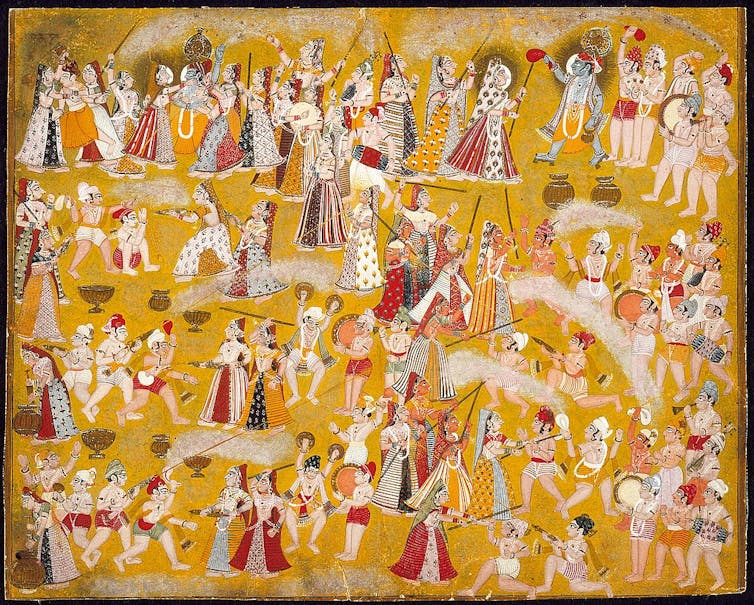
As an ancient tradition with multiple regional variations, Holi is underpinned by two prevailing narratives. The first is the eternal divine love between Lord Krishna (the incarnation of the Hindu deity, Vishnu) and the goddess Radha.

A watercolour depicting Krishna and Radha celebrating Holi from 1750. LACMA|Wikimedia

The other tells of the demon king Hiranyakashipu’s attempt to force his subjects to worship him. When his son, Prahlad, persisted in worshipping Lord Vishnu instead, Hiranyakashipu instructed his sister, Holika, to kill Prahlad.

Holika, who was invulnerable to fire, made the boy sit on her lap, on a pyre. Onlookers were astonished to see, however, that Prahlad’s devotion to Lord Vishnu saved him while Holika burned to death.

The event of playing with colour, now synonymous with Holi, is actually part of a larger series of rituals. The first night of festival, known as Holika Dahan, involves lighting bonfires and throwing on food such as grains. As a re-enactment of the death of the mythical demoness Holika, this ritual marks the end of winter and the overthrow of evil.

The next day, Rangwali Holi, sees people venturing out on to the streets to exchange colour. In the final part of this festival, in the evening, after washing off the colours and donning clean clothes, people gather with family and friends to eat traditional dishes including gujiya (a North Indian sweet fried dumpling).

Like Diwali (the “festival of lights” as it is often known) and the Hindu new year, Holi is celebrated by the Hindu diaspora in the UK, the US, Fiji, Mauritius and beyond. Temple organisations host Holi in their venues. Unlike in India where festivities are public and widespread, diasporic celebrations are more regulated to specific spaces and times.

Parties for Holi are not uncommon. You can routinely find events organised each year on platforms such as Eventbrite where ticket sales often include the prior purchase of non-toxic powders.

Some of these events are targeted at south Asian communities. They include renactments of plays, dance performances and further heritage elements.

Others capitalise on the spirit of revelry embodied by commercially driven colour marathons. These have elicited claims of cultural appropriation for their largely secular tone.The Conversation

Rina Arya, Professor of Critical and Cultural Theory and Head of the School of the Arts, University of Hull

This article is republished from The Conversation under a Creative Commons license. Read the original article.

Wednesday, 20 September 2023

Amid the Hollywood strikes, Tom Cruise’s latest ‘Mission: Impossible’ reveals what’s at stake with AI in movies

The Writers Guild of America (WGA) strike has been going for over 130 days. Joined by the Screen Actors Guild-American Federation of Television and Radio Artists (SAG-AFTRA), Hollywood writers are protesting several issues.

Among other demands, the WGA is calling for explicit regulations on the use of AI in media production, in what Time Magazine called “a pivotal moment” in film history.

Enter Tom Cruise and cue the Mission: Impossible theme music.

Although Barbie and Oppenheimer received most attention this summer, Tom Cruise’s latest instalment in the Mission: Impossible series (Dead Reckoning Part One), reveals more about the future of movies.

Highlights threat from AI

Eerily prescient to the Hollywood strikes, yet begun well before the strike in 2020, this blockbuster explores AI threats to human society and our political order.

Cruise’s nemesis is an AI program called the Entity. Created as a cyberweapon, the Entity achieves sentience to become both agent and object in the ensuing global competition for power.

With computational omniscience in a digitally networked and reliant world, the Entity can manipulate digital and physical infrastructure, such as mobile phones and transit systems, and thus also control the humans who rely on digital interfaces.

Recognizing the Entity as a fundamental threat to humanity, Ethan Hunt (Cruise) of the Impossible Missions Force goes rogue (again) to acquire and destroy the AI.

Immersive experience

The film’s plot is a vivid reminder of how little agency humans have in digital environments, even as the cinematic environment relies on contemporary technologies to immerse its audience.

Like Cruise’s previous summer 2022 blockbuster, Top Gun: Maverick, Mission: Impossible — Dead Reckoning is designed to be cinema as experience more than story, using drone cinematography and sophisticated sound editing.

Director Christopher McQuarrie explained his approach as dedicated to “a fully immersive big screen experience,” including high-definition video and sound technologies that allow editors to create the sensation of sound in the audience’s physical environment.

Human acting, star power

As a Hollywood movie star, Cruise is similarly devoted to creating visceral audience experiences.

Even as computer-generated imagery (CGI) and digital effects have overtaken big-budget films, Cruise insists on doing all of his own stunts. He explicitly compared his approach to classic film performances, saying: “No one asked Gene Kelly, ‘Why do you dance? Why do you do your own dancing?”

Clips of his riding a motorcycle off a cliff circulated online six months before the film released.

When Mission: Impossible was released in July 2023 Cruise surprised fans at global premieres, spending time on the red carpet meeting and talking with them.

His dedication to in-person presence recalls an earlier era of Hollywood, when movie stars could not rely on social media to connect with their fans. Despite his public support for the strike, he also advocated for exemptions to allow actors to promote their films.

No digital de-aging

Unsurprisingly, McQuarrie decided against using a digitally de-aged Cruise, instead focusing attention on the physical fitness of a movie star who appears far younger than his 61 years.

All of Mission: Impossible – Dead Reckoning recalls earlier eras of cinema. The film’s title is taken, at least in part, from the 1947 film with Humphrey Bogart.

References to the six previous Mission: Impossible films abound, including the return of Canadian actor, Henry Czerny as Kittridge, Hunt’s adversary from the franchise’s first film in 1996.

The early desert sequence recalls big-screen desert epics like Lawrence of Arabia (1962), while the submarine introduction to the Entity’s power echoes The Hunt for Red October (1990), among others.

Classic car, train chases

A 20-minute car chase through the streets of Rome features an imperilled baby carriage on steps, a reference to the same scenario in director Sergei Eisenstein’s influential Battleship Potemkin from 1925.

Cruise is handcuffed to costar Hayley Atwell, a trick used in various films, including the James Bond film Tomorrow Never Dies (1997), while driving a small yellow Fiat, reminiscent of both The Italian Job (1965) and The Bourne Identity (2002).

There’s even an extended sequence where Hunt battles enemies on top of and throughout the Orient Express train, evoking everything from the films based on Agatha Christie’s novel, to Buster Keaton’s The General (1926), to yet another James Bond film, From Russia with Love (1963), whose plot hinged on the threat of misused cybertechnology.

The numerous cinematic references are to films that predate the era of streaming and social media.

Physical presence: a luxury?

Writers and actors are right to be worried. With so many processes in commercial media already routinized, the industry appears particularly vulnerable to generative AI.

The current circumstances recall earlier transitions such as the effect when films introduced sound technologies, a threat to silent-film actors dramatized in the Gene Kelly film, Singin’ in the Rain. More recently, movie theatres moved from celluloid to digital projection, largely eliminating projectionists.

Overt resistance to new technologies is rarely successful in the long term. Business professor and pundit Scott Galloway has compared the writers’ strike to the 1980s National Union of Mineworkers strike in Northern England.

With so much digital content available, physical presence and proximity becomes rarer and therefore more of a luxury item.

Return to live experiences

Certainly, audiences have returned robustly to live music concerts. (Just try getting a Taylor Swift ticket in Toronto.)

For now, we will all have to wait and see how it ends for cinema and those who make it. Part two of Mission: Impossible — Dead Reckoning isn’t due out until next summer.

Hopefully, it will be a Hollywood ending for all of us.The Conversation

Sarah Bay-Cheng, Dean of the School of the Arts, Media, Performance & Design and Professor of Theatre and Performance Studies, York University, Canada

This article is republished from The Conversation under a Creative Commons license. Read the original article.

Monday, 11 September 2023

Past Lives: a luxurious and lingering portrayal of lost love and identity in the Korean diaspora


Past Lives is Celine Song’s debut film about Nora and Hae Sung who were deeply connected in childhood. The film focuses on them reuniting as adults after a long separation.

The film introduces global audiences to the Korean Buddhist concept of In-Yun – the connection, fate or destiny of two people. Past Lives takes this millennia-old philosophical idea of human relationships and transposes it into the digital age through the young Korean diaspora.

Audiences meet Nora and Hae Sung when they are 12-year-olds in Korea. They are sweetly obsessed with each other in the way children of that age can be. Just as their young love is blossoming, however, Nora emigrates with her family to Canada. They reunite 22 years later when Hae Sung visits Nora in New York, where she now lives with her American husband.

The film asks what would you do if someone from your past, especially your first love, reappeared later in your life. Would your perception of this person change? Would they still be a lover or could you be friends? What impact would it have on your current relationship? Would you always be wondering what life could have been like?

These questions take on double meanings when considered from a diaspora perspective. Nora’s first love, Hae Sung, is Korean but by the time the pair meet she has lost some of her connection to that side of herself. She has let her Korean name, Na-Young, totally go, she only speaks Korean with her mother and she talks about Korean culture from a distanced perspective. She is Korean but Hae Sung is Korean, Nora explains to her American husband in one particularly funny scene.

Their In-Yun (reunion) and the questions it brings up are as much about love as they are about identity and Nora’s connection, or disconnection, to parts of herself and her past.

Past Lives, then, is not about Korean culture in its entirety but about the Korean diaspora, here represented by an author and playwright who may well see herself as an American woman. In this way, it is a staunchly Korean-American film.
Korean masculinity through a woman’s eyes

Korean film is becoming increasingly transnational today and there is a growing body of work by the Korean diaspora. Past Lives joins films such as the award-winning Minari, which is about a Korean-American family that moves to a farm in search of its American dream.

Past Lives is notable, however, as a Korean diaspora film made by a woman. One of the most fascinating aspects of the film is its female perspective.

Like Minari, Past Lives allows viewers an insight into Korea and Korean-ness from the diaspora perspective. This is all tied up in the very Korean character of Hae Sung. Here, Celine Song has employed the rare female gaze to portray her leading man.

The camera sees him the way Nora (played by Greta Lee) does: as a small-minded Korean man of middle or lower middle-class who does not even dare to fight for her. The camera looks upon him not sexually but lovingly as it lingers over him in a sort of appreciation, highlighting his sensitivity through close ups, like how he readjusts his hair or backpack. It tends to highlight the boyish qualities he maintains because, in my eyes, Nora loved little 12-year-old Hae Sung, but adult Hae Sung is too Korean.

Hae Sung is explosively portrayed by the actor Teo Yoo, a member of the diaspora himself as German-Korean. When Nora and Hae Sung meet in New York, he speaks only the broken English of a typical young middle-class Korean engineer. Yoo does a wonderful job of communicating Hae Sung’s complex feelings through a very physical performance. His nervousness and hopefulness can be read on his face and the way he holds his whole body.
Showing emotion rather than telling

Past Lives is full of extremely long lingering shots and close-ups that highlight the emotions of its characters. Song is invested in showing how characters feel rather than telling. This is heightened by the minimal use of music, acoustics and carefully chosen dialogue by a small number of actors.

The same can be said for her establishment of place as audiences are shown long shots of the landscapes and streets of Seoul. This sort of camera work is steeped in a sense of remembrance of past lives and evokes a lost time and space in a cool, emotionally charged, nostalgic way. Again, Past Lives deftly translates emotions through visuals for audiences who might not fully understand the diaspora experience in words but might through feeling.

Such stylistic choices, in my opinion, recall slow cinema – an atmospheric form of filmmaking steeped in long takes which favours silence over long dialogue.

Past Lives is a romantic tribute to the longing of the Korean diaspora for a lost past and homeland, a captivating and sensitively constructed film that will be enjoyed by many. 

Looking for something good? Cut through the noise with a carefully curated selection of the latest releases, live events and exhibitions, straight to your inbox every fortnight, on Fridays. Sign up here.

Hyunseon Lee, Senior Teaching Fellow in Centre for Korean Studies, SOAS, University of London

This article is republished from The Conversation under a Creative Commons license. Read the original article.

Wednesday, 16 August 2023

Romance fiction rewrites the rulebook

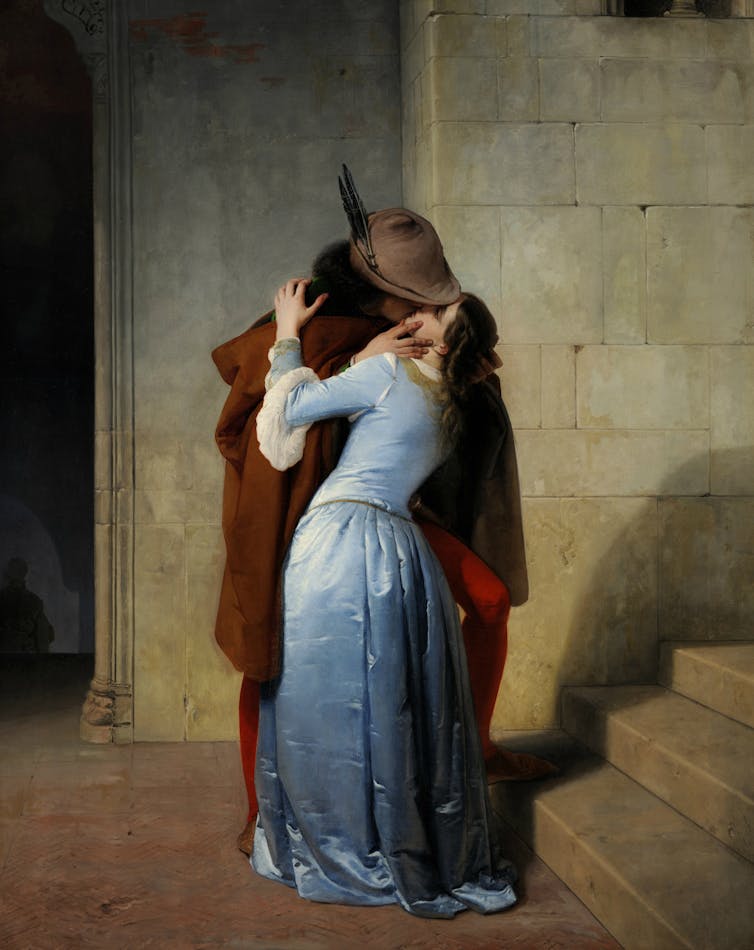
The Kiss - Francesco Hayez (1859). Wikimedia commons Beth Driscoll, The University of Melbourne and Kim Wilkins, The University of Queensland
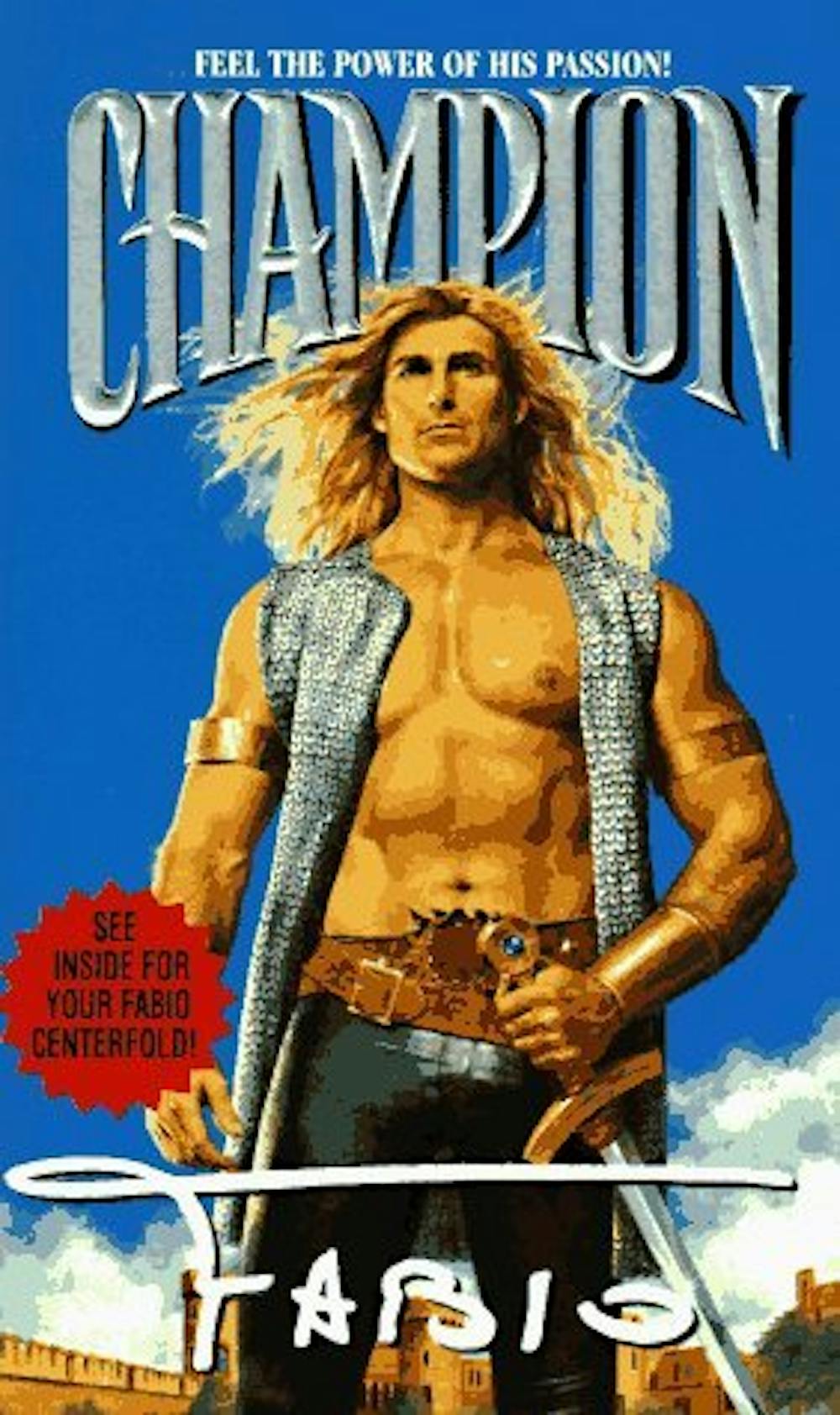
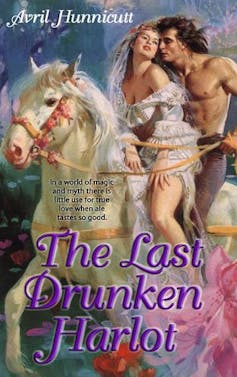
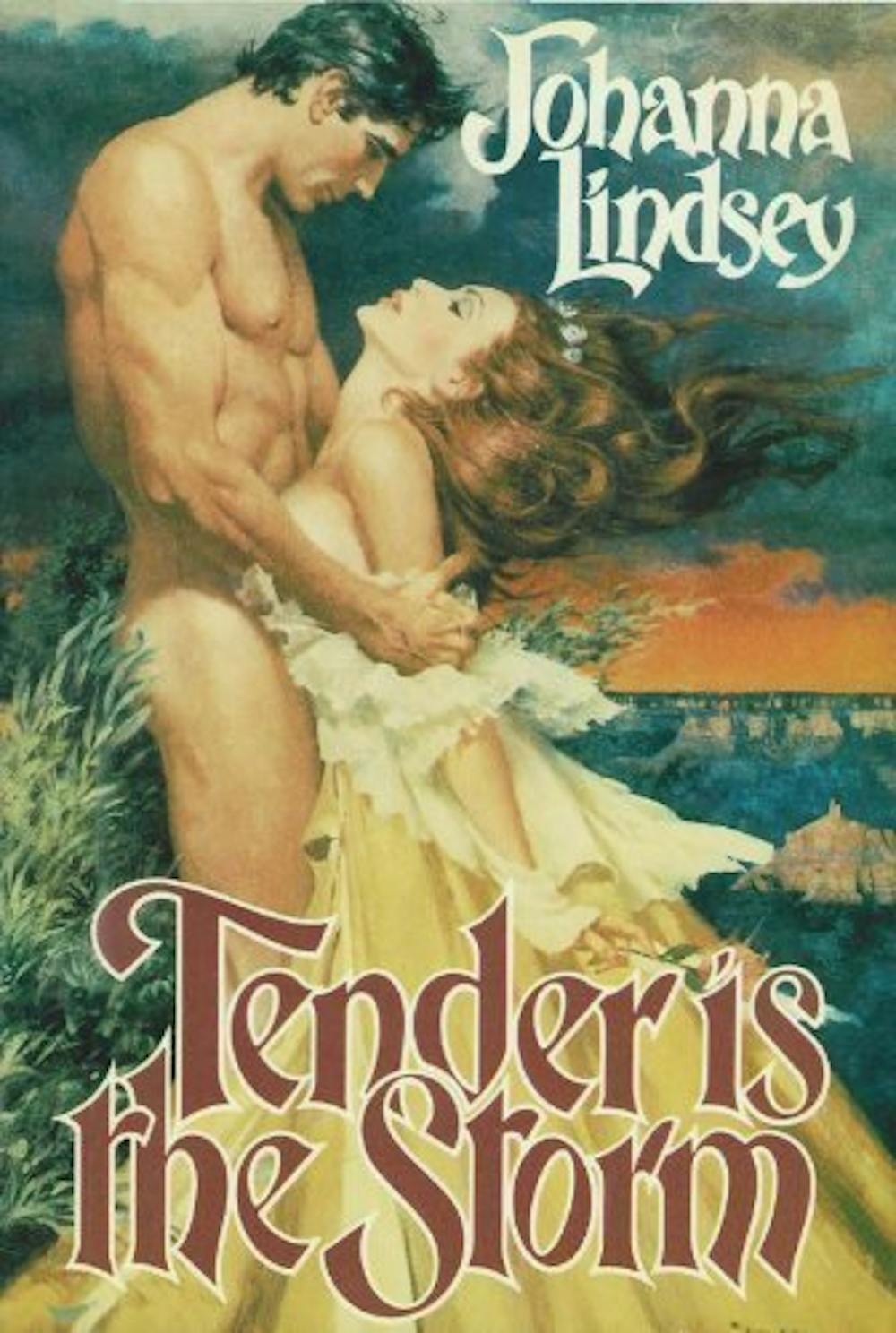
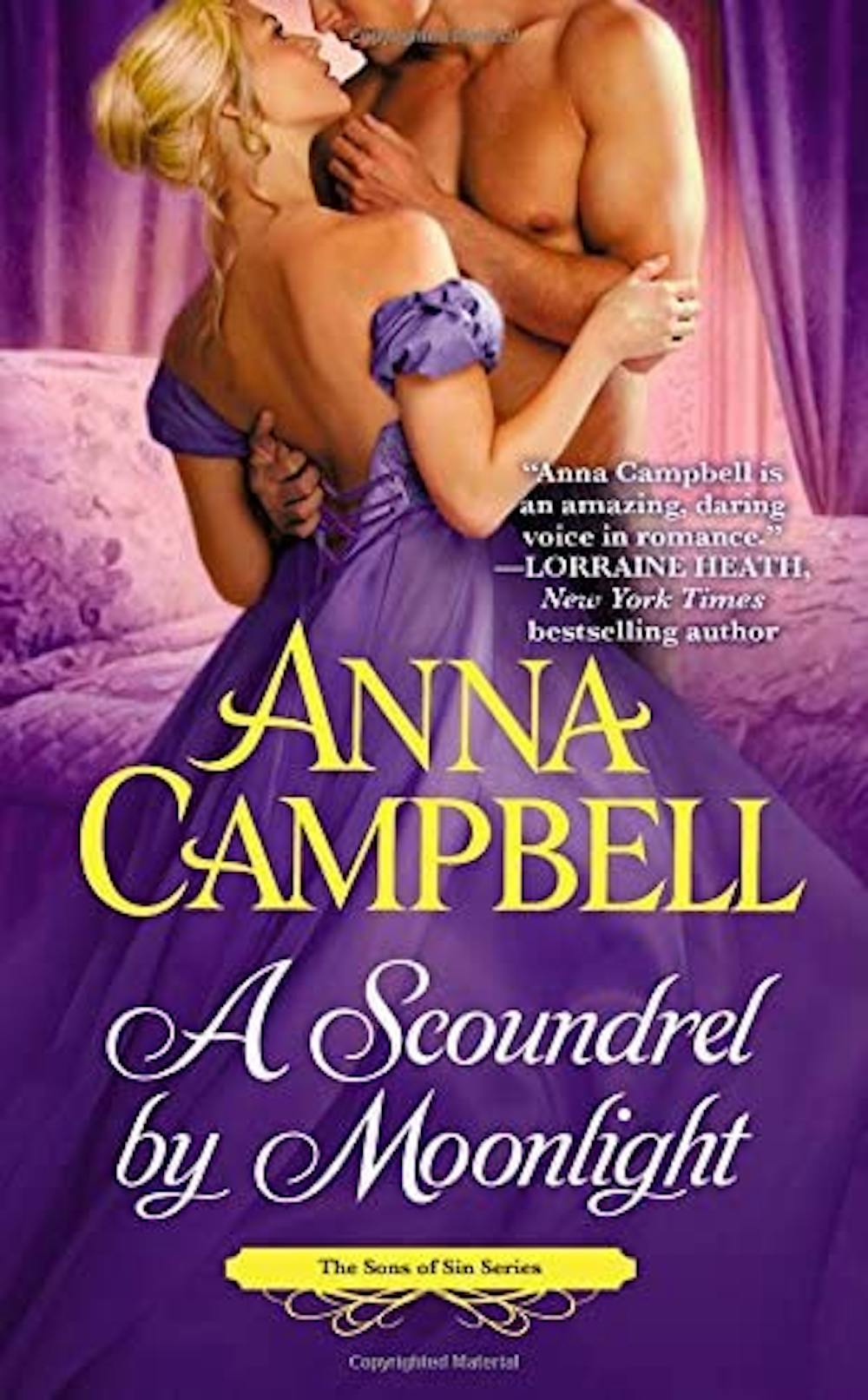
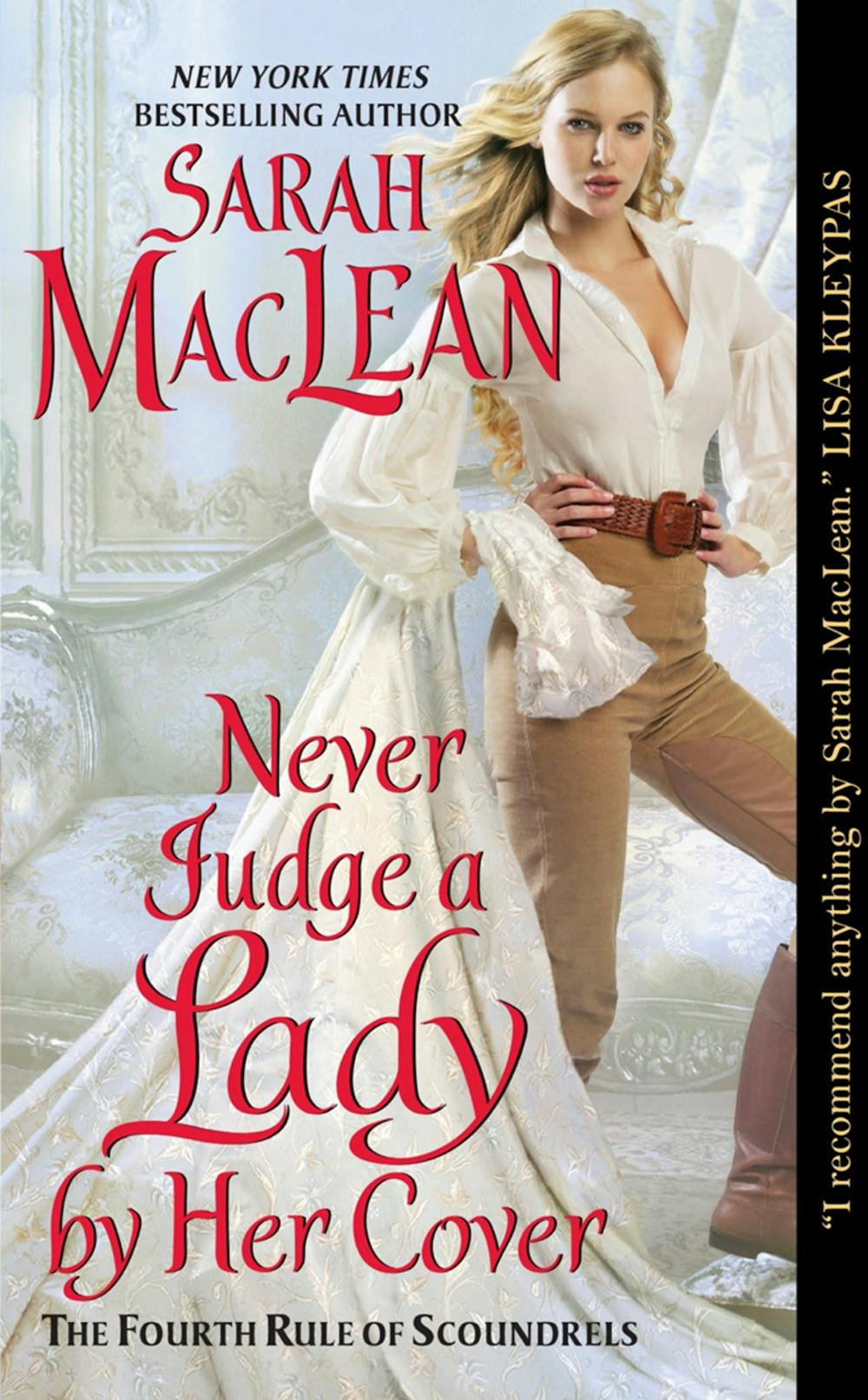
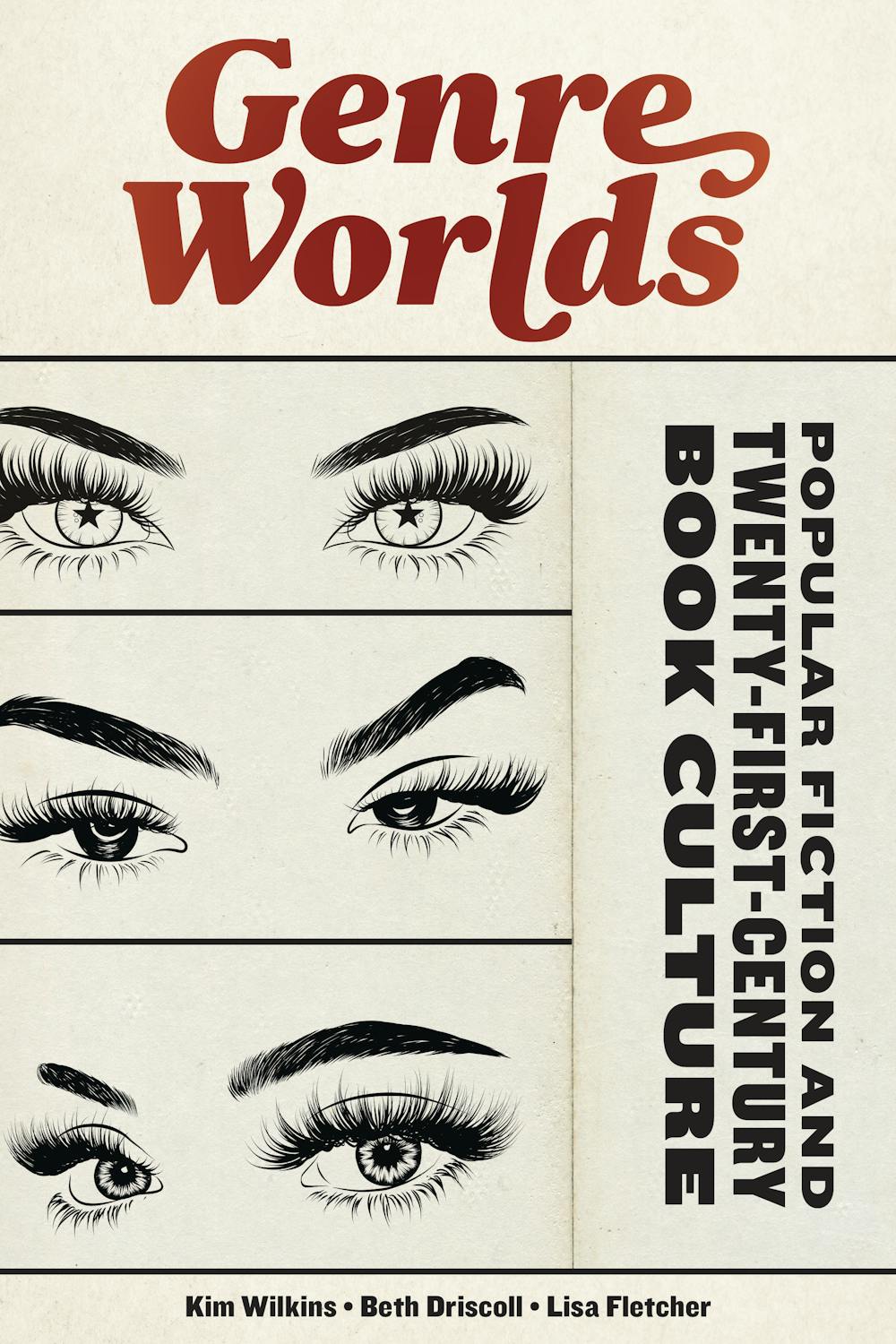
Romance fiction has one of the most recognisable brands in book culture. It is known for a handful of attributes: its happy-ever-after endings, the pocket Mills & Boon and Harlequin editions, the covers featuring Fabio (in the 1990s) or naked male torsos (the hot trend in the 21st century). It is known for being overwhelmingly written and read by women, and for being mass-produced. But romance fiction is also the most innovative and uncontrollable of all genres. It is the genre least able to be contained by established models of how the publishing industry works, or how readers and writers behave. Contemporary romance fiction is challenging the prevailing wisdom about how books come into being and find their readers. For our book Genre Worlds: Popular Fiction and Twenty-First Century Book Culture, coauthored with Lisa Fletcher, we conducted nearly 100 interviews with contemporary authors and publishing professionals. Our research shows that fiction genres are not static. They do not constrain artistic originality, but provide the kind of structure that sparks creativity and passion.
Genre fiction can be understood as having three dimensions. The textual dimension is what happens on the page. The industrial dimension is how the books are produced. And the social dimension is the people who write, read and talk about genre fiction. These three dimensions interact to create what we have called a “genre world”. Each distinct genre world (such as fantasy or crime) combines textual conventions, social communities and industry expectations in its own way. And romance is the most fast-paced, rapidly changing genre world of them all. When it comes to genres of articles, we have a soft spot for the listicle. So, here are five things you may not know about contemporary romance fiction – five things that show the dynamism at the heart of book culture. 1. Romance is at the forefront of digital innovation: Twenty-first century publishing has seen fundamental shifts in the way books are produced, distributed and consumed, largely thanks to digital technology. The romance genre is notable historically for its rapid production and consumption cycle. As a result, it has been well placed to adapt to the widespread uptake of digital publishing, which also moves rapidly. Romance writers and publishers are entrepreneurial and comfortable taking risks. The moment constraints are released, romance writers rush in. This is exactly what has happened with self-publishing. Since the advent of Kindle Direct Publishing in 2007, hundreds of thousands of romance books have been self-published there. Other opportunities have blossomed on sites such as Wattpad or through print-on-demand services such as IngramSpark. In Australia, for example, there was a 1,000% increase in the number of self-published romance novels between 2010 and 2016. 
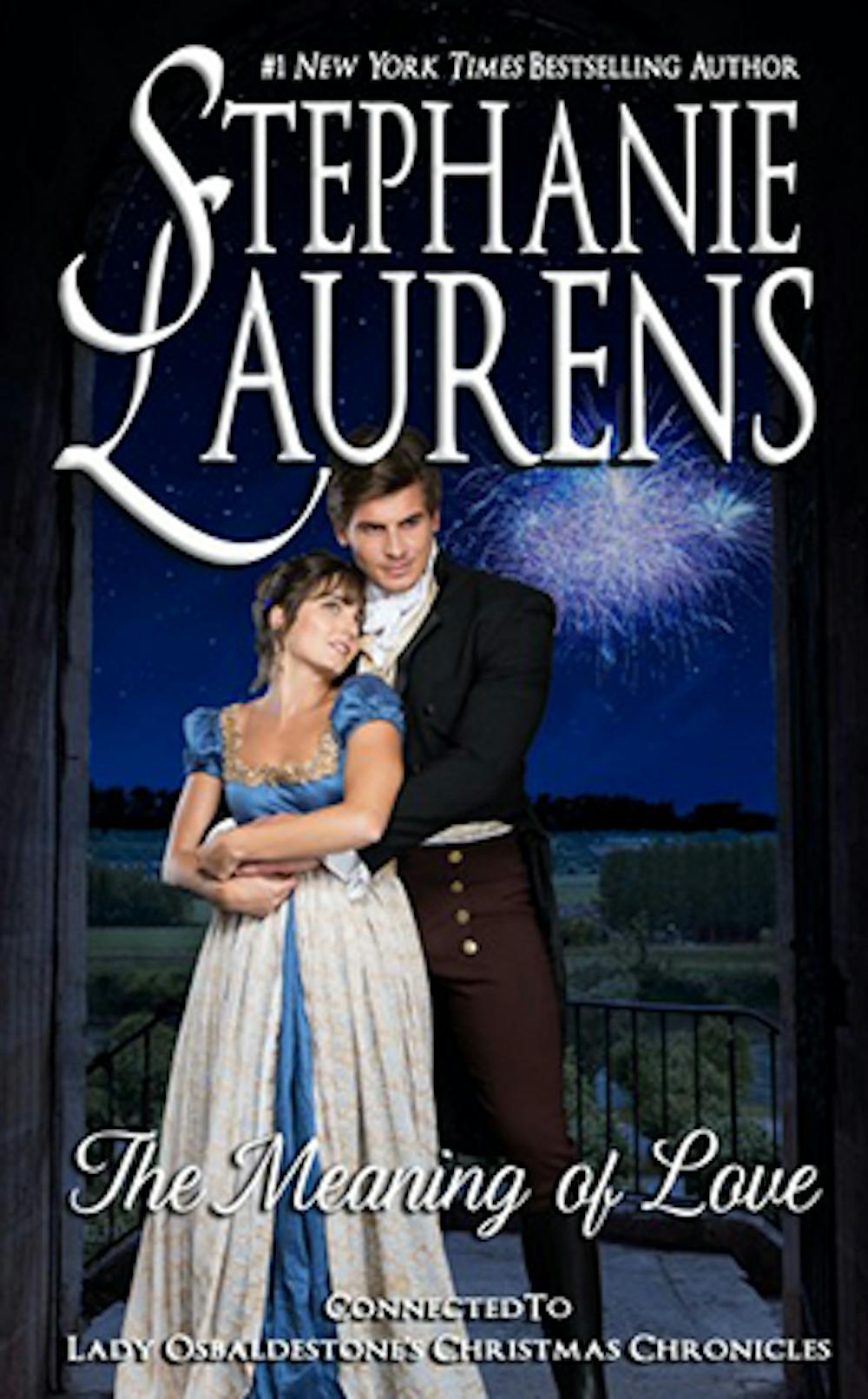
Some self-published romance novels have achieved mind-boggling success. Anna Todd’s 2014 romance novel After, originally fan fiction based on the band One Direction, drew more than 1.5 billion reads on Wattpad. It was subsequently acquired by Simon & Schuster and has spawned a movie series. In other cases, romance authors have formed co-ops to publish work together. Tule Publishing is a small, largely digital publisher with a limited print-on-demand service that produces multi-author continuity series as part of its publishing model. The Tule authors we interviewed spoke of their strong community and creative connections. The self-publishing of genre fiction has blurred the lines between author, agent, editor, cover designer, typesetter, publisher and bookseller. Stephanie Laurens, one of the world’s most successful romance novelists, began writing with Mills & Boon before moving to HarperCollins. In 2012, she gave a keynote address to the Romance Writers of America convention. She used the opportunity to reflect on industry change. Soon after, she began reconfiguring her own publishing arrangements.
Now Harlequin publishes her print novels, while she self-publishes the e-book versions. She also self-publishes novellas that are prequels to, or that sit between, the novels in her traditionally published series. Laurens is a prolific author with loyal fans, an author who can afford to take risks. She realises that self-publishing potentially offers her a better deal and has been able to pursue that while retaining ties to a traditional publisher. Her career complicates any view of self-publishing as second best. Her example has been much emulated among romance writers. Such a career move challenges how we might typically theorise the power relations of literary culture. 2. Romance readers are active and engaged: The dynamism of romance fiction is intimately linked with its engaged readers. Unlike other kinds of publishing, where the fate of each book is relatively unpredictable, romance has historically had many loyal readers who subscribe through mail-order systems to receive books regularly – a model that has not worked successfully at scale for any other genre. In the 21st century, many of these loyal romance readers are online. They tweet about their favourite authors, write Goodreads reviews, and run blogs and podcasts. 
People read romance fiction for different reasons. They might be drawn to its focus on the emotional nuances of relationships, its escape into various times and places (romance subgenres really do cover the gamut), or its gold-plated promise of happy endings and pleasure. They might read casually or intensely, with curiosity, scepticism or devotion. All of these are active modes; they can’t be reduced to consumerism. There is an element of feeling to the involvement. The shared pleasure and sense of belonging that comes with being in the genre world came up regularly in our interviews. Author Rachael Johns, speaking of romance fiction, said “this is my passion, I fell in love with the romance genre”. Agent Amy Tannenbaum described the romance community as “tight-knit”. Harlequin marketing specialist Adam Van Roojen suggested the romance community’s supportive nature makes it “so distinctive I think from other genres”. People say the same thing about other genres, of course, but these claims show how people imagine genre worlds as a kind of community. Communities have boundaries and can be exclusionary. Kristina Busse has written about the impulse to police borders in fan-fiction communities, and of how ascribing positive values to some members of a community may exclude other people. 
This dynamic is at work in genre worlds, even if it is low-key or not openly acknowledged. What’s more, the inside world of romance fiction has an inside of its own. This is evident in the way readers relate to one another (there is an implicit hierarchy of fans) and in the industrial underpinnings of the genre. For example, there is a distinction between a writer’s core audience and fringe audience that affects sales formats and international editions. Core romance readers tend to read digitally, and therefore can often access US editions of a book. Casual romance readers are more likely to pick up a print book from a store like Big W or Target and are therefore more likely to be the target audience for local editions. In general, though, both core and fringe romance readers know how to read romance fiction. They are attuned to the codes that run through the novels. Back in 1992, Jayne Ann Krentz and Linda Barlow argued that certain words and phrases in romance fiction act as a hidden code “opaque to others”. Committed romance readers have a deep knowledge that makes them experts in their genre. When these readers express their views online, authors and publishers take note. One recent example involves a tweet from romance fiction author, podcaster and blogger Sarah McLean. She asked her nearly 40,000 Twitter followers to “Tell me the best romance you’ve read in the last week. Bonus points for it being 🔥🔥🔥.” The tweet was directed at the hardcore readers of the romance genre world. It assumed an audience that reads more than one romance novel per week. The 300 or so replies constitute a mega-thread of recommendations. Romance readers are generous to one another this way, as the sheer abundance of commercially and self-published romance fiction makes it hard to sort and choose. The replies also offer an up-to-the-minute map of the subgenres and tropes to which readers are responding. These include shape-shifters, second-chance love stories, queer romance, and dukes and duchesses (possibly a Bridgerton effect). 3. Romance fiction is global: Far from being circumscribed by small horizons, romance fiction is globally connected and inflected. This is amply demonstrated by the example of Australian romance fiction, which is formed and sustained across international literary markets and creative communities.Pascale Casanova’s theory of the world republic of letters notes the cultural force of London and New York as anglophone publishing centres. This mitigates against the inclusion of Australian content in popular fiction. Stories set in New York or London seem to have no limits in terms of international portability. But stories set in Australia, or another peripheral market, can be harder to pitch. Australian writers are conscious of this, as it directly affects the viability of their careers. But export success is possible for Australian work. The subgenre of Australian rural romance or “RuRo” is the best-known example. Authors like Rachel Johns are bestsellers in other territories. Romance novels set in Australia are popular in Germany – the Germans even have a name for them, the “Australien-Roman”. 
Popular Australian romance author Rachel Johns. Goodreads
Romance fiction is energised by transnational communities of readers and writers, often mediated online. Australian romance author Kylie Scott, for instance, credits American romance bloggers with driving the popularity of her books, and thanks book bloggers in the acknowledgements of her books.
These cultural mediators assist the transnational movement of books in genre worlds. The development of digital-first genre fiction publishers and imprints also supports such movement, not least through promoting global release dates and world rights, so that genre books can be simultaneously accessible to readers worldwide. But nothing comes close to the romance fiction convention, or “con”, in demonstrating the international cooperative links of the romance community. Cons, such as Romance Writers of America, support romance writers by providing professional development opportunities; they offer structure to participants’ professional lives. For example, Regency romance writer Anna Campbell has oriented her career towards the United States. Campbell began to professionalise by joining the Romance Writers of Australia, but then entered professional prizes run through US networks, and it was these that gained attention for her writing and enabled her to get an agent. American success followed: My agent ended up setting up an auction in New York, and three of the big houses wanted to buy it. The auction went for a week, and at the end of Good Friday 2006, I was a published author and they paid me enough money to become a full-time writer. Campbell went on to write five books with Avon, then moved to Hachette for a number of books. She has now moved to self-publishing. The majority of her readership remains in the US. Romance’s capacity to reflect the local concerns of writers and readers, coupled with its responsiveness to global industrial processes, makes it one of the most intriguing genres for considering what “Australian books” might look like in the 21st century. 4. Romance can be socially progressive 
It has been more than 50 years since Germaine Greer, in The Female Eunuch, dismissed romance fiction as women “cherishing the chains of their bondage”. The perception that the genre is conservative persists. But romance writers and readers are more and more concerned with inequality across gender, race and sexuality. They are pushing back against old conventions. In 2018, Kate Cuthbert, then managing editor of Harlequin’s Escape imprint, gave a speech that revealed romance’s internal debates. She addressed the responsibilities of romance fiction writers and publishers in the #MeToo era, arguing that if we want to call ourselves a feminist genre, if we want to hold ourselves up as an example of women being centred, of representing the female gaze, of creating women heroes who not only survive but thrive, then we have to lead. For Cuthbert, this means “breaking up” with some familiar romance fiction tropes, such as the coercion of women: many of the behaviors that are now being called out – sexual innuendo, workplace advances, stolen kisses because the kisser couldn’t resist – feel in many ways like an old friend. They exist in the romance bubble […] and they readily tap into that shared emotional history over and over again in a way that feels familiar and safe. Cuthbert’s compassionate acknowledgement of readers’ and writers’ attachment to established genre norms sits alongside her call for evolution, for renewed attention to “recognising the heroine’s bodily autonomy, her right to decide what happens to it at every point”. Structural hostility in the publishing industry towards people of colour has also become a cause romance writers and readers rally behind. In 2018, Cole McCade, a queer romance writer with a multiracial background, revealed that his editor at Riptide had written to him: We don’t mind POC But I will warn you – and you have NO idea how much I hate having to say this – we won’t put them on the cover, because we like the book to, you know, sell :-(.In the wake of this revelation, multiple authors pulled their books from Riptide, as a further series of revelations about the publisher’s bad behaviour emerged. The following year, the Romance Writers of America examined the past 18 years of its RITA Awards finalists and published the results: no black author had ever won a RITA, and the percentage of black authors represented on shortlists was less than half a per cent. In response, the board published a “Commitment to RITAs and Inclusivity”, in which it called the shocking results a “systemic issue” that “needs to be addressed”. In 2020, they announced they were employing diversity and inclusion experts to help diversify their board, train staff, and help “design and structure” more inclusive membership programs and events, including the annual conference. The Romance Writers of America’s intentions have not always been successful. The ongoing visibility of marginalised groups in the genre continues nonetheless, in part driven by romance’s rapid and robust uptake of digital publishing. Access to publishing platforms has allowed micro-niche genres to proliferate. LGBTQIA+ romance subgenres have become particularly visible: from lesbian military romance to gay alien romance to realist asexual love stories.
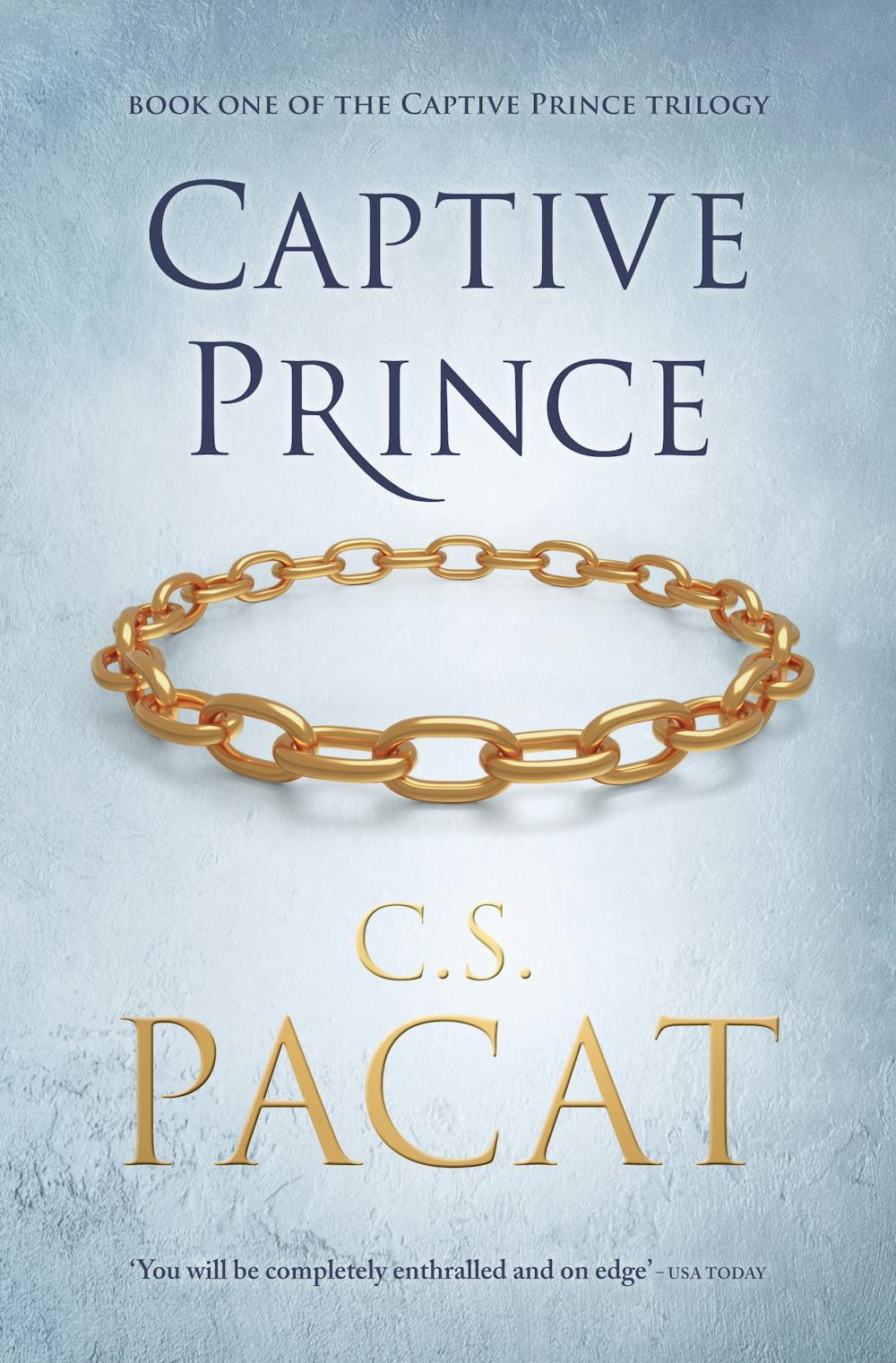
Sometimes these stories go spectacularly mainstream, as with C.S. Pacat’s The Captive Prince, a gay erotic fantasy about a prince who is given to the ruler of a neighbouring kingdom as a pleasure slave. Originally self-published, The Captive Prince started as a web serial that gathered 30,000 signed-up fans and spawned Tumblrs dedicated to fan fiction and speculation about where the series would go.The book was rejected by major publishers, so Pacat self-published to Amazon and within 24 hours it had reached number 1 in LGBTQIA+ fiction. A New York agent approached Pacat and secured her a seven-figure publication deal with Penguin. The queer fantasy or paranormal romance has continued to thrive in Pacat’s wake. In our interviews with romance authors, questions of diversity, inclusion, representation and inequity arose again and again. In representation and amplifying marginalised voices, romance has enormous potential to lead the way. 5. Romance has gates that are kept: Romance fiction is more progressive than some stereotypes might suggest, but it is not free from exclusion or discrimination. The genre is influenced by its gatekeepers – human and digital. One form of gatekeeping takes place through the same voluntary associations that nurture community. In late 2019, the board of the Romance Writers of America censured prominent writer of colour, Courtney Milan, suspending her from the organisation for a year and banning her from leadership positions for life. 
The decision was made following complaints by two white women, author Katherine Lynn Davis and publisher Suzan Tisdale, about statements Milan had made on Twitter, including calling a specific book a “fucking racist mess”. This use of the organisation’s formal mechanisms to condemn a woman of colour and support white women was controversial, provoking widespread debate across social media and email lists. Milan had long been an advocate for greater inclusion and diversity within Romance Writers of America and the romance genre. As the Guardian reported, the choice not to discipline anyone for “actually racist speech” made punishing someone for “calling something racist” seem like a particularly troubling double standard. “People saw it as an attempt to silence marginalised people,” observed Milan. The board retracted its decision about Milan. It is difficult, however, to calculate the damage that may have been done to readers and writers of colour in the romance genre world. Conversely, the use of Twitter to extend debate and eventually correct the Romance Writers of America shows change happening, in real time. 
Another form of gatekeeping in romance fiction happens through the same digital platforms that put the genre at the forefront of industry change. Safiya Umoja Noble’s book Algorithms of Oppression demonstrates how apparently neutral automated processes can work against women of colour — for example, the different results that come up from a Google search of “black girls” compared with “white girls.” In the world of romance fiction, Claire Parnell’s research has shown the multiple ways in which the algorithms, moderation processes and site designs of Amazon and Wattpad work against writers of colour. For example, they make use of image-recognition systems that flag romance covers with dark-skinned models as “adult content” and remove them from search results. They can also override the author’s chosen metadata to move books into niche categories where fewer readers will find them, such as “African American romance” rather than the general “romance fiction”. Concerted activism and attention is needed to work against this kind of digital discrimination, which risks replicating the discrimination in traditional publishing. There is no simple way to account for the dynamics of contemporary romance fiction. It is inclusive and policed; it is public and intimate. Its industrial, social and textual dimensions are not static, but interact dynamically, incorporating the possibility of change. Only by understanding these interactions can we gain a complete picture of the work of popular fiction. Contemporary romance fiction is formally tight, emotionally intense and digitally advanced. It’s where the heartbeat of change and action is in book culture. Beth Driscoll, Associate Professor in Publishing and Communications, The University of Melbourne and Kim Wilkins, Professor in Writing, Deputy Associate Dean (Research), Faculty of HASS, The University of Queensland, The University of Queensland This article is republished from The Conversation under a Creative Commons license. Read the original article.

Friday, 2 May 2014

Victoria Beckham reveals people used to make fun of her in fashion industry

victoriabeckham
Singer-turned-designer Victoria Beckham says she was a “bit of a laughing stock” in the fashion industry for a long time but it did not affect her determination to succeed. The 40-year-old designer said it was a struggle to prove herself in the fashion industry after initially rising to prominence for her pop career, reported Daily Mirror. “For a long time there, I was a bit of a laughing stock. And while everybody was busy laughing, what was I doing? I was laying the foundation to what I have in place now,” Beckham said. “Everybody said, ‘Well it’s never going to work because a celebrity can’t do a line (but because) everyone thought it was going to be rubbish (it took) the pressure off a little bit. I didn’t go into this to prove anything to anybody other than myself,” she added. The brunette beauty, who recently celebrated her 40th birthday, said she is not a big fan of the celebrity life and would rather focus on her successful fashion empire. Source: The Indian Express

Monday, 14 January 2013

Watch Live The Best And The Funniest Ramp Walk Ever


Live Streams Avail From Daily Protein's Channel,  Presents World Ramp Watch, Click Playlist To Select Videos, Embed Source Link

Friday, 10 August 2012

Olympic Swimmer Ryan Lochte Makes Acting Debut In Two 'Funny Or Die' Videos

Ryan LochteOlympic gold medalist Ryan Lochte stars in not one, but two new videos shot for comedy website Funny Or Die.com. The first stars British thespian Sir Patrick Stewart as a master ticket scalper for the 2012 London
Olympics. As he shows off his secrets to landing the hottest tickets to the event he's joined by Game of Thrones's Maisie Williams and the two, dressed in Dickensian garb, take advantage of American tourists looking to get in to the big competitions. Things go well until the pair run into Lochte and then... well, you'll just have to watch. Simon Pegg also stars. The 
second features Lochte sitting down for an interview for "LOCHTv" and revealing that it's actually okay to pee in the pool. © 2012 Starpulse.com, Photo Credits: Ringo, PacificCoastNews.com, Source: Starpulse

Wednesday, 13 June 2012

Getting to Know Miss World Denmark 2012 Iris Thomsen


.Subscribe
IRIS THOMSEN (25, 180 cm, Østerbro) was crowned Miss World Denmark 2012 during the Miss World Denmark 2012 National Final held at Kokkedal Castle on May 18th, by Lisa Lents, director of the "Miss & Mister of Denmark Organization" and National Director of Miss World in Denmark. Iris Thomsen also won "Miss Talent" award at Miss World Denmark 2012 Final. She works as a professional dancer & model. Iris will represent Denmark at the 62nd edition of the Miss World 2012 pageant to be held on August 18th, 2012 in Dongsheng Fitness Center Stadium, Ordos, Inner Mongolia, China. Critical Beauty is grateful to Iris and to her national director, Lisa Lents, for allowing this e-mail interview. What was going through your mind after you were judged as the winner? I was very happy. I had this weird feeling that my whole life had led me to exactly this point. Allthe skills I have accumulated and all the hardship I have gone through culminated in this event. I have always felt that I have a lot to give to the world, and that I want to reach a big audience. Now, after years of hard work, I finally have the opportunity to do exactly that, and I thought to myself “now is the time to work even harder”. What do you tell critics who say that pageants are outdated and exploit women? I do not believe that is true. The women that enter do it out of their own free will. It is a platform that has started the careers of many women. Young women see this as a chance to show the world what they can do, and to network with others in the business. Of course, before entering a contest, you should always make sure that it is a legitimate business, do your research on the organizers and read therules/contract carefully before signing! Yes, pageants do have criteria for physical appearances, but so do casters for movies, dance companies, modelling agencies etc. That is part of the entertainment business. But pageants are also very much into personality, special talents, intelligence and a good heart. The Miss World Organization is looking for a spokesperson that can create more awareness around charitable causes and be a goodrole model to young people. I don’t see how that is exploitation and out-dated. If anything, it’s only more relevant these days with great role models who possess good values and promote the idea of helping others, now that the youth are exposed to so much more than they used to be. What three adjectives would your friends use to describe you? Positive, good-hearted and hard-working. What is your best quality? Your worst quality? My best quality is sometimes my worst quality. I always want to do my very best with whatever I do, and I can sometimes be too hard on myself. Sometimes it’s good to try and look at yourself with an outside perspective, and realise “this is good enough”, but other times it is also good to just keep searching for that something special to make it just right. What do you like to do for fun? Sing, dance, eat, travel, play cards, yoga, spend time with my family. What makes you most uncomfortable? Speaking in front of people. I am naturally quite introverted, I think before I talk and am nervous about being misunderstood. I have cried  for many of my oral exams in my school years, because my nerves simply take over. Also as a dancer, I am used to expressing myself through movement and not words. I wanted to do something about that, so I started singing and acting lessons a couple of months ago. I have become increasingly better, and for the radio- and TV interviews I have done in relation to winning my title, it has gone really well, so I am very proud of myself, but I still get a little bit nervous before an interview. I love challenges & I work really hard at the matter right now, so I’m looking very much forward to be completely confident I speaking in front of a big crowd although I’m a bit shy. If you were to make a time capsule to represent life today, what would you put in it? An iPhone. It symbolizes how technology has become such a big part of our lives, that we can fit the whole world in our hand. We are always on-the-go, and we can listen to music, work, send emails and so many other things with just one device, and the technological development just advances so fast. In 50 years they will look at the iPhone and laugh. At what point does a girl become a woman?  The answer to this may vary according to the perspective you choose to look. Some communities say it’s at a certain age, and have a rite of passage that symbolises the transition from child to adult, followed by a new set of responsibilities. Biologically it can be said that it is when a girl gets her first period. Others may say it is when a female gets married or gives birth to her first child. I believe that it is when you start being independent and take responsibility for your life. I remember a time when I used to blame everyone else for my misfortune, and I truly wished to be someone else. But this way of thinking got me nowhere and was very destructive. When I started taking responsibility, I  realised that I can make the changes I want to make, and I can make things  happen for myself. This doesn’t mean you can’t ask for help – it is also a sign of maturity to know when you need help (and remember to help others when they need it). A woman’s life is filled with suffering and pain and she understands this without running awayfrom it. She understands that life consists of both good and bad times, and that both are equally important to her growth as a human being. Through her experiences, she can give hope and courage to others who are going through the same thing. She can confront a fearful situation and stare it right in the eye. A woman is kind, loving, selfless, enduring, knowledgeable, patient, respectful, empathetic, responsible and comfortable in her own skin. When a girl starts acquiring these attributes, is when her transition into womanhood begins. What would you say to a young girl who has low self-esteem? I would tell her that all the people, including herself, that are telling her she is not good enough, are lying. Then I will ask her to write down the things she thinks she is good at, or wants to be good at. After that I’ll tell her to focus on those things and keep working on them, and promise her that one day, things will get better, because I have been in the same situation, and I know this for a fact. What would you say is the biggest problem facing the youth today and how do you resolve it? It’s become very trendy to be ‘bad’. Being cool typically involves excessive drinking, doing drugs, smoking, not doing well in school, being promiscuous etc. and these activities can have a very big effect on how your life pans out. Religion has become something dangerous that a lot of people cannot relate to, and that is their choice to make. But you cannot abandon spirituality and the development of virtues. Each person needs to find his/her way of doing this, whether it’s through a religion, art, study of philosophy, yoga or something else completely. Even though times have changed and we seek role models outside of the family, I still believe that the parents have the greatest impact on their children. We now know more about parenting than past generations have, and we must  make sure that we are good role models and that we show the love, support and discipline that children need. Iris's Favorites: Singer/Musician – Linkin Park/Evanescence/Fallulah, , Actor – Edward Norton/Ulrich Thomsen, Actress – Penélope Cruz, Color – Light green, Fashion Designer – I do not have a favourite one, there are so many good designers out there! And I have never been able to afford designer items, so I have had to not look at those things to not get tempted or depressed. I love whatever looks good, whether it’s H&M, vintage or by a designer. Perfume – Escada – Rockin’ Rio. I got it as a present for my graduation, I love the freshness of it! Flower – Iris Writer – I don’t have a favourite writer, but I have a favourite genre: psychological thrillers! Book – “Undtagelsen” by Danish writer Christian Jungersen, Movie – The Pursuit of Happyness, Quote – Martha Graham is my hero. She said so many great things, which have inspired me and helped me to continue through bad times. If I have to choose one quote by her, I choose this one: ”There is a vitality, a life force, an energy, a quickening, that is translated through you into action, and because there is only one of you in all time, this expression is unique. And if you block it, it will never exist through any other medium and it will be lost. The world will not have it. It is not your business to determine how good it is nor how valuable nor how it compares with other expressions. It is your business to keep it yours clearly and directly, to keep the channel open. You do not even have to believe in yourself or your work. You have to keep yourself open and aware to the urges that motivate you.” Source: Travelfwd

Friday, 1 June 2012

Animals Smiles and emotions


.Subscribe.Subscribe.Subscribe
There's nothing cuter than when an animal seems to smile or laugh. Following animals are absolutely adorable and guaranteed to make you smile along with their smile!
These orangutans look like they might fall out of the tree if they laugh any harder
Another owl swaps twittering for tittering
The joke was so funny this elephant had to sit down
This mirthful moggy looks as if he's about to burst with laughter
Someone must have told him the one about the horse who walks into a pub and the barman asks 'Why the long face?'  Source: Article

Friday, 27 January 2012

Sushmita Sen walks the ramp with daughters Renee and Alisah

ApunKaChoiceSushmita Sen is always a delight to watch on ramp and this time she had her two lovely daughters for company. Former Miss Universe Sushmita Sen and her daughters Renee and Alisah were the show stoppers for designer Nishka Lulla on Day 3 at India Kids Fashion Show.  It was first time for Sushmita Sen with both the kids on the runway. Though Renee has earlier walked on the ramp with mom Sushmita, Alisah, who is just two year old, was seen enjoying her first stint on the ramp. Sushmita Sen, like a proud mother, also watched the two smart daughters as they
took the ramp. The onlookers and guests couldn’t stop praising the cute Alisah for her confidence as she wasn’t scared of the strobe lights and crowd surrounding the ramp.  Renowned designer Neeta Lulla’s young daughter Nishka Lulla is slowly making her mark in the Indian fashion scene. Earlier, the designer confirmed that Sushmita Sen and her daughters are going to be showstoppers for her show. Nishka’s collection showcased a riot of colours. She says, it’s just like a mela where kids are buzzing with energy and fun. Sushmita Sen was wearing a vibrant pink churidar suit with unsymmetrical hemline. If she added her vivacity and charm to the show, her kids added their innocent beauty to it. Catch the lovely mother Sushmita as she walks the ramp with her daughters Renee and Alisah: Source: ApunKaChoice.com

Wednesday, 25 January 2012

A tourist circuit for every religion, and one that integrates all


..SubscribeSubscribe
Financial Express, By ANUBHUTI VISHNOI: New Delhi: Seven new tourist circuits will be developed across the country to facilitate travel to and stay at religious places. Work has already begun to prepare detailed projectRanakpur temple
 .Subscribe 
reports for Sufi, Buddhist & Jain, Christian, Sikh, Hinduism and Sarva Dharma circuits. The Sufi circuit will include Delhi, Agra, Fatehpur Sikri, Bijapur, Shirdi, Aurangabad, and the Awadh region, besides the dargahs inVaishno Devi Temple, Jammu
J&K, Punjab, Haryana and Uttarkahnad. The Christian circuit will have the churches of Goa, Kerala and Tamil Nadu. The Sarv Dharma Circuit, to promote national integration, will be aligned along Tirupathi-Chennai-he Somnath Temple (Gujarati:સોમનાથ મંદિર) located in the Prabhas Kshetra near Veraval in Saurashtra, on the western coast of Gujarat, India, is the most sacred of the twelve Jyotirlinga shrines of the God Shiva. Somnath means "The Protector of (the) Moon
.Subscribe
Velankanni-Nagoor and Vaishnodevi - Golden Temple-Sacred Heart Church (Delhi)-Nizamuddin. “India is home to a number of religions and there is a huge scope in terms of boosting tourism to religious places. Our aim is to facilitate a packaged tour like experience to tourists complete with stay andSacred Heart Cathedral, Connaught Place, Delhi 
.Subscribe
entertainment options. We have already engaged consultants to work on these circuits and hope to engage state governments in the project,” Tourism Minister Subodh Kant Sahay said. Sahay’s ministry has already held a round of discussions on the Sufi circuit with industry stakeholders and some Sufi exponents, sources confirmed. The ministry wantsEid Milad celebrated
projects under this scheme to follow a comprehensive approach incorporating all facilities required by a tourist. The Ministry of Tourism has already identified 35 destinations for Phase I and will cover another 89 inPhase II. Consultants engaged by the ministry will help identify gaps inThe Golden Buddha, Tawang Monastery
.Subscribe.Subscribe 
infrastructure and amenities, assess Investment requirement and possible source of funds and also evolve business models for investment and operations. The ministry also proposes to bear the cost of preparation of a detailed project report by state governments as well as the cost of setting up
   .Subscribe
project monitoring units for undertaking all activities related to a particular circuit. The ministry has proposed a required outlay plan of Rs 9,450 crore for the 12th Plan and hopes to draw in private investment close to Rs 28,000 crore for such projects. Image Link Blogspot, Source: Financial Express