Toy Story 4, which opened in theaters this June, became the biggest box office animated film blockbuster yet—and it’s no wonder, with beloved toys like Mr. Potato Head playing a starring role.
Toys that engage the body, mind, and imagination, still hold the #1 place in the hearts of children, despite the pervasiveness of digital devices.
In fact, Mr. Potato Head and Play Doh are the top vintage toys that have withstood the test of time, according to new a study of 2,000 American parents.
Other toys that are still starring in American homes and continue to enchant kids after decades of familiarity include trolls, toy phones, teddy bears, and plastic dinosaurs.
Board games have proven to be timeless, as well. Whether you grew up in the ’70s, ’80s, or 90s, families can’t get enough of classic board games—particularly, Scrabble, Monopoly, Candy Land, the Game of Life, and Mouse Trap. They all ranked in the top 30 of toys that were played with by both parents and, later, their children.
Conducted by OnePoll on behalf of Mr. Potato Head, who has undergone several iterations of his own, the survey revealed that adults are still kids-at-heart who love playing with these toys.
Nearly half of parents said their favorite childhood toy is still on the market—and 84% have purchased, or plan to purchase, that toy for their own child.
When it comes to buying any toy for a child, parents are on the look out for a certain set of qualities. Three in five parents want a toy that’s educational, but just behind that is a toy’s ability to make their kid laugh (60%). Fifty-nine percent are on the hunt for a toy that’s colorful, while 56% look for something interactive.
TOP TIMELESS TOYS (ENJOYED OVER MULTIPLE GENERATIONS)
1. Play Doh
2. Mr. Potato Head
3. Trolls
4. My Little Pony
5. Furby
6. Puzzles
7. Toy phone
8. Bop It
9. Building blocks
10. Bicycle
11. Yoyo
12. Guess Who?
13. Water blasters
14. Teddy bear
15. Scrabble
16. Tricycle
17. Candy Land
18. Game Boy
19. Spinning tops
20. Toy cash register
21. Plastic animals
22. Monopoly
23. Mouse Trap
24. Game of Life
25. Transformers
26. Clue
27. Baby Alive
28. Plastic food/kitchen supplies
29. Scattergories
30. Perfection
ALSO CHECK OUT THE TOP TOYS LOVED BY ADULTS WHEN THEY WERE KIDS
The Kakrapar site is also home to two operating 202 MWe PWHR, seen here on the right (Image: DAE GODL-India)
Nuclear Power Corporation of India Ltd has announced that Kakrapar 4 was connected to the grid on 20 February. The 700 MWe unit reached first criticality on 17 December.
The company announced the grid connection following Prime Minister Narendra Modi's 22 February visit to the plant in Gujarat, during which he formally dedicated the first Indian-designed 700 MWe pressurised heavy water reactors (PHWRs) to the nation.
"These reactors have been designed, constructed, commissioned and operated by Nuclear Power Corporation Of India Limited (NPCIL) with the supply of equipment and execution of contracts by Indian industries/companies reflecting the true spirit of Atma Nirbhar Bharat," the company said. (Atma Nirbhar Bharat translates to "self-reliant India".)
Modi said during his visit that "the role of nuclear power in electricity generation is going to increase in 21st century India and it is a matter of pride that India is Atma Nirbhar in this advanced technology", the company added.
"Two days earlier on February 20, 2024, KAPS-4 (700 MW) was connected to the western grid for the first time."
A further eight reactors with a total capacity of 6800 MW are under construction by NPCIL, the company said, while pre-project activities are under way for 10 reactors with a total capacity of 7000 MWe for completion "by 2031-32" to enable India to reach an installed nuclear power capacity of 22,480 MWe.
Reactors under construction at NPCIL's sites include the next two 700 MW PHWRs which are being built as Rajasthan units 7 and 8 at Rawatbhata in Rajasthan, and four Russian-supplied VVER pressurised water reactors at Kudankulam in Tamil Nadu. Site works are also under way for the construction of two 700 MW units Gorakhpur in Haryana. In addition to these, a 500 MWe Prototype Fast Breeder Reactor is being built by BHAVINI at Kalpakkam in Madras.
Ten further 700 MW PHWRs have received administrative approval and financial sanction: Kaiga units 5 and 6 in Karnataka; Gorakhpur units 3 and 4 in Haryana; Chutka units 1 and 2 in Madhya Pradesh; and Mahi Banswara units 1 and 2 and units 3 and 4 in Rajasthan.Researched and written by World Nuclear News India's newest nuclear unit connected to grid : New Nuclear - World Nuclear News
Alex (Taylor Zakhar Perez) and Henry (Nicholas Galitzine) in the film of Casey McQuiston’s Red, White and Royal Blue. Amazon Prime Elizabeth Little, Deakin University
A royal romance is once again trending on social media.
This time, it’s a queer royal romance. And it even has its own hashtag: #firstprince
Casey McQuiston’s beloved, bestselling 2019 young adult novel, Red, White and Royal Blue, has just launched as a movie, on Amazon Prime. And fans are excited. The story follows Alex Claremont-Diaz, son of the first female American president, and his developing relationship with Henry, the Prince of Wales.
As a genre, “royal romance” follows many of the regular romance conventions, but must include a member of a royal family or peerage as one of the love interests. Book blogs and Goodreads are full of suggestions for getting your Prince (or Princess) Charming fix.
Until recent years, the royal romance hasn’t reflected the desires of LGBTQIA+ youth. But that is changing.
The queer injection into the young adult royal romance reflects a broader shift in what’s being published and read. Last year, research showed LGBTQ fiction sales in the US jumped 39% from the same period in the previous year. And young adult fiction grew in particular, with 1.3 million more books sold than the previous year.
Alice Oseman’s Heartstopper, a queer teen (graphic novel) love story, adapted for Netflix, is reported to have sold more than eight million copies to date – and even to have “helped keep bookshops afloat” in recent hard times.
A book industry analyst said the young adult queer fiction growth “mirrors a generational shift toward a more open and inclusive attitude toward gender diversity and sexual orientation”.
The popularity – and acceptance – of texts like Red, White and Royal Blue means the desires and fantasies of queer youth are being normalised.
Royal romance tropes
The key to royal romance is it offers readers possibility and transformation on a grand scale: by getting that crown, the main character does not just become royal, they become their best selves – on the world stage.
It’s been more than 20 years since Anne Hathaway graced our screens in the film adaptation of Meg Cabot’s young adult royal romance The Princess Diaries (2001).
The book follows a familiar narrative, where a girl who discovers she is in fact royalty has to be transformed into a princess. Princess Mia grows into herself as she prepares to lead Genovia.
Other familiar tropes of the royal romance include the “surprise reveal”, where one half of a couple’s royal identity is uncovered, like in Netflix’s The Princess Switch.
A viral success
Released in 2019, Casey McQuiston’s book quickly went viral, becoming an instant New York Times bestseller, winning awards and making best books lists. The classic “enemies-to-lovers” romance trope takes on international significance with the offspring of two world leaders involved.
Alex and Henry’s initial dislike for each other boils over and catches media attention after they ruin the cake at a royal wedding. To try to limit the diplomatic and media fall-out, the two have to pretend to be friends – which leads to their budding romance, and discovering their sexuality together. (Alex is bisexual and Henry is gay.)
Alex and Henry’s ‘enemies’ stage climaxes when they ruin a cake at a royal wedding. Prime
Casey McQuiston, who identifies as nonbinary, has talked about how straight literature has suggested it’s statistically unlikely for more than one queer person to exist in a story. In Red, White and Royal Blue, multiple queer people not only exist: they include the children of the most powerful people of the world, and become romantically involved.
The social media response to Red, White and Royal Blue clearly demonstrates young people want to see queer romance that reflects their own lives, and their own desires for transformation.
Just in the past week, Prime launched individual Instagram accounts for Prince Henry and Alex. The comments sections have thousands of interactions already.
Historically in romance, queer characters have been unhappy, or even killed off. But in Red White and Royal Blue, queerness leads to happiness.
“Alex you bisexual icon,” wrote one Goodreads reviewer, who described it as “comforting” to read the book while “having my own bisexual panic”. “It has meant so much to me as a queer individual,” wrote another, cited in the same study.
Interestingly, that study found many readers were willing to forgive the book for other things they didn’t like, because they were so excited by the queer representation.
More royal romances that explore difference
Other popular young adult royal romances explore queer relationships, too. Her Royal Highness, by Rachel Hawkins, is set in a university in Scotland, where American Millie discovers her roommate Flora is a Scottish princess. The trope of “surprise royal” gets its queer retelling when Millie falls for Princess Flora.
Her Royal Highness is a companion story to Hawkins’ first (heteronormative) royal romance novel, Prince Charming (originally titled “Royals”). Hawkins’ choice to explore queer romance was, she says, a response to what fans wanted. And she was keen to “restore balance” and write a tropey rom-com, but with lesbians.
Other young adult royal romances have maintained the focus on boy-girl couples, but engaged with contemporary audiences in other ways, by exploring concerns around class, wealth and gendered expectations.
In Katharine McGee’s American Royals, the House of Washington are the royal family, with Princess Beatrice the heir to the throne. Beatrice, who is in love with her personal bodyguard, goes on a journey of transformation that ends with her choosing her royal duties of love, and seemingly growing up. An important aspect of American Royals is how Beatrice will cope with being the first female monarch, introducing feminist concerns about leadership.
In Kiera Cass’s The Selection, the young adult royal romance meets a dystopian setting, where in a post-apocalyptic world, girls (and boys) vie for the attention of royals, so they can escape rigid caste systems and live in a palace. It’s been described as The Bachelor meets The Hunger Games. In texts like The Selection, the concerns of young people are not limited to romantic tensions, but include body image and status, conflict and poverty.
Even as young adult romances have shifted to include queer perspectives, one key aspect remains the same – teenage love, in all its forms, has the possibility of bringing about true individual transformation.
The young adult royal romance is about so much more than just love-interests-meet-and-get-crown. It’s about young people desiring to be something more, and undergoing a clear transformative journey.
While Mia Thermopolis lost her bushy eyebrows and gained a sleek tiara, her journey was about discovering her true worth.
In Red, White and Royal Blue, Alex and Henry don’t just avoid an international diplomatic disaster by falling in love: they give voice to the desires of queer and diverse youth who want to see a happily-ever-after that looks like them represented on the page, and the screen.
Luckily, these days, there are increasingly more options to choose from.
Something strange is going on in women’s happiness research. Because despite having more freedom and employment opportunities than ever before, women have higher levels ofanxiety and more mental health challenges, such as depression, anger, loneliness and more restless sleep. And these results are seen across many countries and different age groups.
A recent survey conducted by the American Psychological Association may hold some clues as to why. The results found that most US women are unhappy with how society treats them.
Many women are still the main caregivers for children and elderly relatives. Most also have the double burden of managing the home and family arrangements on top of paid work responsibilities. And within the workplace three in five women have experienced bullying, sexual harassment or verbal abuse.
The gender gap in wellbeing was notably documented during the pandemic, as many women took on more domestic and caregiving responsibilities on top of work. But it was also noted that although women took a bigger hit to their wellbeing they were quicker to recover, which seems to indicate thatwomen are more emotionally resilient than men.
This article is part of Women’s Health Matters, a series about the health and wellbeing of women and girls around the world. From menopause to miscarriage, pleasure to pain the articles in this series will delve into the full spectrum of women’s health issues to provide valuable information, insights and resources for women of all ages.
One of the factors that may contribute towards women’s resilience is social connection. In one 2019 study, researchers found that women scored higher than men for positive relationships with others as well as capacity for personal growth. In essence, women tend to be better than men at getting support. They ask for help sooner and so are more likely to overcome adversity quicker.
Women have also been found to place greater value on social connections than men. Studies have found that women’s friendships are more intimate – women favour face-to-face interactions that enable more self-disclosure and emotional support. Whereas men’s friendships tend to be more side by side, pursuing shared activities. Think catching up watching a football match versus catching up over coffee. Again this may explain the buffer to women’s mental health.
Happiness versus purpose
Although women may not be as happy in the moment as men and face greater social inequality, a recent study suggests that women report having more purpose in their lives. And having meaning and purpose in life is associated with better health and living longer.
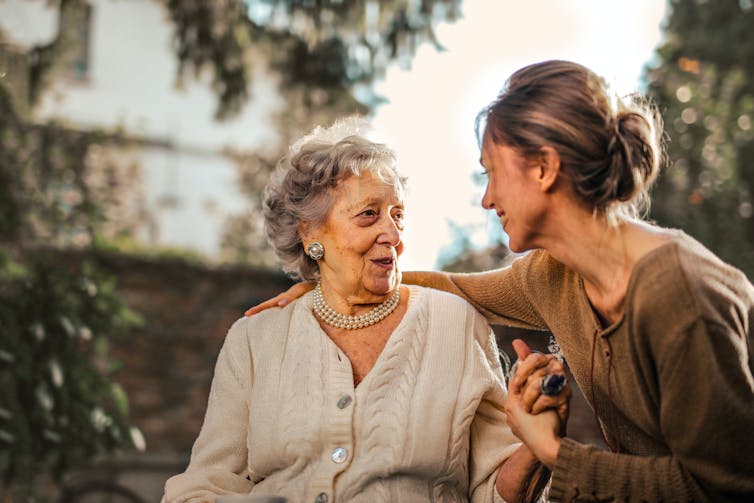
Women are more likely to take on caregiving roles as well as volunteer to help other people. pexels/andrea piacquadio, CC BY
The study found that women tend to engage in more altruistic endeavours, such as supporting others and charity volunteering which leads to a greater sense of meaning and purpose.
However, the researchers also point out that this is likely linked to cultural norms of women being encouraged to put the needs of others first. While putting others first does not necessarily make you happier, having a sense of meaning in life definitely contributes towards happiness.
Given all this, women need to make time for themselves to protect their wellbeing. Here are four evidence-based ways to help you do this:
Spending time outdoors in natural settings can be very comforting. A recent study found that nature-based interventions are particularly healing for women who have experienced trauma or illness . Indeed, as women, our biology and values often align with the natural world. The term “Mother Earth” reflects the feminine tendency to be life-giving and nurturing.
So make sure you factor some time outside in nature into your daily or weekly plans. A walk on the beach, a run through the woods or reading a book in the park, it all helps.
Women face gender-specific risks related to alcohol, including a greater risk of being a victim of violence and more health-related issues such as heart disease and breast cancer. Women also become intoxicated quicker than men which can make them more vulnerable.
Given that women are twice as likely as men to experience anxiety, reducing or eliminating alcohol may be sensible. Indeed, research shows quitting alcohol can significantly improve women’s health and happiness.
Japan’s economy is under pressure from rising energy prices and defence costs and the impact of the pandemic. Plummeting birth rates and an ageing population further threaten the sustainability of its labour market. A 2023 study by independent thinktank the Recruit Works Institute points to a labour supply shortage of 3.41 million people by 2030, and over 11 million by 2040. Gender inequality is another significant pressure point. Research shows that a gender-inclusive society and workforce leads to innovation and economic growth. However, Japan has one of the lowest levels of gender equality among G7 countries. It has slipped to its lowest ranking yet in the World Economic Health Forum’s latest Global Gender Report, particularly in terms of women in leadership positions. Prime Minister Fumio Kishida recently declared that Japan needs to urgently raise its birth rate. He also vowed to increase the percentage of women executives in Tokyo stock exchange-listed companies, from 11.4% to 30% or more, by 2030. A policy draft released in June indicates that this will be achieved through
leadership quotas legally imposed on listed companies. Japan has tried this countless times, however, and largely failed. As my research shows, this is because gender norms are deeply embedded in Japanese society. Socialisation of gender norms: Gender norms in Japanese society are tightly connected to patriarchal hierarchies that have evolved historically from the influence of Confucianism. The role of a man is linked to being the breadwinner and head of the family. Women, by contrast, are seen as wives and caregivers, ultimately subservient to the head of the family. Children are taught these norms from an early age. Research shows that Japanese preschool teachers position children in various gender roles by encouraging gendered speech and behavioural patterns. Girls speak softly and act in a cute, non-threatening way. Boys, by contrast, use more dominant language and behaviour. Children’s books and TV programmes often perpetuate these hierarchical linguistic patterns and behaviour. These beliefs and values influence hiring practices and organisational behaviour within the Japanese workplace, which is still based on the male-based
breadwinner/female-dependent model. From 1945 to 1991, a period which economists refer to as the economic miracle years, most Japanese women were isolated from the leadership career path. This resulted in low levels of Japanese women in key decision-making positions. Today, leadership is still seen as a male-dominated environment – even when the topic is about female empowerment. Japan was the only country to send a male delegate to the recent G7 delegation on gender equality and female empowerment. Gaining promotions to higher-paid positions relies on long hours and commitment to the company, regardless of gender. Gendered norms therefore result in a significant double burden on Japanese women. Despite having one of the most generous paternity-leave provisions in the world, only 14% of Japanese men took paternity leave in 2021, compared with Sweden’s 90% rate of uptake. Japanese men also spend the lowest amount of time doing unpaid housework (41 minutes a day) among OECD countries. Both the highly gendered workplace and unequal division of household labour mean that women are more likely than men to miss out on promotions, take on lower-paid irregular jobs, and/or only consider
having one child. Work-life expectations are unrealistic. And in the workplace, women face discrimination and harassment, as well as restrictive expectations of gendered behaviour and appearance. Yoshiro Mori stepped down as head of the Tokyo Olympics organising committee in 2021, after sexist remarks he had reportedly made in a Japanese Olympic committee meeting caused an international furore. Mori was quoted as saying women talk too much, and that when “allowed into” high-level meetings, they take up too much time. Failed solutions: Previous Japanese government initiatives to raise the birth rate and improve gender equality have focused on introducing quotas for female leadership and executive boards, more childcare places, and enhanced parental leave. However, these have either failed to reach their target or have become tokenistic. In fact, recent initiatives are reported to have exacerbated gender inequality and driven some women into poverty. Singapore recently embarked on a similar mission as part of a national gender equality review. Its government has gathered ideas and feedback from women’s and youth groups, private organisations, academics, policymakers and the wider public. This has resulted in a policy wishlist and report, the findings of which will be implemented into both policy and education. Improving gender
equality must start with early-years education. My research shows that this approach would work for Japan, too. It could allow people to voice their opinions and wishes in an open debate – which chimes with Japan’s cultural preference for decision-making achieved through consensus – rather than making direct criticisms of the patriarchal order. Such a review would need to look at all stages of life and aspects of society that are involved in the socialisation of gender roles, and the impact these have, from both a human rights and an economic perspective. There is already evidence that gender inequality is leading to mental health issues in Japan, especially for divorcees and single mothers. This review would also offer an opportunity for feedback from the younger generation. Research shows that many younger Japanese are becoming disenchanted with traditional gender roles. They are looking at new ways of living by choosing careers outside the echelons of power within Japanese society. They are also rejecting the institution of marriage. Japan has the opportunity to rewrite its gender equality trajectory. Doing so would hopefully include other representations of gender and diversity that have so far not been widely accepted within Japanese society, or protected within the law. Same-sex marriage is still unconstitutional in some prefectures. Societal change at this level will take a generation. The conversation needs to start now.Sarah Parsons, Senior Teaching Fellow and Lecturer in East Asian Business, SOAS, University of London This article is republished from The Conversation under a Creative Commons license. Read the original article.
Sun is the ultimate source of energy on earth and life on Earth is due to the power (energy) provided by the Sun. Scientists have developed the technology to directly convert the Solar Energy into Electricity with the help of photovoltaic cells. The 'Solar Energy' refers to the power generated from the Sun in the day time. In the day time photovoltaic cells can be used to generate the electricity and energy can be stored in the battery for use in the
nigh. The energy generated from the photovoltaic cells can be use at the day time also. The energy generated by the Solar Cells are free energy and it is also Renewable Energy which is Environmentally-friendly.
Here are the benefits of Solar Energy
Solar Energy in Abundance - Solar Energy is every where in the day time and it can be used to generate the power in tremendous amount. Solar Energy generation cab be combined with the wind turbines and the traditional fossil fuel based energy system to generate power in abundance. Home users can use the photovoltaic cells to generate the power and reduce the energy bill.
Renewable Energy - The Solar Energy is renewable energy source and it is environmentally-friendly.
Low Cost - Solar Energy is low cost energy source. Solar energy is the free source of energy and it just requires one time investments in the installation of the solar panels. Battery used by the solar system to store the power is also very durable which makes the Solar power less costly.
Pollution free source of energy - Solar energy does not require the burning of fossil fuels and thus it is pollution free source of energy. There is no adverse effect on the environment. So, Solar power is the best source of pollution free engery.
Save Money for Home users - You can use the Solar Energy at you home and save the power bill.
Save Earth - You save a lot of fossil fuel just by using the Solar Energy at your home. Tones of carbon emission can be controlled if home user starts using the Solar Power at their home. Home solar power can be integrated with the power provided by the power companies to save the fossil fuels thus saving the earth.
Power in remote location - The Solar power is available everywhere so you can use use the solar panels in the remote areas to generate the power. It can be used to run the water wells in the remote locations where there is no supply of electricity. In many locations in the world solar energy is used in the remote locations to generate power.
Maintenance free source of energy - The solar energy is almost maintenance free source of energy and in most of the cases you just have to spend the money on the battery or small equipments. Once installed you can use the Solar Energy to generate the power for years without or very less maintenance.
Infinite source of energy - It is estimated that the worlds oils reserve will only last for 30-40 years, but the Solar Energy is unlimited. Solar energy will last as long as sun is present.
How Solar Power is generated? There are two ways of generating the solar power: (1) Photovoltaic cells - The photovoltaic cells are capable of generating the power in the sun light. This way both home and commercial electricity is being generated. (2.) Concentrating Solar Power Projects - This the preferred way of generating the power on large commercial scale. Here the glasses are used to first concentrate the power to heat the water to convert it to vapor which then runs the turbine. Turbine is connected to the generator to generate the electricity. Source: Article, Image: flickr.com
Today's children are less fit than they were in the 1960s, raising fears that young people could suffer heart disease and other chronic illnesses at a much younger age. Most children today are slower at running than their parents – and can’t run as far - according to new research by the American Heart Association into childhood fitness. VoR's Hywel Davies reports.
In a report presented before the American Heart Association (AHA), it was revealed that fitness in children globally has dropped significantly since the 1960’s. That’s raised fears that young people could suffer heart disease and other chronic illnesses at a much younger age than previous generations. Internationally, children today score 15 per cent lower on measures of cardiovascular fitness than their parents. Tam Fry, a spokesman for the National Obesity Forum, a pressure group, says it’s a global problem, caused by modern life styles and poor diets. “It’s a terrible disease, if you will, that’s affected worldkind in the last 15-20 years, mainly generated by sedentary behaviour and also the proliferation of food that is heavy in energy dense ingredients.” But perhaps most shocking is how much the health of children has declined. Grant Tomkinson of the University of South Australia presented his research before the AHA this week, looking at fifty studies of fitness in children over the last fifty years. Dr Tomkinson says if you took an average child from 1975 and they raced a contemporary child over four laps of an Olympic track, today’s children would finish almost a lap behind the child from the 1970’s. Tam Fry says modern children are simply not getting enough exercise. “We have a situation whereby TV and computer games and other sedentary activities are beginning to rule the roost. We have an appalling number of children who just do not fulfil the prescribed one hour of exercise a day.” And it’s not just speed modern children lack – they’re also falling behind in how long they can run. Average endurance performance has fallen by six per cent per decade between 1970 and 2000. Not surprisingly a lack of cardiovascular fitness means children are more at risk of heart problems. Britain is one of the countries that are worst affected by childhood obesity, with fitness levels declining more quickly than the average. That’s despite hopes that when London was awarded the Olympics in 2005, it could serve as springboard to greater activity among children. But Dr John Ashton of the Faculty of Public Health, a body set up by the three Royal Colleges of Physicians, says we’ve failed to take school sports seriously enough for decades, meaning the Games will have only a limited effect, “The thing about something like the Olympics is that it can be inspirational as a short-term lift or motivation but it needs to be followed through with the investment in infrastructure but also in Physical Education in schools, which has never really recovered since the stand-off between teachers and the Thatcher administration in the 1980s.” Dr Ashton argues that fundamentally most countries have failed to adapt to our office-based, sedentary lifestyles. But some steps can be taken to improve our built environment, he says, so we are encouraged to drive less and take more exercise, like cycling: But both Dr Ashton and Tam Fry are pessimistic about any major changes to fitness levels in British children anytime soon. More than a third of boys and girls in England aged between two and fifteen are either overweight or obese. And funding for public health initiatives aimed at either adults or children, they say, is limited. That means the allure of video games and fast food outlets is likely to remain stronger for most children than the appeal of the running track or the football pitch. (Voice of Russia) Source: Voice of Russia - UK Edition
Republic Day, president Pranab Mukherjee said that democracy was a "sacred trust" for people in power and those who violate it commit sacrilege against the nation. He was addressing on the eve of Republic Day to the nation. On the occasion, president said democracy "had become our most precious guide towards peace and regeneration from the swamp of poverty" created by centuries of colonial rule. He said fraternity, dignity of individual and unity of the nation were ideals that had become the lodestar of modern Indian state. "For us, the democracy is not a gift, but the fundamental right of every citizen; for those in power democracy is a sacred trust. Those who violate this trust commit sacrilege against the nation," the president said. (With inputs form IANS). Source: News Track India
In 2001, Kunqu opera, the 600 year old art form, became the first Chinese item on UNESCO’s world intangible heritage list. Since then, the age old opera’s status has seen a great boost. And nowhere is that better seen than in Suzhou where the 5th Kunqu opera festival is drawing to a close. Apart from its waterways, beautiful gardens and elaborate embroidery, Suzhou is the birthplace of another exquisite art, Kunqu opera. The city is now hosting its 5th Kunqu opera festival. Over the past 8 days, seven major Kunqu opera troupes from across the mainland, Taiwan and Hong Kong as well as colleges have presented 25 stage shows, in competition for the event’s highest honor. It’s also featured an annual gathering of amateur Kunqu singers. Veteran performer Cai Zhengren, hailed for his role in the Kunqu opera classic "Palace of Eternal Youth", was among the 11 masters of the art to receive disciples in an official ceremony. The ceremony with one master taking in two disciples, is a new measure initiated by China’s Ministry of Culture to guarantee the art passes down to new generations. Kunqu Actor, said, "I learned from teachers before. But this formal ceremony give us a responsibility, that we’ll not disgrace our tutor." It’s the Kunqu opera classic "Peony Pavilion", most widely performed both in China and overseas, that popularizes the art to a wider audience. But it’s the festival piece, "A Dream of Red Mansions" that injects new lease of life into it. The literary classic depicts many scenes where its characters watch Kunqu opera, the dominating art in the era of the novel. It’s an apt adaptation. This year, both the Northern Kunqu Opera Troupe and the Jiangsu Kunqu Troupe have their own take on the novel. Yang Fengyi, Director of Northern Kunqu Opera Troupe, said, Because the era changes, we’ve created new dramas like this one "A Dream of Red Mansions". Because characters’ thoughts are nearer to the young audience. We also put in some modern elements in the sets and music. Jiangsu Kunqu Opera troupe, based in Nanjing, is a southern powerhouse practising the art. It has its their own theater and now puts on more than 300 shows per year. Shan Wen, who plays Lin Daiyu in their version of "A Dream of Red Mansions" is a star. She says each of her shows sells out, and young audiences can easily resonate to a young performer. Shan Wen, Actress, Jiangsu Kunqu Opera Troupe, said, "Because we are young faces, the audience can easily relate to us." You can see many young faces in the festival audience. Some are drawn by the elegance of the opera, while some say Kunqu opera is good at telling stories. Kunqu Opera Fan, said, "Kunqu’s beauty is its elegance, it leaves a lingering afterthought." Kunqu Opera Fan, said, "Although it’s a very old art form, the feelings it deals with are universal and unchanging, such as love. It resonates even with modern audiences." With sponsorship from the government, more than fifty Kunqu opera pieces have been staged in recent years. Art troupes visit colleges and tour foreign countries to promote the art. Hailed by the nation as an "orchid" among all China’s operatic arts, the art form is now becoming known and appreciated by many more people. Source: China.org.cn
"As advertising blather becomes the nation's normal idiom, language becomes printed noise," Pulitzer Prize-winning journalist and author George Frederick Will once said. As the short messaging service, or SMS turns 20, it has swept aside in two decades known conventions about courtesy, relationship, language and communication. It troubles linguists that SMS has made deep inroads in language and unfastened from the root the basics on which any language stands. Take the case of a 13-year-old Scottish schoolgirl who handed in an essay written completely in text message jargon to understand the extent of influence of SMS on language. BBC had famously put up an extract from the essay on its website in 2003 and invited a debate on it to gauge readers' reaction. "My smmr hols wr CWOT. B4, we used 2go2 NY 2C my bro, his GF & thr 3 :- kids FTF. ILNY, it's
a gr8 plc," said a chunk of the essay. How has SMS changed our lives in the last 20 years? (1) Language: For those who assiduously believe that language can survive centuries of corrosion and assault by constantly evolving, there is both good and bad news. Whether the threat from cryptic and often lazy mobile phone communication is real or perceived is immaterial, what matters most is that it has morphed into a giant beast, feeding on the demands that time and career make on modern day professionals. Where is the time to send a handwritten note or a letter? In the electronic survival of the fittest, it is amazing that the SMS has outlived the dying email. erhaps language is the biggest casualty of SMS. There are the usual defenders of text messages. Before William Shakespeare came along, the courtly flourish of 14th century writer Geoffrey Chaucer's works were said to be the cornerstone for English language. Chaucer added new words to his language as did Shakespeare. But 21st century thinkers are contemplating modelling spoken and written English to fit the sensibilities of the current day and age. What is wrong with 'u' if that has come to be acceptable in mobile communication in place of 'you' to save time and adhere to a character limit? You can rue the death of the graceful Queen's English, but modern linguists argue that it would be of no use if it ate up space and time when you needed to pack in as much as possible in 160 characters. (2)Clarity of thought and analysis: The ability to think clearly, analyse astutely and infer accordingly has been served a death knell with the 140-160 character texts that urge you instead to come right to the point. SMS, the precursor of social media tools such as Twitter and Facebook – where status updates and tweets come with a character limit – have dulled an entire generation's ability to think. The complex labyrinth serious discourses and societal issues are broken down to a easily comprehensible and overtly simplified 'ok', 'yes', 'no', 'agree' or 'disagree' without putting in the effort needed for analysis. Before one debate is solved, another crops up and issues jostle for space. (3)Attention span: The biggest hostage that text messaging has taken is our collective attention span. We text and speak, not lifting our eyes from our mobile phones to look at the person we are addressing. We text during meetings, longish speeches bore us, written communication that is more than a paragraph in length leave us irritable and flustered. The market has understood our needs, which is why we have booklets of witty SMS saying, novellas written in SMSese and our eyes glaze over anything that is over 160 characters long. (4)Spam: The unsolicited messages that land in your inbox everyday despite your best efforts to block them – spam has become an unwanted companion of our daily lives in the last 20 years. Advertisers use the low entry level barriers and the virtually intractable operation to bomb users with bulk deals that you have no use for. Imagine the pamphlets of the '80s and youngsters putting up posters advertising hair oil in the dead of the night on your home's boundary walls despite several warnings to understand the extent of intrusion of spam. (5)Emotions: Twenty years ago, a reasonable response to a confession of love would be an ornate handwritten letter or a walk in the park. Gradually all acceptable conventions of relationships have
been remodelled into emoticons – an invention of text messages. If there is ever an electronic Nobel instituted, a smiley would be the top contender. Nothing expresses hope, amusement, love, friendship or excitement like a smiley does. (6)Accessibility: From a company's CEO, to a general physician, a local chemist or your boss – suddenly everyone's accessible. There is no longer the need to formally set up an appointment through a reticent personal secretary. SMS has reduced even the strictly formal relationships like that of an employee and an employer into a convivial, homely mush of a thing. (7)informality: 'Won't be coming in to work today." This text would not have worked as method of putting in a leave application 20 years ago, what is perfectly acceptable now. 'R u bored?' a colleague texting you in the middle of a meeting is as acceptable as a future mother-in-law asking you to join you for a 'bite 2 eat @ 1 pm'. (8)Too Much Information: There is such a thing as Too Much Information – TMI for short. People you vaguely know texting you at midnight about their heartbreaks, their life's plans and aspirations. Texting your boss what ails your mother-in-law or your dentist your wedding plans in response to a simple query on shifting of an appointment – yes we are living with TMI. (9)Brevity and wit: It is solely thanks to SMS that we have a flourishing industry of one-liners that crop up during social conversations. SMS has kept wit real and sharp for the times. No one has the attention span to wait for the host to finish the punch line of a joke at the dinner table. They'd rather be 'forwarded' the latest SMS joke doing the rounds. The art of quipping has evolved over
years through elaborately planned and tested text messages. (10)The courier of romance: Perhaps nothing has evolved as much as romance over the last two decades. In electronic age, love is defined by logged in hours and Skype conversations. And even before that, by late night texting under the quilt so as not to wake up the rest of the household. 'Love u 2′ has replaced verbose cards and flowers. Emoticons summarise the depth of feelings of a heart broken by failed communication. We have learnt to adjust our expectations to fit love into 160 characters. Source: Current new, Image : flickr.com
RTSea: Scientists can be an odd lot. They delve into the world of minutiae, seeking the ultimate truths, while knowing that it all may be rewritten with the next experiment or expedition. And, unfortunately, in a time when science can hold the key to addressing many of the worldwide challenges we face, scientists can also prove to be poor communicators, opting for peer-reviewed papers that then gather dust within the covers of obscure journals. This is where I have tried to make my skills and services known to the scientific community, as it is vitally important that scientific research (and the issues and implications it addresses) be distilled and
disseminated to policy and decision makers and the public at large. Fortunately, there is also a generation of new scientists, albeit small, who are trying to develop and utilize the skills of broad communication, whether it be traditional or contemporary (i.e.: social) media, to get the word out. The good folks at Southern Fried Science are a perfect example. Here is a post from David Shiffman, alias WhySharksMatter, from Southern Fried Science that captures both the enthusiasm for communicating science and the frustration, knowing that today's media has shied away from science in favor of entertainment of a lower common denominator. Core themes of 2012: Underrepresented issues in marine science and conservation By WhySharksMatter, on January 26th, 2012 One of the many unfortunate
consequences of the decline in traditional media has been a reduction in science reporting. The formerly great CNN science unit closed in 2008, followed soon after by the health and science page of the Boston Globe. Alarmingly few trained science journalists are left, and people without proper training are being asked to cover the few science stories that still make it on the air ( I was once interviewed about shark research by the weatherman from CNN’s “American Morning”). With few exceptions, science and conservation stories are no longer considered a priority to the major news networks and newspapers. However, science is no less important to our everyday lives.Read Full: Southern Fried Science: new generation of scientists tackling media communications
China: The State Council, or China's Cabinet, said Friday the government will accelerate the development of the next-generation Internet industry in the next few years and boost the sector's role in stimulating the economy.China aims to put the Internet Protocol version 6 (IPv6)-based network into small-scale commercial pilot use and form a mature business model by the end of 2013, according to a statement released after an
executive meeting of the State Council presided over by Premier Wen Jiabao. From 2014 to 2015, thecountry will deploy and commercialize the IPv6-based network on a large scale and achieve the interconnection between IPv4 and IPv6-based operations, the statement said. During that period, a group of international competitive research institutions and enterprises in the next-generation Internet sector will be established, it said. "The Internet industry's effect on boosting consumption, investment, exports and employment will be fully strengthened," according to the statement. China launched the construction of the next-generation Internet in 2003, featuring the IPv6 network as a key technology. The IPv6 network, first developed in the 1990s, allows a much higher theoretical limit on the number of IP addresses than the current IPv4 system. The IPv4 system provided only about four billion addresses, and they had all been used by February this year China's IPv6 addresses only account for 0.29 percent of the global total, lagging far behind other countries, Wu Hequan, a member of the Chinese Academy of Engineering, said at a seminar in June. Read Full: China to develop next-generation Internet system - China.org.cn
World Defence News,By NavyRecognition: The Navy's first Mobile User Objective System satellite was launched Feb. 24 from Space Launch Complex 41. MUOS is a next-generation narrowband tactical communications system designed to improve communications for U.S. forces on the move. MUOS will provide military users simultaneous voice, video and data capability by leveraging 3G mobile communications technology. Source: World Defence News
Carscoop: It may feature a different name and fancier looks, but pay close enough attention and it’s not hard to see that the current Chrysler 200 is a heavily facelifted Sebring. That doesn’t come as a surprise as the Detroit
automaker wanted to buy some time before it develops an all new replacement based on the CUSW platform used on the Dodge Dart, which has been jointly-developed with Fiat. Chrysler has already admitted that the 200's successor will arrive in the market within the next year or so, but we still don't know what it will look like. Lawrence Technological University design student Colin Bonathan, whom we came to know through his Chrysler Review Coupe and Lincoln Continental studies, attempts to shed some light on a possible design direction
InAVate : Barco has launched ImagePRO-II, a combined video scaler, scan converter, switcher and transcoder. The solution, a multi-format processor for the rental and staging industry which converts any input signal to any output format, will be displayed at Integrated Systems Europe from January 31 toFebruary 2, 2012. The ImagePRO-II incorporates the fifth generation of the AthenaTM scaling and offers higher resolutions, frame rates, quality de-interlacing with advanced motion adaptive processing, as well as faster source acquisition, enhanced color depth and native support for computer signals.Source: InAVate
China: China will develop the third - generation Fengyun series weather
satellite to monitor meteorological changes more accurately and persistently to help tackle climate change. The new sets will be able to monitor the meteorological system and different layers of the atmosphere in a long-term and more consistent way to provide scientific evidence for research on climate change, Yu Rucong,
Posted by RTSea: David Shiffman, As a filmmaker, one of the reasons I write the RTSeaBlog is because through my work I have come to see that there is a tremendous amount of important research and data which is not making its way to the decision makers or the general public. This is true in the environmental and ecological field as well as in other disciplines. But I am certainly not alone in this understanding and there is a growing group of young scientists determined to change that status quo. David Shiffman, also known as "Why Sharks Matter" at the Southern Fried Science blog, is one of a new generation of marine scientists who both relishes in research and understands the importance of


.jpg?ext=.jpg)