bloggggg

Home  |  Live  |  Science  |  Lifestyle  |  Entertainment  |  Broadcast  |  Games  |  eBooks  |  Astounds  |  Adbite  |  Cricbell  |  Cyber  |  Idea  |  Digital  |  Privacy  |  Publish  |  ePaper  |  Contact  .Subscribe.Subscribe.Subscribe.Subscribe.Subscribe.Subscribe.Subscribe.Subscribe.Subscribe
Subscribe

Wednesday, 11 October 2023

World needs nuclear for net zero, says John Kerry : Energy & Environment

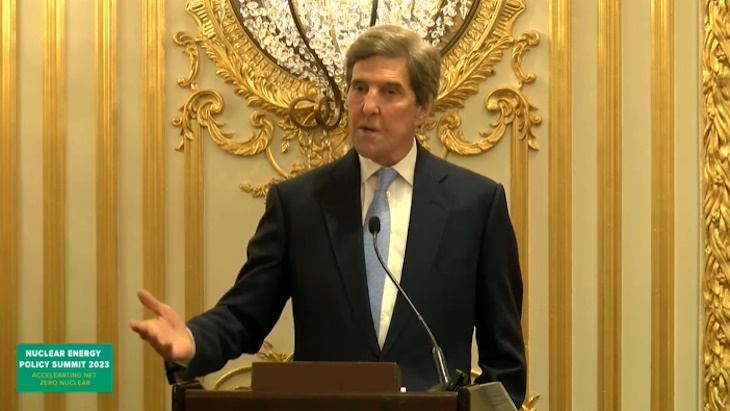
Kerry addresses the summit on 18 September.
Nuclear will be essential for the world to accelerate its transition away from fossil fuels, US Special Presidential Envoy for Climate John Kerry said at a New York summit this week. He also praised the recently launched Net Zero Nuclear Initiative - which has now welcomed GE Hitachi Nuclear Energy (GEH) as its first corporate partner. Kerry was addressing the first day of Nuclear Energy Policy Summit 2023: Accelerating Net Zero Nuclear, an inaugural event organised by the Atlantic Council Global Energy Center in partnership with the Emirates Nuclear Energy Corporation on the sidelines of New York Climate Week and the United Nations General Assembly. Extreme weather events are only going to increase as the world falls behind on its climate targets, Kerry said, as he called for science-based decision-making. "The reality is that this year it's going to be worse than last year, and next year is going to be worse than this year, no matter what we do - for the simple reason that we're way behind," he said. "We're currently heading towards something like 2.4 degrees, 2.5 degrees of warming on the planet and everything that you see happening today is happening at 1.1 degrees Celsius of warming," he said. "We have to recognise a reality here. We have to transition away from unabated burning of fossil fuel," Kerry said. "Most scientists will tell you … we can't get to net zero 2050 unless we have a pot, a mixture, of energy approaches in the new energy economy. And one of those elements which is essential in all the modelling I've seen, is nuclear." The magnitude of the challenge will require commitment, he added. "Even if you had a quintupling of renewable energy, you will not alter the current course of 2.4 degrees - it's that big a challenge right now." This needs commitment firstly "not to keep making the problem worse" by supporting the use of fossil fuels which remain unabated, and secondly to accelerate all zero emissions or extremely low emissions approaches to energy, transportation and ultimately heavy industry: "We don't have the luxury of unilaterally disarming ourselves … with respect to any decarbonisation technology when we're facing the urgency of this crisis - it's all of the above we need on the table." The USA is now committed, "based on experience and based on reality", to trying to accelerate the deployment of nuclear energy, he said. "It's what we believe we absolutely need in order to win this battle and we believe we still can win this battle". Net Zero Nuclear: The COP28 climate conference - which takes place in Dubai from 30 November until 12
Sama Bilbao y Léon announces that GE Hitachi Nuclear Energy has become Net Zero Nuclear's first corporate partner
December - is an opportunity to try to galvanise more action, and Kerry said he was pleased to see the launch of the "pioneering" Net Zero Nuclear platform. This initiative was launched in early September by World Nuclear Association and the Emirates Nuclear Energy Corporation (ENEC), with support from the International Atomic Energy Agency’s Atoms4NetZero and the UK government, and aims to ensure that nuclear energy’s potential is fully realised in facilitating the decarbonisation of global energy systems by promoting the value of nuclear energy and removing barriers to its growth especially in the run-up to COP28. Speaking after Kerry's address to Nuclear Energy Policy Summit 2023, World Nuclear Association Director General Sama Bilbao y Léon announced that GEH has become Net Zero Nuclear's first corporate partner. "We do want to make sure that this initiative brings the entire global nuclear industry together," Bilbao y Léon said. GE's decision to join the initiative clearly shows that the company - which works in a number of clean energy technologies - "sees nuclear as a key component of any serious energy transition towards clean energy processes," she added.Researched and written by World Nuclear News. Source:  World Nuclear News

Sunday, 28 February 2021

RIL to spin off O2C business ahead of stake sale to Saudi Aramco

  • Reliance Industries Ltd (RIL} has initiated a demerger process for its oil-to-chemicals {O2C} business, as the Mukesh Ambani-led firm looks to unlock value for investors ahead of sale of stake in its refining business to Saudi Aramco
  • The move is part of the company’s `RIL 2.0’ strategy, under which the group will metamorphise into a digital technology conglomerate with interests in telecom, wireless broadband, e-commerce and other emerging technologies.
  • The strategy shift is also in tune with the global call for adaption of sustainable energy as fossil fuels add to global warming. The creation of a separate arm for the O2C business with a dedicated management team mzy see another round of fund raising by from strategic global investors who are keen to lap up the growing Indian market.
  • RIL raised a whopping $27 billion for its digital and retail verticals in pandemic hit 2020 to drain off excessive debt from its balance sheet.
  • In August 2019, the oil-to-retail conglomerate announced plans to divest a 20 per cent stake to Saudi Aramco in the O2C business at an enterprise value of $75 billion.
  • RIL is planning to gradually reduce its carbon footprint and be net carbon zero by 2035. The O2C business is looking to invest in next-generation carbon capture and storage technologies to convert CO2 into useful products and chemicals.
  • These plans are in sync with the vision of Saudi Aramco, which wants to diversify its energy mix and emerge as a force to reckon with in clean energy. The tone was set at the recent annual Davos gathering where many global industrial powerhouses pledged their allegiance to a set of ESG (Environmental, Social, and Governance ) goals.
  • RIL’s O2C business has high-quality, hi-tech assets and boasts of the largest single-site crude refinery complex globally. RIL is also the largest petcoke gasifier globally, the largest global producer of PX (para-xylene), and has 12 manufacturing facilities in India and three in Malaysia.
  • As per the official announcement, management control of the O2C business will continue to remain with RIL and the firm expects regulatory approvals for the demerger (which will not impact its consolidated financial position) to be secured by Q2FY22. The deal will result in O2C cash flows optimised to fund its own growth along with efficient upstreaming of cash to RIL.
  • RIL is focusing on four high-growth areas to drive value, including the O2C business where it expects growth from high-value downstream chemicals and materials. The Digital Platform, which includes Jio Infocomm, retail where consumer-led growth will look to leverage technology, New Material & Energy and clean energy will form the other focus areas for lead clean, green growth.The demarcation of separate growth engines is also seen as a step towards eventual succession planning by Mukesh Ambani. Source: https://www.domain-b.com/

Wednesday, 9 December 2020

NZ PM Ardern declares ‘climate emergency’


New Zealand’s Prime Minister Jacinda Ardern moves a motion in the Parliament House in Wellington, New Zealand, to declare a climate emergency, Wednesday, December 2, 2020; Photo: AFP/Mark Mitchell

New Zealand Prime Minister Jacinda Ardern declared a “climate emergency” on Wednesday, telling the Parliament that urgent action was needed for the sake of future generations.

“The science on climate change was clear and New Zealand had to acknowledge the threat,” Ardern said.

The center-left leader said the challenges posed by global warming meant parliament’s declaration — an act undertaken by more than a dozen other countries — was warranted.

“In those cases where we do issue declarations, it is often where there is a threat to life, a threat to the property, and civil defence emergencies,” she told Parliament.

“If we do not respond to climate change, we will continue to have these emergencies on our shores.”

Lawmakers passed the largely symbolic emergency declaration by 76 votes to 43 after Ardern urged them to back the move.

“Vote in favor of this declaration, be on the right side of history, be part of the solution we must collectively deliver for the next generation,” she said.

Britain’s parliament became the first in the world to declare a climate emergency, passing the motion in May last year, followed closely by Ireland.

However, New Zealand’s center-right opposition National Party rejected the climate emergency declaration, labeling it “virtue signaling”.

“It can do harm in making people think that by declaring an emergency something has happened, when it hasn’t,” National leader Judith Collins told Radio New Zealand, saying: “It’s quite false and misleading.”

Ardern, last year, announced New Zealand to become carbon neutral by 2050 and to generate all its energy from renewable sources by 2035. She has also halted all new offshore oil and gas exploration in New Zealand
waters.

However, critics say that Ardern’s government has not done enough to enhance New Zealand’s “clean, green” reputation since she took office in 2017 after campaigning strongly on environmental issues.

Tuesday, 1 December 2020

White House transition to Joe Biden starts as President Trump relents

A reluctant US President Donald Trump on Monday allowed the transition to a new Joe Biden-led government to begin with the White House finally lifting its unprecedented block on assistance to the transition process.
Without formally conceding the election to Biden, Trump gave the go-ahead for federal funds to start flowing to Biden so that he can carry out his transition duties before his 20 January inauguration as the 46th US president.
The General Services Administration on Monday ascertained that President-elect Joe Biden is the “apparent winner” of the 3 November election, clearing the way for the start of the transition from President Donald Trump’s administration and allowing Biden to coordinate with federal agencies on plans for taking over on 20 January.
Trump, who had refused to concede the election, said in a tweet that he is directing his team to cooperate on the transition but is vowing to keep up the fight.
Administrator Emily Murphy announced the decision after Trump’s efforts to subvert the vote failed. She also cited “recent developments involving legal challenges and certifications of election results.” 
Trump had to finally back out after losing court battles and under pressure from leaders of his own Republican Party, including Senate Majority Leader Mitch McConnell and House Minority Leader Kevin McCarthy.
Trump acknowledged it was time for the General Services Administration to "do what needs to be done." However, in the same tweet he insisted that he was still refusing to concede, saying: "Our case STRONGLY continues, we will keep up the good fight, and I believe we will prevail!"
But the Republican decision to sign off on the GSA's decision to work with the Biden transition team signaled the end of Trump’s resistance.
This means that Biden's team will now have access to funds, office space and the ability to meet with federal officials.
Biden's office has already announced a highly experienced group to be nominated for top US foreign policy and security posts. The GSA would now allow "support necessary to carry out a smooth and peaceful transfer of power."
"In the days ahead, transition officials will begin meeting with federal officials to discuss the pandemic response, have a full accounting of our national security interests, and gain complete understanding of the Trump administration's efforts to hollow out government agencies," Biden's transition director Yohannes Abraham said in a statement.
Trump acknowledged it was time for the General Services Administration to "do what needs to be done."
In the same tweet he insisted that he was still refusing to concede, saying: "Our case STRONGLY continues, we will keep up the good fight, and I believe we will prevail!"
But the Republican decision to sign off on the GSA's decision to work with the Biden transition team signaled the end of Trump’s resistance.
This means that Biden's team will now have access to funds, office space and the ability to meet with federal officials.
Biden's office, which hours earlier announced a highly experienced group to be nominated for top US foreign policy and security posts, said the GSA would now allow "support necessary to carry out a smooth and peaceful transfer of power."
"In the days ahead, transition officials will begin meeting with federal officials to discuss the pandemic response, have a full accounting of our national security interests, and gain complete understanding of the Trump administration's efforts to hollow out government agencies," Biden's transition director Yohannes Abraham said in a statement.
Earlier, Biden announced a foreign policy and national security team, consisting mostly Barack Obama team veterans, including former State Department number two Antony Blinken as secretary of state.
Biden also named the first female head of intelligence, the first Latino chief of Homeland Security, the first woman as treasury secretary, and a heavyweight pointsman on climate issues -- Obama-era top diplomat John Kerry.
Avril Haines has been named director of national intelligence, and Cuban-born Alejandro Mayorkas will head the Department of Homeland Security, in what is seen as a reversal of Trump’s controversial immigration restrictions.
The list put out by Biden's team ahead of a formal announcement Tuesday demonstrated a push to bring back the US role of leader in multilateral alliances, in contrast to Trump's "America first" regime.
"They will rally the world to take on our challenges like no other -- challenges that no one nation can face alone," Biden tweeted. "It's time to restore American leadership."
Blinken, a longtime advisor to Biden, will spearhead a fast-paced dismantling of Trump's go-it-alone policies, including rejoining the Paris climate agreement and the World Health Organisation and resurrecting the Obama-crafted Iran nuclear deal.
John Kerry has been named as new special envoy on climate issues, signaling the Democratic president-elect's policy on global warming threats.
Biden named career diplomat Linda Thomas-Greenfield for UN ambassador while Jake Sullivan, who also advised Biden when he was vice president under Obama, was named national security advisor.
Biden is also bringing back 74-year-oid Janet Yellen, the Obama era Treasury Secretary, to manage the world's largest economy as Treasury secretary.President Trump, meanwhile, has largely ended his public work duties, mostly heading out to a golf course he owns in Virginia more often than earlier. Source: https://www.domain-b.com

Thursday, 22 August 2019

Paris climate agreement becomes international law

United Nations: The Paris Agreement to combat climate change becomes international law today, a landmark demonstrating that countries are serious about tackling global warming amid growing fears that the world is becoming hotter faster than scientists expected.

So far, 96 countries, accounting for just over two-thirds of the world’s greenhouse gas emissions, have formally joined the accord, which seeks to limit global warming to 2 degrees Celsius (3.6 degrees Fahrenheit).

Many more countries are expected to come aboard in the coming weeks and months.

UN spokesman Stephane Dujarric said Secretary-General Ban Ki-moon plans to commemorate “this historic day for both the people and the planet” by holding a conversation with civil society organizations about how they can contribute to the objectives of the Paris agreement.

“For years, he warned that we are the first generation to really feel the effects of climate change – and the last that can meaningfully prevent its worst consequences,” Dujarric said.

“His push for action was backed by government officials, scientists, faith leaders, business executives and civil society activists around the world who understood that the future of our common home is at stake. They made today possible.”

Scientists praised the speed at which the agreement, signed by 192 parties last December in Paris, has come into force, saying it underscores a new commitment by the international community to address the problem which is melting polar ice caps, sending sea levels rising and transforming vast swaths of arable land into desert.

“It took more than seven years for the Kyoto Protocol to go into effect while less than a year for the Paris climate agreement to achieve the same,” said Dr Feng Qi, executive director of the School of Environmental and Sustainability Sciences at Kean University in New Jersey.

“While the real effect of the agreement after it goes into effect is still uncertain, it is a simple sign that the international society is much more open to alter economic and political behavior to control climate change, which is by all means positive.”

But scientists and policy makers say the agreement entering into force is just the first step of a much longer and complicated process of transitioning away from fossil fuels, which currently supply the bulk of the planet’s energy needs and also are the primary drivers of global warming.

“Climate change is a marathon not a sprint and the agreement sets a course for the marathon in the years ahead,” said David Sandalow, inaugural fellow at the Columbia Center on Global Energy Policy and a former under-secretary of energy in the Obama administration.

While the Paris agreement is legally binding, the emissions reductions that each country has committed to are not. Instead, the agreement seeks to create a transparent system that will allow the public to monitor how well each country is doing at meeting its goals in hopes that this will motivate them to transition more quickly to clean, renewable energy like wind, solar and hydropower.

The agreement also requires governments to develop climate action plans that will be periodically revised and then replaced with new, even more ambitious, plans. Many of these details will begin to be addressed at the COP22 meeting next week in Marrakech, Morocco. Source: http://www.navhindtimes.in/

Wednesday, 26 June 2013

Obama lays out bold plan for US to address climate change challenges

Obama photo: obama obama.png
Barack Obama used to bully pulpit of the presidency on Tuesday to lay out a bold strategy for addressing climate change while simultaneous throwing down the gauntlet before his Republican opponents in the Congress over the controversial Keystone XL pipeline. Standing before the Old North building at Georgetown University, the same building President George Washington spoke from in 1797, Obama staked out what many subsequently described as a revolutionary set of proposals on climate change. And he vowed to make climate change and renewable energy a priority no matter what the Congress and climate-change deniers do to slow his administration's progress in its final two-and-a-half years. “We don’t have time for a meeting of the flat-earth society,” he said. The president said the high human and monetary costs of climate change are already apparent in an allusion to last year's Hurricane Sandy, which devastated the highly populated Northeastern US last year and epic tornadoes that smashed through Oklahoma in recent weeks. "I refuse to condemn your generation and future generations to a planet that's beyond fixing," Obama said. He then outlined s wide range of initiatives intended to dramatically reduce greenhouse admissions, fired up the development of renewable energy, and to better safeguard the country's populous coastal communities. As part of a promise to bring down US greenhouse gas emissions 175 from 2005 levels by the end of the decade, the president issued a directive to the Environmental Protection Agency to significantly curtail emissions from coal-fired power plants. "Limitless dumping of carbon pollution .. is not right," he said. "It's not safe and it needs to stop." “I'm directing the [EPA] to put an end to the limitless dumping of carbon pollution from our power plants and complete new pollution standards for both new and existing power plants,” he added. Administration officials said Tuesday President Obama hopes to see proposals doe new emissions rules for existing power plants by this time next year, ands wants to see them finalized before he leaves office. Although the president refrained from tipping his hand in the ongoing debate over the Keystone XL pipeline, which would be used to transport tar said oil from Canada deep into the heart of the US, he promised environmentalist the implications for the climate would be critical in his decision-making. “The question is not whether we need to act. The overwhelming judgment of science, of chemistry and physics and millions of measurements, has put all that to rest,” the president told students who had gathered on a steamy summer afternoon in Washington to hear him speak. “So the question now is whether we will have the courage to act before it's too late.” Almost as soon as he was done speaking, House Speaker John Boehner, R-Ohio, released a statement saying, " “The president has always been hostile to affordable sources of American energy that power most of our economy, but this program – which amounts to a National Energy Tax – only escalates his attack.” Such opinions, however, were largely drowned out from the jubilation of the other side. "This is the change Americans have been waiting for on climate. President Obama is finally putting action behind his words," said Michael Brune, executive director of the Sierra. “The president nailed it: this can’t wait,” said Frances Beinecke, the president of the Natural Resources Defense Council. “We must cut this carbon pollution today so our children don’t inherit climate chaos tomorrow,” Beinecke said. The White House Climate Change Action PlanObama lays out bold plan for US to address climate change challenges, Source: Renewable Energy MagazineImage: photobucket.com

Sunday, 14 April 2013

Climate Change Is Simple: David Roberts at TEDx

David Roberts is staff writer at Grist.org. In "Climate Change is Simple" he describes the causes and effects of climate change in blunt, plain terms.
On April 16, 2012, speakers and attendees gathered at TEDxTheEvergreenStateCollege: Hello Climate Change to reflect on the ability -- and responsibility -- of formal and informal education to inspire and empower action in this era of climate change. In the spirit of ideas worth
spreading, TEDx is a program of local, self-organized events that bring people together to share a TED-like experience. At a TEDx event, TEDTalks video and live speakers combine to spark deep discussion and connection in a small group. 

Saturday, 23 February 2013

Russia's Arctic strategy: development and innovations

Russia's Arctic strategy: development and innovations
With many countries having their eyes on the Arctic and its rich resources, the region is becoming the intersection of strategic interests and economic ambitions.
Countries of the Artic rim should be aware of the worst-case scenario and work closely together to avert it. Experts polled by the Voice of Russia agree that Russia’s new strategy for the development of its Artic territories, which was rubberstamped by President Vladimir Putin this week, is a major step forward along this path. A project of unprecedented scale in Russia’s post-Soviet history, it outlines the key Arctic policy priorities and sets a wide range of tasks from socio-economic development and ecological security to tighter border protection and the expansion of international ties. Those are the ambitious targets that Russia must work towards consistently if it wants to secure its positions in the Arctic. Inland mineral resources are rapidly shrinking and will be fully exhausted in 30-40 years, scientists warn, while hidden beneath the untapped Arctic shelf are vast reserves of hydrocarbons. Melting Arctic seas are making them easier to get at. Sergei Pikin is Director of the Energy Development Fund. "The Arctic is a Klondike for decades ahead. All future energy wars will be fought around the Arctic shelf. Therefore, it’s important to attract both Russian companies and foreign partners to the geological exploration and industrial development of the Arctic – the sooner, the better. But it should be remembered that offshore exploration creates environmental risks. To minimize them, everything must be done within the frames of a single strategy. That’s the purpose." With 70% of Russia’s hydrocarbon reserves located in the Arctic shelf, the government’s decision to form a strategic reserve of oil and gas fields in the Arctic region to guarantee national energy security is of utmost importance. Sergei Pikin: "The above reserve will help stabilize the situation on international markets. Excess supply pushes gas prices down but affects the interests of exploration and extraction companies. On the other hand, supply deficit pushes prices up, but then the demand goes down. Such reserves will keep the situation stable for both producers and consumers, making development more sustainable. But that requires a detailed exploration database." Offshore exploratory drilling will begin shortly in the Barents, Pechora and Kara Seas and in the Yamal and Gydan Peninsulas. Simultaneously, a major Arctic infrastructure program will be launched. The Northern Sea Route will be the main artery and the core of the future Arctic transportation and supply network, says Vasily Gutsulyak, an expert at the Institute of State and Law of the Russian Academy of Sciencfes: "As larger areas of Arctic ice are melting away due to global warming, all-year-round navigation without icebreakers will no longer be impossible. Naturally, transportation costs will be considerably cheaper than now because we still have to use icebreakers. Also, faced with the increasing piracy threat, ship owners will search for alternative routes. This opens up great prospects for the Northern Sea Route. Japan has already shown interest in it." Another important task is to settle the international formalities regarding the disputed outer border of Russia’s Arctic shelf. Russia will soon file all the necessary documents with the United Nations to substantiate its claims. The case in point is about 10% of the country’s territory. The entire strategy is designed for 2020, but the first stage is to be completed by 2015. Source: Voice of Russia

Friday, 8 February 2013

Super volcano awakening in Italy?

Super volcano awakening in Italy?
It looks like we may be in for an earth-shattering explosion. A dormant super volcano appears to be stirring under the Phlegraen Fields of Naples in Italy. Rising soil temperatures and surface deformation in the area have alarmed seismologists. In the distant past, volcanic super eruptions caused global climate change responsible for mass extinctions of plant and animal species.
So far, scientists are unable to model the potential consequences of an awakening super volcano. Latest studies show that the Phlegraen Fields have actually been swelling above sea level at a rate of 3 cm per month. Micro quakes and large amounts of gases accumulated in soil indicate that the volcano may be preparing to erupt, says Vladimir Kiryanov, Assistant Professor of Geology at the St. Petersburg University. "The Phlegraen Fields are a super volcano. Yellowstone in the United States and Toba in Indonesia are also super volcanoes capable of spewing more than 1,000 cubic km of magma. These are catastrophic eruptions. There was a huge volcanic eruption in the Phlegraen Fields some 30,000-40,000 years ago. Volcanic ash from that eruption is still found in the Mediterranean, Bulgaria, Ukraine, and even in Russia. We are now seeing the expansion of a magma pocket, which means that there might be an eruption at a certain time." Super eruptions of such magnitude may produce the so-called “volcanic winter” effect when sulfur gases and ash will reach the stratosphere and cover the globe with thick ash clouds that solar rays will be unable to penetrate. Condensed sulfur trioxides will react with moisture, forming sulfuric acid. Downpours of sulfuric acid will hit the Earth. Scientists have obtained new evidence of a similar cataclysm following the eruption of the Toba super volcano on island of Sumatra in Indonesia about 74,000 years ago. But today, things promise to be even more devastating. Suffice it to recall the havoc wreaked by a minor increase in volcanic activity in Iceland in 2010 on air transportation over Europe. Super eruptions occurred so rarely that it is virtually impossible to calculate the approximate time span between the first and last stages of a future potential eruption. In the 1970s, the Phlegraen Fields inflated by more than 50 cm. There were even cracks in house walls. But then the process slackened. Apparently, the fact itself that a magma chamber is being filled with magma may or may not signal any immediate eruption. Alexei Sobisevich, laboratory chief at the Institute of Volcanology and Geophysics of the Russian Academy of Sciences, shares his view: "It actually seems to be a long-term precursor. A magma chamber may be filled up within a span ranging from decades to centuries. Many mounts grow by 5 cm per year. This is a natural process." Some scientists hold that the volcanic system of the Earth is becoming increasingly tense and that underground cavities are full of magma threatening to burst out any moment. Whether this will be a super eruption or a string of smaller eruptions, we should prepare for the worst. Source: Voice of Russia

Saturday, 26 January 2013

Global warming ‘a myth’ – Russian academic

Global warming ‘a myth’ – Russian academic
Russian geoscientist Professor Nikolai Dobretsov has called attention to the fact that after decades of decline, the Arctic Ice Cap is into its fifth straight year of growth. Speaking in Moscow Monday, he argued that what is known as ‘global warming’ is in fact a brief phase of climatic oscillation which may bring ‘global cooling’ towards the end of the 21st century. He also said that the matter cannot be sorted out without many more permanent observation posts in the High Arctic. Source: Voice of Russia

Monday, 21 January 2013

Weather changes becoming the norm?

Many European countries are again hit by snowfalls, while a spring season has just begun in the USA. Experts are calm on that score, saying that such phenomena are none other than natural anomalies. This time snowfalls have emerged in the Alpine ski resorts, where they are needed most of all – in Austria and Switzerland. Snowfalls have also hit the south of Germany, The Netherlands, Sweden, Poland, the Czech Republic, and Croatia. The Baltic countries have suffered from snowfalls as well. However, there is no point in alarming signals at the moment, Assistant Professor Pavel Toropov from the Department of Climatology and Meteorology at the Faculty of Geography of the Lomonosov Moscow State University says. "Both meteorological observations and media reports say snowfalls were frequent earlier as well. A considerable part of Europe is located in a moderate climate zone – therefore, snowfalls often occur in the European countries. Of course, winters in Europe are milder than in European Russia." While tourists are “conquering” snowy tracks in the mountains and car drivers are doing that on the highways, a spring season has begun in the USA. This is the earliest spring on the EastCoast of the USA in the past 150 years. American scientists say that this is caused by the global climate change. This may be a one-time action though. Climatologists are not in a hurry to characterize this as an “anomaly. "On the results of meteorological observations that were made earlier it is possible to say what deviations should be regarded as strong anomalies. Each region has its own indices. In the Arctic and Antarctic regions, as well as in the tropics temperature changes are not very strong while in moderate latitudes the temperature changes heavily." According to the World Meteorological Organization (WMO), climate changes have acquired speed over the past few years. In all the history of observations since 1850, 2010 has proved to be the hottest of all. Those in Siberia in Russia, which is traditionally snowy and frosty, are very skeptical about the above-mentioned information. Frosts are stiffening, and snowdrifts are becoming higher in Siberia. As it seems, this runs counter to the theory of global warming. However, there is nothing strange in all this. When air temperature rises, moisture content rises as well, Head of the Climate and Energy Programme of the World Wildlife Fund (WWF) Alexei Kokorin says. One should get accustomed to surprises, caused by weather changes, including cancelled flights. There are scientists who say that throughout this century world temperature may undergo changes of several degrees. Source: Voice of Russia

Friday, 16 November 2012

New Particle was discovered that could help to cool Earth

Earth
Scientists have discovered a particle that could "cool the planet" and naturally clean up the atmosphere. According to researchers from The University of Manchester, The University of Bristol and Sandia National Laboratories, Criegee biradicals are invisible chemical intermediates and are powerful oxidisers of pollutants such as nitrogen dioxide and sulfur dioxide, produced by combustion. Although these chemical intermediates were hypothesised in the 1950s, it is only now that they have been detected. Scientists now believe that, with further research, these species could play a major role in off-setting climate change. The detection of the Criegee biradical and measurement of how fast it reacts was made possible by a
Evolution of Green house gases
unique apparatus, designed by Sandia researchers, that uses light from a third-generation synchrotron facility, at the Lawrence Berkeley National Laboratory's Advanced Light Source. The intense, tunable light from the synchrotron allowed researchers to discern the formation and removal of different isomeric species – molecules that contain the same atoms but arranged in different combinations. The researchers found that the Criegee biradicals react more rapidly than first thought and will accelerate the formation of sulphate and nitrate in the atmosphere. These compounds will lead to aerosol formation and ultimately to cloud formation with the potential to cool the planet. Carl Percival, Reader in Atmospheric Chemistry at The University of Manchester and one of the authors of the paper, believes there could be significant research possibilities arising from the discovery of the Criegee biradicals. "Criegee radicals have been impossible to measure until this work carried out at the Advanced Light Source. We have been able to quantify how fast Criegee radicals react for the first time," Percival said. "Our results will have a significant impact on our understanding of the oxidising capacity of the atmosphere and have wide ranging implications for pollution and climate change. "The main source of these Criegee biradicals does not depend on sunlight and so these processes take place throughout the day and night," he added. The study has been published in Science.Source: Ananta-Tec

Friday, 10 August 2012

Climate Change Study Ties Recent Heat Waves To Global Warming

WASHINGTON — The relentless, weather-gone-horriable type of heat that has blistered the United States and other parts of the world in recent years is so rare that it can't be anything but man-made global warming, says a new statistical analysis from a top government scientist. The research by a man often called the "godfather of global warming" says that the likelihood of such temperatures occurring from the 1950s through the 1980s was rarer than 1 in 300. Now, the odds are closer to 1 in 10, according to the study by NASA scientist James Hansen. He says that statistically what's happening is not random or normal, but pure and simple climate change. "This is not some scientific theory. We are now experiencing scientific fact," Hansen told The Associated Press in an interview. Hansen is a scientist at NASA's Goddard Institute for Space Studies in New York and a professor at Columbia University. But he is also a strident activist who has called for government action to curb greenhouse gases for years. While his study was published online Saturday in the Proceedings of the National Academy of Science, it is unlikely to sway opinion among the remaining climate change skeptics. However, several climate scientists praised the new work. In a blunt departure from most climate research, Hansen's study – based on statistics, not the more typical climate modeling – blames these three heat waves purely on global warming: _Last year's devastating Texas-Oklahoma drought. _The 2010 heat waves in Russia and the Middle East, which led to thousands of deaths. _The 2003 European heat wave blamed for tens of thousands of deaths, especially among the elderly in France. The analysis was written before the current drought and record-breaking temperatures that have seared much of the United States this year. But Hansen believes this too is another prime example of global warming at its worst.Source: Sam Daily Times

Saturday, 4 August 2012

Exxon CEO says climate change fears overblown


Climate change and a potential global energy crisis are overblown, said ExxonMobil CEO Rex Tillerson in widely published comments. In a speech on Wednesday, the Exxon CEO argued that while he admits that fossil fuels are a factor in warming the planet, societies can “adapt” to the changes. He argued that the risks of oil and gas drilling are well understood and can be mitigated. And dependence on other nations for oil is not a concern as long as access to supply is certain, he said, alluding to the perceived notion that the United States is dependent on Middle East oil. The reality, however, is different, as the United States only imports around five percent of its crude oil from Arab nations. Tillerson then blamed the American public, which he argued is “illiterate” in science and math, a “lazy” media, and advocacy groups that “manufacture fear” for energy misconceptions in the speech at the Council on Foreign Relations. He highlighted that huge discoveries of oil and gas in North America have reversed a 20-year decline in U.S. oil production in recent years. He also trumpeted the global oil industry’s ability to deliver fuels during a two-year period of dramatic uncertainty in the Middle East, the world’s most important oil and gas-producing region. “No one, anywhere, any place in the world has not been able to get crude oil to fuel their economies,” he said. Tillerson, in a break with predecessor Lee Raymond, has acknowledged that global temperatures are rising. “Clearly there is going to be an impact,” he said Wednesday. But he questioned the ability of climate models to predict the magnitude of the impact. He said that people would be able to adapt to rising sea levels and changing climates that may force agricultural production to shift. “We have spent our entire existence adapting. We’ll adapt,” he said. “It’s an engineering problem and there will be an engineering solution. Source: Bikyamasr, ***

Sunday, 29 July 2012

US tuna record Fukushima radioactivity

Pacific Bluefin tuna caught off the coast of California have been found to have radioactive contamination from last year's Fukushima nuclear accident. The fish would have picked up the pollution while swimming in Japanese waters, before then moving to the far side of the ocean. Scientists stress that the fish are still perfectly safe to eat. However, the case does illustrate how migratory species can carry pollution over vast distances, they say. "It's a lesson to us in how interconnected eco-regions can be, even when they may be separated by thousands of miles," Nicholas Fisher, a professor of marine sciences at Stony Brook University, New York, told BBC News. Fisher and colleagues report their study in the journal Proceedings of the National Academy of Sciences. Source: Sam Daily Times

Saturday, 21 July 2012

Elevated levels of bacteria found in Atlantic water - swimming banned

Swimming has been prohibited at three Atlantic beaches after elevated levels of bacteria – e-coli - was found in the water. Following consultations with the Health Service Executive, Clare county council have announced that all water activities at three popular coastal spots is not allowed until further notice. The results of routine tests on water samples at all three beaches have shown up traces of e-coli. Swimming and all other water activities at the coasts will be allowed after safe results come from further tests. The three affected beaches are Lahinch, Kilkee and Spanish Point. Lifeguard presence remains unchanged but the council is asking all people to stay out of the water. Source: Sam Daily Times

Friday, 15 June 2012

Rising sea level threatens India's coastal areas

Sea level
New Delhi, Sun Jun 03 2012, New Delhi, Kerala's tranquil stretches of emerald green backwaters and Mumbai are among several locales on the western and eastern coasts facing threat from the rising sea level due to climate change. Deltas of the Ganga, Krishna, Godavari, Cauvery and Mahanadi on the east coast may also be threatened along with irrigated land and adjoining settlements, according to a Government report. “It is estimated that sea level rise by 3.5 to 34.6 inches between 1990 and 2100 would result in saline coastal groundwater, endangering wetlands and inundating valuable land and coastal communities. The most vulnerable stretches along the western Indian coast are Khambat and Kutch in Gujarat, Mumbai and parts of the Konkan coast and south Kerala,” says the report submitted to the UN. The report - India's Second National Communication to the United Nations Framework Convention on Climate Change- was prepared by multi-disciplinary teams and other stakeholders comprising more than 220 scientists belonging to over 120 institutions. “The loss of these important economic and cultural regions could have a considerable impact in some states,” it says. The experts who prepared the report visited some vulnerable areas, including the 2004 tsunami-hit Nagapattinam in Tamil Nadu, backwaters surrounding Kochi in Kerala and Paradip in Odisha, in order to make a detailed impact study of the rise in sea level. The study, using digital elevation model data (90m resolution), digital image processing and GIS software, showed that estimated inundation areas are 4.2 sq km and 42.5 sq km in case where the sea level rise is 1.0 m and 2.0 m respectively in the region surrounding Nagapattinam. “But for the same sea level conditions, 169 sq km and 599 sq km will be inundated in the coastal region surrounding Kochi,” says the report. Source: Indian Express

Thursday, 12 April 2012

Coral Reefs: struggling with more than just climate change

RTSea: Marine scientists have been studying the negative impact of rising sea temperatures on coral for some time. Coral reefs have been diminishing, in part due to increases in water temperature which destroys the algae that symbiotically lives inside coral tissues. The loss of algae produces coral bleaching, a weakened coral community; and a totally dead reef is often the final outcome.  However, new research by Scripps Institution of Oceanography shows long term effects on Caribbean coral reefs dating back to the 1800s due to silt runoff and other terrestrial pollutants and overfishing - man-made impacts brought on by development of the islands throughout the Caribbean.  According to Scripps alumna Katie Cramer, now with the IUCN's Global Coral Reef Monitoring Network,“This study is the first to quantitatively show that the cumulative effects of deforestation and possibly overfishing were degrading Caribbean coral and molluscan communities long before climate change impacts began to really devastate reefs."  Working off the coast of Panama, the researchers dug deep into several coral reefs to determine, using radio carbon dating and analysis of coral skeleton remnants, the types of corals that were growing as far back as the turn of the century. With coastal land being cleared for plantations, the resulting silt and other sediments that ran into the sea, combined with the heavy fishing taking place to feed a growing population, took its toll on the
 surrounding reefs. One of the significant discoveries was evidence of a shift or transition from branching corals, like staghorn coral, to more non-branching corals in response to changing environmental conditions. Non-branching corals, which are slower growing than branching corals, provide less habitat for many reef creatures and fish. With less algae-eating fish, coral reefs can be locked in a constant struggle for space with fast-growing algae. This can make the reefs more susceptible to the growing effects of climate change. “Because the governments of the world have yet to undertake any meaningful efforts to mitigate climate change, it is of the utmost importance that locally caused stressors to reefs such as overfishing and deforestation are minimized,” said Cramer. “Advocating for more intelligent use of land as well as implementing sustainable fisheries management, those are things that can be done right now.”  Interestingly, while Scripps' research shows that coral has been impacted by other environmental factors long before climate change became an issue, researchers from the Australian Nuclear Science and Technology Organization (ANSTO) and the University of British Columbia, writing in the PLoS ONEjournal, have determined that some coral reefs might be able to better sustain an increase in temperature. Studying reef environments in the central Pacific, in particular the island nation of Kiribati, the researchers examined the coral skeletons and fat issues of corals in various areas and found that coral reefs that experienced greater temperature variance naturally have a greater potential for surviving the possible effects of climatemore caribbean sponges
change. The more consistent the temperature for a particular reef environment, the more adversely susceptible it might be to a change in temperature. "We're starting to identify the types of reef environments where corals are more likely to persist in the future," said Simon Donner of UBC and a co-author of the study. "The new data is critical for predicting the future for coral reefs, and for planning how society will cope in that future." As an example, Kiribati is located in an area of the Pacific that can be hit with seasonal El Nino-induced heat waves and has a potential for weathering temperature changes, whereas Australia's Great Barrier Reef exists in a more uniform temperature range and therefore could be more negatively impacted. All this research points to the fact that coral reef environments will change and adjust as conditions change. Some corals will remain pretty much the same, while in other areas there can be transitions from one dominant species to another. Nature will do what it has to to try to survive in an ever-changing future. But what those changes are, what that future might be, as compared to the coral reef environments of years past - with abundant fish and animal life - is anyone's guess. And what it means to mankind in terms of a continuing resource for food, a barrier to stormy weather, or a contributor to healthy ocean water quality is at question.Source: RTSea

Saturday, 31 March 2012

Australia’s north, east coast in particular risk from climate change


New research indicates marine creatures in waters north of Australia and along the country’s east coast are at particular risk from climate change, said Director of the Oceans Institute at the University of Western Australia, Professor Carlos Duarte, who was part of the study led by Scottish academic Mike Burrows and published in the journal Science. To find out how quickly the ocean is heating up, the researchers studied global temperatures recorded over the past 50 years. Duarte said “The velocity of climate change is much faster in the northern hemisphere and is particularly fast in the marine region north of Australia as well as the nation’s east coast.” According to Duarte climate change wasn’t as rapid in waters south of Australia and was “moderate” off the west coast. Source: Bikya MasrImage: flickr.com

Tuesday, 20 March 2012

Arctic ice at 2nd lowest level since 1979: US report

ArcticIndian ExpressWashington: The frozen Arctic has shrunk to its second lowest level since satellites began measuring it in 1979, capping a decade of "rapidly decreasing summer sea ice," US scientists said The Colorado-based National Snow and Ice Data Centre (NSIDC) said the ice cap appeared to have reached its lowest level for the summer, at 4.33 million square kilometres (1.67 million square miles) on September 9. That is the second lowest level since the centre began
   Image Link Photobucket
tracking the ice mass by satellite more than 30 years ago, with the lowest level recorded in 2007. The NSIDC cautioned that the measurement was based on preliminary results and that changing winds could push the ice flows closer together, resulting in a smaller figure when final numbers are released in early October. "The last five years (2007 to 2011) have been the five lowest extents in the continuous satellite record, which extends back to 1979," the NSIDC said. Read Full: Arctic ice at 2nd lowest level since 1979: US report - Indian Express