bloggggg

Home  |  Live  |  Science  |  Lifestyle  |  Entertainment  |  Broadcast  |  Games  |  eBooks  |  Astounds  |  Adbite  |  Cricbell  |  Cyber  |  Idea  |  Digital  |  Privacy  |  Publish  |  ePaper  |  Contact  .Subscribe.Subscribe.Subscribe.Subscribe.Subscribe.Subscribe.Subscribe.Subscribe.Subscribe
Subscribe

Tuesday, 29 December 2020

Google delays return to office until at least Sept next year


Google-parent Alphabet on Monday confirmed that it is delaying the return of workers to its offices until at least September 2021 and is testing “flexible work weeks” for the longer term.

In an email on Sunday to Google workers, Alphabet chief executive Sundar Pichai said that the company is exploring a schedule combining “collaboration” days in the office with days of working from home.

The New York Times quoted Pichai’s email as reading “We are testing a hypothesis that a flexible work model will lead to greater productivity, collaboration, and well-being.”

Pichai noted that no company the size of Alphabet has created a “fully hybrid work force model.”

Google confirmed the email on Monday, as the United States kicked off a mass vaccination drive hoping to turn the tide on the world’s biggest coronavirus outbreak, and with the nation’s death toll passing a staggering 300,000.

Google and other Silicon Valley firms shifted to remote work early in the pandemic, relying on the internet tools they create to get jobs done.

Google had originally expected staff to begin returning to offices early in 2021, but the date has proven to be a moving target due to the pandemic.Facebook chief Mark Zuckerberg has said he expects the shift to remote work to be a lasting one at the leading social network, which plans to look for employees able to do their jobs from wherever they happen to live. Source: https://www.daily-bangladesh.com/

Tuesday, 15 December 2020

Google, Gmail, YouTube down in massive outage worldwide


DEC 14, 2020 Google service abruptly went down on Monday evening, impacting hundreds of users. Among the services that were disrupted at the time of writing include Gmail, Google search engine, YouTube, and Google Maps among others. The latest outage, which seems to be more intensive than the last one, seemingly started around 10-15 minutes back. Downdetector, the website that tracks web outages, has reported over 20,000 outage cases from around the world. Copyright © Jammu Links News,  Source: Jammu Links News

Monday, 5 October 2020

Google launches `Google News Showcase'; to pay publishers for content

  • Alphabet's Google on Thursday unveiled a new product called `Google News Showcase’, with an investment of $1 billion, under which it plans to pay publishers globally for their news over the next three years.
  • Announcing this, Alphabet CEO Sundar Pichai said Google will pay “publishers to create and curate high-quality content” for “Google News Showcase.” This differentiated “online news experience” leverages swipeable cards called “story panels.”
  • These panels give participating publishers the ability to package the stories that appear within Google’s news products, providing deeper storytelling and more context through features like timelines, bullets, and related articles. Other components like video, audio, and daily briefings will come next, Google stated in a release. 
  • CEO Sundar Pichai said the new product called Google News Showcase will launch first in Germany, where it has signed up German newspapers including Der Spiegel, Stern, Die Zeit, and in Brazil with Folha de S.Paulo, Band and Infobae. 
  • It will be rolled out in Belgium, India, the Netherlands and other countries. 
  • Reports said about 200 publishers in Argentina, Australia, Britain, Brazil, Canada and Germany have signed up to the product. 
  • "This financial commitment - our biggest to date - will pay publishers to create and curate high-quality content for a different kind of online news experience," Pichai said in a blog post. 
  • Google, facing resistance from media groups over blocking revenues due to them, had in June announced plans to pay for content. It is facing legal action in Australia, where the court had given publishers and Google time to settle mutually.
  • Australia wants to force Google and Facebook to share advertising revenue with local media groups. 
  • However, Google on Sunday said Australia’s News Media Bargaining Code is highly unusual, largely untested and one-sided arbitration system, suggesting the setup won’t allow for fair negotiations.
  • Last week, Google proposed changes to help resolve the challenges and on Sunday said the Australian code is “highly unusual, largely untested, one-sided arbitration system that would determine commercial arrangements between Google and news companies.” 
  • “We don’t oppose a code governing the relationship between news businesses and digital platforms — but right now the way the law is drafted isn’t fair or workable,” Mel Silva, vice president of Google Australia and New Zealand, wrote in a blog post.
  • Google parent Alphabet reported a net profit of $34.3 billion on revenue of almost $162 billion last year. 
  • The product, which allows publishers to pick and present their stories, will launch on Google News on Android devices and eventually on Apple devices. 
  • "This approach is distinct from our other news products because it leans on the editorial choices individual publishers make about which stories to show readers and how to present them," Pichai said.
  • German publisher the Spiegel Group has welcomed the project. "With News Showcase and the new integration of editorial content like from Spiegel, Google shows that they are serious about supporting quality journalism in Germany. We are happy to be part of it from the start," said Stefan Ottlitz, managing director of the Spiegel Group. 
  • The European Publishers Council (EPC), whose members include News UK, the Guardian, Pearson, the New York Times and Schibsted, however, said it is a ploy to skirt regulations. 
  • "By launching a product, they (Google) can dictate terms and conditions, undermine legislation designed to create conditions for a fair negotiation, while claiming they are helping to fund news production," said EPC executive director Angela Mills Wade. 
  • The product builds on a licensing deal with media groups in Australia, Brazil and Germany in June, which also drew a lukewarm response from the EPC. 
  • Google is negotiating with French publishers, among its most vocal critics, while Australia wants to force it and Facebook to share advertising revenue with local media groups Source: https://www.domain-b.com/

Tuesday, 29 September 2020

Paytm accuses Google of trying to dominate India's digital ecosystem

SEP 21, 2020 NEW DELHI: Financial services app Paytm has accused Google of making policies that are over and above the laws of India after it was briefly delisted from the Playstore last week. "As a startup, we are running law-abiding businesses and building for India. Google and its employees are making policies which are over and above the laws of our country, and are arbitrarily implementing them," it said in a blogpost. Paytm said Google owns Android which is the operating system on which over 95 per cent of smartphones in India run. Google, as a result, has enormous control over which apps you download through its Playstore policies. "It also makes billions of dollars in advertising revenues from the Indian startups that make these apps. In many cases like maps, email, payments, shopping and cloud storage, Google also has apps that compete with other apps, including, of course, the apps that are made by Indian startups." Paytm said it had launched a campaign where users could collect cricket stickers and scratch cards to earn UPI cashback. The offer was applicable on recharges, utility payments, UPI money transfers and adding money to Paytm wallet. On September 18, it got an email from Google Play Support informing that the Paytm Android app had been delisted. This was the first time that Google was sending it a notification regarding its UPI cashback and scratch cards campaign. "Contrary to accepted practise, we were not given any opportunity to respond to their concerns or put forth our views. We maintain that our cashback campaign was within guidelines, as well as all laws of the land. We did not break any rules and there was no violation. It is not related to gambling in any manner whatsoever," said Paytm. Copyright © Jammu Links News, Source: Jammu Links News

Monday, 31 August 2020

The next Google, Facebook & Twitter are coming from India: PM Modi

a

In the quest for the next Google, Facebook and Twitter coming from India, Prime Minister Narendra Modi on Sunday talked about several homegrown apps which were recently awarded top prizes in the AatmaNirbhar Bharat (Self-reliant India) App Innovation Challenge.

In the latest of his monthly radio address 'Mann ki Baat', Modi said that the youth participated enthusiastically in the challenge. He noted that nearly two thirds of the entries were made by the youth of tier-2 and tier-3 cities.

Awards have been given to around two dozen apps in different categories, he said, asking listeners to familiarise themselves with these apps and to connect with them.

He spoke about several of these apps, including Kutuki Kids Learning app, an interactive app for children; ku KOO ku, an app for a microblogging platform; Chingari app which is getting popular among the youth; Ask Sarkar app to get right information about any government scheme; and Step Set Go, a fitness app etc.

Noting that today's small start-ups will transform into big companies tomorrow and become the mark of India in the world, he said that one should not forget that the big companies which exist in the world today, were also, once, start-ups.

The Aatmanirbhar App Innovation Challenge selected the best apps from around 7000 entries across India. These were from different categories like gaming, entertainment, business, utilities, social media, fitness, etc.

Indian video app Chingari that is a competitor to the now-banned Chinese app TikTok was the winner in the social category.

The second winner in the category was YourQuote, India's largest writing app, and news app Koo was the third winner.

Some of the top winners in each category were -- CaptionPlus (Entertainment); Logically - Check Fake News and Verify Facts (News); Hitwicket Superstars - 3D Cricket Strategy Game (Games); Zoho Workplace & Cliq (Office); StepSetGo (SSG) - Step Earn Redeem (Health); Disprz (elearning); Zoho Invoice, Books & Expense (Business); and MapmyIndia Move: Maps, Navigation & Tracking (Others) Source: https://southasiamonitor.org

Thursday, 13 August 2020

Australia to make Facebook, Google pay for local news content

  • US tech giants Facebook Inc and Alphabet Inc’s Google will have to pay for news content sourced from local media outlets in Australia, in a landmark decision by state regulators to protect media rights.
  • Internet firms like to Facebook and Google will have to pay for news content provided by media companies under a royalty-style system that will become law this year, Treasurer Josh Frydenberg said.
  • This means that to continue in the news business, Facebook and Google, which currently lift news content directly from news sources, including newspapers and websites, will have to compensate the source or gather news themselves. 
  • “It’s about a fair go for Australian news media businesses. It’s about ensuring that we have increased competition, increased consumer protection, and a sustainable media landscape,” Frydenberg told reporters in Melbourne.
  • “Nothing less than the future of the Australian media landscape is at stake.”
  • Australian government late last year told Facebook and Google to negotiate a voluntary deal with media companies to use their content, but that did not materialise.
  • Canberra now says if an agreement cannot be reached through arbitration within 45 days the Australian Communications and Media Authority would set legally binding terms on behalf of the government.
  • The Australian government’s move is another hurdle in the path of the tech giants as they try to fend off calls for greater regulation.
  • It comes a day after US lawmakers, in a congressional hearing, pulled up Google and Facebook for alleged abuse of market power. This followed an inquiry into the state of the media market and the power of the US platforms. 
  • Google said the regulation ignores “billions of clicks” that it sends to Australian news publishers each year.
  • “It sends a concerning message to businesses and investors that the Australian government will intervene instead of letting the market work,” Mel Silva, managing director of Google Australia and New Zealand, said in a statement.
  • “It does nothing to solve the fundamental challenges of creating a business model fit for the digital age.”
  • Media companies, including News Corp Australia, a unit of Rupert Murdoch’s News Corp, lobbied the government to force the US companies to the negotiating table amid a long decline in advertising revenue.
  • While media companies continue to lose advertisement revenue, the tech giants have been reaping gains from ever increasing advertisements. A 2019 study estimated about 3,000 journalism jobs have been lost in Australia in the past 10 years, as traditional media companies bled advertising revenue to Google and Facebook.
  • For every A$100 spent on online advertising in Australia, excluding classifieds, nearly a third goes to Google and Facebook, according to Frydenberg.Source: https://www.domain-b.com

Sunday, 9 August 2020

Australia to make Facebook, Google pay for local news content

  • US tech giants Facebook Inc and Alphabet Inc’s Google will have to pay for news content sourced from local media outlets in Australia, in a landmark decision by state regulators to protect media rights.
  • Internet firms like to Facebook and Google will have to pay for news content provided by media companies under a royalty-style system that will become law this year, Treasurer Josh Frydenberg said.
  • This means that to continue in the news business, Facebook and Google, which currently lift news content directly from news sources, including newspapers and websites, will have to compensate the source or gather news themselves. 
  • “It’s about a fair go for Australian news media businesses. It’s about ensuring that we have increased competition, increased consumer protection, and a sustainable media landscape,” Frydenberg told reporters in Melbourne.
  • “Nothing less than the future of the Australian media landscape is at stake.”
  • Australian government late last year told Facebook and Google to negotiate a voluntary deal with media companies to use their content, but that did not materialise.
  • Canberra now says if an agreement cannot be reached through arbitration within 45 days the Australian Communications and Media Authority would set legally binding terms on behalf of the government.
  • The Australian government’s move is another hurdle in the path of the tech giants as they try to fend off calls for greater regulation.
  • It comes a day after US lawmakers, in a congressional hearing, pulled up Google and Facebook for alleged abuse of market power. This followed an inquiry into the state of the media market and the power of the US platforms. 
  • Google said the regulation ignores “billions of clicks” that it sends to Australian news publishers each year.
  • “It sends a concerning message to businesses and investors that the Australian government will intervene instead of letting the market work,” Mel Silva, managing director of Google Australia and New Zealand, said in a statement.
  • “It does nothing to solve the fundamental challenges of creating a business model fit for the digital age.”
  • Media companies, including News Corp Australia, a unit of Rupert Murdoch’s News Corp, lobbied the government to force the US companies to the negotiating table amid a long decline in advertising revenue.
  • While media companies continue to lose advertisement revenue, the tech giants have been reaping gains from ever increasing advertisements. A 2019 study estimated about 3,000 journalism jobs have been lost in Australia in the past 10 years, as traditional media companies bled advertising revenue to Google and Facebook.
  • For every A$100 spent on online advertising in Australia, excluding classifieds, nearly a third goes to Google and Facebook, according to Frydenberg. Source: https://www.domain-b.com

Friday, 17 July 2020

TEHNOLOGY: Google plans to remove unauthorised nude photos from search results

SAN FRANCISCO, JUNE 20: Google plans to censor unauthorised nude photos from its influential Internet search engine in a policy change aimed at cracking down on a malicious practice known as "revenge porn." The new rules announced will allow people whose naked pictures have been posted on a website without their permission to ask Google to prevent links to the image from appearing in its search results. A form for submitting the censorship requests to Google should be available within the next few weeks. Google traditionally has resisted efforts to erase online content from its Internet search engine, maintaining that its judgments about information and images should be limited to how relevant the material is to each person's query. That libertarian approach helped establish Google as the world's most dominant search engine, processing roughly two-thirds of all online requests for information. The Mountain View, California, company decided to make an exception with the unauthorised sharing of nude photos because those images are often posted by ex-spouses, partners in a broken romance or extortionists demanding ransoms to take down the pictures. "Revenge porn images are intensely personal and emotionally damaging, and serve only to degrade the victims - predominantly women," Amit Singhal, Google's senior vice president of search, wrote in a Friday blog post. Laws against revenge porn already have been passed in at least 17 states and a federal ban is expected to be introduced in Congress this year. Google's stand against revenge porn won't necessarily purge it because not even the Internet's most powerful company has the authority to order other sites to remove offensive or even illegal content. But Google is hoping revenge porn will prove less mortifying to its intended victims by making it more difficult to find. Other heavily trafficked sites, including Twitter and the social forum Reddit, have embraced policies banning nude photos from being posted without the subject's permission. Earlier this year, Google tried to prohibit sexually explicit material from the publicly accessible sites in its Blogger service only to reverse itself within a few days amid cries of unwarranted censorship among Blogger's users. This isn't the first time Google has excised sensitive content from its search index. In most instances, the company has been forced to do so under laws imposed in various countries where it operates. While its search engine operated in mainland China from 2006 through 2010, Google blocked information that the country's Communist government deemed to be inappropriate and the company has been scrubbing humiliating information from people's pasts in Europe for the past year. Copyright © Jammu Links News, Source: Jammu Links News

Friday, 3 April 2015

Google turns any TV into computer for under $100

Google has unveiled a tiny HDMI dongle that can turn any TV into a full-fledged computer. Called the Chromebit, it uses Google's Chrome OS. It contains a fully featured, which uses the TV (or a standard monitor) as its display, and wirelessly connects to a keyboard and mouse using bluetooth. ''Smaller than a candy bar, the Chromebit is a full computer that will be available for less than $100,'' Google said. ''By simply plugging this device into any display, you can turn it into a computer. ''It's the perfect upgrade for an existing desktop and will be really useful for schools and businesses.'' Google also said it is releasing its cheapest Chromebook laptops yet, two versions priced at $149 aimed at undercutting Microsoft's Windows franchise and gaining ground in even more classrooms. Various PC manufacturers have been working with Google to design lightweight laptops running on the Chrome operating system since 2011. The newest versions are made by
Hisense and Haier. Hisense's Chromebook can be ordered beginning Tuesday at Walmart.com and Haier's version can be bought at Amazon.com. Their arrival coincides with Microsoft's rollout of a lower-priced Surface tablet in an effort to reach students and budget-conscious families. Pre-orders for that device began Tuesday, too. The success of the Chromebook line is intensifying the PC pricing pressure. The cheaper version of the Surface Pro 3 sells for $499, compared with $799 to $1,949 for the higher-end models.  The discounted version has a slightly smaller screen - 10.8 inches rather than 12 - a slower processor, and less flexible kickstand - just three angles rather than unlimited positions. The Chromebook has served a dual purpose for Google. Like the company's Android software for mobile devices, the Chrome system is set up so users will automatically begin using Google's search engine and other services, such as Gmail and YouTube. Google has used the Chromebooks as a prod to bring down the prices of all PCs, something the company wanted to do because it has more opportunities to show the digital ads that bring in most of its revenue when more people can afford to buy an internet-connected device. Source: Article

Wednesday, 4 February 2015

Internet will 'disappear', Google boss tells Davos

Eric Schmidt, Google
By Richard Carter: Google boss Eric Schmidt predicted on Thursday that the Internet will soon be so pervasive in every facet of our lives that it will effectively "disappear" into the background. Speaking to the business and political elite at the World Economic Forum at Davos, Schmidt said: "There will be so many sensors, so many devices, that you won't even sense it, it will be all around you." "It will be part of your presence all the time. Imagine you walk into a room and... you are interacting with all the things going on in that room." "A highly personalised, highly interactive and very interesting world emerges." On the sort of high-level panel only found among the ski slopes of Davos, a panel bringing together the heads of Google, Facebook and Microsoft and Vodafone sought to allay fears that the rapid pace of technological advance was killing jobs. "Everyone's worried about jobs," admitted Sheryl Sandberg, chief operating officer of Facebook. With so many changes in the technology world, "the transformation is happening faster than ever before," she acknowledged. "But tech creates jobs not only in the tech space but outside," she insisted. Schmidt quoted statistics he said showed that every tech job created between five and seven jobs in a different area of the economy.  "If there were a single digital market in Europe, 400 million new and important new jobs would be created in Europe," which is suffering from stubbornly high levels of unemployment.  The debate about whether technology is destroying jobs "has been around for hundreds of years," said the Google boss. What is different is the speed of change. "It's the same that happened to the people who lost their farming jobs when the tractor came... but ultimately a globalised solution means more equality for everyone." - Everyone has a voice - With one of the main topics at this year's World Economic Forum being how to share out the fruits of global growth, the tech barons stressed that the greater connectivity offered by their companies ultimately helps reduce inequalities. "Are the spoils of tech being evenly spread? That is an issue that we have to tackle head on," said Satya Nadella, chief executive of Microsoft. "I'm optimistic, there's no question. If you are in the tech business, you have to be optimistic. Ultimately to me, it's about human capital. Tech empowers humans to do great things." Facebook boss Sandberg said the Internet in its early forms was "all about anonymity" but now everyone was sharing everything and everyone was visible. "Now everyone has a voice... now everyone can post, everyone can share and that gives a voice to people who have historically not had it," she said. Schmidt, who said he had recently come back from the reclusive state of North Korea, said he believed that technology forced potentially despotic and hermetic governments to open up as their citizens acquired more knowledge about the outside world. "It is no longer possible for a country to step out of basic assumptions in banking, communications, morals and the way people communicate," the Google boss said. "You cannot isolate yourself any more. It simply doesn't work." Nevertheless, Sandberg told the assembled elites that even the current pace of change was only the tip of the iceberg. "Today, only 40 percent of people have Internet access," she said, adding: "If we can do all this with 40 percent, imagine what we can do with 50, 60, 70 percent." Even two decades into the global spread of the Internet, the potential for opening up and growth was tremendous, she stressed.  "Sixty percent of the Internet is in English. If that doesn't tell you how uninclusive the Internet is, then nothing will," said the tycoon. The World Economic Forum brings together some 2,500 of the top movers and shakers in the worlds of politics, business and finance for a four-day meeting that ends on Saturday.  Source: ArticleImage: flickr.com

Saturday, 25 October 2014

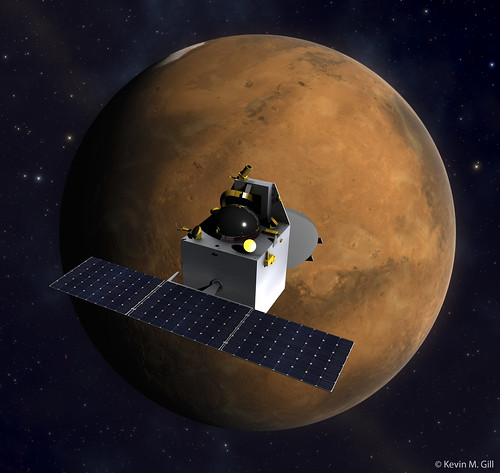
Google celebrates Mangalyaan's 1 month in Mars orbit

Mars Orbiter Mission Over Mars
Google on Thursday night put out a unique doodle on its abode page for India, blotching Mangalyaan's one month in Mars orbit. The Mars Orbiter Mission (MOM), also called Mangalyaan is a spacecraft orbiting Mars since 24 September 2014. It was launched on 5 November 2013 by the Indian Space Research Organisation (ISRO) under the guidance of the Project Director Mylswamy Annadurai. The mission is a "technology demonstrator" project to develop the technologies for design, planning, management, and operations of an interplanetary mission. It carries five instruments that will help advance knowledge about Mars to achieve its secondary, scientific, objective. The Mars Orbiter Mission  probe lifted-off
from the First Launch Pad at Satish Dhawan Space Centre (Sriharikota Range SHAR), Andhra Pradesh, using a Polar Satellite Launch Vehicle (PSLV) rocket C25 at 09:08 UTC (14:38 IST) on 5 November 2013. The launch window was approximately 20 days long and started on 28 October 2013. The MOM probe spent about a month in geocentric, low-Earth orbit, where it made a series of seven altitude-raising orbital manoeuvres before trans-Mars injection on 30 November 2013 (UTC). After a 298-day transit to Mars, it was successfully inserted into Mars orbit on 24 September 2014. It is India's first interplanetary mission and ISRO has become the fourth space agency to reach Mars, after the Soviet space programNASA,and the European Space Agency. It is also the first nation to reach Mars orbit on its first attempt, and the first Asian nation to do so. The spacecraft is currently being monitored from the Spacecraft Control Centre at ISRO Telemetry, Tracking and Command Network (ISTRAC) in Bangalore with support from Indian Deep Space Network (IDSN) antennae at ByalaluCourtesy: http://en.wikipedia.org, Image: flickr.com

Tuesday, 9 September 2014

Google celebrates Leo Tolstoy's 186th birthday with an animated doodle

Leo Tolstoy, was a Russian writer, philosopher and political thinker who primarily wrote novels and short stories. Tolstoy was a master of realistic fiction and is widely considered one of the greatest novelists of all time. He is best known for two long novels, War and Peace (1869) and Anna Karenina (1877). Tolstoy first achieved literary acclaim in his 20s with his semi-autobiographical trilogy of novels, Childhood, Boyhood, and Youth (1852–1856) andSevastopol Sketches (1855), based on his experiences in the Crimean War. His fiction output also includes two additional novels, dozens of short stories, and several famous novellas, including The Death of Ivan Ilych, Family Happiness, and Hadji Murad. Later in life, he also wrote plays and essays. Tolstoy is equally known for his complicated and paradoxical persona and for his extreme moralistic and ascetic views,File:Lev Nikolayevich Tolstoy 1848.jpg
which he adopted after a moral crisis and spiritual awakening in the 1870s, after which he also became noted as a moral thinker and social reformer. His literal interpretation of the ethical teachings of Jesus, centering on the Sermon on the Mount, caused him in later life to become a fervent Christian anarchist and anarcho-pacifist. His ideas on nonviolent resistance, expressed in such works as The Kingdom of God Is Within You, were to have a profound impact on such pivotal twentieth-century figures as Mohandas GandhiMartin Luther King, Jr, and James BevelSource: http://en.wikipedia.orgOn september 9 2014, Google celebrates Leo Tolstoy's 186th birthday with an animated doodle

Monday, 4 August 2014

Google creates a doodle for Kishore Kumar on his 85th birthday


The late legend’s doodle has a picture of him smiling from the Google India home page Google, the most popular search engine in the world never fails to recognize and pay tribute to some of the best icons ever born. Today’s Google Doodle celebrates the 85th birth anniversary of none other than the late singing legend, Kishore Kumar. Kishore Kumar was born on August 4, 1929 and it is a well known fact that not only was he a talented singer but was a multi-talented personality overall. Along with being a sensational singer, he was also an actor, lyricist, producer, music composer, director, screen play writer etc. He was introduced to the industry by his elder brother Ashok Kumar. Kishore Kumar is most popularly known for his roles in Chalti Ka Naam Gaadi and Padosan. His first film wasShikari where he acted opposite his brother Ashok Kumar. Some of his evergreen songs include gems likeHum Hain Rahi Pyaar Ke, Phoolon Ke Rang Se, Yeh Raatein Yeh Mausam etc. Kumar was said to have been married 3-4 times with one of the names in his list being Mughal-e-Azamsensation Madhubala who also acted with him in the film Chali Ka Naam Gaadi. The legendary singer passed away on October 13, 1987. To celebrate Kumar’s 85th birth anniversary BollywoodLife has in store for you, a list of the best songs sung by the sensation. Stay tuned! Kishore Kumar (4 August 1929 – 13 October 1987), was a popular Indian film playback singer, actor, lyricist, composer, producer, director, screenplay writer and scriptwriter. He is considered one of the most  successful playback singers of the Hindi film industry. He sang in many Indian languagesincluding Bengali, Hindi, Marathi, Assamese, Gujarati, Kannada, Bhojpuri, Malayalam, Oriya, and Urdu. He won 8 Filmfare Awards for Best Male Playback Singer and holds the record for winning the most Filmfare Awards in that category. He was awarded the "Lata Mangeshkar Award" by the Madhya Pradesh government and from that year onwards, the Madhya Pradesh Government initiated a new award called the "Kishore Kumar Award" for contributions to Hindi cinema. Wikipedia.org, Source: Article

Sunday, 4 May 2014

Google celebrates Audrey Hepburn's 85th birthday with a doodle

The latest Google Doodle commemorative logo has paid tribute to screen icon Audrey Hepburn on her 85th birthday on Sunday. A picture of the noted British actress with a pink background features in the middle of the Google logo. The 'Breakfast at Tiffany's' star and fashion icon became a big screen legend during Hollywood's so-called 'Golden Age.' She was born on May 4, 1929 in Brussels to a British father and Dutch aristocrat mother, before moving to London in 1948 to continue training as a ballet dancer. Widely
considered to be the world's most beautiful women ever, Hepburn rose to film stardom after appearing in several British movies. She won an Oscar, a Golden Globe and a BAFTA for her lead role in 'Roman Holiday' and starred in other classics, including 'Breakfast at Tiffany's' and 'My Fair Lady'. She won a record three BAFTA awards for best British actress in a leading role. Hepburn appeared in fewer acting roles in later life, devoting much of her time to working with UNICEF on good causes in the developing world. She died in Switzerland aged 63 in 1993 after a battle with cancer. Source: Hindustan TimesImage: flickr.com

Thursday, 20 March 2014

Google, Yahoo, Apple, Microsoft and Facebook knew about PRISM surveillance - NSA

The top lawyer for the National Security Agency told a civil liberties oversight board on Wednesday that companies such as Google, Yahoo, Apple, Microsoft and Facebook knew all about the NSA surveillance program PRISM, the Guardian reported.
That effort extracted user data such as photos, emails and documents stored in the cloud by big Internet services, allowing NSA analysts to track users communications. PRISM is a surveillance program designed to collect and process "foreign intelligence" that passes through American servers. The law that authorized the program was 2008's Section 702 of the FISA Amendments Act. The Guardian reported that when asked if collection of communications and associated metadata occurred with the "full knowledge and assistance of any company from which information is obtained," NSA general counsel Rajesh De said, "Yes." Since RISM was exposed to the public in Jubne, when of documents provided by whistleblower Edward Snowden was released, tech companies, including AOL, Apple, Google, Facebook, Microsoft, and Yahoo denied involvement in anygovernment data collection operation, and have fought for increased transparency regarding requests for data and increased security measures. De explained to the board that "PRISM was an internal government term that as the result of leaks became the public term." Data collection under PRISM, he said, was a "compulsory legal process, that any recipient company would receive." De and his colleagues also rejected the board's suggestion to limit searches inside 702 databases."If you have to go back to court every time you look at the information in your custody, you can imagine that would be quite burdensome," testified Brad Wiegmann, deputy assistant attorney general. "That information is at the government's disposal to review in the first instance," De added. However, De cited privacy risks when explaining why the agency does not search the communication data of American citizens "taken directly" from the Internet, the Guardian said. It is unclear what sort of legal process the government serves on a company to compel communications content and metadata access under Prism or through upstream collection. Documents leaked from Snowden indicate that the NSA possesses unmediated access to the company data. The secret Fisa court overseeing US surveillance for the purposes of producing foreign intelligence issues annual authorisations blessing NSA’s targeting and associated procedures under Section 702. Source: Article

Wednesday, 5 February 2014

Google Maps spotted alien ship on the Moon

Google Maps spotted alien ship on the Moon - reports
Google Maps spotted a weird looking object on the Moon, report the Times of India on Tuesday. According to the news source, triangular shaped object reminds greatly of an alien spaceship. Soon as the images appeared online, various UFO sites reported that seven light dots around the edge of an object shape an alien spaceship.
The space object was reportedly discovered by a so-called WowForRee l, who claims to be a paranormal researcher and who posted a video of the finding online. "It's unique and unusual in the area," said WowForReel in his Youtube description below the video. "After going there on Google Moon and staring at this thing for quite a long time I can say yes, it is really
there, not faked and I have no clue what it is." At the same time, Techandgadgetnews announced that huge figure seems to be a triangular space ship, very similar to Stealth aircraft technology. It also added that it looks several times bigger than any airplane from Earth. Secret KGB alien civilizations project, According information the Russians have known about alien civilizations for several decades, to many this comes as no surprise, there have been rumors floating around for many years. The first Russian contact with grey aliens allegedly took place in 1942. At that time, a series of diplomatic visits to discuss matters of mutual concern were planned, according to alleged Russian documents and a treaty was made. According to the document 072 / E, at the meeting of 1961 there was an incident involving 3 subjects due to the violation of the agreement by the officers at the military base when they discovered that their arrival was filmed with a hidden device without their consent. Under the treaty 23/04, the meetings would be confidential and filming or taking photographs would not be allowed. In 1969 in the state of Sverdlovsky, a UFO was reported to have crashed. It is alleged that a UFO crashed, and was recovered by the Russian military. Video film is shown of the recovery, with close-ups of the UFO itself. There was one dead alien found in the craft. The remains of the alien and the UFO debris was taken to a secure Russian site, where the saucer was analyzed, and an autopsy was done on the alien. Photo of the crashed craft that brought the small alien to Russia. The reputed event was broadcast on a TNT special, “The Secret UFO Files of the KGB.” The show was hosted by former James Bond movie star Roger Moore. Compelling video and photographic evidence were shown to support the event. According to Pravda, the KGB has allegedly had a special unit designed to gather and monitor all pieces of information regarding mystical and unexplained phenomena reported inside and outside the Soviet Union. Also according to Pravda, a photocopy of the order shown in the TNT documentary by the Soviet defense minister looks authentic too. Pursuant to the order, General A. G. Ponomarnko, head commander of the Urals military district, was to ensure that KGB agents be involved in the work pertaining to the UFO at all stages. The agents’ reports were promptly forwarded to Colonel A. I. Grigoriev, chief of the KGB scientific department. According Billy J Booth on About.com there are unsubstantiated reports that a UFO crashed or was shot down near the city of Prohlandnyi, in the USSR at on August 10, 1989. Soviet military radar tracked an unidentified flying object and the Russian attempted unsuccessfully to contact the craft.. The UFO was classified as “hostile.” Soviet defenses were alerted, and MIG-25s flew to find and identify the UFO. There was obvious damage to the exterior of the craft. The retrieval team, wearing protective outer wear, moved to the site. There was a small amount of radiation, and some members of the team were effected. A helicopter on the scene was hooked up to the craft, and the UFO was transported to Mozdok Air Base. Russians entered the the UFO and discovered three alien bodies-two dead, one barely alive. A team of doctors and other medical personnel made every effort to keep the alien alive, but failed. All three of the beings were about 3 1/2 to 4 feet tall, with gray outer wear. Underneath, their skin was a blue-green color with a reptilian texture. They had no hair, large black eyes covered with a protective lid, and web fingers ended their long, slender arms. The alien bodies were being kept in glass containers and UFO was taken to Kapustin Yar. This information was first reported by three Russian investigators-Anton Anfalov, Lenura Azizova and Alexander Mosolov who had no documentation to support their story. Voice of Russia, Times of India, beforeitsnews.com, Source; Article

Wednesday, 26 June 2013

Google may implement balloon project in India

Google  photo: Google Google.jpg
Hyderabad: Internet search giant Google may implement its prestigious 'Project Loon', which is a balloon-mounted Internet access service, in various countries including India. "We are doing a pilot project in New Zealand and going to see how it works. Once we get satisfactory results, we will be in a position to implement it in other countries as well," Google's Managing Director, Global Channel Sales, Todd Towe told reporters here today. "Interestingly, while we are still in the pilot phase, we have been getting multiple queries from different countries including India, which are interested in implementing the project," Towe said. However, he said, there is no time-frame to launch the project in India. 'Project Loon' balloons, which carry Internet signal antennas float in the stratosphere, at a height twice as high as air planes. They are carried around the earth by winds and can be steered by rising or lowering them to a particular altitude, with winds moving in the desired direction. Customers may connect to Google's balloon network using a special Internet antenna attached to their building. The signal bounces from balloon to balloon, onto the Internet and back to the earth. A 'Project Loon' pilot project began on June 15 at the 40th parallel South, which is a circle of latitude, that is 40 degrees south of the earth's equatorial plane, when 30 balloons launched from New Zealand's South Island beamed Internet signals to a small group of pilot testers. The experience of these pilot testers will be used to refine the technology and shape the next phase of 'Project Loon', Google had said earlier. Speaking about the company's Premier Small and Medium Enterprises (SME) Partner Programme, Rowe said within 10 months of its launch, the model has gained significant momentum in India. "We have partnered with 16 medium sized companies, with over 3,000 sales people who have been trained to help SMEs gain from digital advertising. In the next one year, we are looking to significantly increase our presence in South India by doubling our partners and add another 3,000 sales force though these partners," Rowe said. Source: News-Bullet, Image: photobucket.com

Monday, 14 January 2013

Google rolls out Street View's biggest ever update


.Subscribe
While Apple is apologizing for its new flop Maps app service in the latest iPhone, Google is hitting the nail in the coffin as hard as it can, by announcing its plans to release the biggest update ever to its Street View feature. The Internet search giant has announced that it will release a new update of its map service that would give users a view of what places actually look like from cars dispatched by the firm to photograph everything they pass. According to ABC news, Google has doubled the number of images in Street View images, adding 250,000 miles of road from around the world. Listed on Google''s blog are places where they have added more Street View coverage. Some are in the U.S., but most are abroad, in places like South Africa, Denmark, Japan, and Spain, the report said. The move come as Apple continues to apologise for its new maps app in iOS 6, and tries to mend the omissions and errors made in it. Apple introduced the new maps app after replacing Google Maps for the iPhone and iPad. It was quickly criticized by many users for its lack of certain features, mistaken locations and jumbled images.Source: Hindustan TimesImage: flickr.com

Sunday, 16 December 2012

Google vs Facebook war

Bisarbeat: The Google+ vs Facebook war is heating up. Both the companies have managed to create a great deal of hype as to who will rule the future of Social networking. Google+ has most of the features of Facebook but those features are overly simplified with good aesthetics and extremely cool user interface. In fact, Google+ is so user friendly to use that it is said: the only thing not user friendly about Google+ is its url plus.google.com.This heated debate has brought some nice looking GIF images showing how Google Inc has managed to sideline Facebook by its new product Google+. Google’s Financials: Google’s revenues grew 24% over the year to $8.14 billion, marginally shy of the market’s expected revenues of $8.15 billion. Over the year, paid clicks grew 39%, with cost per click falling 12% during the same period driven by the company’s push in mobile advertising. Among other
operating metrics, Google+, their social network service, continued to add users and reported more than 170 million registered users. According to market data, U.S. users of Google+ spent an average 3.3 minutes on the network in January, compared with Facebook’s user average of more than seven hours. Chrome and Android also showed strength, with Chrome reporting more than 200 million users and Android activations growing to 850,000 a day. eMarketer estimates that Google will account for 16.5% of the US market for display ads this year. Their growth is expected to continue to the next year, when their market share will surpass Facebook’s as Google goes on to claim 20% of the US display ad market. Display advertising has become a two-horse race, with Google and Facebook together expected to account for a third of online display revenues. Google’s share has been on the rise since they acquired AdMob in 2010. eMarketer expects Facebook’s
growth to slow down based on their S-1 filing, which reflected a lower than expected growth rate in 2011, especially in the fourth quarter. Google’s Advertising GrowthGoogle’s mobile business is strong and now accounts for more than 90% of mobile searches in the country. Last year, Google’s mobile ad revenues were a mere 5% of their total revenues. They are also focusing on video advertising and plan to roll out a streamlined advertising program for YouTube. The program will be known as AdWords for Video and will be launched next month to help small businesses create self-service video campaigns. The new system will help Google do away with the sales reps who were needed earlier to manage ads for the businesses. Google Launches Google Play:  This quarter, Google announced the launch of Google Play, a service that lets users access their media content, books, apps, and games from the web or from their Android device wirelessly and with no synchronization required. Play is integrated with their other offerings so that users of Google+ can see recommendations from friends. Source: Bisarbeat

Thursday, 27 September 2012

Google's 14th Birthday


Google doodle's a Chocolate cake for it's Birthday
Google is an American multinational corporation which provides Internet-related products and services, including internet search, cloud computing, and software and advertising technologies. On September 27, 2012 Google turns 14 and the search giant celebrates the occasion with a doodle on its home page. The animated doodle shows a chocolate cake with 14 candles on it and the Google logo on the cake. The cake then gets covered in Google colours and the 14 candles rearrange themselves as tally marks to denote the number 14. Interestingly, the selection of September 27 as Google's birthday seems to be a one of convenience than the actual date when the company was founded. Google celebrated September 7 (the day when the company was incorporated) as its birthday till 2005. In 2005 Google changed the date to September 27 to make it coincide with the announcement of the record number of pages that the search engine was indexing. The company was founded by Larry Page and Sergey Brin while both attended Stanford University. Together, Brin and Page own about 16 percent of the company's stake. Google was first incorporated as a privately held company on September 4, 1998, and its initial public offering followed on August 19, 2004. The company's mission statement from the outset was "to organize the world's information and make it universally accessible and useful" and the company's unofficial slogan is "Don't be evil".In 2006, the company moved to its current headquarters in Mountain View, California. Source: Cyber News