Los Angeles, (IANS) Actress Priyanka Chopra took to the stage along with actor Javier Bardem to present the International Feature Film Oscar at the 98th edition of the Academy Awards on Monday.
The duo presented the award to Norway's ‘Sentimental Value’, directed by Joachim Trier. The film explores the strained relationship between a father and his two daughters as they confront unresolved family history and artistic legacy. The film is set in Norway, and follows a once-acclaimed filmmaker attempting to reconnect with his family while preparing a new film project.
As Priyanka and the ‘No Country for Old Men’ made an appearance on the stage, Javier Bardem roared on the mic, “Free Palestine”.
For the occasion, Priyanka opted for a custom gown by Dior. The outfit followed a classic Hollywood aesthetic with modern detailing. The gown was strapless and white, designed with a structured corset-style bodice that shaped the upper silhouette and highlighted the waist. From the midsection, the dress flowed into a long skirt featuring a dramatic thigh-high slit, which created movement and added a contemporary edge to the otherwise bridal-style design. Along the slit and lower portion of the gown, black-and-white feathered or tulle detailing added texture and visual contrast to the monochrome look.
She paired the dress with diamond and emerald jewellery including a statement necklace and matching earrings. Her styling leaned toward Old Hollywood glamour, finger-wave style curls, luminous makeup, and subtle smoky eye accents.
The actress attended the ceremony with her husband Nick Jonas, who wore a classic black tuxedo that complemented her monochrome ensemble.
Los Angeles, (IANS): The Oscar-winning actor Leonardo DiCaprio is recollecting his fond memories of working with the late actress Diane Keaton.
The 50-year-old actor, who starred in 1996's ‘Marvin's Room’ with the actress, paid tribute to the late Academy Award winner following the news of her death on Saturday, reports ‘People’ magazine.
Sharing a photo of himself and Keaton seemingly taken around the time of filming some three decades ago, Leonardo DiCaprio wrote on his Instagram Stories, "Diane Keaton was one of a kind. Brilliant, funny, and unapologetically herself. A legend, and icon, and a truly kind human being. I had the honor of working with her at 18. She will be deeply missed”.
As per ‘People’, Keaton played Bessie, the aunt of DiCaprio's troubled teen character, Hank, in the Jerry Zaks-directed drama, whose star-studded cast also boasted Meryl Streep and Robert De Niro.
And Leo certainly stood out to Keaton even decades later, as she complimented his "beauty" on Instagram back in November 2021, though it involved a hilarious (yet flattering) mix-up. It all began when she posted a slideshow video of famous celebrity men with the caption, "Male beauty”. In a voiceover, Keaton provided commentary for each image, kicking off her collection with a picture of whom she thought was Leo.
"Talk about beauty, Leonardo DiCaprio", Keaton narrated over a black-and-white image of a young man staring at the camera. "Give me a break. I knew him when he was a kid”.But Reese Witherspoon chimed in to good-naturedly correct Keaton, writing in the comment section of her post, "Diane, the first one is my son”. While Keaton thought she was posting an image of a young Leo, the ‘Annie Hall’ actress was apparently really showing her followers a picture of Deacon Phillippe, Witherspoon's then-18-year-old son with ex-husband Ryan Phillippe. Keaton replied to the ‘Morning Show’ star with a surprised emoji while Witherspoon, now 49, simply wrote back a laughing emoji. Leonardo DiCaprio shares fond memories of working with Diane Keaton | MorungExpress | morungexpress.com
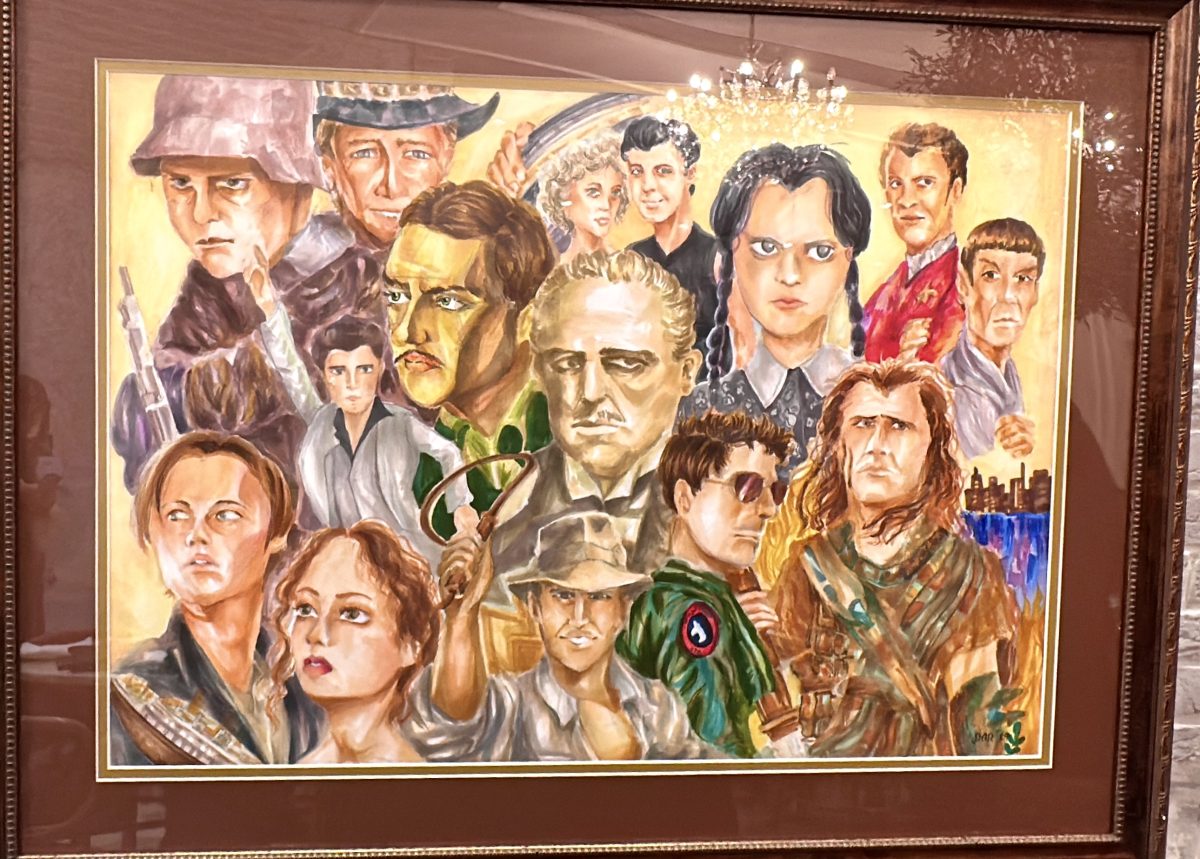
The PaintBrush Art Community, a collective of Indian diaspora artists, hosted a unique exhibition titled “Retro Revival.” This cross-cultural artistic endeavor brings together 22 artists from 8 countries to pay homage to iconic Paramount movies from Hollywood’s golden era.
The exhibition features 26 artworks, spanning vibrant paintings that revisit beloved films like The Terminator, Titanic, The Godfather, Sleepy Hollow, Tomb Raider, and Top Gun.
These pieces capture the magic of these classic movies and transport viewers back to a time of cinematic excellence. ‘Retro Revival’ goes beyond the silver screen, with artistic depictions of iconic figures like Marilyn Monroe, Michael Jackson, and Bob Marley.
These artworks serve as a powerful reminder of the eras these cultural giants defined. The exhibition draws inspiration from Paramount Pictures, one of the oldest film studios in the world.
The UAE has seen a remarkable rise as a hub for the arts in recent years.
From world-class museums and galleries to renowned events like World Art Dubai and the Sharjah Biennale, the country fosters a dynamic environment for creative expression.This government-backed focus on arts and culture has not only attracted Indian artists but has also empowered the local art scene. Brushstrokes Through Time: Indian diaspora artists celebrate Hollywood’s Golden Age
NBC’s “The Voice” had just announced that Legend would join as a judge. He would go on to reportedly earn US$14 million per season by his third year on the show. Meanwhile, all of the participants on “The Voice,” save for the winner, earned $0 for their time, apart from a housing and food stipend – much like those congressional interns.
The fall 2023 TV lineup will be saturated with low-cost reality TV shows like “The Voice”; for networks, it’s an end-around to the ongoing TV writersand actors strikes.
Whether it’s “The Voice,” “House Hunters,” “American Chopper” or “The Bachelorette,” reality shows thrive thanks to a simple business model: They pay millions of dollars for big-name celebrities to serve as judges, coaches and hosts, while participants work for free or for paltry pay under the guise of chasing their dreams or gaining exposure.
These participants are the unpaid interns of the entertainment industry, even though it’s their stories, personalities and talent that draw the viewers.
The book was about the exploitative nature of record contracts. But during my research, I kept running into singers who had either auditioned for or participated in “The Voice.”
On “The Voice,” singers compete on teams headed by a celebrity coach. Following a blind audition and various elimination rounds, the live broadcasts begin with four teams of five members apiece. These 20 contestants spend months working in Los Angeles and are provided with only their room and board. Each week, at least one player is eliminated. At the end of each season, the winner receives $100,000 and a record contract.
While some viewers might see reality shows like “The Voice” as launching pads for music careers, many of the musicians I spoke with were disheartened by their experiences on the show.Contestants audition for ‘The Voice’ ahead of its 24th season.
Unlike “American Idol,” where a number of winners, from Kelly Clarkson to Jordan Sparks, have made it big, no winners of “The Voice” have become stars. The closest person to “making it” from “The Voice” is the controversial country singer Morgan Wallen, who was infamously dropped by his label and country radio following the emergence of a video of him using a racial slur. And Wallen didn’t even win “The Voice”; in fact, he barely made it past the blind audition.
Former contestants repeatedly told me that the television exposure did little to help their careers.
Prior to joining the show, many of the musicians were trying to scratch out a living through touring or performing. They put their developing careers on pause to chase their dreams.
However, the show’s contracts have stipulated that contestants cannot perform, sell their name, image and likeness, or record new music while on “The Voice.” (The Conversation reached out to NBC to see if this remains the case for the current season, but did not receive a comment.)
This leaves the 20 finalists with no means to sell their music, even as they spend up to eight months competing. When the show’s losers return to performing, many of them have little new material to promote. By the time they drop a new single or album and announce a tour, some of them told me that they had lost a good portion of their following.
There is one group of people who receive meaningful exposure from these shows: the coaches and judges. Several singers, such as Gwen Stefani and Pharell Williams, have used “The Voice” to jolt their stagnating music careers. While earning millions as coaches and judges, these stars even use the show to promote their music – something the contestants themselves are barred from doing.
Paying these contestants is feasible. If Legend earned $13 million instead of $14 million, that spare million dollars could be dispersed to half of the contestants at $100,000 apiece – an amount that’s currently only reserved for the winner of the show. Cut the salaries of all four coaches by $1 million apiece, and it would free up enough money to pay all 20 contestants $200,000 each.
A gold mine for networks
“The Voice” is far from the only reality show to take advantage of the genre’s low overhead costs.
Viewers might not realize just how profitable these shows are.
Take “House Hunters.” The show follows a prospective homebuyer as they tour three homes. Homebuyers featured on the show have noted that they earn only$500 for their work, and the episodes take three to five days and about 30 hours to film. The show’s producers don’t pay the realtors to be on it.
The low pay for people on reality TV shows matches the low budget for these shows. A former participant wrote that episodes of “House Hunters” cost around $50,000 to film. Prime-time sitcoms, by comparison, have a $1.5 million to $3 million per episode budget.
Sidestepping the unions
That massive budget gap between reality TV and sitcoms is not simply due to an absence of star actors.
Many scripted television shows are based in Los Angeles, where camera crews, stunt doubles, costume artisans, makeup artists and hair stylists are unionized. But shows like “House Hunters,” which are filmed across the country, will recruit crews from right-to-work states. These are states where employees cannot be compelled to join a union or pay union dues as a condition of employment. For these reasons, unions have far less power in these states than they do in places traditionally associated with film and entertainment, such as California and New York.
That’s one reason why TV production started moving to Atlanta – what’s been dubbed the “Hollywood of the South” – where shows like “The Walking Dead” and “Stranger Things” have been filmed.
But in my research, I also learned that Knoxville, Tennessee, has become a reality TV mecca. Like Georgia, Tennessee is also a right-to-work state. In Knoxville, many working musicians join the city’s low-paying entertainment apparatus by taking gigs working on TV and film production crews in between shows and tours.
At a time when TV writers and actors are on strike, it is important to understand that the entertainment industry will try to exploit labor for profit whenever it can.
Reality TV is a way to undercut the leverage of striking workers, whether it’s through their lack of unionized actors, or their use of nonunionized production crews.
Contestants, casts and crew members are starting to catch on. Many reality TV participants have said that they feel like strike scabs, and Bethenny Frankel of “Real Housewives” is reportedly trying to organize her fellow reality performers.
Preying off contestants who are desperate for exposure, reality TV might just be the next labor battle in the entertainment industry.
As John Legend put it, “Unpaid internships make it so only kids with means and privilege get the valuable experience.”
Reality TV does the same to aspiring actors, musicians and celebrities.
The Writers Guild of America (WGA) strike has been going for over 130 days. Joined by the Screen Actors Guild-American Federation of Television and Radio Artists (SAG-AFTRA), Hollywood writers are protesting several issues.
Among other demands, the WGA is calling for explicit regulations on the use of AI in media production, in what Time Magazine called “a pivotal moment” in film history.
Although Barbie and Oppenheimer received most attention this summer, Tom Cruise’s latest instalment in the Mission: Impossible series (Dead Reckoning Part One), reveals more about the future of movies.
Cruise’s nemesis is an AI program called the Entity. Created as a cyberweapon, the Entity achieves sentience to become both agent and object in the ensuing global competition for power.
With computational omniscience in a digitally networked and reliant world, the Entity can manipulate digital and physical infrastructure, such as mobile phones and transit systems, and thus also control the humans who rely on digital interfaces.
Recognizing the Entity as a fundamental threat to humanity, Ethan Hunt (Cruise) of the Impossible Missions Force goes rogue (again) to acquire and destroy the AI.
Immersive experience
The film’s plot is a vivid reminder of how little agency humans have in digital environments, even as the cinematic environment relies on contemporary technologies to immerse its audience.
Like Cruise’s previous summer 2022 blockbuster, Top Gun: Maverick, Mission: Impossible — Dead Reckoning is designed to be cinema as experience more than story, using drone cinematography and sophisticated sound editing.
Director Christopher McQuarrie explained his approach as dedicated to “a fully immersive big screen experience,” including high-definition video and sound technologies that allow editors to create the sensation of sound in the audience’s physical environment.
Human acting, star power
As a Hollywood movie star, Cruise is similarly devoted to creating visceral audience experiences.
Even as computer-generated imagery (CGI) and digital effects have overtaken big-budget films, Cruise insists on doing all of his own stunts. He explicitly compared his approach to classic film performances, saying: “No one asked Gene Kelly, ‘Why do you dance? Why do you do your own dancing?”
Unsurprisingly, McQuarrie decided against using a digitally de-aged Cruise, instead focusing attention on the physical fitness of a movie star who appears far younger than his 61 years.
All of Mission: Impossible – Dead Reckoning recalls earlier eras of cinema. The film’s title is taken, at least in part, from the 1947 film with Humphrey Bogart.
The early desert sequence recalls big-screen desert epics like Lawrence of Arabia (1962), while the submarine introduction to the Entity’s power echoes The Hunt for Red October (1990), among others.
Classic car, train chases
A 20-minute car chase through the streets of Rome features an imperilled baby carriage on steps, a reference to the same scenario in director Sergei Eisenstein’s influential Battleship Potemkin from 1925.
Cruise is handcuffed to costar Hayley Atwell, a trick used in various films, including the James Bond film Tomorrow Never Dies (1997), while driving a small yellow Fiat, reminiscent of both The Italian Job (1965) and The Bourne Identity (2002).
The numerous cinematic references are to films that predate the era of streaming and social media.
Physical presence: a luxury?
Writers and actors are right to be worried. With so many processes in commercial media already routinized, the industry appears particularly vulnerable to generative AI.
The current circumstances recall earlier transitions such as the effect when films introduced sound technologies, a threat to silent-film actors dramatized in the Gene Kelly film, Singin’ in the Rain. More recently, movie theatres moved from celluloid to digital projection, largely eliminating projectionists.
Overt resistance to new technologies is rarely successful in the long term. Business professor and pundit Scott Galloway has compared the writers’ strike to the 1980s National Union of Mineworkers strike in Northern England.
With so much digital content available, physical presence and proximity becomes rarer and therefore more of a luxury item.
Return to live experiences
Certainly, audiences have returned robustly to live music concerts. (Just try getting a Taylor Swift ticket in Toronto.)
For now, we will all have to wait and see how it ends for cinema and those who make it. Part two of Mission: Impossible — Dead Reckoning isn’t due out until next summer.
Hopefully, it will be a Hollywood ending for all of us.
Rihanna mocks Trump with viral video and her song ‘Needed Me’
Rihanna has poked fun at US President Donald Trump by posting a viral video of the president and his wife Melania, with her own track edited in.
The clip in question shows Donald and Melania disembarking Air Force One on Sunday (16 August). The president appears to try to hold the first lady’s hand, however, she seems to be more concerned with stopping her skirt from blowing up in the wind, ignoring his numerous attempts at affection.
Rihanna has shared a version of the video with her 2016 hit “Needed Me” playing over the top.
The lyrics “I was good on my own, that’s the way it was” can be heard as Melania refuses to hold her husband’s hand.
Rihanna posted the clip with a caption referencing how many days are left until the US election, writing: “Melania likes art. #78days.”
The “Wild Thoughts” singer has been working on her ninth studio album for the last four years.
She recently told fans they are “not going to be disappointed” after the long wait. Speaking about her new music, Rihanna said: “I am always working on music and when I am ready to put it out in the way that I feel fit, it’s gonna come out.
Weightless Every year Cannes Film Festival has a strong line-up of movies. For every cinema lover, it’s the highlight of the movie calendar as it showcases agenda-setting films. This year’s line-up looks special, with the latest films by Woody Allen and Steven Spielberg. Here are the seven movies we’re most looking forward to...
Cafe Society: Being Woody Allen’s fourth time opening, the non-competition slot at Cannes, the film stars Jessie Eisenberg, Steve Carell and Blake Lively in the prominent cast. It’s a romantic dramedy exploring the story of a young man who arrives in Hollywood during the late 1930s.
La La Land: Directed by the amazing Damien Chazelle, whose last film Whiplash received much success and acclaim, is back in this musical with Ryan Gosling and Emma Stone. The film is about the story of a jazz pianist who falls for an aspiring actress in Hollywood.
Silence: Who wouldn’t be excited to see a movie directed by Martin Scorcese? In his next directorial, Scorsese puts together a historical drama called Silence starring Adam Driver, Liam Neeson and Andrew Garfield.
Money Monster: This Jodie Foster directed film brings together the magic of Julia Roberts and George Clooney together after a long time. With such star power both in front and behind the camera; we are certain this film will have all the elements of a gripping film. Set on the Wall Street, the film is tale of a common man who takes a newsroom hostage to take revenge of his loss of money because of a misleading advice given to him.
The Nice Guys: Set in the 70s The Nice Guys is the first time pairing of Ryan Gosling and Russell Crowe in this bizarre crime, drama and comedy film set on the case of a missing girl. What follow is a series of complicated twists in the gripping and comedic twist of events as they go deeper into the case.
The BFG: Directed by Hollywood royalty, Steven Speilberg’s The BFG is an adaptation of the most beloved tales by Ronald Dahl. The film is a story of a young girl who befriends a friendly giant as they set out on an adventure to stop the evil man eating giants. What’s more interesting is that the screenwriter is late Melissa Mathinson who last collaborated with the director genius on ET.
Weightless: Who wouldn’t want to see an ensemble cast of Rooney Mara, Cate Blanchett, Ryan Gosling, Micheal Fassbender, Chritian Bale, Natalie Portman and Val Kilmer. While not much is known of the plot, Weightless is a story of two intersecting love triangles set in the music scene in Texas.Source: http://www.tribuneindia.com
Los Angeles, May 5 (IANS) Actor Brad Pitt has reportedly bought a painting of singer Justin Bieber to gift to his son Pax, who is a fan of the musician. Pitt got the portrait by street artist Bambi after her agent offered him the artwork. "Pax loves Justin and so Brad thought this would be the perfect gift for him. Brad loves Bambi's unique style and this is his third purchase from her," dailystar.co.uk quoted a source as saying. "When he found out she'd done a piece with Justin, he knew he'd have to get it for Pax. The Justin artwork is done on a panel of wood and he loves how unique it is," added the source. The painting portrays the pop star alongside the words, "Rebel without a clue". Source: Article, Image: flickr.com
August 12, 2014: Amitabh Bachchan and Shah Rukh Khan on Tuesday joined other Bollywood celebrities to mourn the untimely death of Oscar-winning actor Robin Williams. The ‘Good Will Hunting’ star, 63, was found dead yesterday of an apparent suicide. Hailing his stage performances as the best ones, Amitabh Bachchan tweeted, “Lost in person Robin Williams… his versatility extraordinary, his best though to me was his stage stand-up solo performances!!” Shah Rukh Khan called Williams‘ his captain, referring to the actor’s inspiring role in film ‘Dead Poets Society’ (1989) while quoting Oscar Wilde. “‘To have no yesterday, and no to-morrow. To forget time, to forgive life, to be at peace’… may death be so for My Captain. RIP Mr Williams,” the star wrote on his Twitter page. Earlier in the day, other celebrities like Kamal Haasan, Arjun Kapoor, Abhishek Bachchan, Shabana Azmi, Abhay Deol, Farah Khan, Shekhar Kapur took to the micro-blogging site to express their sadness over Williams’ demise. Haasan, whose ‘Chachi 420′ was said to be inspired by Williams ‘Mrs Doubtfire’, said, “If the alleged story about his suicide is true then I dislike him for ending his life before his due date of expiry. That’s a cop out that I don’t expect of an artist of his calibre. Same applies to my Indian idol Guru Dutt”. Abhishek remembered him for his funny antics in films and wrote, “Oh captain, my… Terrible news about the passing of one of my favourite actors. Mr Robin Williams. This is the 1st time he made anyone cry.” Azmi and Abhay call his death a major loss to the films. “Robin Williams. What a loss! You leave behind a vaccum difficult to fill but your remarkable body of work will continue to inspire. RIP,” Shabana tweeted. Abhay said, “Philip Seymour Hoffman, Zohra Sehgal, Robin Williams. The world’s a better place because they lived. RIP.” “RIP Robin Williams. You will always remain in my memory as Mrs Doubtfire… Hope you find happiness up there you mad genius…,” Arjun posted. “Robin Williams… This seems like a personal loss… What a sad start to the day… So much to learn, much to mourn… #RIPRobinWilliams,” Richa Chadha tweeted. Shekhar Kapur questions the alleged suicide committed by the actor. “The man that brought us so much laughter and joy committed suicide? Who knows the internal conflicts of the creative mind #RIPRobinWilliams,” he tweeted. Farah tweeted, “Oh God!! How do you tell your kids Mrs Doubtfire has died!? RIP Robin Williams.. Thank you for the laughter in the movies!” Farhan Akhtar and Sidharth Malhotra thanked the legendary actor for entertaining them from decades. “Robin Williams. Thank you for the decades of entertainment. RIP,” Farhan wrote. Sidharth said, “Sad to hear about Robin Williams-RIP and thank you for all the laughs.” “Woke up to the awful and tragic news of Mr Robbin Williams. He touched our hearts through so many wonderful characters. RIP captain o captain,” Arjun Rampal tweeted. Source: The Indian Express
After the roaring success of her first 2 singles - In My City featuring Will.I.Am and Exotic feat Pitbull, Priyanka Chopra will soon launch her 3rd international single this April. Titled "I Can't Make you Love Me", this is unique cover of Bonnie Raitt's 1991 hit single that was voted into Rolling Stone Magazine's 500 Greatest Songs of All Time. The video for the new single will feature American actor and heartthrob Milo Ventimiglia. Capturing hearts and audiences across the globe as Peter Petreilli in TV’s hit series Heroes, Milo has established himself as household name, capturing hearts on a global level with his roles in both TV and film internationally. Source: Page3
Steven Spielberg has pulled out of directing 'American Sniper'.
The award-winning filmmaker and his DreamWorks studios have cut ties with the project, which will see Bradley Cooper starring as Navy SEAL Chris Kyle as well as producing. According to Deadline.com, the 'War Horse' director simply couldn't make his vision work with the envisioned budget. Warner Bros. and Cooper are still attached and they are expected to find another director. Spielberg has been known to drop out of projects in the past, and famously took 11 years to get Oscar-winning film 'Lincoln' the way he wanted. The script for 'American Sniper' was penned by Jason Hall and is based on Kyle's eponymous memoir 'American Sniper: The Autobiography of the Most Lethal Sniper in US Military History'. Kyle was a Texas-born shooter with the highest recorded number of sniper kills in the US military at 160 deadly shots. However, his dedication to his career as a Navy SEAL chief affected his relationship with his wife, and he was tragically killed at a shooting range by a fellow veteran he was trying to help deal with his experiences in the military. Photo Credits: Pixplanete / PR Photos. Source: Starpulse.com
When Demi Moore and Bruce Willis were still married, they owned over $20 million worth of real estate in the mountains of Idaho, reportedly as a getaway from their Hollywood lives. After the divorce, Bruce Willis still owned The Mint Bar and Liberty Theater in the small town of Hailey, Idaho, as well as a ski resort in Fairfield, Idaho. In April, Willis put his Hailey home and bar up for sale for a combined $21 million. He had hoped to also sell the ski resort but has since decided to donate it to the citizens of Fairfield. "I couldn’t be more pleased with the organization that will be responsible for the management of Soldier Mountain Ski Area," Willis said in a press release to the Idaho Statesman. "It was exciting to see that the very people who ski at Soldier care so much about its future. I wish them the very best." A nonprofit group formed to take over the mountain, bringing ownership back to the locals. Back in April, Willis was in town to take part in a town hall to discuss ownership changes of the mountain. "It went from idea to execution in a matter of weeks," local attorney Will Varin, president of the new nonprofit, said. Willis made it a point to give the mountain back to the community, and the community understands the importance of that move. "It's an honor and a privilege to do it," Varin told the Idaho Statesman. "At the end of the day, we don't own the mountain, it's a community mountain." The spokesperson for the new nonprofit group, local Justin Nyquist, echoed the sentiment. "Soldier Mountain is the pride of Fairfield," Nyquist told the Idaho Mountain Express. "The new owners want to keep it that way. This community meeting is a chance to lay out the ownership change to the town and offer residents an opportunity to ask questions." In March 2009, the base lodge at Soldier Mountain burned down, but Willis quickly rebuilt it. The new lodge, which is 4,500 square feet, opened just 10 months later, in January 2010. Photo Credits: PR Photos, Source: Starpulse.com, Image: flickr.com
Rapper Honey Singh has apparently hit a jackpot by bagging the offer to compose for Bruce Willis’ actioner Diehard 5. But there is a catch. He has to write and compose the song in a week, which is too short a time for him. If notoriety is a stepping-stone to stardom, then the recent controversies surrounding some of his songs have taken rapper Honey Singh to another level of popularity. If things will work out, he may end up singing for Hollywood film "Diehard 5". The singer courted controversies for his songs allegedly based on sexual themes. Honey sang hit songs last year in the films Cocktail and Khiladi 786. He is now in the process of cracking deals for at least seven new Bollywood projects for topnotch filmmakers including Sajid Nadiadwala and Anurag Kashyap. But the topping on the controversial cake is the Hollywood deal likely to be cracked with the producers of "Diehard 5", the latest instalment of the franchise. Apparently, Honey Singh is game for his first international film-song except for the time-factor. "They need the song in a week. I take at least three weeks to write and compose a song. If it's my first international song and that too for a franchise as well-known as 'Diehard' I've to make sure it's an effort worth listening to," said Honey. Honey is working on the song. He will deliver to the producers only if he is fully satisfied with the number. Impeding his progress on this and others musical projects are the various FIRs filed against him in different parts of the country accusing him of composing misogynistic songs. He said: "My lawyers have been busy. Only now have I been able to get out of the tangle. Now, I can again think straight. But it hasn't been an easy time for me. I was unnecessarily attacked and ripped apart." Honey has written a song about the whole experience that he went through earlier this month when the moral police slammed down on him. The song titled "Bring Me Back" will be premiered later this week on MTV. Source: ApunKaChoice
Megan Fox has gone all mushy now that she's a mom. The actress and her husband Brian Austin Green welcomed their first child, Noah Shannon, on September 27 and she confesses she's a changed woman after becoming a mother She told Eonline.com, "I used to have this wicked, dark sense of humour, and now I don't find morbid things laughing anymore. I'm so much softer than I used to be, and I feel everything so much deeper than I used to. "When I watch the news, everyone is somebody's child or someone's mother. So, I'm constantly worrying now about everything." No surprise, Fox says her needs come second to Noah's. She told HollyScoop.com, "He's (son) very bossy! He's only two and a half months and he's super opinionated and I'm already a complete slave to him!" Photo Credits: PR Photos, Source: Starpulse.com
Gosh! Just a few months after their reconciliation, Robert Pattinson and Kristen Stewart seem to have called off their relationship, apparently because Rob wants to cool it off. Actors Robert Pattinson and Kristen Stewart have reportedly split once again. The "Twilight" co-stars first split last summer when Stewart admitted to cheating on Pattinson with "Snow White And The Huntsman" director Rupert Sanders. According to thesun.co.uk, Pattinson told Stewart that he wanted to call time on their relationship once again over the weekend. "She flew to LA and was supposed to be Robert's date for the Golden Globes, but he told her he wants to cool it off. He loves her, but would rather go back to being good friends so they can rebuild their trust and focus on work after 'Twilight'," said a source. "Kristen's upset but understands. She should not have pushed him to reconcile after her infidelity. She's hoping he'll come round and time will be a great healer. "He was getting so much pressure to ditch her. His friends told him to focus on his career and said she was wrecking his chances," added the source. The couple reconciled in September last year, but were recently rumoured to have been fighting a lot, with Robert Pattinson, 26, said to be feeling unhappy in the relationship. Kristen Stewart, 22, is reportedly planning to move to New York for a fresh start, with another source claiming that the she feels she has a bit more peace there than in Hollywood. Source: ApunKaChoice
Critics praise Scarlett Johansson's performance but complain that she is drowned out by the soundtrack
SCARLETT JOHANSSON has impressed critics with her first return to theatre since her Tony-winning performance three years ago as Catherine in A View From the Bridge. Johansson stars as Maggie the 'cat' in Tennessee Williams' Cat on a Hot Tin Roof, which examines the relationships within the family of a wealthy cotton tycoon in the Mississippi Delta. Johansson, who spends much of the first act of the play dressed in nothing but a slip, is expected to draw in the crowds to Richard Rodgers Theatre in New York – and they won't be disappointed, writes Mark Hughes in the Daily Telegraph. Like Elizabeth Taylor in the 1958 film version of the play, Johansson delivers "a charismatic, if at times slightly breathless, performance", says Hughes. "Affecting a very passable Southern accent, [Johansson's] Maggie flits between rage at the fact her husband no longer seems even to like her, and sorrow that she cannot force him to. In between, there are moments of genuine comedy that drew loud laughs and applause," he adds. The New York Times says Johansson "seems to possess a confidence that can turn raw nerves into raw power", while Bloomberg describes her Maggie as "more tigress than the kitty so often portrayed in this role". But critics have warned that the actors risk being drowned out by the play's soundtrack. The creative team has added a soundtrack of fireworks, cap guns, the sound of crickets, chiming clocks, thunder crashes and nine songs. A mention of glory days on the football field prompts the eerie echo of a cheering crowd, while talk of a fateful phone-call triggers a ghostly ringing. "Somebody spayed the cat," says David Rooney at the Hollywood Reporter. And it wasn't the "hard-working" main attraction Johansson. "The star and her similarly marooned fellow cast members are all at the mercy of Rob Ashford, a director out of his depth and reaching for any flotation device he can grab in this sinking Broadway revival, which manages to be both thunderously emphatic and curiously flat." The production's "cluttered audio" means the actors are forced to compete against busy sounds and music cues, says Rooney. "As a result, the humour often doesn't land and the dramatic peaks tend to fly by unnoticed." Johansson is "cerebral, angry and proud" says the Washington Post, but asks "who can hear any of the actors through this din?" ·Source: The Week UK
According to sources, actor Esha Gupta is likely to play the Indian version of the Hollywood character – Lara Croftfrom the movie Lara Croft: Tomb Raider. Reportedly, it is Esha’s uncanny resemblance to Hollywood actress Angelina Jolie that got her this role. A source said, “Esha was approached for the role as she’s tall and has a very athletic physique. Obviously, her looks are an advantage, as those who’ve seen the original will be able toconnect with the film better…” The project will be made by Indian producers and backed by a Hollywood studio. No other details about the project were provided. Source: Bollywood3
Actress Jennifer Lawrence says she eats normally and does not worry about the 'size zero' fad in Hollywood. The 22-year-old shot to fame with her role of Katniss Everdeen in "The Hunger Games" and she says wants to be a good role model to her fans, reported Contactmusic. "Oh god, yes, I am so tired of the lollipops. I mean, if I looked like that I wouldn't be tired of it, obviously, but it's hilarious, the way I am supposedly the overweight one. "Like, they (the paparazzi) got me at the movies yesterday and the caption read something like, 'Curvy star cannot wait to dig into a tub of popcorn'. I mean come on! I'm just a normal girl who likes to eats," she said. The actress takes her role in "The Hunger Games" very seriously and think she has little in common with her tough on-screen alter-ego. "I guess people expect that of me, and if I had to kill something for survival, maybe I would and yeah, maybe I was a tomboy when I was growing up. But I'm definitely a girl now. "Of course, there's a responsibility I'm aware of. In one sense, luckily, it comes naturally because I can't stay out beyond midnight. I don't really have an exciting life."Source: Screen India
As arrangements for the public Presidential swearing-in ceremony are at their final stage in Washington DC, pop stars are ready to join the inauguration festivities. Earlier this month the Inauguration Committee announced Beyonce will sing the national anthem. Rumors are now circulating that Lady Gaga will perform at one of the inauguration balls. Popular artists have become regular guests at concerts during the inauguration period ever since Frank Sinatra performed at the President John F. Kennedy’s inauguration party in 1961.
Back then John F. Kennedy was a friend of many popular artists and Hollywood stars. That’s why when Kennedy asked Frank Sinatra, the most beloved singer at that time, to sing at an inauguration event, Sinatra came and sang. Time goes by, musical preferences change and now we learn that Lady Gaga, an extravagant American singer, may perform on Tuesday at a private ball organized especially for White House staffers. Earlier January the Inauguration Committee announced another diva Beyonce, Kelly Clarkson and James Taylor would sing at the swearing-in ceremony. Beyonce is expected to sing the national anthem. Clarkson will sing the patriotic song “My Country 'Tis of Thee” and Taylor - “America the Beautiful”. Inauguration balls date back to the very first inauguration of the George Washington in 1789. Since then balls were a regular accompaniment of the inauguration ceremony. Sometimes balls were cancelled by presidents for various reasons. In 1853 Franklin Pierce cancelled balls due to the mourning for his son. In 1913 Woodrow Wilson cancelled balls because of their expensiveness. In 1921 Warren G. Harding supported Wilson’s initiative and no balls were held due to the same reason. But inauguration balls are finally reinstated, they are popular and draw millions of people. Artists usually say “I’m honored” when accepting the invitation. Inauguration concerts do not only show who is who in the American popular music at the moment but they hint at the musical preferences of the nation’s first man. Beyonce seemed to be one of the luckiest as this year would be her second time. Back in 2009 she sang Etta James’ classic “At Last” as the Obamas were dancing at Washington Convention Center after Obama had said his first Oath of Office at the Capitol Hill. In 1993 at the Presidential Gala President Bill Clinton, then elected for the first time, was sharing the stage with Chuck Berry and Michael Jackson. “The younger the president, the more we see a connection to pop culture and to music,” said Phil Gallo, senior correspondent for Billboard. “So Kennedy, you have it. Nixon, you don't.” According to records of the Joint Congressional Committee on Inaugural Ceremonies, at Nixon’s inauguration the nation was listening to the Mormon Tabernacle Choir performing “This is My Country”. Еhe Mormon Tabernacle Choir participated six times in inauguration events: in 2001 for President George W. Bush, in 1989 for President George H.W. Bush, in 1981 for President Ronald Reagan, in 1973 and 1969 for both inaugurations of President Richard Nixon, and in 1965 for the, inauguration of President Lyndon B. Johnson. This year’s line-up include Alicia Keys, Katy Perry, Stevie Wonder, Jennifer Hudson, Marc Anthony, and Usher. Beloved music is what the public would certainly like before the nation haы to plunge into a new period of new challenges and tasks. Source: Voice of Russia
Esquire's profile of Hollywood actress sets new benchmark for awful celebrity interviews, say critics
BY Richard Jinman, MEGAN FOX is not the biggest name in Hollywood, but an article about the actress published in Esquire has sent her profile rocketing after being labelled 'The Worst Thing Ever Written'. Stephen Marche's interview with the Transformers actress takes place "deep" in Fox’s LA house where the pair warm up by discussing an Aztec ritual involving "human sacrifice". Marche, it transpires, is framing Fox as a kind of sacrifice on the altar of celebrity, but Vice Magazine’s Jamie Lee Curtis Taete says the "weird" metaphor "doesn’t make any sense" and is one of five reasons the piece is the "worst thing ever written". Taete also takes issue with the author's fascination with Fox's beauty, in particular his observation that "the symmetry of her face, up close, is genuinely shocking". Elsewhere, Marche compares the colour of Fox's skin to the colour of the moon “in the thin air of northern winters”. As the interview progresses we learn that Fox believes in "aliens and leprechauns" and has "an obsession with the Book of Revelations". But Marche returns to her beauty, pointing out that it far outshines "plain" women like the singers Adele and Lady Gaga and Girls actress Lena Dunham. Gawker calls the profile "terrible" and says the "main takeaway" message after 2,400 words is that Fox is "pretty". It ends, as it began, "suffocating under the weight of a giant honking metaphor", this one involving Noah and his ark. Some commentators have speculated that Marche's piece might be a parody of a celebrity interview, but the author has remained largely silent on the issue. He has tweeted just once on the online furore ignited by the piece, saying: "It's not every day you get challenged to a duel over a celebrity profile you've written". Victoria Wright was so transfixed by the profile she has written a parody of Marche's piece in The Independent. In the parody, Fox’s eyes are "all glassy in contemplation", a sight which moves Wright to exclaim, "My God she's beautiful!" There's no word yet about what Fox thinks of the article. Source: The Week UK


 Country singer Adley Stump, a former contestant on NBC’s hit reality show ‘The Voice,’ performs at an Air Force base in Washington state.


