


- Walt Disney is aiming to revamp its streaming business in India by providing cost-free cricket content on smartphones. This strategic move is anticipated to drive an increase in advertising revenue and counterbalance the effects of a decline in subscribers.

- As subscriber dropouts continue to escalate, reducing the user base by a third from October 2022 to July 2023, the financial performance of the Burbank, California, there are warning signs of the entertainment giant facing even greater challenges in India.
- In 2019, the company acquired the Indian streaming service Hotstar as part of its $71 billion deal for select 21st Century Fox global assets. After securing the streaming rights to the Indian Premier League (IPL), the world's wealthiest cricket league, Disney converted Hotstar's cricket content into paid service in 2020. Clearly, Disney held high hopes of attracting as many as 100 million users within a few years.
- However, Indian billionaire Mukesh Ambani secured the IPL rights with a $2.9 billion bid last year and proceeded to offer game streaming for free. This move prompted a mass exodus of Disney subscribers; from the 61 million users in October, approximately 21 million had departed by July.
- Disney is set to livestream the Asia Cup matches starting on August 30, as well as the World Cup in October and November. These broadcasts will be accessible to the 600 million smartphone users in the cricket-loving nation at no cost.

- This new approach coincides with Disney's ongoing exploration of potential joint venture partnerships or even the sale of its business in India.
- Disney secured an extension of its rights to broadcast the International Cricket Council's tournaments in India from 2024 to 2027, committing approximately $3 billion to the deal. While retaining digital streaming rights, Disney, according to an insider, licensed the TV broadcast rights to India’s Zee Entertainment for an estimated $1.5 billion last year.
- The company has determined that the model of offering free cricket content on mobile phones and tablets is the essential strategic shift required to increase revenues. This initiative is referred to as a ‘hybrid model’ aimed at increasing advertising revenues by attracting more smartphone viewers while simultaneously attracting new subscribers to the paid plans of the Hotstar TV app, where cricket content will remain accessible.
- The company has set its sights on achieving a new milestone of 50 million concurrent viewers during the World Cup, which is double the number recorded in 2019. This figure would also mark a 56% increase compared to the viewership that JioCinema, led by Ambani, garnered during this year’s IPL finals in May.

- In the United States, the subscription rates for the ad-free Disney+ streaming service are slated to increase by 27%, reaching $13.99 per month. In contrast, the Disney+ Hotstar service in India is priced at $3.62 per month.
- According to Disney's latest quarterly earnings report, the average revenue per user (ARPU) in India is significantly lower, at just $0.59, while the Disney+ service in the US commands an ARPU of $7.31.
- In March, as the Ambani group promoted the IPL on its streaming apps, its emphasis was on how people could watch matches on the go, using smartphones, and eliminating the need for a TV. In response, Disney launched advertisements asserting that cricket was best enjoyed on television, a platform for which it still held the IPL rights.
- In its recent advertising campaigns, Disney adopted a new approach. It proclaimed, ‘Now, enjoy all the matches from the world's largest tournaments anywhere, on your mobile, completely free.’ Disney attempts to provide free cricket to gain momentum in streaming wars with rivals

Sunday, 3 September 2023
Disney attempts to provide free cricket to gain momentum in streaming wars with rivals

Monday, 26 January 2015
India and United States break nuclear deadlock

Prime Minister Narendra Modi with US President Barack Obama at Hyderabad House in New Delhi on Sunday. — Sondeep Shankar
Deal is done, announces foreign secretary Sujatha Singh: After talks between visiting US President Barack Obama and Prime Minister Narendra Modi, India and the United States on Sunday managed to “break the logjam” that had existed since 2008 for operationalising their landmark civil nuclear agreement, with an announcement by foreign secretary Sujata Singh that “the deal is done”. In what President Obama called a “breakthrough”, the two sides have resolved key hurdles on the liability of suppliers of nuclear reactors in the event of an accident and the tracking of fuel supplied by the US and other countries for its proposed nuclear plants. “We have broken the logjam of the past few years. We have reached an agreement. The deal is done,” foreign secretary Sujatha Singh announced after extended discussions between the two leaders lasting over three hours. In another major step on cooperation in the defence sector, the two countries renewed an enhanced Defence Framework Agreement for the next 10 years. Under the Defence Technology and Trade Initiative, four projects were also agreed on as “pathfinder projects”, which are the “next generation Raven Mini UAVs, roll on and roll off kits for C-130 J-Super Hercules military transport aircraft, mobile electric hybrid power source and Uniform Integrated Protection Ensemble Increment 2”. Both also agreed on a working group to explore aircraft carrier technology besides designing and development of jet engine technology. India and the US decided to resume talks on the bilateral investment treaty during discussions between Prime Minister Modi and US President Obama, who lauded reforms undertaken by the new government. The White House said the understanding on the civil nuclear programme resolves US concerns on both tracking and liability. “In our judgment, the Indians have moved sufficiently on these issues to give us assurances,” US ambassador to India Richard Verma told US journalists. Mr Verma explained that it will still be for US companies to assess the market and decide whether to partake in India’s nuclear programme. Neither country needs to take any legislative action to complete the agreements reached between the two leaders. As Prime Minister Modi described it, the nuclear deal was the centrepiece of the Obama-Modi discussions, given its contentious nature, but the two leaders reached an understanding on a number of other areas, including defence. In breaking the logjam, experts feel the Modi government has managed to achieve what the previous Manmohan Singh government could not. The foreign secretary said assurances were given to the US side on both the liability clause and tracking issues. “The liability provisions and administrative arrangements finalised under the 123 Agreement (tracking) are consistent with our bilateral legal arrangements and contracts, IAEA safeguards and international laws and obligations,” Ms Singh said. “The civil nuclear agreement was the centrepiece of our transformed relationship, which demonstrated new trust. It also created new economic opportunities and expanded our options for clean energy. In the course of the past four months, we have worked with a sense of purpose to move it forward. I am pleased that six years after we signed our bilateral agreement, we are moving towards commercial cooperation, consistent with our law, our international legal obligations, and technical and commercial viability,” Prime Minister Modi said. The deal on nuclear cooperation and other areas was clinched between the two leaders after discussions spread over three hours at the delegation level as well as one-on-one talks, besides a tête-à-tête on the lawns of Hyderabad House, reflecting the warm personal chemistry between the two leaders. On defence cooperation, Mr Modi said: “Today, we have also decided to take our growing defence cooperation to a new level. We have agreed, in principle, to pursue co-development and co-production of specific advanced defence projects.” He added this will help upgrade the country’s domestic defence industry and expand India’s manufacturing sector. He also said both countries will explore cooperation in other areas of advanced defence technologies. “We have renewed our Defence Framework Agreement. We will deepen our cooperation on maritime security,” he said. The new framework will enhance the bilateral defence partnership by stepping up joint military exercises and in-depth intelligence-sharing, maritime security efforts, among other things, besides giving a strong push for joint- development and production of high-end defence gear. President Obama said: “We agreed to deepen our defence and security cooperation... And in a major step forward for our relationship, defence technology and trade initiative will allow us to jointly develop and produce defence technologies,” he said. Foreign secretary Sujata Singh said both countries had also “agreed on a working group to explore aircraft carrier technology, sharing, design and also development of jet engine technology”. Asked for details, Indian ambassador to Washington S. Jaishankar said all four projects involve joint development and joint production. “Two of these are with American companies. Two of them with US governments. They have to work out the modalities because they just had a DTTI working group meeting before the visit,” he said. The ambassador noted that the purpose of DTTI was to identify technologies that were unique and which were viable to produce. He said the identified projects are “called pathfinder projects because experience of this will guide us on how we take this forward”. On the working group for jet engines, he said both sides had a discussion under DTTI and have decided “to explore the development of jet engines in India”. He said it was much broader than the Kaveri jet engine that India was already working on. Replying to a query about the difference between the existing defence framework and the new one, he said India has “negotiated a new” agreement for the next 10 years. “DTTI is an initiative which is within the defence framework. It is a new initiative. It was announced a few years ago but it has really become operational now. The big change is that we have taken that big step towards operationalising an initiative, and this case specifically identifying projects and agreeing on important areas where we will have working groups,” he said. The significant project under DTTI is the plans for joint development and production of next generation Raven Mini UAVs, a device which the Indian Army is eyeing. If the joint manufacturing of the UAV happens, then India would be able to get a slice of the multi-billion order book for the world’s most advanced hand-launched drone. The drone proved to be a great success for US forces in Afghanistan as it gives air observations up to a distance of 10 km, which makes it possible to increase situational awareness. Defence sources said the roll on and roll off kits for C-130 aircraft deals with specialised plates and technology for loading and loading off cargo. Mobile Electric Hybrid Power Source is conceived to be a non-grid-tied smart power system with output ranging from 300W to 800kW. This was also effectively put into use by the US Army in Afghanistan. Uniform Integrated Protection Ensemble Increment 2 refers to a more advanced protection gear for soldiers against chemical and biological warfare. On steps to promote clean energy, Mr Obama said the two countries had agreed to make “concrete progress” in phasing out major greenhouse gases, apart from expanding solar energy initiatives and launching joint projects to improve air quality in Indian cities. Prime Minister Narendra Modi also ruled out India coming under pressure from any country on the global climate pact, as India and the US announced steps to boost cooperation in clean energy and to confront climate change issues. Speaking on the breakthrough in operationalising of the Indo-US nuclear deal, President Obama said, “Today, we achieved a breakthrough understanding on two issues that were holding up our advances on civil nuclear cooperation and we are committed to moving towards full implementation and this is an important step that shows how we can work together to elevate our relationship.”Source: The Asian Age
Tuesday, 4 February 2014
Global hybrid electric vehicle market will generate 2.07 million sales in 2013, study says

The global hybrid electric vehicle (HEV) market will generate 2.07 million sales in 2013, as consumers across the globe seek to lower their fuel expenditure and manufacturers are compelled to decrease vehicle CO2 emissions, according to a new report from ASDReports.com.
"Hybrid vehicles are a growth market as they offer opportunities to satisfy consumer needs and also government emission regulations," the firm said in an accompanying statement. "The rising price of oil and the current economic climate have made consumers more conscious about fuel efficiency. Modern technologies enable manufacturers to obtain better fuel efficiency and lower emissions from hybrid vehicles without sacrificing engine performance." The report contains 71 tables, charts and graphs that add visual analysis in order to explain developing trends within the hybrid market. The study provides forecasts for the period 2013-2023 in terms of unit sales (m) for hybrid vehicles. Hybrid penetration rate forecasts are also provided from 2013-2023 for conventional ICE including stop/start, mild hybrid, full hybrid and plug-in hybrids. Twelve leading national hybrid vehicle markets are forecast and analysed over the period 2013-2023. The report provides profiles of 17 leading companies operating within the hybrid market, and an exclusive interview with the principal automobile hybrid manufacturer, Toyota / Lexus (GB) Plc, providing expert insight alongside the analysis. Source: Article
Tuesday, 14 May 2013
Solar Panels As Inexpensive As Paint? It's Possible Due To Research

Credit: University of Buffalo
Most Americans want the U.S. to place more emphasis on developing solar power, recent polls suggest. A major impediment, however, is the cost to manufacture, install and maintain solar panels. Simply put, most people and businesses cannot afford to place them on their rooftops. Fortunately, that is changing because researchers such as Qiaoqiang Gan, University at Buffalo assistant professor of electrical engineering, are helping develop a new generation of photovoltaic cells that produce more power and cost less to manufacture than what’s available today. Qiaoqiang Gan, University at Buffalo assistant professor of electrical engineering One of the more promising efforts, which Gan is working on, involves the use of plasmonic-enhanced organic photovoltaic materials. These devices don’t match traditional solar cells in terms of energy production but they are less expensive and - because they are made (or processed) in liquid form - can be applied to a greater variety of surfaces. Gan detailed the progress of plasmonic-enhanced organic photovoltaic materials in the May 7 edition of the journal Advanced Materials. Co-authors include Filbert J. Bartoli, professor of electrical and computer engineering at Lehigh University, and Zakya Kafafi of the National Science Foundation. The paper, which included an image of a plasmonic-enhanced organic photovoltaic device on the journal’s front page, is available at:http://bit.ly/11gzlQm. Currently, solar power is produced with either thick polycrystalline silicon wafers or thin-film solar cells made up of inorganic materials such as amorphous silicon or cadmium telluride. Both are expensive to manufacture, Gan said. Advanced 
Credit: Wiley-VCH, Weinheim
Materials - A new generation of solar cells, including plasmonic-enhanced organic solar cells His research involves thin-film solar cells, too, but unlike what’s on the market he is using organic materials such as polymers and small molecules that are carbon-based and less expensive. “Compared with their inorganic counterparts, organic photovoltaics can be fabricated over large areas on rigid or flexible substrates potentially becoming as inexpensive as paint,” Gan said. The reference to paint does not include a price point but rather the idea that photovoltaic cells could one day be applied to surfaces as easily as paint is to walls, he said. There are drawbacks to organic photovoltaic cells. They have to be thin due to their relatively poor electronic conductive properties. Because they are thin and, thus, without sufficient material to absorb light, it limits their optical absorption and leads to insufficient power conversion efficiency. Their power conversion efficiency needs to be 10 percent or more to compete in the market, Gan said. To achieve that benchmark, Gan and other researchers are incorporating metal nanoparticles and/or patterned plasmonic nanostructures into organic photovoltaic cells. Plasmons are electromagnetic waves and free electrons that can be used to oscillate back and forth across the interface of metals and semiconductors. Recent material studies suggest they are succeeding, he said. Gan and the paper’s co-authors argue that, because of these breakthroughs, there should be a renewed focus on how nanomaterials and plasmonic strategies can create more efficient and affordable thin-film organic solar cells. Gan is continuing his research by collaborating with several researchers at UB including: Alexander N. Cartwright, professor of electrical engineering and biomedical engineering and UB vice president for research and economic development; Mark T. Swihart, UB professor of chemical and biological engineering and director of the university’s Strategic Strength in Integrated Nanostructured Systems; and Hao Zeng, associate professor of physics. Gan is a member of UB’s electrical engineering optics and photonics research group, which includes Cartwright, professors Edward Furlani and Pao-Lo Liu, and Natalia Litchinitser, associate professor. The group carries out research in nanphotonics, biophotonics, hybrid inorganic/organic materials and devices, nonlinear and fiber optics, metamaterials, nanoplasmonics, optofluidics, microelectromechanical systems (MEMS), biomedical microelectromechanical systems (BioMEMs), biosensing and quantum information processing. Contacts and sources: Cory Nealon, University at Buffalo, Source: Nano Patents And Innovations
Tuesday, 2 October 2012
New Photos and Details of Peugeot's Onyx Supercar Concept, gets a 680HP V8 Diesel-Hybrid Powertrain

Set to be one of the most impressive concepts at this year's edition of the Paris Motor Show, the Onyx is Peugeot's vision of what a 21st century supercar should be. The concept's sharply styled body features wings and doors that are handmade from pure copper sheet, and whose appearance Peugeot says will change over time gaining a patina, while the other panels are from carbon fibre painted matte black. The Onyx incorporates some design references to the RCZ such as the ‘double-bubble’ roof and aluminium arches, but overall, it's a unique looking model. "The silhouette of the Onyx is sculpted softly, sensuously, but it is also alive and technological," explains Sandeep Bhambra, Onyx Exterior Stylist. "From the first sketches I wanted to create a showcase for technological excellence and craftsmanship by combining elements demonstrating high 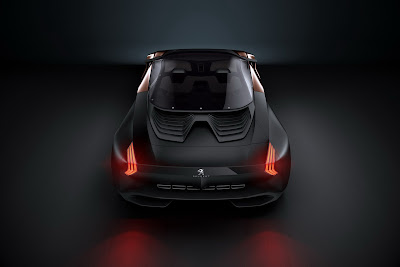
aerodynamic performance, Black Diamond lamps and copper bodywork panels fashioned by hand." The study is 4.65m long, 2.20m wide and 1.13m tall, and according to Peugeot, has a drag coefficient of 0.30 and tips the scales at just 1,100kg (2,425 pounds). The Onyx is built around a carbon fiber central structure that consists of 12 parts and weighs only 100kg (220 pounds). Power comes from a diesel-hybrid drivetrain comprising a 3.7-litre V8 hybrid HDi FAP engine (and not a 1.6-liter unit as previously rumored) capable of delivering 600-horses to the rear wheels via a 6sp sequential gearbox and a kinetic energy system that turns braking power to electricity that is stored in a set of lithium-ion batteries and which can offer an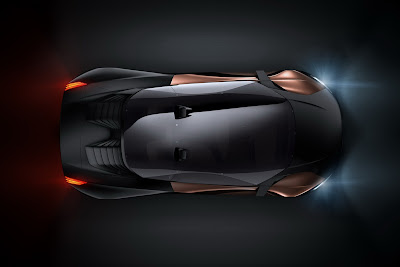
additional 80hp. The concept features double wishbone and an in-board controlled suspension on both ends, while braking power is provided by four carbon discs, 380mm at the front and 355mm at the rear. It is fitted with tires specially developed by Michelin, size 275/30 at the front and 345/30 at the rear, with 20-inch lightweight alloy rims. The passenger compartment of the Onyx sports a minimalistic design and plenty of light thanks to the glass roof. Unusually, the concept doesn't feature traditional seats but two separated areas with Peugeot using foam under the felt, in the areas of contact with the body. "For the interior, I was inspired by an everyday object, the egg box. With remarkable economy of material, it protects very fragile items. I adapted the concept into an intuitive space, with a minimum of connected parts, to become one with the car," explained Julien Cueff, Onyx Interior Stylist. Other highlights include the materials used in the interior such as the dashboard that is made from recycled newspapers that are compressed to create new ‘logs’ from which the parts are made. Peugeot says this material is named "Newspaper Wood". Needless to say, Peugeot has no plans to produce the Onyx. Source: Carscoop
Monday, 26 March 2012
100m hybrid STBs in 2015
 Advanced Television: Hybrid STBs are a fast-growing segment of the worldwide STB market says NPD In-Stat. The boxes include a TV tuner and an Internet connection. Hybrid STBs are appearing in all service categories and new usage models and applications have provided momentum. As television services begin employing applications that are Internet-connected, hybrid STBs are emerging as a key growth driver for the global STB industry. In-Stat research forecasts that 100 million hybrid STBs will ship in 2015. “As the STB industry continues its forward march, the next logical iteration is for the set top box to
enhance and expand traditional TV-related services by permitting access to content from the Internet, or from Internet-like web services that provide a ‘walled garden’ of authorized content,” says Gerry Kaufhold, Research Director. “By combining traditional TV services with ‘enhancements’ that come in via broadband, content owners and service providers think they can successfully compete with all the emerging over-the-top approaches.” Research findings include: - Over 23 million hybrid STBs will ship in North America in 2012. - The Asia Pacific annual revenue will approach $1.5 billion in 2015. - Satellite hybrid STBs will represent 58 per cent of the hybrid STB market in 2013. Source: Advanced Television
Tuesday, 20 March 2012
Toyota Video Teases New NS4 Plug-in Hybrid Concept Car – Is it a Coupe?
 Carscoop: In addition to a very closely cropped teaser photo, Toyota has now published a new video on the NS4, a plug-in hybrid concept car that will be fully revealed at next week's 2012 North American International Motor Show in Detroit. While mystery continues to shroud the details on the NS4, the new promotional clip gives us a sneak peek on some of the car's styling and tech

elements such as instrument panel and center console. We also get a quick glimpse of a few sketches that appear to be showing a coupe or perhaps a sporty looking four-or five-door fastback, but we can't be sure. Follow the break to watch the video for yourself. Source: Carscoop
Saturday, 25 February 2012
Aora to flip switch on Europe's first hybrid micro CSP power plant
Toby Price: The Israeli solar company, Aora, has announced that it will commission its second hybrid micro concentrating solar power (CSP) plant next month. After developing its first solar-gas hybrid plant in Israel in 2009, the company has been working to build a second plant in Spain capable of generating low-cost, continuous clean energy 24/7.Back in 2009, the Israeli firm, Aora, impressed the CSP community when it installed an innovative tower plant based on technology developed at the Weizmann Institute of Science in the Arava desert in southern Israel. The facility was immediately nicknamed the "Power Flower" station, due to its unique yellow tulip design developed of by Haim Dotan Ltd. architects. The plant consists of a field of 30 tracking mirrors (heliostats) situated on half an acre of land, with a 30-metre high tower standing in the middle of the complex at Kibbutz Samar, outside Eilat. Described as the world's first hybrid solar thermal gas turbine power station, the facility is capable of generating 100 kW of electric power in addition to 170 kW of thermal power. “This marked the first time that CSP stations can provide environmentally-friendly power 24 hours a day”, said Aora’s CEO at the time, Haim Fried. The patented receiver uses the solar energy to heat air to a temperature of 1,000 degrees Celsius and directs this energy into the turbine, which converts the thermal energy into electric power that is fed directly into the national grid. Besides solar energy, the power station can also run on other alternative fuel, including bio-gas, bio-diesel and natural gas. So the station can produce electricity when sunlight is insufficient, such as at night or when it is cloudy. "It can shift seamlessly between using the sun as fuel and a conventional or another renewable fuel," explains Pinchas Doron, Aora’s Chief Technology Officer Click Hear To Read Full At Renewable Energy Magazine
Tuesday, 27 December 2011
Toyota launches world's most fuel-efficient hybrid compact 'Aqua'

Toyota Motor Corporation (TMC) has launched the world's most fuel-efficient gasoline-electric compact hybrid car in Japan, as the company gears itself to competition from pure electric vehicles. The compact car, labelled 'Aqua' in Japan and the 'Prius C' overseas, has a listed fuel efficiency of 35.4 km/litre, ahead of the current top Prius, which gets 32 km/litre. The Aqua incorporates 17 years of Toyota expertise and technology in the development of mass-produced hybrid vehicles, and boasts a small, light and efficient hybrid system. Toyota is aiming for monthly Aqua sales in Japan of 12,000 units, with a starting price of 1.69 million yen having its assembly plant located at Iwate Plant, Kanto Auto Works, Ltd. TMC dominates the hybrid field and has plans to launch about 10 new gasoline-electric models by 2015 and offer a fuel-sipping option across its entire line-up around 2020. In expectation of strong demand from emerging markets, Toyota Motor Corp, Japan's biggest carmaker, plans to boost its global production output by 20 per cent to a record 8.65 million vehicles in 2012. (See: Toyota to raise 2012 production to record high; plans merger of three group entities) The Aqua combines a comfortable and roomy interior with a stylish body, and displays exciting acceleration and agility, the company statement said. The Aqua features a state-of-the-art, small, light and efficient 1.5-liter Toyota Hybrid System II (THS II) with reduction gear, which achieves a fuel efficiency. A cooled Exhaust-Gas Recirculation (EGR) system fitted helps improve the efficiency in the high-expansion-ratio Atkinson cycle engine. A battery-powered water pump, a friction-reducing beltless design and precise coolant-water-flow volume control helps increase the engine efficiency The hybrid transaxle, which includes the power control unit, the power-generation motor and drive motor, has also been designed to be small and light. A selectable electric-vehicle mode (EV Mode) enables driving with only the electric motor. The vehicle comes in ten vibrant and stylish body colors, including new Citrus Orange Mica Metallic and Lime White Pearl Crystal Shine. The instrument panel structure has a distinctive and effective accent color placement with a bright interior and is available in four patterns: Earth Brown, Fresh Green, Cool Blue, and Natural Gray. The hybrid battery is placed under the rear seat, resulting in a spacious cargo area of 305 liters. In addition to a long 2,550 mm wheelbase, the hybrid unit and engine are positioned to create a low centre of gravity for superior manoeuvering performance. According to TMC the engine and motor power combine provide smooth acceleration from standstill to 100 km/h in 10.7 seconds and also at mid-range speeds, such as from 40 km/h to 70 km/h in 3.6 seconds. Aqua also boasts excellent manoeuverability with a minimum turning radius of 4.8 meters. The instrument panel sports a myriad of functions that support environment-conscious and enjoyable driving. The Hybrid System Indicator offers easy-to-understand information concerning eco-driving, such as effective accelerator use. In addition to the standard display, an optional high-resolution thin-film-transistor liquid crystal multi-information display provides a variety of eco-driving information. Eco Judge ranks eco-driving on a 100-point scale, and Eco Wallet shows money saved as compared with other levels of fuel efficiency. The car is provided with 'electronic brake-force distribution' (EBD) which maximises braking performance, distributing braking force between the front and rear wheels according to driving conditions. Also, a brake assist function generates extra braking force to assist the driver in emergency braking situations. The Aqua has a vehicle stability control which controls brake and engine output to maintain vehicle stability in case of skidding and traction control helps control wheel spin to simplify acceleration operation. A hill-start assist control provided in the car helps reduces anxiety about the vehicle rolling backwards when starting on a steep incline. Automatic air conditioning comes standard on all models and is equipped with an electric inverter compressor run by the electric motor, enabling a comfortably air-conditioned interior even when the engine is off. In addition to seat heaters, the exhaust heat recirculation system draws heat from the engine directly into the cooling water, enhancing heating performance and fuel efficiency in the winter. Source: Domain-B, Image: https://en.wikipedia.org/
Sunday, 13 November 2011
The Montreal Jazz Festival “A Hybrid Musical-Mix”
The Montreal Festival has a deep love connection with jazz, attracts thousands of performer, millions of guest to conquer the hybrid melodious feel of Jazz, annually held in Montreal, Quebec, Canada. The Montreal Jazz

Fest 2004 seizes the Guinness World Record as the world's largest jazz festival. Each year it traits roughly 3,000 artists from 30-odd nations, more than 650 concerts (together with 450 free outdoor performances), greets

close to 2.5 million visitors (34% of whom are travelers) as well 400 credited reporters. The festival takes place at 10 free outdoor stages and 10 indoor concert halls for two weeks, every July; Montreal’s gorgeous city center is

renovated into a ferment of jazz, with stages dotting many major intersections. The streets are turned into pedestrian walkways and artists from around the world play in front of enormous crowds. Image Flickr: Link1, Link2, Link3, Link4
Fest 2004 seizes the Guinness World Record as the world's largest jazz festival. Each year it traits roughly 3,000 artists from 30-odd nations, more than 650 concerts (together with 450 free outdoor performances), greets
close to 2.5 million visitors (34% of whom are travelers) as well 400 credited reporters. The festival takes place at 10 free outdoor stages and 10 indoor concert halls for two weeks, every July; Montreal’s gorgeous city center is
renovated into a ferment of jazz, with stages dotting many major intersections. The streets are turned into pedestrian walkways and artists from around the world play in front of enormous crowds. Image Flickr: Link1, Link2, Link3, Link4
Thursday, 10 November 2011
New Honda 'Asimo' 2011 Robot Now Smarter, Faster

Watch Video at Telegraph-TV Honda's human - shaped robot can now run faster, balance itself on uneven surfaces, hop on one foot and pour a drink. Some of its technology may even be used to help out with clean-up operations at the stricken Fukushima nuclear plant. Honda's demonstration of the revamped "Asimo" on Tuesday at its Tokyo suburban research facility was not only to prove that the bubble-headed childlike machine was more
limber and a bit smarter. It was a way to try to answer some critics that Asimo, first shown in 2000, had been of little practical use so far, proving to be nothing more than a glorified toy and cute showcase for the Honda Motor Co. brand. Honda President Takanobu Ito told reporters some of Asimo's technology was used to develop a robotic arm in just six months with the intention of helping with the nuclear crisis in northeastern Japan. The mechanical arm can open and close valves at Fukushima Dai - ichi nuclear power plant, which went into meltdown after the March tsunami, according to Honda. The automaker is working with the utility behind the problem plant, Tokyo Electric Power Co., to try to meet demands to bring the plant under control. Ito acknowledged that the first idea was to send in Asimo to help out, but that was not possible because the robot cannot maneuver in rubble, and its delicate computer parts would malfunction in radiation. But in Tuesday's demonstration, Asimo was able to walk without falling over 2 centimeter (0.8 inch) padded bumps on the floor. It can also now jog faster than itdid in 2005, at 9 kilometers per hour (5.6 mph), instead of the earlier 6 kph (3.7 mph), pushing better with its toes so its run was smoother and not as jerky. Asimo was also able to distinguish the voices of three people spoken at once, using face recognition and analyzing sound, to figure out that one woman wanted hot coffee, another orange juice, and still another milk tea. The new Asimo got improved hands as well, allowing individual movement of each finger, so it could do sign language. "My name is Asimo," it said, making the signs of its

words with stubby fingers. It also opened a thermos bottle and gracefully poured juice into a paper cup. Ito said Asimo had developed autonomous artificial intelligence so that it could potentially maneuver itself through crowds of people, without remote control or stopping each time to check on its programming. But he acknowledged that making robotics into a practical business will take more time, meaning Asimo wasn't about to show up in any home soon. "Maybe at the start this was a dream of engineers to make a machine that was close to a human being, like Astro Boy," he said. "We think Asimo is good." Other manufacturers are also developing robots, eager to cash in on the expected needs of Japan's rapidly aging population. Toyota Motor Corp., Japan's top automaker which makes the Prius hybrid and Lexus luxury models, is among those to have jumped on the robotics bandwagon. In the past, it has shown robots that can play the violin and talk like receptionists. Last week, it showed a computerized device that latches on to the body to help old or sick people walk and keep balance. Honda, which makes the Odyssey minivan and Accord sedan, has developed similar brace-like gadgets to help people get about. Neither the Toyota nor Honda product is on sale yet. Still, experts say such research is important to keep up. "Maybe it can't be put to use right away, but it is definitely a technology that we should keep working on to advance," Hiroshi Kobayashi, a mechanical engineering professor at Tokyo University of Science, said of the new Asimo. "It is common for what we achieve in research to turn out later to lead to many products," said Kobayashi, who has developed experimental robots. open images in new tab or window to find its source of sharing.
words with stubby fingers. It also opened a thermos bottle and gracefully poured juice into a paper cup. Ito said Asimo had developed autonomous artificial intelligence so that it could potentially maneuver itself through crowds of people, without remote control or stopping each time to check on its programming. But he acknowledged that making robotics into a practical business will take more time, meaning Asimo wasn't about to show up in any home soon. "Maybe at the start this was a dream of engineers to make a machine that was close to a human being, like Astro Boy," he said. "We think Asimo is good." Other manufacturers are also developing robots, eager to cash in on the expected needs of Japan's rapidly aging population. Toyota Motor Corp., Japan's top automaker which makes the Prius hybrid and Lexus luxury models, is among those to have jumped on the robotics bandwagon. In the past, it has shown robots that can play the violin and talk like receptionists. Last week, it showed a computerized device that latches on to the body to help old or sick people walk and keep balance. Honda, which makes the Odyssey minivan and Accord sedan, has developed similar brace-like gadgets to help people get about. Neither the Toyota nor Honda product is on sale yet. Still, experts say such research is important to keep up. "Maybe it can't be put to use right away, but it is definitely a technology that we should keep working on to advance," Hiroshi Kobayashi, a mechanical engineering professor at Tokyo University of Science, said of the new Asimo. "It is common for what we achieve in research to turn out later to lead to many products," said Kobayashi, who has developed experimental robots. open images in new tab or window to find its source of sharing.
Sunday, 6 November 2011
Honda's Newest Hybrid Model is a Snow blower


Carscoop We've heard of hybrid cars, plants and even fish, but how about a hybrid snowblower? Honda'sPower Equipment division came up with the idea and introduced its first hybrid snowblower model for the U.S. market. So how does it work? The all-new Honda HS1336ihybrid combines a gasoline engine that simultaneously drives the machine's fan apparatus for clearing and throwing the snow and charges the battery, with a pair of electric motors that control the treads upon which it moves. In addition, the electric motors also function as a generator during deceleration of the snowblower providing electrical energy. Honda says that the hybrid operation results in lower fuel consumption, emissions, noise and vibrations when compared to a conventional snowblower. "Our new snowblower models reflect the Honda commitment to enhanced environmental performance and technological advancement," said Scott Conner, vice president, Honda Power Equipment.Read Full: Honda's Newest Hybrid Model is a…Snowblower! - Carscoop
Friday, 2 September 2011
World’s first solar-powered ship getting power upgrades - Fresh Plaza

NYK Lines has announced that the M/V Auriga Leader, the world’s first solar power cargo ship, will be undergoing further developments to strengthen the vessels efficiency. Starting in June, the vessel will be fitted with a new hybrid power supply system, a ballast water management system and will be adapted to use low-sulfur fuel in order to further reduce fuel costs and cut carbon emissions.Since completion of the vessel in December 2008, the car carrier M/V Auriga Leader has been equipped with 328 solar panels placed on its deck as an alternative source of power. Tests, however, have revealed power generation and storage difficulties in adverse weather conditions. It was also found that making the solar panels bigger resulted in problematic fluctuations in the power supply.Read Full: World’s first solar-powered ship getting power upgrades
Friday, 12 February 2010
Art and Fashion: Wildlife as Headgear
Magpie & Whiskeyjack, By minouette (scientist by vocation artist by avocation) If you did peruse the portfolio of Raquel Aparicio, you would be sure to notice this delightful, avarian headpiece, which I call the Goosehat
(for obvious reasons): But she, of course, is not the only one to portray such living headgear. In fact, the idea of furry and feathered friends on our heads has been in the collecive unconcious, forever, but a clear trend in art and illustration for the last few years. The always fascinating Art and Ghosts (flickr, blog and shop) has a bear-head, a wolf-head, flocks of birds, nests and fruit as headgear (as well as the ever-popular anthropomorphic animal-human hybrids, wherein the subject has the head of an animal - a related but distinct trend, less importable to street fashion and millinary). The ever magical Julie Morstad has multiple birds, boxing bunnies and even swimming fish as worn on heads.

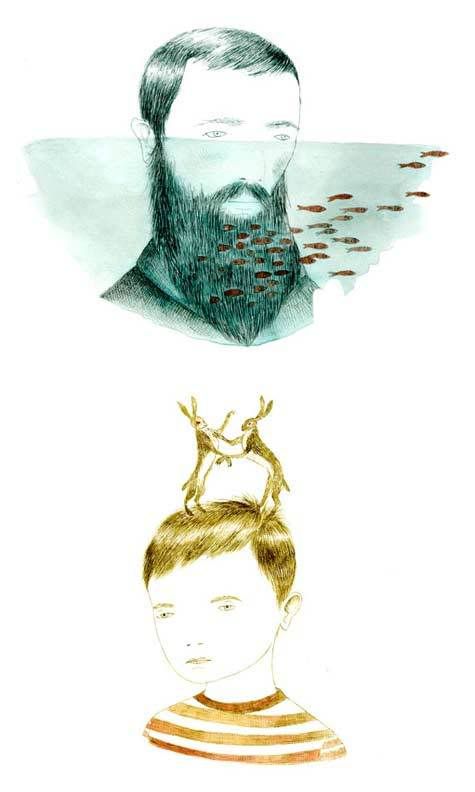
Sirène is an illustration by one of our favorites, Princesse Camcam and shows a young girl with a school of fish as hat.


Wondering how to get in on this trend? You could always follow the lead of Nagi Noda and use your own hair to make an avatavistique hat.


I dare you. You know you want to. The Magpie and Whiskeyjack look forward to seeing this trend filter down to streetware.Courtesy: Magpie & Whiskeyjack