bloggggg

Home  |  Live  |  Science  |  Lifestyle  |  Entertainment  |  Broadcast  |  Games  |  eBooks  |  Astounds  |  Adbite  |  Cricbell  |  Cyber  |  Idea  |  Digital  |  Privacy  |  Publish  |  ePaper  |  Contact  .Subscribe.Subscribe.Subscribe.Subscribe.Subscribe.Subscribe.Subscribe.Subscribe.Subscribe
Subscribe

Thursday, 5 June 2025

Mumbai ranks 6th globally in data centre under-construction capacity: Report


New Delhi, (IANS): Mumbai ranks sixth globally in data centre under-construction capacity, surpassing global hubs like London and Dublin while demonstrating the city’s rapidly growing status as a data centre hub, a report showed on Tuesday.

Mumbai is emerging as a significant contributor to capacity expansion in the Asia-Pacific (APAC) region.

The report by Cushman & Wakefield said that Mumbai ranks as the seventh most established data centre market in the APAC region.

At the end of 2024, the city had 335 MW of data centre capacity under construction, which, once completed, will expand its operational capacity by 62 per cent.

“India’s data centre landscape is undergoing a strategic shift. Mumbai has firmly positioned itself among the top global markets, while Pune is emerging as a key data centre hub in the APAC region. India’s data center sector has attracted prominent international operators and investors, even as domestic players continue to expand capacity,” said Gautam Saraf, Executive Managing Director–Mumbai and New Business, India, Cushman & Wakefield.

This dual momentum — global confidence and local commitment — underscores the country’s readiness to scale sustainably.

“The next few years will see India add over 2.7 GW of capacity across under-construction and planned projects, reinforcing its position as a future-ready digital infrastructure powerhouse,” he mentioned.

The report, covering 97 global markets, highlighted power access, land availability, and infrastructure as key factors shaping data centre development.

In Mumbai, the data centre growth is further supported by digital infrastructure upgrades. This year may witness the completion of three crucial undersea data cable projects landing in Mumbai.

These are expected to significantly increase India’s internet capacity and speed, enhancing inter-regional digital connectivity with Africa, Europe, the Middle East, and Asia. The completion of these projects will further elevate Mumbai’s position as a major connectivity hub in the Southeast Asian region, said the report.

Ranked 4th among APAC’s top emerging data centre markets, Pune is rapidly becoming a preferred destination for hyperscalers and enterprise-grade colocation facilities.As of Q1 2025, Pune’s operational data centre stock stands at 112 IT MW. With an additional 190 IT MW of capacity currently in the under-construction or planned stages, across key corridors such as Hinjewadi and Pimpri-Chinchwad, the city is well-positioned for accelerated growth, said the report. Mumbai ranks 6th globally in data centre under-construction capacity: Report | MorungExpress | morungexpress.com

Friday, 21 July 2023

Five Senses Theatre's Vital Acting Classes in Andheri and Acting School in Mumbai

Five Senses Theater leading the Best Acting Classes in Andheri, Acting School in Mumbai, conduct acting courses and short term workshops. The primary thrust of the acting classes is to create an atmosphere in which the actor can build upon their own processes to get into the skin of their characters. The acting classes dives into advanced techniques like method acting, stella Adler acting techniques, Meisner acting techniques that entail in-depth script analysis, characterization process, scene design and construction, and much more. The Five Senses acting school run by NSD & FTII professionals. Five Senses Theater constantly evolving plays which are then staged at around the India and abroad, theatre festivals etc.
Posted By / Five Senses Theatre for publication.

Tuesday, 18 August 2020

Mumbai night club raided, 97 arrested for violating Covid rules

a

Mumbai police swooped on a night club in Jogeshwari early on Sunday morning and arrested at least 97 persons, including 28 women, for violating COVID-19 norms, officials said. Police raided the Bombay Brute Lounge and Dance Bar night where a crowd of over 100 people were found drinking, smoking hookahs and dancing to loud music, violating pandemic norms.

Among those arrested included 65 clients, the hotel manager and three waiters, besides 28 women - who were released later.

According to investigations, the hotel authorities had allegedly solicited clients for the party, claiming it had reopened, although such eateries, pubs or clubs have been barred from resuming operations in view of the COVID-19 restrictions. (IANS)

Friday, 11 November 2016

Mumbai Police constable is found to be worth Rs 2.77 crore, booked

  • Mumbai: The Anti Corruption Bureau (ACB) has registered a case against a police constable and his wife for possessing disproportionate assets worth Rs 2.77 crore.
  • ACB had received a complaint of corruption against police constable Nitin Shrirang Gaikwad (40) after which it started an inquiry.
  • Gaikwad had been posted in the Protection and Security branch of police here from January 2008 to November 2014.
  • Probe revealed that Gaikwad's assets were 883 per cent more than his income from legitimate sources during this period.
  • Gaikwad was found to have purchased flats, jewellery, and held substantial amounts in mutliple bank accounts in his and his wife's name.
  • His wife Manisha (40) too has been named in the case for abetment. Further probe is on. Source: ummid.com

Saturday, 12 December 2015

Mumbai RPO to hold Passport Adalat on December 2

BY Sameersachdeva, Mumbai, Nov 26 (PTI) The Mumbai Regional Passport Office (RPO) will organize Passport Adalat on December 2 here. The Passport Adalat will be attended by Regional Passport Officer Swati Kulkarni and will settle the matters on the spot. It would be held between 10:30 AM to 01:30 PM at the Regional Passport Old Office in Worli here. "Applicants who have applied for passport before 3 months back and in whose case, police verification or clearance reports have also been received, but still the delivery (of passport) is pending, are eligible to take advantage of the adalat," a statement released by Deputy Passport Officer H T Fulpadia said. Before taking part in the adalat, applicants would have to register their complaints in writing with the passport office or through email at rpo.mumbai@mea.gov.in before Dec 1, and then come to the office at the specified time with original documents," the statement said. The last such adalat was held in May that saw scores of passport applicants avail the services, an officer from the department said, adding, the frequency of such adalats has gone down as the department has adopted a mechanism for speedy delivery of passports. A recent RTI query has found that the Regional Passport Office (RPO) in Mumbai has witnessed a rise in the issuance of passports in the last three years. In 2012, a total of 1.50 lakh diplomatic, official, ordinary jumbo and ordinary normal passports were issued by Mumbai Regional Passport office. This number went up to 3.35 lakh in 2013 and further rose to 3.69 lakh in 2014, according to the RTI reply. The Mumbai RPO started functioning in November, 1954. Its jurisdiction extends to the districts and regions of Mumbai, Daman, Beed, Sindhudurg, Aurangabad and Ratnagiri in Maharashtra state. Source: igovernment.in

Friday, 11 December 2015

Chennai floods a warning for Mumbai?


The Chennai floods were a warning to the Brihanmumbai Municipal Corporation (BMC) that Mumbai too could witness a similar situation. Activists have alleged that the Maharashtra Regional Town Planning (MRTP) Act, 1966 mandates the marking of flood buffer zones in the development plan (DP). The BMC has, however, not marked such buffer zones in the proposed DP of (2014-2034) by the BMC. Buffer zone is a neutral area where land is designated for environmental purposes to build gardens or playgrounds. However, a buffer zone has different meanings in different context. Godfrey Pimenta, activist, Bombay East Indian Association, alleged, “Slum dwellers have encroached the land on the banks of Dahisar river, Mithi river, Oshiwara river and Poisar river. Due to these encroachments, when there is a flood-like situation in the city, the water gets collected in the city and does not disperse into the rivers. This is one of the reasons behind the city witnessing floods in July 2005.” According to the Indian Meteorological Department’s website, one of the reason why Chennai witnessed floods is because it failed to prevent encroachments on the banks of Adyar river and Cooum river, which it said was supposed to act as the main source for rain water drainage in Chennai. It also further states that IT corridors and knowledge corridors consisting of engineering colleges were also constructed on the banks of rivers in Chennai. Nicholas Almedia, activist, Watchdog Foundation, said, “If the law mandates to have buffer zone on the river banks, why has the BMC ignored it? Also, if municipal corporations in Thane and Nashik can follow the law in marking buffer zones for rivers in their DP, why can’t BMC do the same?”Source: The Asian Age

Monday, 17 August 2015

Bombay High Court lifts ban on Maggi, orders fresh tests

IANS: Mumbai: Nestle India got a significant respite on Thursday with the Bombay High Court lifting the ban on sale of its Maggi instant noodles and ordering fresh tests in three separate labs to ascertain that the noodles complied with the country's food safety norms. The conditional relief came following a petition filed by Nestle, challenging the regulatory order of June 5 for the withdrawal and recall of nine variants of "Maggi Instant Noodles" and “Maggi Oats Masala Noodles with Tastemaker". A division bench of Justice V.M. Kanade and Justice B.P. Colabawalla also directed fresh tests to be conducted on all major Maggi samples by three separate laboratories within the next six weeks, before it can return to the markets. "We have examined the evidence in great detail. Since the petitioner Nestle has already agreed not to make and sell Maggi until the food authorities are satisfied, we see no reason to allow any relief to food authorities," Justice Kanade said. The Food Safety and Standards Authority of India (FSSAI), the watchdog for the industry, had said in its order that tests conducted on a batch of Maggi were found to contain more-than-permissible levels of lead and high quantities of mono-sodium glutamate. Refusing also to stay its own order observing that manufacturing and fresh testing would take time, the bench said the ban (called for by the watchdog) was imposed without following the due principles of natural justice. It also said the tests were conducted in unauthorised labs. Justice Kanade and Justice Colabawalla further said that the company itself had stated it would not manufacture and sell Maggi till it secured a clean chit from labs accredited with the food safety regulator. Nestle was also directed to provide five samples from each Maggi batch for testing by three labs, while also specifying that only if the lead content was found to be within permissible limits, the company could resume its
manufacture and sale. The significant ruling came a day after Indian authorities announced that they will seek Rs.640 crore as damages from Nestle India for indulging in what they alleged was "unfair trade practice" and mis-statements pertaining to the popular noodles brands. The National Consumer Disputes Redressal Commission (NCDRC) is set to hear the case on Friday. However, the company said recently that more than 2,700 samples of Maggi noodles have already been tested by laboratories in India and abroad in recent months and all have concluded that the lead content was far below permissible limits. The company also said that five samples tested by the government-accredited referral food laboratory, Central Food Technological Research Institute, Mysuru, on samples sent by the Food and Drug Administration (FDA) of Goa, had also found similar results. "Maggi noodles made in India have been tested and found to be safe for consumption by the authorities of several countries across the world." Among the four divisions of Nestle India, the category of "prepared dishes and cooking aids", which broadly translate into Maggi, accounted for 31.5 percent of sales in 2014, as per a presentation by the company to analysts. The Maggi unit also saw a 1.8 percent increase in volumes in 2014 over the previous year and 8.1 percent rise in value at Rs.21.4 billion Of the remaining divisions, the category of "milk products and nutrition" had the largest share of 47.1 percent, followed by 12.2 percent for "chocolates and confectionery" and 9.2 percent for "beverages". Source: ummid.comImage: flickr.com

Tuesday, 21 April 2015

Love At First Fight

Divya Unny at practice during a Kalaripayattu class at IIT Mumbai (Photo: RITESH UTTAMCHANDANI)
BY Divya Unny: Gyms were too cold. Yoga was too slow. Going for a jog required too much discipline, and a swim was too expensive in Mumbai. For years, I was ready with an excuse when it came to pushing my body—partly because I’m blessed with the metabolism of a new-born and partly because I never really craved a regular workout. With the lifestyle a city like Mumbai offers, you spend half your time swinging out of local trains, and the other half, working towards never having to take such trains again. As a result, your body is more or less warmed up most of the time. Plus, the secret motto of my subconscious was: ‘You are thin, why not wait until that extra layer of fat accumulates, if it does?’ All that changed towards the end of last September when I dunked myself into a 21-foot deep kuzhi kalari (underground mud pit) built on the edges of Adishakti Theatre camp near Auroville, about two hours from Chennai. To the smell of incense and the chill of wet earth, we, 20 young artists from various cities, attempted to accomplish the initial few moves of India’s oldest martial art form. We were being introduced to kalaripayattu as the first step of our actor’s training workshop. Most of us were from a space where martial arts were part of pop culture (read Jackie Chan, and in my case, Mammootty) than real life. As a Keralite, the state where kalaripayattuoriginated, for me it was about flying bodies, the clinking of metal arms and thoroughly choreographed combat moves that could only be mastered by training from a very young age. To pursue it in everyday life seemed far-fetched. That was among many other perceptions about to be shattered over the next 11 days. Our mornings would begin at 7 am in the kalari that was dotted with deities in each corner. If legend is to be believed, we were training in a 3,000-year-old spot that had hosted some of the greatest warriors of all time. The energy within the mud pit engulfed and cocooned us from the outside world for that one hour. “Kalaripayattu was always taught in isolation, away from the prying eyes of the enemy. It prepares you to combat the brutalities in the real world,” said our master Vinodji when we asked him about the significance of the closed space. With the flicker of the flame shining in front of the deities, we warmed up. We began learning the vadakkan (northern style ofkalaripayattu) by paying salutations to a seven-tier platform symbolising the seven stages of the art form. Some of us were classical dancers, others had dabbled in tai chi and taekwondo, and a few owed their flexiblity to gym equipment. But as we began with the kalari moves, our bodies surprised us. In a half sitting position for almost a minute, I was losing sense of my shin. My torso was parallel to the earth and arms extended straight following my eye line. Sweat that began accumulating on my forehead was now making the ground around me moist. “Focus on one point,” is what I thought I heard Vinodji say. As a Bharatanatyam dancer, my body was used to gravitating towards the ground, but kalaripayattu demands that you be as close to the earth as possible. It was challenging, and we had to find a motivation we did not know we had within us. The crouches, the leaps, the kicks, every thump of the leg, every cross-split, every scissor cut we attempted drew inspiration from the raw power and sinuous strength of animals; moves graciously borrowed from the lion, the tiger, the snake, the elephant, even the cock. The first few days were pain-ridden, but the key was to keep focus. What amazed me was that after an intense hour of class, I’d never feel out of energy. Instead, I felt a source of strength unleashing itself at the navel point. It empowered me like no other physical activity had. For the first time in 30 years, my body craved being wrung in ways it didn’t know it could be. “The form is so organic that it brings you closer to nature. You draw energy from the earth. It makes you agile, and once you really discover it, it’s a different kind of high,” says Nimmy Raphael, 32, the actor who coached us after our kalaripayattu sessions. Those 11 days had started something, and it was a fight I knew I couldn’t leave half way. Once I was back in Mumbai, I immediately enrolled myself for classes. The classes were conducted by Belraj Soni, kalaripayattu instructor at Mumbai’s Somaiya College and founder-director of Navaneetham Cultural Trust, Thrissur, Kerala. He had been teaching the art form for over 20 years. The sprawling sports ground at IIT Mumbai, where it was conducted, was however far removed from the quiet mud pit I had crawled out of in Auroville. There were students playing basketball on one side, hockey on the other, and right in the middle were 30 of us, kalari beginners, bare feet, with our bodies the only instrument to work with. Distractions were aplenty, and hence the challenge to combat them. Young and old, people from various walks of life diligently followed the Malayalam instructions the moves were coupled with. “Edathu neere, valathu neere, edathu neere, valathu neere,” Belraj Sir would say, instructing us to kick our legs one-by-one high up in the air and back. We trembled, limped, sometimes even cried our way through class, but did not give up. We performed in track pants instead of the traditional half dhoti, but the appeal of kalari went beyond its costumes. “Eight years ago, when I started practising it in Mumbai, barely two students were actively involved. Now, due to the overwhelming response, I am forced to limit the seats on a first- come-first-served basis,” says Belraj, who has trained over 600 students from Mumbai so far. Of late, the art form has found resonance with urban folk irrespective of age or gender. Like 17-year-old Poorvi Bellur and her mother, 45-year-old Sumana Srinivasan, who started learning it together a month ago. “I have a really stressful schedule because of my 12th grade boards. So there’s a different kind of satisfaction coming out here and letting yourself get physically beaten up. You feel like you have done some substantial work, which you don’t after six hours of studying,” says Poorvi, who has also been a classical dancer for 12 years. “The aggression of martial arts wasn’t something I really saw myself doing. As a dancer, my physical exercise has always been paired with some amount of aesthetic appeal. But that perception of kalari being aggressive has completely evaporated.” Sumana is a patient of rheumatoid arthritis. “I was always told by doctors to keep my body active. Yoga and a few other forms helped, but I was always curious about kalari,” she says, “I was most concerned about my knees and elbows, as they don’t have a complete range of motion. But with kalari, when I started doing the squats, my quads got very strong. My knee and shoulder pain has considerably reduced and I haven’t had the need to take painkillers ever since I started learning it.” I discovered that kalari in Mumbai was finding students in ad executives to housewives to PhD candidates. “I could barely climb two flights of stairs before I started practising kalaripayattu. It’s the kind of workout that works on your body and your mind. I feel way calmer and better equipped to deal with the kind of rushed lifestyle I lead,” says Priya Anchan, a 30-year-old brand manager at Lowe Lintas who has been training for over a year now. “My mother thinks I’ll build muscles and no one might marry me because of this,” she adds with a smile, “but that’s a misconception.” Purists may express dissent over the art form being perceived primarily as another method of exercise, but there is no dispute about its rising popularity. “It is good that awareness is increasing. Other forms of martial arts, gymming or aerobics concentrate on improvement and strengthening of one’s physique, but it doesn’t work your mind. Kalari aims at the balanced growth of both. The training is more acute and time consuming. It cannot be treated as a hobby,” says Belraj. As an actor, there are few tools that have helped me hold my own on stage as much as kalari. During performances, I am more aware of my body and consequently more in control of it. There is a sense of calm that has replaced the incessant nervous energy that would often rule me on stage. Kalari has always been used as a form of self-expression. But I am now able to identify the train of thought behind a series of contemporary works that have used the art form to communicate their stories. I am particularly intrigued by the Bengali play Tomar Dake, conceptualised by Theatre Shine, a group of under 25-year-olds from Kolkata. The play is a visually striking portrayal of social injustice and violence, where kalari motifs are glaringly used to symbolise growing anarchy. Says its director Suvojit Bhandopadhyay, “We specialise in psychophysics threatre, and the history of the art form worked for us. We trained in kalari for about four months before applying it to text. We used the kalari pranam to symbolise a new ruling power emerging within states. The attack and defence modes inkalari became a strong and aesthetic tool for us to portray social violence.” +++ For others, like the artists from the Adishakti Theatre group, founded by the late Veenapani Chawla, kalaripayattu is a way of life. So too for Nimmy Raphael, popular for reprising the mythological figures Laxmana and Kumbakarna in her play Nidrawathwam. “I’m a performer who doesn’t feel gender on stage,” she says, “I don’t have a very feminine body, neither do I feel very masculine. Kalari helped me with my journey in being able to transcend gender on stage. Whatever movement you do, it forces you to find something. It trains you psychologically as an actor, it lays down the basics of your movements.” Be it the Attakalari Centre for Movement Arts in Bangalore or National School of Drama (NSD) in Delhi, kalari is being used by institutions to add aesthetic and emotional appeal to works of art. This includes a recent play called Zubaan, where I perform a series of monologues to promote gender sensitisation. The play, which also has Tom Alter, requires me to act out an attack sequence as a rape victim, and to my surprise while choreographing my moves, I found myself using several kalari stances. The role, which began as a disturbing experience for me, has transformed into one where I feel better equipped to fight the perpetrator. That was perhaps also the reason for my response when my learning was recently put to test in real life. It happened one evening about five months into my kalari training. I was riding in an autorickshaw to the IIT ground. A minor dispute with the auto driver turned into a fight that had the burly man grab me by the collar, threatening to slap me right across the face. He was twice my size. But something within me nipped my fear. I did not attack him, but I found the strength to undo myself from his hold and turn him over to the police. I missed class by 45 minutes that day. “You should have done theashwa vadivu on him,” one of my kalari girlfriends told me. It was the day I realised I have a long way to go. The martial art form helps centre the mind, keep the body in shape, and for urban women living in an increasingly turbulent environment, it is an ideal tool for self-defence. “My confidence levels have increased a lot,” says Dilna Shreedhar, a 26-year-old PhD student, “The way I sit, carry myself, my personality, my walk, everything has changed. I am short and small of frame, and I often felt weak, but now I feel like I have the inner strength to deal with anything that comes my way.” We are currently learning attack and defence moves. “Look into the eyes of the person you are attacking,” Belraj Sir would reiterate. Each time he’d pick me as his opponent, I’d anticipate the pain and cringe. There are days when we students compare the blisters on our forearms, but this is only a minor price to pay. We’re gradually hoping to be introduced to sticks and daggers and swords. Full training demands a temple-like environment and a residential schedule with one’s guru. I hope to get back soon to my mud pit for a month-long workshop. But before that, I need to perfect my split. “Push, push yourself a little more,” the instructions go. Believe me, I’m trying. Source: OPEN Magazine

Tuesday, 2 December 2014

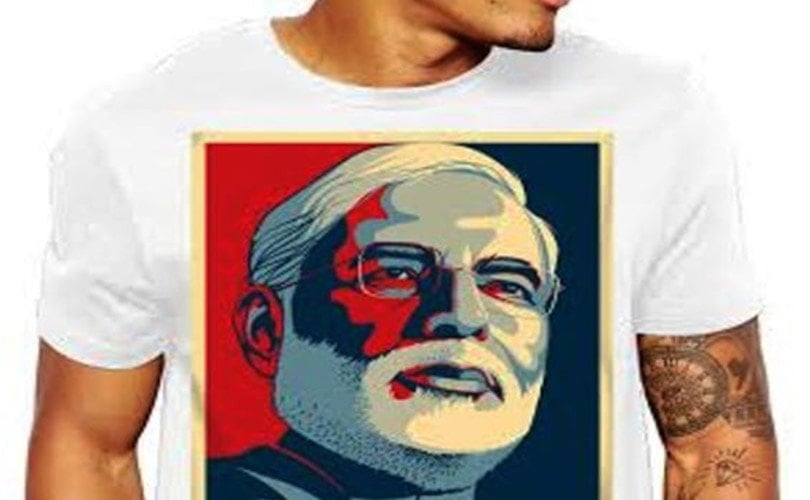
Tantra introduces 'Modi' series T-shirts

Tantra introduces 'Modi' series T-shirts
Sujata Sachdeva: Tantra the popular T-shirt brand which is also called India's official unofficial Tees', is ready to launch an exclusive range of T-shirts based on pet projects, mantras and sayings of the country', prime minister Narendra Modi. Cashing in on Modi's popularity: The brand's founder Ranjiv Ramchandani says besides introducing the 'Modi' range of tees, the brand also proposes to enter other segments of apparel business. 'Our prime minister is an icon. He was voted by the masses to be the leader of the second most populous country in the world. One may like him or hate him but you can't ignore him. Befitting his personality, we at Tantra have developed a series of T-shirts mirroring some of Modi's pet projects, mantras and sayings. Like our previous series such as 'India On A T-shirt', 'Barking Dog', 'Line Maro', 'Loose Motion' etc, India will take our 'Modi' series head on," explains an optimistic Ramchandani, a copywriter turned brand manufacturer. Earlier too Tantra had introduced a line of anti-corruption themed tees showing a picture of the anti-graft activist Anna Hazare against the red, white and blue background. These had had created a storm as Indian youths, who were participating in the movement against corruption, found them aptly expressive. Spreading brand's reach to the Middle East: The famed T-shirts brand has already made inroads in foreign shores such as New Zealand, England, Japan, US, France, South Africa, Poland, Fiji and now plans to conquer the Gulf countries. The brand now addresses the global youth through cool, funny and pungent messages on products. Besides being creative in art and copy, Tantra T-shirts are of high quality and pocket-friendly. All these add together to put Tantra tees in collegians' wardrobe. When Tantra was incepted in 1997, Ramchandani had decided to make it a cult brand to represent India in its true sense. The brand had set eyes on foreign tourists as Tantra T-shirts gave them an insight into India. "Now, many new domestic and international brands have entered the market. But, Tantra is still far ahead as its creative lines caters to the classes as well as masses," points out Ramchandani. Ramchandani whose headquarter is located in Mumbai's plush Nariman Point has a 'Department of Ideas' from where creative ideas take concrete shape. Leading a battery of creative professionals, Ramchandani classifies life as 'simple' and 'meaningful' which gets reflected in Tantra's T-shirts.Source: Fashion United

Friday, 21 November 2014

‘Sprouts’ Aakriti Pre-School celebrated Blue Day

The tiny tots of ‘Sprouts’ Aakriti Pre-School celebrated the “Blue Day” with great enthusiasm here today. Children and teachers were dressed in blue and did various activities like tearing and pasting of blue paper on cutout of whale, blue colour dabbing on clouds, colouring things those are blue in colour, making of fish pond etc; children  also learnt about the things those are naturally blue in colour and various shades of blue. Ms. Supriya Singh, Centre Head, Sprouts School said" To familiarize kids with the color of water and sky, ‘Sprouts’ Aakriti Pre-School celebrated Blue Day. It was a fun-filled day and Kids seemed to be thrilled in their blue attires. To make the activity more inclusive, teachers and kids brought different objects like toys, decorative items and drawings based on the theme. The items were set on the table and decorated with descriptive balloons. Students also participated in games and other interesting theme-based activities". Ms. Anshul Soni, Director, Aakriti Educare Pvt Ltd said" This is not only the most effective way of concept building among the students, but also one of the best ways to acquaint them with the blue colour. The students recited rhymes using blue-coloured props such as balloons, toys and cut-outs. They were apprised of different objects having blue colour through cut-outs prepared by the teachers. Blue is the color of the sparkling sea, Blue is the sky that looks down at me. Source: Article

Saturday, 4 October 2014

Pearl Academy on a mission to develop creative minds


Pearl Academy, with two decades of experience in developing professionals
Pearl Academy on a mission to develop creative mindsfor the creative industries has close links with the industry and develops new courses as per to industry needs. Fashion Styling and Image Design and Luxury Brand Management are examples of courses that were developed in keeping with industry needs. Some courses that are being worked on in close association with the industry are: Indian Couture and Online Business, which will be launched in May 2015. “Additionally, online courses for working adults in the industry and those looking to join the industry, have just been launched. Courses like Design Management, Entrepreneurship for Creative Professionals, Social Media Marketing and Digital Commerce have been developed to address key needs in today’s industry. These courses will start in October and November 2014,” informs Sharad Mehra, CEO, Pearl Academy. Quality education in creative fields: The Academy recently opened a new campus in Mumbai. Good labs for media, fashion and interiors have ensured a world class learning experience for students. “A strong industry advisory board and experienced faculty right in the center of bustling Mumbai make it a great place to get ready for creative industries. We have courses in fashion, business, luxury, communication design, interiors, styling and interiors. Our faculty in Mumbai has been selected after thorough process. It has a healthy mix between industry and academic experience and trained at the other campuses of Pearl in order to ensure parity and excellence at Mumbai,” asserts Mehra. Pearl Academy is a member of the Laureate International Universities (LIU) network, a leading international network of quality, innovative institutions of higher education. The LIU network of more than 75 accredited campus-based and online universities offers undergraduate and graduate degree programs to nearly 900,000 students around the world. The students are part of an international, academic community that spans 29 countries throughout the Americas, Europe, Africa, Asia, and the Middle East. Pearl’s under graduate BA (Hons.) courses (validated by Nottingham Trent University, UK) allows a 8-12 weeks/semester study abroad option in 3rd year (Level-2) from Jan-May each year with full credit exchange of 20/40 credits. Pearl Academy’s mission is to be amongst the leading global institutes in art, design, fashion and related business education through continuous innovation, high quality standards and delightful experience to students, employees and the industries that it works with. Campus placements have been growing since last three years reaching a success rate of 95 per cent in the year 2013. Some of the most sought after companies, like GAP, Li and Fung, Tommy Hilfiger, WWF, Da Milano and Titan, among others visit the campus each year to hire. Developing creative minds: Since its inception in 1993, the academy has evolved into a globally renowned institution of higher learning with a focus on international exposure; entrepreneurship and employability. “We started off with 40 students and now have 3,000 students at campuses in Delhi, Noida, Jaipur and now in Mumbai. Over the years we have been recognized at various forums across industries and our students have been welcomed into the workforce. We are working closely with our industries and developing a better tomorrow for design and creative business in India,” elaborates Mehra. The academy today has emerged as the best privately owned institute in the country in art, design, fashion and related business education through continuous innovation, high quality standards and delightful experience to students, employees and the industries that it serves. In 2014, Pearl Academy has been ranked No. 2 by India Today-Nielsen survey in ‘Top 10′ list of ‘India’s Best Colleges’ under Fashion Category. “We conduct events across India where students and parents can meet with the industry and understand the opportunities for themselves. This initiative is called the Creative Career Conclave and has been welcomed across India. This year we are looking at live telecasting these events on the internet so that a wider audience can benefit from them,” sums up Mehra. Source: Fashion United

Thursday, 3 April 2014

Tatas' Croma to adopt Best Buy-style sales strategy

The Tata Group's consumer electronics retail chain Croma is preparing to adopt the 'store pickup' approach adopted by American retailer Best Buy, which it sees as a huge sales booster across the country. Ajit Joshi, chief executive and managing director of Infiniti Retail Ltd, the company which runs the Croma stores, said no retailer in India offers this facility, which will act as a key differentiator for Croma stores in the country. The 'store pickup' concept allows customers to order items online and pick them up later from the store. "This is a big concept in the West, especially with Big Buy, and Croma is looking at playing on similar strengths," Joshi said at the opening of Croma's 101th retail outlet, spread across 13,500 square feet at Prabhadevi in Mumbai. "The customer chooses to buy the latest iPhone online and has paid for the product; all he has to do is collect it from the nearest store, thus reducing the transaction time. This will be a unique offering, something no other company is providing either online or in the offline space," said Joshi. The Croma staff would also help customers personalise the product being purchased in addition to transferring data, photographs, etc. With stiff competition from online retailers such as Flipkart and Snapdeal, Croma views the online-offline combo as a key strategy to increase reach/sales while also offering convenience to its customers. "People are adopting a mix of online and offline and every single dot-com company has started making noise about coming offline. Over 100 stores in the chain is a big strength and we will combine the forces of brick and mortar and offline for expansion," said Joshi. Interestingly, despite being small at the moment, the online platform gives Croma Rs1 crore worth of business every week. The company will adopt an omni channel (mix of online and offline) strategy and add 10-14 stores this year. The focus, however, will be to invest and expand in the existing cities, thereby avoiding the need for multiple distribution centres for multiple stores. The zip store (smaller stores of 2,000-3,000 square feet) format will be purely for expanding in a crowded market where finding bigger real estate (8,000-12,000 square feet) is a challenge. For every city that Croma has presence in, the management is targeting a consumer durable and information technology (CDIT) share of 20 per cent. "At the moment, we are not even close to that. But we are working on it. We are also looking at developing kiosks that can be taken to a large number of people such as station or factory," said Joshi, stressing that Croma continues to be the number one retailer as per turnover generating sales per square feet of around Rs38,000. Source: Domain-B

Friday, 12 July 2013

Rs.550 crore given for alternate medicine systems: Azad

New Delhi, July 12 (IANS) More than Rs.550 crore have been given to various states for establishing centres for alternate medicine like homeopathy and ayurveda as part of the National Rural Health Mission, union Health Minister Ghulam Nabi Azad said Friday. For mainstreaming of alternate systems of medicine under the National Rural Health Mission (NRHM), grants-in-aid amounting to more than Rs.550 crore have been given to the state and Union Territory governments, Azad said, addressing a function here. The money would be used for establishment of new facilities of homeopathy, ayurveda, siddha and unani streams of medicine in 803 primary health centres, 113 community health centres and 24 district hospitals, and for upgradation of 379 such hospitals and 415 dispensaries. “We have a pluralistic healthcare delivery system, where the government provides opportunities to every recognised medical system to develop and be practised, with a view to provide integrated and holistic healthcare,” he said. “We are open to patronising best practices and proven standards for the benefit of the people. That is why naturopathy is also a recognised system in India,” he said. State governments like Gujarat, Rajasthan, Bihar, Uttar Pradesh, Maharashtra, Kerala, Tamil Nadu, Karnataka and Andhra Pradesh have recognised naturopathy. Azad said India had incorporated traditional medical services in the public health delivery system since the 1960s. Source: Dainik-Disha

Saturday, 11 May 2013

Hrithik Roshan's body in 'Krrish 3' will wow audience, says trainer Kris


Mumbai Superstar Hrithik Roshan has left no stone unturned to get into shape for his upcoming superhero film Krrish 3 and his trainers vouch for his dedication towards fitness. There were reports that Hrithik was in a bad shape both physically and mentally, with injuries and issues in his personal life. But he has managed to bounce back in a short time with an excellent physique for Krrish 3with the help of famous American trainers Kris Gethin and his wife Maraica Johnsoone. "He (Hrithik) is good as a student and I appreciate his hard work. It made my job easy. And no wonder why he is at the top as an actor as he is very dedicated towards his work," Kris told PTI. Krrish 3 is an superhero science fiction, produced and directed by Rakesh Roshan. Kris had seen the previous version of the films before working with the 39-year-old actor on Krrish 3. "I had seen his film and him and the images as to how it (character) looked like. When he came to me...he was am I able to attain that again, can I look like that again. He attained the results in short time and then progressed upon," he said. "Its (body) 110 per cent better than what he has done in the past. I am sure people will be blown away seeing him on screen. His physique is better.. he is more muscular and athletic in Krrish 3," the trainer added. Source: Express India

Tuesday, 7 May 2013

Air India pilots snooze as attendants turn off autopilot

самолет кабина самолет управление самолет пилот самолет штурвал
Two Air India pilots were caught napping in business class while flight attendants in the cockpit accidentally turned off the auto-pilot, a lapse that led to the crew being suspended, news reports and officials said Saturday.
The alleged incident happened at 33,000 feet on an April 12 flight from Bangkok to New Delhi, the Mumbai Mirror reported. The pilots were rattled out of their 40-minute nap and rushed to the cockpit to save the plane from a disaster that could have claimed the lives of 166 people onboard, the report said. According to the report, co-pilot Ravindra Nath was the first to take a break, saying he needed to use the washroom 30 minutes into the flight. Minutes later, Captain BK Soni called another flight attendant into the cockpit and showed the two stewardesses how to operate the controls. He put the plane on auto-pilot and left to join his co-pilot for the nap in business class, the report said. Air India spokesman G Prasada Rao said Captain BK Soni and the two stewardesses had been suspended. He denied the report that the pilots had allowed the two attendants to operate the aircraft. "It is a serious matter. We are investigating the incident," he told dpa. The airline stressed that at "no point in time was the cockpit left unattended by the cockpit crew". Voice of Russia, dpa. Source: Voice Of Russia

Mika held at Mumbai airport, released on bail

Mumbai: Bollywood singer Mika Singh was on Wednesday arrested at the international airport here for allegedly carrying Indian and foreign currency beyond permissible limit, customs officials said. Singh, who arrived here from Bangkok by a private airline around 7.30 pm, was intercepted by the officials. During checking, he was found in possession of $12,000 and Rs 3 lakh in cash, a senior Customs official said. As per Customs norms, Indian passengers coming from abroad and carrying over Rs 7,500 and USD 5,000 need to make declaration about the same upon arrival, he said. The 35-year-old singer was unable to give satisfactory answers about the currency in his possession, the official said, adding his statement has been recorded. Singh has been arrested under relevant sections of customs act, he said. However, he was later released on bail. ISource: News-Bullet

Saturday, 6 April 2013

Vivek Oberoi pulled over by cops

Recently, Bollywood actors Vivek Oberoi and Neha Sharma got pulled over by a group of Mumbai cops for violating road safety rules. The two actors were filming for a bike ride scene for the film ‘Jayantabhai Ki Love Stoory’ when they were pulled over by traffic cops for not wearing helmets. A source from the sets said, “It was a morning shoot and Vivek and Neha are shown to go for a long bike ride in the film. We were ready with the set-up and were waiting for them to enter into the frame. But they did not turn up for a long time. Finally, we realised that they had been caught by cops.” Apparently, the cops refused to listen to Vivek when he said they were shooting. Director Vinnil Markan said that only when the crew showed up to show the cops the permits and other formalities did the cops let the two actors go. Source:  Bollywood3

Sunday, 17 March 2013

Salman knew he would injure people:Court

PIC: AFP
Mumbai: Actor Salman Khan had knowledge that his act of rash driving would result in death or injuries to people, a Magistrate observed while charging him with a more serious offence of culpable homicide not amounting to murder in a decade-old hit-and-run case. Watch: Salman Khan knew he would kill or injure people, says court, Salman was warned by his police bodyguard Ravindra Patil not to drive at a speed of 90 to 100 km per hour as there was a turning ahead or else the vehicle would meet with accident but he did not pay heed to his advice, Additional Chief Metropolitan Magistrate VS Patil noted last week in his order, a copy of which was made available on Thursday. Salman's lawyer Dipesh Mehta said that the actor would challenge the order, given on a Maharashtra government plea, in the Bombay High Court soon. On the night of September 28, 2002, Salman had allegedly rammed his Toyota Land Cruiser into a roadside
bakery at suburban Bandra, killing one person and injuring four others who were sleeping on the pavement. The 47-year-old was earlier charged under IPC Section 304A (rash and negligent driving) which attracts two years of imprisonment and is tried by a Magistrate. Now he has been charged under IPC Section 304 part II (culpable homicide not amounting to murder), for which maximum jail term is 10 years. The Magistrate, in his order on January 31, said the actor was under the influence of liquor, according to reports of pathological tests. The court disagreed with Salman's argument that he had no knowledge that there would be an accident and people would die if he drove at a fast speed. On the contrary, the actor had knowledge about this because he stays in the vicinity and knows the topography of the place, the Magistrate noted. The Magistrate rejected Salman's contention that at the relevant time it was dark and the accident was not intentional but an act of God. He reiterated the actor had knowledge that he would meet with accident if he drove at high speed because he was warned by the police bodyguard who was sitting next to him in the ill-fated car. Salman argued that the court cannot alter the charge on the basis of an application made by the prosecution. The Magistrate, however, felt that the court can any time alter the charge before the trial concludes. In this case, the Magistrate pointed out, prosecution had only drawn the court's attention to the evidence adduced by it to show that charge of 'culpable homicide not amounting to murder' was made out against the accused. Ultimately, it was the court's decision to invoke this charge on the basis of evidence tabled before it.
In Pic: A police officer inspects the bumper on a white Toyota Land Cruiser belonging to Bollywood actor Salman Khan 28 September, 2002. PIC: AFP.
Interestingly, this is the second time that Salman is being tried under the stringent provision of IPC. Earlier too, the Magistrate had charged with him with the same offence and referred the case to Sessions Court for trial. The actor had challenged application of this charge in the Sessions Court which rejected his plea. He had then moved the Bombay High Court which ruled that the charge of 'culpable homicide not amounting to murder' would not apply in the case. The Maharashtra government approached the Supreme Court, which set aside the order of both Sessions Court and High Court. "But we make it very clear that at any appropriate stage if the Magistrate comes to the conclusion that there is sufficient material to charge the accused with a more serious offence than the one punishable u/s 304(A), he shall proceed to do so. "As such decision of the Magistrate shall be purely based on the material brought in evidence at the time of trial," the apex court had observed. Acting on a prosecution plea, the Magistrate last week slapped the charge of 'culpable homicide not amounting to murder' on the actor and referred the case to Sessions Court for trial. Source: News-Bullet

Thursday, 21 February 2013

TV is a regressive medium, says Prachi Desai

Mumbai: She made it big with television show, but actress Prachi Desai does not approve of how the medium has become on Thursday and feels that it is regressive in nature. "I think, I was a part of TV in a more fortunate time. Even though my story was of a girl being in love with an older man, it was a slightly modern drama as compared to what it is right now. It is extremely regressive," she said in an interview. Before venturing into movie with 2008 hit 'Rock On!!', she featured as Bani Walia in hit show 'Kasamh Se' in 2006. "You feel that everyone is doing the same thing and copying each other. When I was in TV, there were so many different stories. I think that stage has gone," she said. An Ekta Kapoor discovery, Prachi has been part of films like 'Once Upon A Time In Mumbaai' and 'Bol Bachchan'. Will you go back to TV? "If a very interesting phase on Indian TV comes where we have short stories and films, then why not? At the end of the day, you are an actor and the medium doesn't matter," she said. However, she can't think of doing a daily soap. "I surely cannot go back to daily soaps. That is something I know. At least not right now. It's a decision I made when I did 'Rock On!!'" said the 24-year-old. She feels in India you can't do both. "You can't be a film star and a TV actor. In the West you can. But the culture here is different," she added. Source: News-Bullet

Thursday, 14 February 2013

Bullish on US recovery this year: Mukesh Ambani

"We will see the beginning of a recovery, particularly in the US", Mukesh Ambani, chairman, Reliance Industries tells journalist and author Fareed Zakaria, who hosts CNN's weekly public affairs talk show "Fareed Zakaria GPS", in an interview. domain-bbrings you a transcript of the interview 
Fareed Zakaria, host "Fareed Zakaria GPS": Mukesh Ambani hasn't given a television interview in almost a decade. He has never let TV cameras into his 27-story home in Mumbai. Until now. Ambani is the richest man in India, the second richest man in all of Asia. He is the chairman of India's topest company, Reliance Industries, which his father started in 1980, making textiles. Today, their revenues come mostly from energy, though they are 
making big bets in retailing and telecommunications as well. Zakaria: Tell me, you have a vantage point to look at the global economy. You run India's topest company. Where do you think we are, um, five years after the financial crisis began? Mukesh Ambani: Well, I'm more optimistic than most. And, my view is that this year, we will see the beginning of a recovery, particularly in the US, Zakaria: And you - and you - you think that that's because just the inherent strengths of the US economy? Ambani: There has been a fundamental transformation in the energy scene in the US. For many decades, we have heard that the US will be independent of foreign imports of energy. Realistically, I can now tell you that it is my judgment that this will happen in the next five or seven years, The US has truly found non-conventional energy in shale oil and gas which is really, really bringing benefit not only to the population in the US, but, really, to across the world. Zakaria: You've invested in solar? Do you think, in the next 10 or 15 years, the costs will come down dramatically? Ambani: Absolutely. I think so. And I think that, ultimately, the way I think about energy is that we will transit from what I call a hydrocarbon present, which is coal, oil and natural gas, over the next many decades, into a fully renewable, sustainable future. And solar really will be at the heart of it. Zakaria: Let me ask you about the hydrocarbon present. You run the topest refinery in the world in Jamnagar. What will happen, if there were a military strike on Iran? What would happen to the price of oil, in your estimation? Ambani: Well, I think that the world is a lot more sane. My own view is that if we see small blips, I think that we have a resilient enough system. And today, there is enough spare capacity, right, in the system to take care of eventualities. Zakaria: You were very bullish about the United States, probably more bullish than a lot of Americans. What about the other key drivers of the world economy? Because a lot of people say, look, China is slowing down, Brazil has slowed down, India has slowed down? What do you think of the emerging markets story? Ambani: I think that China is maintaining steady growth. It's not decelerating. Europe has found its own transition path. And they will transgress (sic) through the financial system in an orderly way, India has had some slow growth, but I am really very optimistic on India. I think that...Zakaria: Why is that? Explain that, because in - when people look at India today, they see growth is at 5.5 per cent now. You talk to foreign investors and they say the infrastructure is terrible, the government, you know, doesn't do enough reform, it's very difficult to operate in India. You look at all that and you're not - you're not - you're still bullish? Ambani: Well, I'm very bullish on India because it's really the aspirations of a billion people. And ours is a country where all the billion count. There are some countries in the world where one person counts. There are some countries where the politburo of 12 people count, right. The beauty of India is that all our billion people count. And they have aspirations. And it is really a bottom-up story. It's not a top-down story. So, yes, we will, adjust with what happens in the rest of the world, but we are on a long-term growth trajectory. And this is just not growth in terms of GDP numbers, right. This really is for well being of each and every Indian. And that's the aspiration. Zakaria: Do you think that one of the problems India has to deal with is inequality? It is still one of the poorest countries in the world, and yet it has the second- topest number of billionaires in Asia. People worry about the growing inequality. Ambani: If you think about inequality, that's not only a problem in our country. It's really the problem all across the world. Income comes from opportunity. You take our own example, as Reliance. When I joined Reliance in 1980, the market value of Reliance was $30 million or $40 million. And in 30 years the opportunities that were provided, by this country has enabled us to create wealth for India. My father was a big believer that any business that has the sole purpose of making money is not worth doing. Business must serve a larger societal purpose. Reliance raised all its money from capital markets and from individual small shareholders. So we've created a million millionaires just by investing in Reliance out of ordinary Indians. And that is the process of creating wealth for the country. Once you create opportunity, wealth comes. Zakaria: But do you agree, you -- you've heard all this criticism, that you, in particular, have responsibility. You are the richest Indian. You run the topest company in India. You live in this fabulous house that was, you know, talked about much. Do you see yourself as having a special responsibility? Ambani: Yes, of course. The way I think about these things is I really have my father as my role model. And he started off with nothing. And one of the things that he said to me is that you really don't know, Mukesh, what it is to be poor. And make sure that you maintain everybody's self-respect. So when you give, people hold their hand on this basis, don't give on that basis. When you give, and if people hold their hand like this (holding his hand in a gesture of blessing), that means they bless you. That's the way to give. And in a certain sense, some amount of anonymous giving or doing things that change societies, doing things that leave a lasting impact, and even if it be creation of businesses, creation of jobs, right, creation of sustainable institutions that last beyond you, is the best way that you can contribute to India. Zakaria: Mukesh Ambani, a pleasure to have you on. Ambani: Thank you, Fareed. It was a pleasure. Source: Domain-B