bloggggg

Home  |  Live  |  Science  |  Lifestyle  |  Entertainment  |  Broadcast  |  Games  |  eBooks  |  Astounds  |  Adbite  |  Cricbell  |  Cyber  |  Idea  |  Digital  |  Privacy  |  Publish  |  ePaper  |  Contact  .Subscribe.Subscribe.Subscribe.Subscribe.Subscribe.Subscribe.Subscribe.Subscribe.Subscribe
Subscribe

Sunday, 28 February 2021

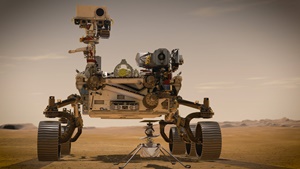
Nasa's Mars Perseverance rover safely lands on the Red Planet

  • Nasa’s Mars 2020 Perseverance mission, the agency’s fifth rover to land on the Red Planet, touched down in Jezero Crater at around 3:55 pm EST (12:55 pm PST) on Thursday (18 February 2021), engineers at Nasa’s Jet Propulsion Laboratory in Southern California, where the mission is managed, have confirmed.
  • The largest, most advanced rover NASA has sent to another world touched down on Mars, after a 203-day journey traversing 472 million kilometres (293 million miles).
  • Packed with groundbreaking technology, the Mars 2020 mission launched on 30 July 2020, from Cape Canaveral Space Force Station in Florida, the Perseverance rover mission marks an ambitious first step in the effort to collect Mars samples and return them to Earth.
  • “This landing is one of those pivotal moments for Nasa, the United States, and space exploration globally – when we know we are on the cusp of discovery and sharpening our pencils, so to speak, to rewrite the textbooks,” said acting Nasa Administrator Steve Jurczyk. “The Mars 2020 Perseverance mission embodies our nation’s spirit of persevering even in the most challenging of situations, inspiring, and advancing science and exploration. The mission itself personifies the human ideal of persevering toward the future and will help us prepare for human exploration of the Red Planet.”
  • About the size of a car, the 2,263-pound (1,026-kilogram) robotic geologist and astrobiologist will undergo several weeks of testing before it begins its two-year science investigation of Mars’ Jezero Crater. While the rover will investigate the rock and sediment of Jezero’s ancient lakebed and river delta to determine the region’s geology and past climate, the sample that is being planned to be brought back to earth by NASA and European Space Agency, will allow scientists to search for definitive signs of past life using instruments too large and complex to send to the Red Planet.
  • “Because of today’s exciting events, the first pristine samples from carefully documented locations on another planet are another step closer to being returned to Earth,” said Thomas Zurbuchen, associate administrator for science at NASA. “Perseverance is the first step in bringing back rock and regolith from Mars. We don’t know what these pristine samples from Mars will tell us. But what they could tell us is monumental – including that life might have once existed beyond Earth.”
  • The spacecraft carries a new suite of scientific instruments to build on the discoveries of Nasa’s Curiosity rover, which has found that parts of Mars could have supported microbial life billions of years ago.
  • Some 45 kilometers (28 miles) wide, Jezero Crater sits on the western edge of Isidis Planitia, a giant impact basin just north of the Martian equator. Scientists have determined that 3.5 billion years ago the crater had its own river delta and was filled with water.
  • The power system that provides electricity and heat for Perseverance through its exploration of Jezero Crater is a Multi-Mission Radioisotope Thermoelectric Generator, or MMRTG, developed bt the US Department of Energy (DOE) for civil space applications.
  • The Planetary Instrument for X-ray Lithochemistry (PIXL) and the Scanning Habitable Environments with Raman & Luminescence for Organics & Chemicals (SHERLOC) instruments, located on a turret at the end of the rover’s robotic arm, will work together to collect data on Mars’ geology close-up.
  • The rover chassis is home to three science instruments, as well. The Radar Imager for Mars’ Subsurface Experiment (RIMFAX) is the first ground-penetrating radar on the surface of Mars and will be used to determine how different layers of the Martian surface formed over time. The data could help pave the way for future sensors that hunt for subsurface water ice deposits.
  • “Landing on Mars is always an incredibly difficult task and we are proud to continue building on our past success,” said JPL Director Michael Watkins. “But, while Perseverance advances that success, this rover is also blazing its own path and daring new challenges in the surface mission. We built the rover not just to land but to find and collect the best scientific samples for return to Earth, and its incredibly complex sampling system and autonomy not only enable that mission, they set the stage for future robotic and crewed missions.”
  • The Mars Entry, Descent, and Landing Instrumentation 2 (MEDLI2) sensor suite collected data about Mars’ atmosphere during entry, and the Terrain-Relative Navigation system autonomously guided the spacecraft during final descent. The data from both are expected to help future human missions land on other worlds more safely and with larger payloads.
  • Project engineers and scientists will now put Perseverance through its paces, testing every instrument, subsystem, and subroutine over the next month or two. Only then will they deploy the helicopter to the surface for the flight test phase. If successful, Ingenuity could add an aerial dimension to exploration of the Red Planet in which such helicopters serve as a scouts or make deliveries for future astronauts away from their base.Once Ingenuity’s test flights are complete, the rover’s search for evidence of ancient microbial life will begin in earnest, says a Nasa release. Source: https://www.domain-b.com

Sunday, 12 July 2020

Nasa's Curiosity rover captures highest-resolution Martian panorama yet

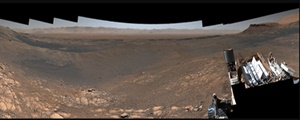
Nasa's Curiosity rover has captured its highest-resolution panorama yet of the Martian surface. Composed of more than 1,000 images taken during the 2019 Thanksgiving holiday and carefully assembled over the ensuing months, the composite contains 1.8 billion pixels of Martian landscape. 
  • The rover's Mast Camera, or Mastcam, used its telephoto lens to produce the panorama; meanwhile, it relied on its medium-angle lens to produce a lower-resolution, nearly 650-million-pixel panorama that includes the rover's deck and robotic arm, says a Nasa release.
  • Curiosity also captured a 650-million-pixel panorama that features the rover itself.
  • Both panoramas showcase "Glen Torridon," a region on the side of Mount Sharp that Curiosity is exploring. They were taken between 24 November and 1 December, when the mission team was out for the Thanksgiving holiday. Sitting still with few tasks to do while awaiting the team to return and provide its next commands, the rover had a rare chance to image its surroundings from the same vantage point several days in a row. 
  • It required more than 6 1/2 hours over the four days for Curiosity to capture the individual shots. Mastcam operators programmed the complex task list, which included pointing the rover's mast and making sure the images were in focus. To ensure consistent lighting, they confined imaging to between noon and 2 p.m. local Mars time each day.
  • "While many on our team were at home enjoying turkey, Curiosity produced this feast for the eyes," said Ashwin Vasavada, Curiosity's project scientist at NASA's Jet Propulsion Laboratory, which leads the Curiosity rover mission. "This is the first time during the mission we've dedicated our operations to a stereo 360-degree panorama." 
  • In 2013, Curiosity produced a 1.3-billion-pixel panorama using both Mastcam cameras; its black-and-white Navigation Cameras, or Navcams, provided images of the rover itself. Imaging specialists carefully assemble Mars panoramas by creating mosaics composed of individual pictures and blending their edges to create a seamless look.
  • Malin Space Science Systems in San Diego built and operates Curiosity's Mastcam. JPL, a division of Caltech in Pasadena, manages the project for NASA's Science Mission Directorate in Washington and built the Navigation Cameras and the rover.
  • Meanwhile, an international team of astrobiologists analysing Martian data sent by Curiosity, believe that the organic molecules discovered by Curiosity rover could be evidence of life on Mars.
  • In a paper published in the journal Astrobiology, the team argues that the presence of “thiophenes,” which are special compounds found in coal, crude oil and white truffles back on Earth, could be a sign of ancient life on the Red Planet.
  • “We identified several biological pathways for thiophenes that seem more likely than chemical ones, but we still need proof,” Washington State University astrobiologist and lead author Dirk Schulze-Makuch said in a statement.
  • The team, however, isn’t jumping to any conclusions just yet.
  • “If you find thiophenes on Earth, then you would think they are biological, but on Mars, of course, the bar to prove that has to be quite a bit higher,” Shulze-Makuch added.
  • While thiophenes are made up of two bio-essential elements, carbon and sulfur, it’s still very possible they could’ve been created during meteor impacts that heat sulfates to high temperatures — a possible explanation the researchers are also considering. 
  • If the compounds were indeed a sign of life, they could’ve been the result of bacteria some three billion years ago breaking down sulfates — or alternatively could have been broken down by the bacteria.
  • But, again, it’s far too early to draw conclusions.
  • The Curiosity rover analyzes compounds by breaking them down into fragments. The upcoming European Space Agency’s Rosalind Franklin rover, however, could fill in the gaps with its Mars Organic Molecule Analyzer (MOMA), which doesn’t use the same destructive technique as Curiosity. Source: https://www.domain-b.com

Saturday, 31 March 2018

NASA launches ‘next generation’ weather satellite

  • WASHINGTON: A “next generation” US weather satellite that was rocketed into space from Cape Canaveral Air Force Station in Florida at 6:42 p.m. EST on Saturday (5.12 a.m. Sunday, India time) is on its way to sharpen forecasts, watches and warnings about hurricanes and storms, NASA said.
  • After the US National Oceanic and Atmospheric Administration’s (NOAA) Geostationary Operational Environmental Satellite-R (GOES-R), reaches its final designated orbit in the next two weeks, it will be renamed GOES-16, the US space agency said in a statement.
  • “The launch of GOES-R represents a major step forward in terms of our ability to provide more timely and accurate information that is critical for life-saving weather forecasts and warnings,” said Thomas Zurbuchen, Associate Administrator for NASA’s Science Mission Directorate in Washington.
  • “It also continues a decades-long partnership between NASA and NOAA to successfully build and launch geostationary environmental satellites,” Zurbuchen added.
  • The new satellite will become operational within a year, after undergoing a checkout and validation of its six new instruments, including the first operational lightning mapper in geostationary orbit.
  • “The next generation of weather satellites is finally here,” NOAA Administrator Kathryn Sullivan said.
  • Forecasters will use the lightning mapper to hone in on storms that represent the greatest threats. The satellite’s primary instrument, the Advanced Baseline Imager, will provide images of Earth’s weather, oceans and environment with 16 different spectral bands, including two visible channels, four near-infrared channels, and 10 infrared channels.
  • Improved space weather sensors on GOES-R will monitor the sun and relay crucial information to forecasters so they can issue space weather alerts and warnings.
  • In all, data from GOES-R will result in 34 new or improved meteorological, solar and space weather products, NASA said. Source: http://www.navhindtimes.in/

Tuesday, 18 August 2015

NASA astronauts eat space-grown food

NASA Logo (Meatball) on Goddard B29
Monday on the International Space Station, a batch of romaine lettuce became the first food grown and consumed in space. The leaves were harvested from NASA's experimental plant growth system called Veg-01, a microgravity environment in which plants grow from seed "pillows" under primarily red and blue LED lights. In 2014, an astronaut on NASA Expedition 39 grew and harvested the first plants from Veg-01 and then sent the plants back to Earth for food safety analysis. This time around, the crew members of Expedition 44, including astronaut Scott Kelly, who is four months into a yearlong space mission, got to enjoy the bounty. Kelly activated the seed pillows on July 8, and then tended to the plants for 33 days before harvesting. While this isn't NASA's first experiment designed to test the growth of plants in controlled-environment agriculture settings (scientists previously designed a habitation to grow plants on the moon), this is the first and only experiment to evaluate the effect of plant life on humans in space. Source: ArticleImage: flickr.com