bloggggg

Home  |  Live  |  Science  |  Lifestyle  |  Entertainment  |  Broadcast  |  Games  |  eBooks  |  Astounds  |  Adbite  |  Cricbell  |  Cyber  |  Idea  |  Digital  |  Privacy  |  Publish  |  ePaper  |  Contact  .Subscribe.Subscribe.Subscribe.Subscribe.Subscribe.Subscribe.Subscribe.Subscribe.Subscribe
Subscribe

Wednesday, 25 October 2023

Tensions rise as Haley vies to overtake DeSantis as Trump alternative

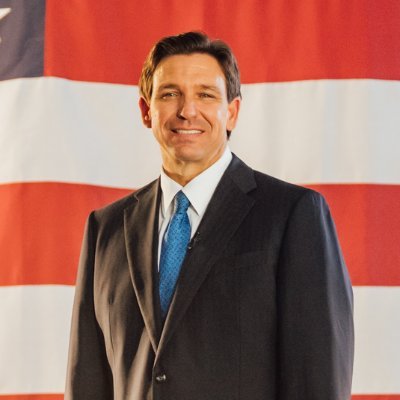
Candidate Ron DeSantis. 
  • Nikki Haley is increasingly threatening to supplant Ron DeSantis as the principal GOP presidential rival to Donald Trump, escalating frictions between the two candidates that are playing out before voters on the campaign trail and behind closed doors with wealthy donors.
  • While DeSantis held an advantage over other non-Trump candidates for much of the year, his support has eroded and Haley’s has climbed, according to interviews with voters, strategists and a review of early state polling, putting them in a contentious battle for a distant second place. Their teams circled one another at a recent private donor summit in Dallas, where they charted their respective paths before potential financial backers – many of whom have been skeptical about the ability of either to beat the former president.
  • In the past few days, in the midst of the war between Israel and Hamas, the two candidates have tussled over their contrasting positions, both past and present, on U.S. policy in the Middle East and how to help refugees fleeing war-torn regions. DeSantis courted voters Thursday in Haley’s home state of South Carolina, where she is leading him in the polls, before they crossed paths Friday in Iowa, where the Florida governor is anchoring his candidacy and has built a much larger footprint.
  • The intensifying competition was evident in Iowa, where some voters said they had moved to Haley from DeSantis and the two appeared at a multicandidate event. Both focused on foreign policy, avoiding direct shots at each other in their remarks. Haley’s campaign on Friday released a video labeling him “desperate” for attacking her, and when asked by a voter about her stance on accepting refugees from the Middle East at a town hall in Pella on Saturday she used the opportunity to criticize DeSantis.
  • “God bless Ron DeSantis, because he continues to try and bring up this refugee situation. He has said that I want to take Gazan refugees; I have never said that,” Haley said. “He can keep doing it, but that’s what happens when a campaign starts to spiral out.”
  • For the first time since making a small expenditure against Haley in April, Never Back Down, a super PAC supporting the Florida governor invested significant money on the airwaves in recent days opposing Haley, echoing comments DeSantis has made publicly. They spent nearly $1 million airing a new ad in Iowa, according to disclosures filed with the Federal Election Commission, highlighting DeSantis’s opposition to allowing refugees from Gaza into the U.S. and suggesting that Haley would be open to that idea. The ad misconstrued Haley’s remarks in a recent CNN interview and her campaign underscored that she is opposed both to providing U.S. aid to Gaza and to sheltering Gaza refugees in the U.S.
  • The back-and-forth between the two camps marked a combative new phase of the GOP race that has echoes of 2016 – where Trump’s lower-polling rivals trained much of their fire on one another rather than on him, a strategy that ultimately helped Trump win the nomination. Both Haley and DeSantis, who has been more forcefully criticizing the former president in recent weeks, are trailing Trump by an average of between 40 and 50 points in the polls. But advisers to both candidates see a narrowing of the field as an essential element to toppling Trump.
  • That consolidation could happen sooner rather than later as other candidates such as former vice president Mike Pence and Sen. Tim Scott (R-S.C.) are struggling. The challenges for lower-tier candidates have led some Republicans to envision a contest that eventually comes down to three finalists: a runaway favorite in Trump and two longer-shots with sharply contrasting pitches.
  • Haley rose to third in a Washington Post average of national polling from October, with 8 percent support to DeSantis’s 14 percent. She’s pulled into third in Iowa, where DeSantis’s support is still noticeably stronger, and jumped ahead of DeSantis in recent surveys of New Hampshire and South Carolina.
  • DeSantis operatives and allies acknowledge that Haley is having a “moment” and some increasingly view her as the main threat to his efforts to consolidate voters looking for an alternative. But they also argue she appeals primarily to a smaller, anti-Trump segment of the Republican electorate that many candidates are fighting over, and that she can’t win enough voters from the pro-Trump majority of the party to defeat Trump in a head-to-head.
  • In a closed door address to donors this month in Park City, Utah, at a conference organized by former House Speaker Paul D. Ryan and attended by Sen. Mitt Romney of Utah, Haley addressed the potential financiers who do not want to see Trump win the nomination. She bluntly told them that “sitting on the sidelines is not an option” and suggested their reluctance to engage has been a critical factor in Trump’s dominance. “You need to make a choice – and I hope you choose me,” she told them, according to several people who described her remarks in the private session.
  • At the meeting of GOP megadonors who are part of the American Opportunity Alliance in Dallas – where the teams of both DeSantis and Haley were invited to present their respective cases – DeSantis campaign advisers argued that consolidation of the field would help DeSantis but not Haley, partly because 90 percent of DeSantis’s voters would migrate to Trump if he dropped out, according to several people familiar with the presentation, who like others spoke on the condition of anonymity to describe private comments.
  • At that same gathering, Haley’s team cited polls showing her ahead of DeSantis in New Hampshire and argued that she is closing in on him in Iowa. They also noted her cash advantage over DeSantis, who had about $5 million left for the primary and $1 million in debts on reports recently filed with the FEC – compared to her $9.1 million in cash reserves for the primary. Haley’s advisers told the donors at the Dallas meeting that the GOP contest is “a two-person race between one man and one woman,” according to people familiar with the presentation.
  • “We have to have a new generational leader, one that’s going to understand that these threats are real and we need new solutions to do with it,” Haley said on Friday in Iowa as she detailed the foreign policy experience she gained through her role as U.N. Ambassador.
  • “I’m the only one running for president that can tell you I have delivered on 100 percent of my promises. Everything I told the people in Florida I will do, I’ve accomplished,” DeSantis said at the same event.
  • Different paths to power
  • DeSantis, 45, and Haley, 51, both represent a new generation of leadership in the Republican Party, but they have charted different paths to power. Haley – a conservative former South Carolina governor who has long appealed to the foreign policy hawks as well as moderates in her party, even as she has embraced some polarizing positions – has campaigned on her ability to find consensus on difficult issues such as the handling of the confederate flag in her state and abortion. DeSantis, by contrast, has relished his role as a bomb-throwing firebrand in Florida – continually running to Trump’s right on many issues in his quest for the nomination.
  • Both were once allies of Trump, who endorsed DeSantis in his first tough race for governor of Florida and chose Haley as his ambassador to the United Nations. Haley has a more complicated history with Trump – criticizing and opposing him when he ran in the 2016 GOP primary before joining his administration the following year.
  • She later said she would not run against the former president, but ultimately decided to do so. During the first debate, which Trump skipped, Haley called Trump “the most disliked politician in America,” drawing some boos. “We can’t win a general election that way,” she added.
  • Haley is now drawing the DeSantis camp’s attention after flying under the radar for much of the race. She and her team have criticized DeSantis off and on throughout this year, faulting his efforts to punish Disney, for example, or suggesting that he is a Trump imitator in a fall campaign memo.
  • Trump has branded both candidates with disparaging nicknames. In a sign of Haley’s rising influence, he has gone after her more in recent weeks than he had before.
  • As recently as July, a DeSantis campaign memo was more focused on Scott than Haley. At a Never Back Down briefing with donors just ahead of the first GOP debate, strategist Jeff Roe said entrepreneur Vivek Ramaswamy could become a problem and that the super PAC was spreading opposition research on him.
  • The DeSantis camp hopes growing scrutiny of Haley will take a toll. At the same time, they publicly reject the notion that Haley is threatening to eclipse DeSantis – insisting that they are merely drawing out key policy contrasts between the two candidates’ records just as they have done with other candidates.
  • “Ron DeSantis will always stand up against dangerous ideas and in support of Israel,” DeSantis campaign spokesman Andrew Romeo said in a statement Friday. “That doesn’t change the fact that this is a two-man race for the nomination.”
  • The DeSantis campaign and its allies are drawing attention to Haley’s past statements on refugees, pointing to her initial support for resettlements as governor of South Carolina and her opposition in 2015 to Trump’s proposed ban on Muslim immigrants. The attacks do not note her 2015 opposition to refugees from Syria and loyalty to Israel as U.N. ambassador.
  • “Nikki Haley has a history of weakly flip flopping on critical issues and so far, she has never had to defend her actions,” said Kristin Davison, chief operating officer of Never Back Down. “She’s provided an opportunity with her own missteps to fully expose her record versus her rhetoric. She will not be able to survive that.”
  • The Haley campaign said the attacks from DeSantis and his allies were proof of her ascent: “Nikki has a long and strong record of taking on Hamas and standing up for Israel. Since announcing, DeSantis insisted it’s a ‘two-man race’ between him and Trump. As his fundraising and poll numbers plummet, he’s lobbing false attacks at Nikki because he knows it’s a two-person race – Nikki and Trump,” her spokeswoman Olivia Perez-Cubas said in a statement.
  • In Iowa on Friday, DeSantis spoke of the ties between Israel and Florida, and touted his role in organizing flights out of the country. Haley highlighted her foreign policy experience, recalling telling Israeli Prime Minister Benjamin Netanyahu to “finish them” – when speaking about the threat posed by Hamas – and participating in hostage negotiations. Both received standing ovations, with many in the audience sporting black and gold Iowa Hawkeyes jerseys.
  • Haley’s aides recently accused DeSantis and his allied super PAC of lying about her record, pointing to fact checks that rated claims by Never Back Down as false. In an Oct. 15 interview with CNN, Haley had questioned why Arab countries weren’t doing more to help innocent Palestinians, and she had argued that many Palestinians in Gaza want to be “free from this terrorist rule” of Hamas.
  • But her campaign underscored that Haley “opposes taxpayer dollars for Gaza just like she did when she helped eliminate it at the U.N. The money is too easily diverted to Hamas and is not a good use of tax dollars. Arab countries should step up if they want to help Palestinians as much as they claim.”
  • Voters eye both Haley and DeSantis
  • While DeSantis and his allied super PAC have built a larger ground presence in Iowa, a state Haley is seen as weaker in compared to New Hampshire and South Carolina, voters in the Hawkeye State have taken notice of Haley.
  • Iowa voter Karen Skovgard, who plans to participate in the Republican caucuses and calls herself a “moderate,” said she impressed with Haley’s “demeanor, her ability to take charge of things.”
  • The 75-year-old said she trusts her on foreign policy and liked her “practical” answer on abortion during the first GOP debate, where Haley set herself apart from her rivals by arguing that most federal abortion bans would never pass Congress.
  • Nikki Kemper said her vote was for DeSantis until she attended Haley’s town hall in Cedar Rapids Friday afternoon – the first time she saw Haley in person.
  • “Hands down, she won it,” Kemper said, citing Haley’s broader focus on international issues. “She really hit on every topic across local and international, and I think DeSantis didn’t really cover a lot of the same topics. So I just felt like she was more [well] rounded and really had the experience overseas, as well, to help sell it.”
  • Some early state voters who are hoping for a strong Trump alternative are waiting to see who emerges as the most viable candidate of the two.
  • “Anyone but Trump,” Kirk Hayes replied immediately at a DeSantis event in Algona, Iowa late this summer. But he wasn’t sure whether any of the contenders could topple Trump. “No one’s really come out in front.”In a follow-up interview this month, Hayes, 87, said he was still considering both Haley and DeSantis, even though the Florida governor is “a little more conservative than I am,” Hayes said. “But it’s not a dealbreaker for me.”Tensions rise as Haley vies to overtake DeSantis as Trump alternative


Tuesday, 5 September 2023

Trump indicted in Georgia: Why do his supporters remain loyal?

This booking photo provided by Fulton County Sheriff’s Office shows Donald Trump on Aug. 24, 2023, after he surrendered and was booked at the Fulton County Jail in Atlanta. Trump is accused of scheming to subvert the will of Georgia voters in a desperate bid to keep Joe Biden out of the White House. (Fulton County Sheriff's Office via AP) Ron Stagg, Toronto Metropolitan University 

People around the worldincluding many Americans — cannot understand why a sizeable portion of the United States population continues to support Donald Trump, despite an ever-increasing list of charges against him, including the latest indictments in Georgia.

Before the newest charges were announced, Trump was running neck and neck against President Joe Biden in a hypothetical rematch. It seems unlikely the Georgia indictments, pertaining to alleged attempts to interfere with the 2020 presidential election results, will erode the former president’s support.

This shocks people because strong backing of a man who lies, cheats and threatens the U.S. Constitution has no precedent in national politics. However, there is a precedent in state politics which almost reached the presidential level, and some comparable situations in other countries.
You can always get what you want?

Those who support Trump unconditionally have not varied much since the last election. This support encompasses numerous groups with numerous reasons, but, for most, there is one overriding concern. They believe that he will get them results on the issues that they feel are the most important in the country.

Evangelical Christians who support him do so because he appointed conservative justices, leading to — among other outcomes — the overturning of Roe v. Wade. His extra-marital affairs pale in comparison to this long-term goal of the Christian right.

Some disenchanted Democratic voters have joined the Trump bandwagon. They include blue-collar workers and small business people who see jobs being sent overseas, as well as some Latino voters who regard Trump as acting in concert with their Catholic morality by appointing justices who are more conservative. They also like his opposition to illegal immigration.

The tens of thousands of potential immigrants struggling to illegally cross the U.S.-Mexico border frighten those worried that they will lose the non-skilled jobs still remaining in the U.S., and those in rural areas who see the values of what they consider traditional white America under threat.

For all of these supporters, getting what they want is more important than worrying about Trump’s marital indiscretions, purloined government documents or whether he tried to overturn the results of the 2020 presidential election or encouraged the storming of the Capitol building on Jan. 6, 2021.
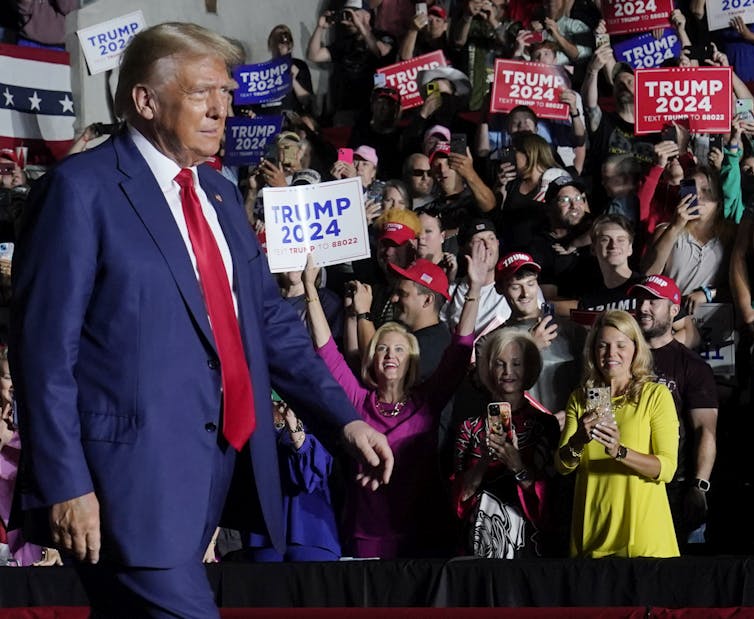
Donald Trump arrives for a campaign rally in July 2023 in Erie, Pa. (AP Photo/Sue Ogrocki) Lies become the truth
Of course, there is more to Trump’s appeal than simply promising to Make America Great Again. He is a true demagogue who repeats his simple message over and over again, often loudly and with great emphasis. He repeatedly and relentlessly demeans his detractors and lies about the 2020 election.
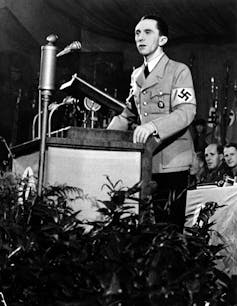
In this 1938 photo, Nazi propaganda minister Joseph Goebbels speaks to party members in Berlin. (AP Photo)
A quote attributed to Joseph Goebbels, the Nazi propaganda minister, translates roughly as: “Repeat a lie often enough and it becomes the truth.”

Trump uses this technique very effectively with his supporters, including those on the far-right fringe, who respond well to his implied message to “make America white again.” A substantial portion of the Republican Party reinforces Trump’s lies by either agreeing with his claims of election fraud, or being careful not to comment on them or to criticize Trump.

The effect of social media in Trump’s allure shouldn’t be dismissed. There you will find “proof” of Trump’s claims — plots by the “Deep State” and by Democratic justice officials to persecute the winner of the 2020 election. These allegations are highly effective with citizens who have turned away from mainstream media because of its criticism of the man who is working for them.
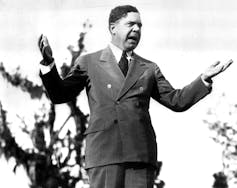
In this 1934 photo, Sen. Huey P. Long addresses students at Louisiana State University in Baton Rouge, a year before he was assassinated. (AP Photo)
While there is no other presidential candidate who has used this demagoguery and appeal to prejudice so brazenly, there is a partial parallel in Huey Long, governor of Louisiana from 1928 to 1932 and a U.S. senator from 1932 to 1935.

A supporter of the poor, a harsh critic of banks and a believer in authoritarian government, he was famous for his rousing speeches. A controversial figure, he was dogged by accusations of political corruption but nonetheless loved by many. He was planning to run for president but was assassinated in 1935.
Trump’s Brazilian doppelganger

For a modern parallel, one must look outside the United States.

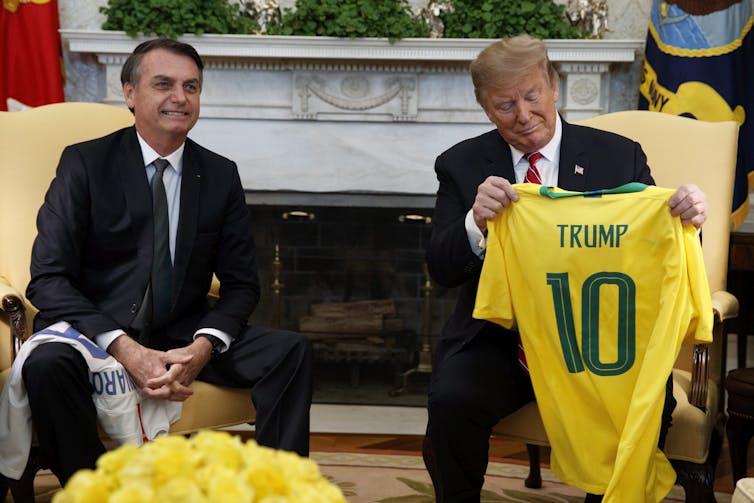
The most obvious parallel is in Brazil, where strongman Jair Bolsonaro ruled from 2018 to 2023. He is a man Trump admires, claiming that Bolsonaro “fights hard for, and loves, the people of Brazil — just like I do for the people of the United States.”
Jair Bolsonaro presents Donald Trump with a Brazilian national team soccer jersey in the Oval Office of the White House in March 2019. (AP Photo/Evan Vucci)
Bolsonaro believed in cutting taxes, defending “family values” and was opposed to gun control and immigration from places like Haiti and the Middle East. Considered racist, sexist and homophobic by some, his fiery speeches often incited violence, particularly against political opponents, criminals and “reds.”

He dismissed COVID-19 as a fantasy, resulting in Brazil having one of the highest rates of infection in the world. Defeated in 2022, he did not acknowledge the defeat, but said that he would abide by the country’s constitution.

He left the country rather than acknowledge his defeat, but his supporters stormed the Supreme Court, the congress building and the presidential palace to try to overturn the election. Unlike Trump, he’s been barred from running for office until 2030 because of his refusal to accept his defeat, and prosecuted for election fraud.

The coming months will reveal whether the charges against Trump will erode his support or instead encourage his supporters to continue donating millions of dollars to support his election bid and his legal fees. So far, those supporters are showing no signs of turning against him.


This article is republished from The Conversation under a Creative Commons license. Read the original article.

Thursday, 6 July 2023

Should the voting age in Australia be lowered to 16?


Attempts to lower the voting age in Australia to 16 have been historically unsuccessful. More recently, the Make It 16 campaign has been advocating for the enfranchisement of 16 and 17-year-olds, but with no fines for under 18s who fail to cast their ballots.

Voluntary or not, lowering the voting age will have consequences for how political behaviour shapes political outcomes, especially for issues that particularly interest the young, such as climate change, cost of living, mental health and wellbeing.

Younger people tend to be more progressive in their views. This in turn would alter the make-up of the Australian electorate at each election or referendum. The addition of socially progressive voters might well be decisive on a highly contentious and divisive issue such as the Indigenous Voice to Parliament.
Who should have the right to vote?

In 1973, following mass youth casualties in the Vietnam War, Australia’s voting age was lowered from 21 to 18. The reasoning behind this centred on equity: if 18-year-olds were old enough to fight and die, they should be old enough to vote.

Today’s equity arguments centre on taxation: many 16 and 17-year-olds pay tax and therefore should have equal rights to representation. However, this representation logic is not unique to 16 and 17-year-olds. It applies equally well to those under 16, as well as to tourists and temporary residents, who pay tax but do not have the right to vote.

Beyond the taxation argument, the franchise has been aligned with other adult responsibilities such as driving a car and consenting to sex. An important point of distinction, though, is the motivation: do they actually want to vote?

Although enthusiastic young leaders are driving campaigns such as Make It 16, we cannot be confident that a subset of politically engaged young people is representative of the Australian youth. There is no question about the cognitive abilities of 16 to 17-year-olds to engage with the electoral process. But there is little longitudinal data to firmly establish that younger people are enthused about voting.

That is not to say young people are not interested in politics. Evidence from Australia and elsewhere shows young people engage differently: their engagement with politics is based more on issues than party loyalties.

Being able to vote would mean younger people feel less excluded and alienated from politics. However, critics worry voluntary voting for 16 to 17-year-olds would weaken compulsory voting.

Australia’s compulsory voting means it has resisted youth electoral disengagement at the polls, which has markedly happened in other non-compulsory voting democracies. Given the highly transitory life stage they are in, young people are more likely to abstain if voting is voluntary. This would also run the risk of imprinting the habit of abstention.

What does the evidence suggest?

Data from the Australian Election Study suggest lowering the voting age would not invigorate electoral participation. It is likely early enfranchisement alone will not be a panacea for youth engagement. Rather, there are concerns that voluntary voting might further exacerbate the problem of lower youth enrolment.

My comparative study of youth electoral disengagement in advanced democracies studied a suite of institutional factors, including:
  • electoral system (majoritarian versus proportional)
  • type of executive (parliamentary/presidential)
  • type of system (federal/unitary)
  • party system (two/multi)
  • voting age (16-21).
I found that, even when controlling for compulsory voting, it is the registration system that significantly influences generational engagement at the polls.

Transition to adulthood is characterised by increasing mobility in every aspect of life. On top of this, registration rules make it difficult for young people without a permanent, long-term residence to register to vote.

Within the voluntary registration system, young people are especially disadvantaged since new eligible voters are often unfamiliar with the registration system, including how and where to register to vote. Consequently, many confused, eligible voters inadvertently miss voter registration deadlines. Current evidence shows voter enrolment is lowest among those aged 18-24, at 89.5%, compared to a national figure of 97.2%.

However, what has been largely missing in the voting age debate is that lowering it to 16 may be a way to redress this enrolment discrepancy. It may be an institutional design feature that could cater to youth transition: 16-17-year-olds are more likely to be in parental homes when they enrol and then finally vote. This may help attract and keep them as active voters as they gain independence.  

What does this mean for (major) parties?

The Coalition’s historic low support among young voters in the 2022 federal election may be a symptom of a long-lasting generational shift in the electorate. In the past two elections, only 26% of Gen Z voters, born after 1996, reported voting for the Coalition, while 67% of them voted either for the Greens or Labor. Although historically young people have tended to become more conservative as they age, recent evidence suggests voters born after 1980 are not doing that.

Extrapolating this trajectory of voting preferences, the addition of more socially progressive, issue-based younger voters will potentially benefit the left-of-centre parties, particularly the Greens. One political reason for Labor’s reluctance to lower the voting age seems to be the stark popularity of the Greens among Gen Z voters, which would increase the Greens threat to the incumbent.

Over the years, both major parties have been losing their (youth) votes to the Greens. Lowering the voting age may well pronounce this.

What would it mean for young voters?

Given the context of compulsory voting, Australia is best placed to implement the lowering of voting age to reap the benefits of engaging younger voters to the electorate. Much has been said about how this would improve youth representation, efficacy and outcomes.

However, lowering the voting age might not address the problem of youth distrust of politicians and the widening gap between younger generations and political parties. This would require a sincere effort to understand what causes the drift, before enfranchising younger voters and loosely tying them to a voluntary voting system. In fact, there is a real risk that voluntary voting might encourage the type of abstention driven by a strong dislike for politicians.

Enfranchising hundreds and thousands of additional voters would also inevitably raise the issues of ensuring proper enrolment and that young voters are well informed to vote. It would need to be accompanied by a major boost to civics education in Australian secondary schools.

All in all, while compulsory voting is the best system for lowering the voting age, we’d have to be careful not to undermine the system as it stands. Instead, it is important to tie it to efforts to inform younger voters and reduce the age-related barriers in a (compulsory) electoral process.

Intifar Chowdhury, Youth Researcher, Centre for Social Research and Methods, Australian National University

This article is republished from The Conversation under a Creative Commons license. Read the original article.

Sunday, 19 February 2023

"Energized and excited": Chris Hipkins becomes 41st Prime Minister of New Zealand

On January 25, Chris Hipkins succeeded Jacinda Ardern as prime minister of New Zealand after the latter's 'shock' resignation on January 19.

At the swearing-in ceremony in Wellington, Governor-General Dame Cindy Kiro, King Charles III's representative, appointed Hipkins prime minister and Carmel Sepuloni the first Pasifika New Zealander deputy prime minister.

Hipkins, 44, was elected to replace Ardern as leader of the Labour Party unopposed on January 22. He is expected to lead the party into the October elections amidst economic challenges and two years of declining Labour popularity against a stronger conservative opposition.

In his first speech as prime minister, Hipkins, who under Ardern led New Zealand's response to COVID-19, said: "This is the biggest privilege and responsibility of my life [...] I’m energized and excited by the challenges that lie ahead."

Hipkins said the cost of living was an "absolute priority" for the new ministry but ruled out announcing specifics "only a couple of hours into the job". Quarterly consumer spending figures published that morning showed New Zealand's inflation rate remained high at 7.2%, led by increases in housing and food costs.

"New Zealanders will absolutely see in the coming weeks and months the cost of living is right at the heart of our work program [...] It is the number one priority that we are facing as a government and they will see tangible evidence of this", he told reporters, but said "I’m not going to be so hasty as to make things up on the fly".

Sepuloni expressed her gratitude for the position and saluted Hipkins' victory. On Sunday, Sepuloni, of Samoan, Tongan, and New Zealand European descent, said she "want[s] to acknowledge the significance of this for our Pacific community".

On Sunday, Hipkins pledged to fight what he described as a "pandemic of inflation": "COVID-19 and the global pandemic created a health crisis. Now it’s created an economic one and that’s where my government’s focus will be". But he said focusing on the economy won't detract from other priorities, including climate change, which remains "one of the biggest intergenerational challenges that we face."

Christopher Luxon, the Leader of the Opposition, said he texted Hipkins and Sepuloni his congratulations, but declared the Ardern government "failed spectacularly", and Hipkins promised only 'more of the same'.

Despite previous cabinet positions as Minister of Education and Minister of Police, Hipkins became known as the 'architect' behind New Zealand's COVID-19 policy. Nevertheless, according to the Associated Press, he and other party members were obscure compared to Ardern, a "global icon for the left".

Ardern said she resigned after serving almost fifteen years as a member of parliament because she didn't "have it in the tank [to continue]." She is expected to remain an MP before resigning in April, to prevent a by-election before the October vote.

Ardern was elected prime minister in a coalition government in 2017 and won a landslide re-election three years later. She has governed during the nation's deadliest terrorist attack, natural disasters, and the COVID-19 pandemic.

In her last event as prime minister on Tuesday, Ardern said people were "the joy of the job". On Wednesday morning, staffers and supporters gathered to say goodbye and hug her as she walked out of the Parliament building.

William and Catherine, the Prince and Princess of Wales, tweeted Ardern and her family their gratitude "for your friendship, leadership and support over the years, not least at the time of my grandmother’s death." Source: https://en.wikinews.org/, Under Creative Commons Attribution 2.5 License

Thursday, 16 February 2023

Nikki Haley joins growing list of Indian-origin politicians

With Republican Party's rising star Nikki Haley launching her US presidential campaign against her former boss Donald Trump, she joins a long list of Indian-origin leaders who are dominating politics at important world capitals. In the US, the growing influence of the Indian-American community can be seen in the success of Kamala Harris, who became the first woman and the first coloured Vice President of the country. She was a senator for California from 2017 to 2021. Harris, a Democrat, also served as the attorney general of California from 2011 to 2017. She was born to Indian and Jamaican parents in California. In the crucial midterm elections in November, a record five Indian-American lawmakers from the ruling Democrat Party Raja Krishnamoorthi, Ro Khanna, Pramila Jayapal, Ami Bera and Shri Thanedar were elected to the US House of Representatives. Harmeet Dhillon, a prominent politician in California, recently contested the election for the chairmanship of the Republican National Committee (RNC). Rishi Sunak was installed as Britain's first Indian-origin Prime Minister last year. He is the youngest British prime minister in 210 years. He is also Britain's first Hindu Prime Minister. Goan-origin Suella Braverman is serving as his Home Secretary. Under Sunak's predecessor, Boris Johnson's Cabinet, Priti Patel was the Home Secretary. Alok Sharma was the International Development Secretary in Johnson Cabinet. Ireland's Prime Minister (Taoiseach) Leo Eric Varadkar is also of Indian origin. Varadkar is the third child and only son of Ashok and Miriam Varadkar. His father, a doctor, was born in Mumbai and moved to the United Kingdom in the 1960s. Antonio Costa has been the Prime Minister of Portugal since 2015. He is half Indian and half Portuguese. Canada's Defence Minister Anita Anand's parents were Indians. Her father was from Tamil Nadu and her mother was from Punjab. Apart from Anand, Canadian Prime Minister Justin Trudeau's Cabinet has two more Indian-origin members Harjit Sajjan and Kamal Khera. Priyanca Radhakrishnan is the first person of Indian origin to become a Minister in New Zealand. Born in Chennai to Malayali parents, is currently the Minister for the Community and Voluntary Sector. Christine Carla Kangaloo, who is the president-elect of Trinidad and Tobago, was born into an Indo-Trinidadian family. Pritam Singh, an Indian-origin Lawyer and author, has been serving as Leader of the Opposition in Singapore since 2020. Devanand "Dave" Sharma became the first person of Indian origin to become a Member of the Australian Parliament in 2019. Mohamed Irfaan Ali, the President of Guyana, was born into a Muslim Indo-Guyanese family in Leonora. Pravind Jugnaut has been serving as the prime minister of Mauritius since January 2017. He was born into a Hindu Yaduvanshi family in 1961. His great-grandfather migrated to Mauritius from the Indian state of Uttar Pradesh in the 1870s. Prithvirajsing Roopun, the president of Mauritius since 2019, was born in an Indian Arya Samaj Hindu family. Chandrikapersad "Chan" Santokhi has been the president of Suriname since 2020. Santokhi was born in 1959 into an Indo-Surinamese Hindu family in Lelydorp. Wavel Ramkalawan has been serving as the president of Seychelles since October 2020. His grandfather was from Bihar. According to the 2021 Indiaspora Government Leaders List, more than 200 leaders of Indian heritage have ascended to the highest echelons of public service in 15 countries across the globe, with over 60 of them holding Cabinet positions. With more than 32 million people of Indian origin or (PIOs) globally, according to India's Ministry of External Affairs, Indians are the largest diaspora population in the world. Copyright © Jammu Links News. Source: Jammu Links News

Thursday, 29 September 2022

Suu Kyi gets 3 years in prison for breaching state secrets


A court in Myanmar today sentenced the country’s ousted pro-democracy leader Aung San Suu Kyi to three years in prison for breaching state secrets. The news agency AFP reported this information on Thursday (September 29), citing a source related to this case. According to the report, Aung San Suu Kyi and Australian citizen Sean Turnell were sentenced to three years in prison for the Official Secrets Act case. On February 1, 2021, the junta government overthrew the elected government in Myanmar and seized power. The country’s leader, Aung San Suu Kyi, along with the top leaders of her party, were imprisoned. After that, the military government filed a case against the Nobel Peace Prize-winning leader one by one.Aung San Suu Kyi has been charged with at least 18 crimes, including violations of corruption, election laws and state secrets laws, which could lead to up to 190 years in prison if convicted. Source: https://www.daily-bangladesh.com/

Tuesday, 13 September 2022

Who is Liz Truss?

Liz Truss is to become the UK's next prime minister after winning the contest to replace Boris Johnson as Conservative Party leader. But where did she come from and what makes her tick?

A Remain supporter who has become the darling of the Brexit-backing Conservative right wing.

A former Liberal Democrat activist, who marched against Margaret Thatcher in the 1980s, but who now claims to be the keeper of the Thatcherite flame.

It is fair to say that Mary Elizabeth Truss has been on a political journey.

She may not be a household name like her predecessor at Number 10 - and she was not the first choice of Tory MPs to replace Boris Johnson.

But her promise to return to fundamental Conservative values - cutting taxes and shrinking the state - proved to be exactly what party members, who got the final say over who took over from Mr Johnson, wanted to hear.

And, crucially, as foreign secretary she remained loyal to Mr Johnson until the bitter end as other ministers deserted him, winning her favour with Johnson loyalists.

Grassroots Tory supporters of Liz Truss see in her the steadfast, tenacious and determined qualities they admired in Margaret Thatcher - an image Ms Truss herself has tried to cultivate.

But despite her shifting political positions and allegiances over the years, these words also come up frequently when friends and family are asked to describe her character - along with "ambitious".

"She's a very opinionated person in terms of what she wants," said her brother Francis in 2017, when recalling his older sister's teenage dalliance with vegetarianism.

"When you go to a restaurant, you might be 14 but she was precocious about what she wants, what she didn't want."

When the family played Cluedo or Monopoly, "she was someone who had to win," added Francis in a BBC Radio 4 profile of Truss.

"She would create some special system to work out how she could win."

Maurizio Giuliano, a university contemporary who first met her at Liberal Democrat event, says she stood out from the other students.

"I remember her being very well-dressed compared to other 18 to 19-year-olds. She also had the demeanour of a real adult compared to what we were at that age.

"She was forceful and opinionated and she had very strong views."

Serious political debate was the order of the day in the Truss household, according to Francis, the youngest of her three younger brothers.

"You didn't sit around talking about the latest Megadrive game at the dinner table, it was much more issues, political campaigns etc," he told Radio 4's Profile programme.

It must have felt inevitable that she would get involved in politics in some capacity when she grew up, but no-one in her family would have predicted the path she eventually took.

The teenage Truss caused a stir at the Lib Dem conference with her anti-Monarchy stance

Born in Oxford in 1975, Ms Truss has described her father, a mathematics professor, and her mother, a nurse, as "left-wing".

As a young girl, her mother took on marches for the Campaign for Nuclear Disarmament, an organisation vehemently opposed to the Thatcher government's decision to allow US nuclear warheads to be installed at RAF Greenham Common, west of London.

Though she is now proudly a Conservative from Leeds, back then she was a Scottish liberal.

The family moved to Paisley, just west of Glasgow, when Ms Truss was four-years-old.

In a BBC interview, she recalled shouting "Maggie, Maggie, Maggie - oot, oot, oot," in a Scottish accent, as she took part in marches.

The Truss family later decamped to Leeds, where she attended Roundhay, a state secondary school. She has described seeing "children who failed and were let down by low expectations" during her time there.

Some of Ms Truss's contemporaries at Roundhay have disputed her account of the school, including Guardian journalist Martin Pengelly, who wrote: "Perhaps she is selectively deploying her upbringing, and casually traducing the school and teachers who nurtured her, for simple political gain."

One Roundhay school mate, who did not want to be named, told the BBC: "It was a really good school, really supportive teachers. Quite a lot of us have gone on to good universities and good careers."

Although not part of her friendship group, he has clear memories of the young Truss.

"She was quite studious, serious," he says, with a "heavy social conscience" and part of a group that were into environmentalism.

"I remember a school trip to Sellafield and her asking difficult questions and giving them a grilling. I remember that quite distinctly."

At Oxford University, Ms Truss read philosophy, politics and economics. Friends recall a well-liked, if frenetic student.

"I remember her determination which was very impressive for me," says Jamshid Derakhshan, who was studying for a postgrad degree in mathematics when Truss was an undergraduate.

"She was very quick with everything. Going around the college quickly, being everywhere."

As to what sort of prime minister his old friend will make, Dr Derakhshan says: "My feeling is she's not going to be stuck with one particular idea, she's very flexible in her mind and what will be best for the time."

Ms Truss was involved in many campaigns and causes at Oxford but devoted much of her time to politics, becoming president of the university's Liberal Democrats.

At the party's 1994 conference, she spoke in favour of abolishing the Monarchy, telling delegates in Brighton: "We Liberal Democrats believe in opportunity for all. We do not believe people are born to rule."

She also campaigned for the decriminalisation of cannabis.

"Liz had a very strong radical liberal streak to her," said fellow Lib Dem student Alan Renwick in 2017.

"We were setting up the Freshers Fair stall, Liz was there with a pile of posters, saying 'Free the Weed' and she just wanted the whole stall to be covered with these posters.

"I was scurrying around after Liz trying to take these down and put up a variety of messages, rather than just this one message all over the stall."

Her conversion to Conservatism, towards the end of her time at Oxford is said to have shocked her left-leaning parents, but for Mark Littlewood, a fellow Oxford Lib Dem, it was a natural progression.

"She's been a market liberal all of her adult life," according to Mr Littlewood, who is now director general of the libertarian, free market think-tank, the Institute of Economic Affairs.

"Her political career reflects her ideology - she has always been highly sceptical of big government and privileged institutions who think they know best," Mr Littlewood said.

She clearly changed parties, but that "was a judgement about what's the best and most likely vehicle for her to succeed in politics and get what she wants to get done," Mr Littlewood said.

Nevertheless, what she has described as her "dubious past" came back to haunt her as she tried to convince Tory members she was truly one of them.

At a leadership hustings in Eastbourne, some in the audience jeered, as she told them: "We all make mistakes, we all had teenage misadventures, and that was mine.

"Some people have sex, drugs and rock and roll, I was in the Liberal Democrats. I'm sorry."

She had become a Conservative because she had met like-minded people who shared her commitment to "personal freedom, the ability to shape your own life and shape your own destiny," she explained.

After graduating from Oxford she worked as an accountant for Shell, and Cable & Wireless, and married fellow accountant Hugh O'Leary in 2000. The couple have two children.

Ms Truss stood as the Tory candidate for Hemsworth, West Yorkshire, in the 2001 general election, but lost. Ms Truss suffered another defeat in Calder Valley, also in West Yorkshire, in 2005.

But, her political ambitions undimmed, she was elected as a councillor in Greenwich, south-east London, in 2006, and from 2008 also worked for the right-of-centre Reform think tank.

Conservative leader David Cameron put Ms Truss on his "A-list" of priority candidates for the 2010 election and she was selected to stand for the safe seat of South West Norfolk.

But she quickly faced a battle against de-selection by the constituency Tory association, after it was revealed she had had an affair with Tory MP Mark Field some years earlier.

The effort to oust her failed and Ms Truss went on to win the seat by more than 13,000 votes.
Liz Truss became an MP in 2010

She co-authored a book, Britannia Unchained, with four other Conservative MPs elected in 2010, which recommended stripping back state regulation to boost the UK's position in the world, marking her out as a prominent advocate of free market policies on the Tory benches.

During a BBC leadership debate, she was challenged about a comment in Britannia Unchained, describing British workers as "among the worst idlers in the world". She insisted she had not written it.

In 2012, just over two years after becoming an MP, she entered government as an education minister and in 2014 was promoted to environment secretary.

At the 2015 Conservative conference, she made a speech in which she said, in an impassioned voice: "We import two-thirds of our cheese. That. Is. A. Disgrace."

The speech was little noticed at the time, but it has taken on a life of its own on social media, attracting much mockery and becoming widely shared.

Less than a year later came arguably the biggest political event in a generation - the EU referendum.

Ms Truss campaigned for Remain, writing in the Sun newspaper that Brexit would be "a triple tragedy - more rules, more forms and more delays when selling to the EU".

However, after her side lost, she changed her mind, arguing that Brexit provided an opportunity to "shake up the way things work".

Under Theresa May's premiership, she became the first female Lord Chancellor and justice secretary, but she had several high-profile clashes with the judiciary.

Her initial failure to defend judges after they were branded "enemies of the people" by the Daily Mail, when they ruled Parliament had to be given a vote on triggering Brexit, upset the legal establishment.

She later issued a statement supporting the judges, but she was criticised by Lord Chief Justice Lord Thomas of Cwmgiedd as "completely and absolutely wrong" for not speaking out sooner.

After 11 months as justice secretary, she was demoted to chief secretary to the Treasury.

When Boris Johnson became prime minister in 2019, Ms Truss was moved to international trade secretary - a job which meant meeting global political and business leaders to promote UK PLC.

In 2021, aged 46, she moved to one of the most senior jobs in government, taking over from Dominic Raab as foreign secretary.

In this role she has sought to solve the knotty problem of the Northern Ireland Protocol, by scrapping parts of a post-Brexit EU-UK deal - a move the EU fiercely criticised.

She secured the release of two British-Iranian nationals who had both been arrested and detained in Iran.

And when Russia invaded Ukraine in February she took a hard line, insisting all of Vladimir Putin's forces should be driven from the country.

But she faced criticism for backing people from the UK who wanted to fight in Ukraine.

Her decision to pose for photographs in a tank while visiting British troops in Estonia, was seen as an attempt to emulate Margaret Thatcher, who had famously been pictured aboard a Challenger tank in 1986. It also fuelled speculation that she was on leadership manoeuvres.

Claims she was deliberately trying to channel Thatcher grew even louder when she posed for a photograph in a white pussy bow collar of the kind favoured by the Iron Lady.

But she has always dismissed such criticism, telling GB News: "It is quite frustrating that female politicians always get compared to Margaret Thatcher while male politicians don't get compared to Ted Heath."

Ms Truss's campaign for the party leadership has not been free of controversy.

Pressed on how she would tackle the cost-of-living crisis, she said she would focus her efforts on "lowering the tax burden, not giving out handouts".

She has been forced to scrap a plan to link public sector pay to regional living costs by a backlash from senior Tories who said it would mean lower pay for millions of workers outside London.

And she called Scotland's First Minister Nicola Sturgeon an "attention seeker", adding it was best to "ignore her".

She also got into a spat with French President Emmanuel Macron, who accused her of "playing to the gallery" at a leadership hustings. Asked if Mr Macron was a "friend or foe", she had said the jury was still out.

But it was domestic issues, or rather one domestic issue, that dominated the sometimes fractious leadership contest with Rishi Sunak.Ms Truss's response to the cost of living crisis promised within days of taking office, is likely to define her premiership and her chances of gaining a mandate of her own at the next general election.- BBC. Source: https://www.daily-bangladesh.com

Tuesday, 12 July 2022

Japan`s ruling party secures strong win after Abe assassination


Japan's ruling party and partners won enough votes to form a supermajority in an upper house election held just days after the assassination of former prime minister Shinzo Abe, local media said Monday.

The ex-premier's ruling Liberal Democratic Party (LDP) and its coalition partner Komeito strengthened their hold by winning more than 75 of the 125 upper house seats up for grabs, according to national news outlets.

The parties are part of what is now a two-thirds supermajority willing to amend the country's pacifist constitution, thereby strengthening its military role on the global stage — a longtime Abe goal.

Even before the former prime minister's murder, the LDP and Komeito were expected to cement their majority, though the final number of seats will be scrutinized for signs of whether the attack bolstered support for them.

"I think it is significant we were able to complete the elections," Prime Minister Fumio Kishida told NHK, adding he wants to tackle the pandemic, Ukraine-related issues and inflation.

Kishida had insisted the election proceed despite the assassination, saying "we must never allow violence to suppress speech."

Conceding defeat, Kenta Izumi, leader of the opposition Constitutional Democratic Party, which was projected to have lost several seats, said it was clear "voters did not want to switch from the LDP and entrust us with running the government," according to Kyodo News.

Despite the murder, turnout for the election remained low at only 52 percent, national outlets reported.

Abe was gunned down at close range on Friday in the western region of Nara, and died of blood loss at a local hospital. His body was brought to his family home in Tokyo on Saturday.

The assassination rattled the nation and sent shockwaves around the world, prompting an outpouring of sympathy even from nations with which the hawkish Abe had sometimes difficult relations, such as China and South Korea.

The man accused of his murder, 41-year-old Tetsuya Yamagami, is in custody and has told investigators he targeted Abe because he believed the politician was linked to an unnamed organisation.

Local media have described the organisation as religious and said Yamagami's family had suffered financial trouble as a result of his mother's donations to the group.

He also reportedly visited the western region of Okayama on Thursday with the intent of killing Abe at a different event, but backed out because participants had to submit their names and addresses.

Additionally, Yamagami admitted to police to test-firing guns at a facility connected to the religious group beforehand, according to media.

No bigger regret

With little violent crime and tough gun laws, security at Japanese campaign events can be relaxed, though in the wake of Abe's murder, measures were beefed up for Kishida's remaining appearances.

Security at polling stations on Sunday remained normal, however, with 79-year-old Takao Sueki saying he was voting with an eye on international instability, including Russia's invasion of Ukraine.

"Watching the world now, I think every day about how Japan will manage with the situation," he told AFP.

"This is a democratic country and I despise the use of violence to eliminate someone," he added when asked about Abe's murder.

"I strongly believe that if people have disagreements, they should dispute them with dialogue."

Police have promised a "thorough investigation" into what the head of the Nara regional police called "problems with guarding and safety measures" for Abe.

"In all the years since I became a police officer in 1995... there is no greater remorse, no bigger regret than this," chief Tomoaki Onizuka tearfully told reporters on Saturday evening.

Wake, funeral planned

Abe's office told AFP that a wake would be held on Monday night, with a funeral for family and close friends only on Tuesday. Local media said both were expected to be held at Tokyo's Zojoji Temple.

US Secretary of State Antony Blinken, who was in Asia for meetings, arrived in Tokyo on Monday to see Kishida and offer condolences in person.

Abe was the scion of a political family and became the country's youngest post-war prime minister when he took power for the first time in 2006, aged 52.

His hawkish, nationalist views were divisive, particularly his desire to reform Japan's pacifist constitution to recognise the country's military, and he weathered a series of scandals, including allegations of cronyism.

But he was lauded by others for his economic strategy, dubbed "Abenomics," and his efforts to put Japan firmly on the world stage, including by cultivating close ties with Biden's predecessor Donald Trump.

Kishida, 64, was once described as among Abe's favoured successors, and holds a solid majority in parliament with Komeito.

But he faces significant policy headwinds, including rising prices and energy shortages, particularly after an early summer heatwave that led to a power crunch.Kishida is expected to reshuffle his cabinet in the coming months. Source: https://www.daily-bangladesh.com

Saturday, 10 July 2021

PM Modi to chair Council of Ministers meeting on July 14


JUL 10, 2021 NEW DELHI: Prime Minister Narendra Modi is scheduled to chair a meeting with the Council of Ministers on Wednesday (July 14), said sources. This will be PM Modi's second meeting with the Council of Ministers after the Union Cabinet reshuffle on July 7. A day after the expansion of the Union Cabinet, the Prime Minister had back-to-back meetings with the union cabinet and council of ministers on Thursday. In the meeting on Thursday, sources said that Prime Minister had cautioned Ministers against any complacency in the fight against COVID-19, saying that over the past few days there have been pictures and videos of crowded places and people roaming about without masks or social distancing and "it should instil a sense of fear in us". The sources said the Prime Minister noted that people not following COVID-19 protocols was not a "pleasant sight". Copyright © Jammu Links News, Source: Jammu Links News

Monday, 3 May 2021

Not Mamata, Suvendu wins in Nandigram


West Bengal Chief Minister and TMC supremo Mamata Banerjee lost the Nandigram seat to BJP's Suvendu Adhikari in a neck and neck fight. Banerjee lost to Adhikari by a narrow margin of 1622 votes, reports Anandabazar.

Earlier, some Indian newspapers reported that Mamata defeated her former aide Suvendu by a margin of 1,200 seats. It is said that due to a problem in the server, something is not known properly.

Regarding this, Suvendu said, 'I won by 1622 votes'. However, Suvendu's margin of victory with Mamata without the postal ballot was 9787 votes.

In a press conference just after the results were announced, the West Bengal chief minister said, "Don't worry about Nandigram, I struggled for Nandigram because I fought a movement. It's ok. Let the Nandigram people give whatever verdict they want, I accept that. I don't mind. We won more than 221 seats & BJP has lost the election."

Shortly afterward, the Trinamool tweeted that the counting was still going on in Nandigram. The tweet also requested not to listen to any speculation.

However, Mamata expressed her gratitude to the people of Bengal for her team's victory despite her defeat. She congratulated everyone for the victory of Bengal. The victory of Bengal, the victory of the people. Bengal has saved India today.

Mamata complained that the people of Nandigram did well. At the same time, Mamata said she would go to court against the confusion over the results. She said, "I have a complaint, there has been fraud after the verdict was announced."

Earlier, news agency ANI reported that Mamata had won Nandigram by 1202 votes. The counting of votes was stopped for 40 minutes at noon due to a server error. Even after the news of Mamat: Source: https://www.daily-bangladesh.com/

Friday, 19 February 2021

Suu Kyi faces second charge by military


Aung San Suu Kyi was hit with another charge after the military deposed her and seized power in a coup on February 1, her lawyer said on Tuesday.

Suu Kyi’s lawyer Khin Maung Zaw told local media Suu Kyi was facing a second charge of violating the country’s Natural Disaster Law.

Meanwhile, she has already been charged with importing walkie-talkies.

He said that Suu Kyi had met with a judge on a video call due to COVID-19 regulations, but lawyers could not attend because they had not been granted power of attorney.

Asked about her health, Khin Maung Zaw said, “No news is good news. We haven’t heard or received bad news.”The date of the next court hearing will be March 1, he added Source: https://www.daily-bangladesh.com

Wednesday, 10 February 2021

Narendra Modi tears up in parliament


Indian Prime Minister Narendra Modi choked up and teared up as well as struggled to speak today as he stood in Parliament to address the departure of veteran Congress leader and Rajya Sabha Leader of Opposition Ghulam Nabi Azad. 

Modi also shared an episode when they were both Chief Ministers - of Gujarat and Jammu and Kashmir.

Ghulam Nabi Azad has repeatedly criticized the Modi government on various issues. But forgetting the political bitterness, Modi was seen to applaud the Congress MP.

"I have known Shri Ghulam Nabi Azad for years. We were Chief Ministers together. We had interacted even before I became Chief Minister when Azad Sahab was very much in active politics. He has a passion not many know about - gardening," PM Modi said.

In his speech, Modi also referred to a 2007 terror attack in Jammu and Kashmir with saying Mr. Azad was the first to call him to inform him about the incident. The Prime Minister said Mr. Azad's tears would not stop.

"I will never forget Shri Azad's efforts and Pranab Mukherjee's efforts when people from Gujarat were stuck in Kashmir due to a terror attack. That night...Ghulam Nabi Ji called me...," he recalled, fighting tears, and paused for water.

"He sounded concerned like people are concerned about their own family members. That is the kind of feeling he showed." As the Prime Minister stopped to gather himself, there was loud desk-thumping."Power comes and goes. But how to handle it...," PM Modi broke off again and saluted Azad. Source: https://www.daily-bangladesh.com

Wednesday, 13 January 2021

Political dynasts weakening democracy: PM


Without taking names of political rivals, Prime Minister Narendra Modi said on Tuesday said that political dynasts posed the biggest threat to democracy and appealed to the youth to enter politics to redress the situation.

"There are still people who want to do politics only to save their family's name in politics. This sort of politics keeps 'nation first' at second place and 'my family and my benefits' as first priority.

"The youth need to enter politics to end this practice of family-based politics. It is important to save our democratic practices," he said at a valedictory function of the second Youth Parliament here.

"Dynasts are the biggest threat to democracy and this leads to social corruption; more youths should come forward to curb this problem."

Modi maintained that people nowadays supported those who worked with honesty and sincerity.

He said that politics of nepotism was nearing its end, adding that it hadn't ended completely though.

"Those who have corruption as part of their legacy now are not able to come out of that burden."

Invoking Swami Vivekananda, Modi advised the youth to believe in themselves and take the nation forward. The new National Education Policy 2020 will take the youth towards modern education and learning, he added. Source: https://southasiamonitor.org/

Saturday, 9 January 2021

Trump concedes defeat for 1st time, admits he won’t serve again


Incumbent US President Donald Trump has conceded defeat publicly for the first time and said that he will not serve a second term and acknowledging that the transfer of power is currently underway.

“My focus now turns to ensuring a smooth, orderly and seamless transition of power,” he said in a video speech shared on his Twitter account which was reactivated on Thursday after being suspended following the Capitol turmoil, ‍according to CNN.

“A new administration will be inaugurated on January 20.”

“Even though I totally disagree with the outcome of the election, and the facts bear me out, nevertheless there will be an orderly transition on January 20,” Trump said in a statement after Congress certified his loss. 

“I have always said we would continue our fight to ensure that only legal votes were counted. While this represents the end of the greatest first term in presidential history, it’s only the beginning of our fight to Make America Great Again.”

The statement was meant as a signal that the Trump administration will end its office for the next 13 days without incident.

A White House adviser said Trump recorded the video because his presidency is threatened by resignations of his officials and potential impeachment.

“That message and tone should have been relayed on election night ... not after people died,” the adviser added.

Earlier, The Democrats lawmakers on Thursday have called for the removal of incumbent US President Donald Trump from office after his supporters invaded Capitol Hill on Wednesday.

“Trump should be removed immediately,” remarked Democratic Senator Chuck Schumer, saying if he is not, House Speaker Nancy Pelosi could be “impeached” him. 

Donald Trump, who has repeatedly refused to concede the election, provoked his supporters on Wednesday to breach the US Capitol in an attempt to stop the lawmakers from certifying the victory of Joe Biden in the November presidential election.

During the unrest, four people died and at least 68 have been arrested. Besdies, the police action came under question with criticisms for failing to stop the breaching.

The Sergeant at Arms, an official responsible for security in the House of Representatives, has resigned. US Capitol Police (USCP) chief Steven Sund is also resigning. 

Transport Secretary Elaine Chao is the latest member of the Trump administration who is set to quit over the incident. Several lower-level officials have also resigned.Source: CNN, BBC, Source: https://www.daily-bangladesh.com

Thursday, 7 January 2021

Four die at US Capitol turmoil, 52 detained


the supporters of outgoing United States President Donald Trump have stormed the U.S. House of Representatives in the name of ‘protests’ on Wednesday; Photo: Collected
Involved News

Washington DC police say four people have died during the storming of the Capitol building on Wednesday local time.

According to BBC, one woman shot dead by police while three others died as a result of “medical emergencies”

So far, more than 52 people have been arrested — 47 of them for violating the curfew.

At least 14 members of the Metro police department were injured. Two were admitted to hospital, one with serious injuries after being dragged into the crowd, and the other was hit by a projectile in the face.

DC Mayor Bowser and police chief Robert Contee hold a press conference about the Capitol Hill protest.

They said the woman who was shot was part of a group of multiple individuals that forced entry into the House room that was still in session.

They were confronted by plainclothes officers, and an officer pulled out a weapon and fired it.

The woman was taken to hospital and declared dead. Her ID is being withheld by authorities until next of kin are notified.

They said of the three other deaths in the clashes at the Capitol grounds, one was an adult female and two were adult males. All three involved unspecified, separate medical emergencies.

Earlier, the supporters of outgoing United States President Donald Trump have stormed the U.S. House of Representatives in the name of ‘protests’, as a result, the whole Senate building became turmoil with the protests of Trump’s supporters. Outgoing United States President Donald Trump has provoked his supporters, alleging of vote-rigging, to march on the Capitol building.Law enforcement has been forced to block the House of Representatives to bring the situation under control. The process of certifying Joe Biden’s victory in the election to the joint session of Congress was underway there. Source: https://www.daily-bangladesh.com