bloggggg

Home  |  Live  |  Science  |  Lifestyle  |  Entertainment  |  Broadcast  |  Games  |  eBooks  |  Astounds  |  Adbite  |  Cricbell  |  Cyber  |  Idea  |  Digital  |  Privacy  |  Publish  |  ePaper  |  Contact  .Subscribe.Subscribe.Subscribe.Subscribe.Subscribe.Subscribe.Subscribe.Subscribe.Subscribe
Subscribe

Wednesday, 17 September 2025

This Undersea Tunnel Marvel is Set to Break 5 Records and Shave Hours Off Travel Times in Europe

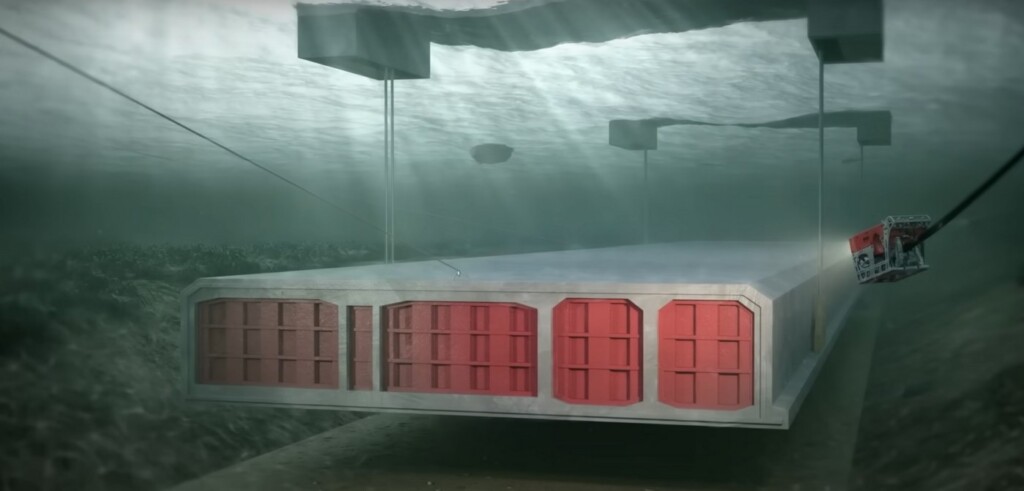
The Fehmarnbelt tunnel will carry two rail lines and a pair of two-lane highways under the Baltic Sea – credit: Femern A/S, screenshot

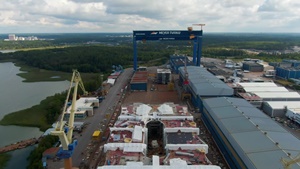
Betwixt the shores of Germany and Denmark, a massive road and rail tunnel is being built and assembled for positioning under the seafloor.

The marvel of modern engineering will set records; even the facility erected to build it will be an achievement, and the product will dramatically alter the road and rail networks of Northern Europe.

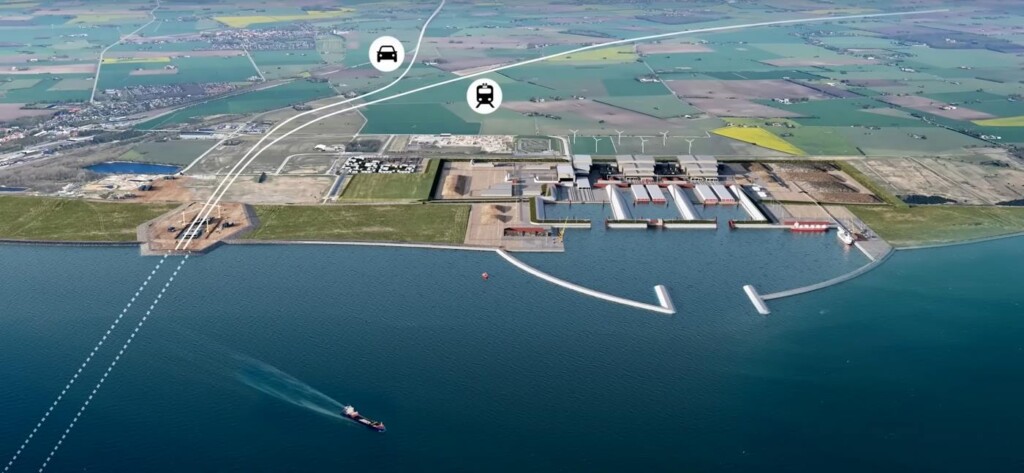
Called the Fehmarnbelt Tunnel, it will span 18 kilometers (11 miles) of water with two double-lane highways, and two rail tunnels. From Hamburg, the journey to Copenhagen will be reduced by half, from 5 hours to just 2.5. From the seashore, a ferry trip that once took 45 minutes will now be a ten-minute drive.


Each 700-foot-long section of the tunnel is as heavy as 10 Eiffel Towers, and there are 79 of them in all, plus another 10 special sections that will house the largest electrical components. They can be manufactured 5 x 1 at a time in an assembly facility as big as 300 football fields on the shore—purpose-built for the project.

When finished, a pair of purpose-built pontoons will utilize 120 miles of steel cables to lower each section into place 40 feet down into a trench dredged on the Baltic Seabed, connected to the other sections, and then buried, making the structure the longest “immersed” undersea tunnel in the world.


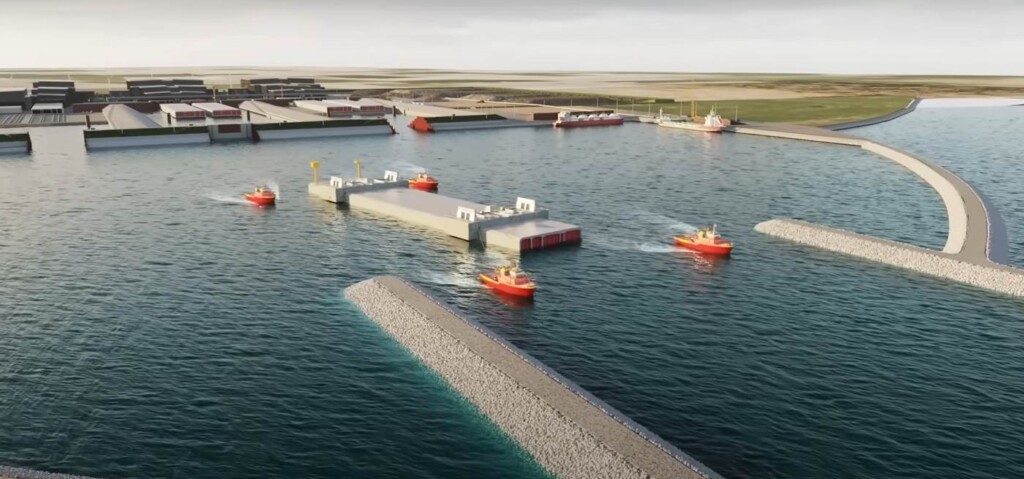
Specially engineered gaskets and secondary seals mean that these massive concrete blocks, which by then will have taken 9 weeks to build, can float. After the crews finish installing as many accessory components into each section as possible on land, the sections are positioned in a basin that will be flooded with seawater.

The tunnel elements will be floated into position – credit: Femern A/S, screenshot

Thus christened, a fleet of tugboats will move them into the grip of the two pontoons for positioning in the sea.

“There will be no test run for the actual immersion,” Denise Juchem, a spokesperson for Femern A/S, the state-owned Danish company in charge of the project, told CNN. “It must work the first time. We will not compromise on quality and safety. That is why we are taking the necessary time to ensure that we are perfectly prepared.”

Femern A/S reckon they can lower the pieces into the trench with a precision of 12 millimeters thanks to a suite of underwater cameras.

When finished it will be the “world’s longest immersed tunnel; world’s longest combined road and rail tunnel; the world’s longest underwater tunnel for road; the deepest immersed tunnel with road and rail traffic; and the second deepest concrete immersed tunnel,” the senior project managers claim.

A rendering showing the tunnel’s construction site and eventual opening – credit: Femern A/S, screenshot

Fehmarnbelt will have a price tag of around $7.4 billion, and is expected to be a boon in both cross-border business and tourism between the countries, which while touching each other, have 12 miles of seawater between the island on which sits Copenhagen and the German mainland.

As a result, eastern Denmark is especially eager to see the tunnel opened, which will see it seize a justifiable place high amongst the great marvels of undersea engineering. This Undersea Tunnel Marvel is Set to Break 5 Records and Shave Hours Off Travel Times in Europe

Monday, 6 May 2024

Guinness World Records - Nigerian Concludes 115-Hour Ironing Marathon

  • The longest marathon ironing record attempt was held at the Jabi Lake Mall in Abuja.
  • On Monday, Zahani Kuma, aka Mr Reliable, a Nigerian fashion entrepreneur, completed a 115-hour ironing marathon in a bid to set a new Guinness World Record (GWR).
  • Gareth Sanders, a cleaning company manager in Bristol, UK, achieved the longest marathon ironing, 100 hours, from 26 to 30 October 2015.
  • Mr Sanders attempted this record at a local Asda Superstore in the UK to raise funds for charity, and it took him over two weeks to fully recover.
  • Mr Reliable, who revealed his GWR application was approved in November 2023, began his quest to set the longest marathon ironing record at the Jabi Lake Mall in Abuja from 23 April to 28.
  • He said he was inspired to begin the record attempt because he hopes to support children experiencing academic challenges.
  • The fashion designer who is awaiting GWR confirmation said: "For five sleepless days and nights, I will be dedicating myself to resilience, endurance, and hard work with the utmost goal of raising a sum of money and supporting in my little way the educational challenges faced by many children within my locality through my profound NGO," he wrote on Instagram.
  • "As an orphan at a very young age, my desire for education was vast; even though there was no one to aid me, I persistently pushed my way through. Now, I've taken it upon myself to assist as many children as possible in reaching their full potential.
  • "This dream can only be achievable with your full support."
  • Mr Reliable's feat follows that of Nigerian Youtuber and social media entrepreneur Clara Kronborg, who broke the Guinness world record for the longest interviewing marathon with a time of 55 hours and 24 seconds last Wednesday.The previous record was 37 hours 44 minutes, achieved in 2022 by Rob Oliver from the United States of America.Guinness World Records - Nigerian Concludes 115-Hour Ironing Marathon

Wednesday, 10 April 2024

British Man Finishes His Run Across Africa: 385 Marathons in 352 days

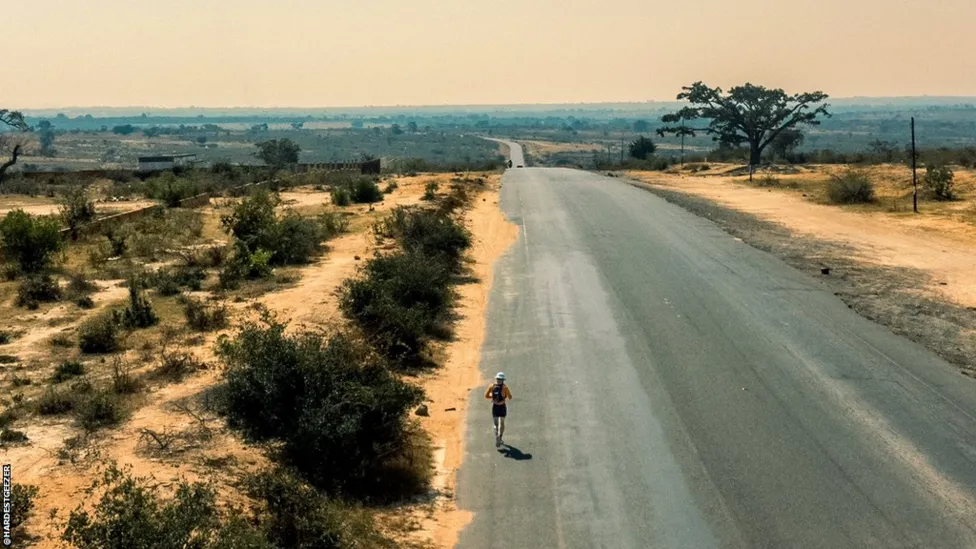
Credit – @hardestgeezer
A red-headed Brit named Ross Cook claims he’s become the first person ever to run across the entire length of Africa after crossing a finishing line in Tunisia. The feat was immense, filled with danger, and when the self-styled “Hardest Geezer” arrived at the shores of the Mediterranean, he had run just over 385 marathons in 352 days; a total of over 10,000 miles. More importantly as Cook sees it, his inspirational accomplishment has raised over £650,000, close to a million dollars, for a selection of charities. His route crossed 16 countries, deserts, rainforests, and mountains, and saw him get entangled in visa issues, muggings, sandstorms, injuries, sickness, and snowstorms. It started in South Africa’s remote southern town of La Agulhas and landed him on a Tunisian beach with a strawberry daiquiri in his hand. BBC reports that his route started in South Africa, and was followed by Namibia, Angola, Democratic Republic of the Congo, Republic of Congo, Cameroon, Nigeria, Benin, Togo, Ghana, Ivory Coast, Guinea, Senegal, Mauritania, Algeria, and Tunisia. His first 60 marathons went off without a hitch when he started in April 2023, but it was in Angola that he and his team were robbed at gunpoint, with money, passports, and phones all stolen. The next major setback occurred in Cameroon where he was constantly battling food poisoning. After crossing Nigeria to Benin he felt like a shell of himself. By that point he had run something like 210 marathons. Reaching the very unique country of Mauritania on day 267, people were endlessly stopping on the roads to offer water and supplies. But then, unable to transit into the vast Algerian Sahara because of visa difficulties, he needed the help of the British government to intervene on his behalf. That would have been a fitting last obstacle to overcome, but the Sahara buffeted him with both sandstorms and snowstorms in the same period. On the final day, his last 44 kilometers to the finish line were characterized by a gang of inspired runners who had flown out for the occasion. British Man Finishes His Run Across Africa: 385 Marathons in 352 days:

Monday, 14 August 2023

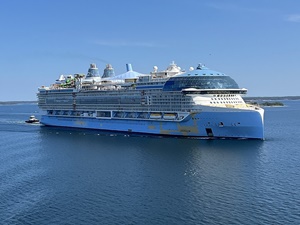
World's largest cruise ship, Icon of the Seas, scheduled to set sail

  • By Aniket Gupta: Following the COVID pandemic, luxury liners went temporarily taken out of service. Now they are back. With a bang. Or should we say, with a big splash? Cruise bookings have surged, and a Finnish shipyard is now in the final stages of completing what is set to become the largest cruise ship in the world.
  • The luxurious ship from Royal Caribbean, named Icon of the Seas, is approaching its final stages of construction at the Meyer Turku shipyard in Turku on the south-western coast of Finland. The shipbuilding company is fully owned by German shipbuilder Meyer Werft GmbH.
  • The Icon of the Seas is expected to be delivered in late 2023, and its inaugural journey is scheduled for January 2024.
  • Tim Meyer, CEO of Meyer Turku, says the ship is the largest cruise ship in the world. The massive ship features lively waterparks, over 20 decks, and the capacity to accommodate nearly 10,000 people.
  • Many have been attracted by the clever design and careful planning that promise an extraordinary cruise, and have eagerly purchased tickets. Others have referred to the massive construction as a ‘monstrosity’, given what they say will be its significant negative environmental impact.
  • The shipping industry was severely impacted by the pandemic, casting doubt on its potential for recovery. According to the Cruise Lines International Association, passenger volume is anticipated to exceed pre-pandemic levels, projecting a total of 31.5 million passengers for the year 2023.
  • Weighing a gross tonnage of 250,800, which is five times larger than the ill-fated Titanic, the Icon of the Seas is poised to claim the distinction of being the world's largest cruise ship, surpassing Royal Caribbean’s existing flagship, the Wonder of the Seas.
  • Although the trend towards constructing massive ships is not expected to stop, it is likely to slow down. For financial reasons rather than engineering limitations.
  • Mega-sized ships are said help lower per-passenger costs. But they require huge investments, and involve advanced technologies, which come at a significant price. Larger vessels also bring challenges like port congestion.
  • Furthermore, as cruise companies aim to increase passenger capacity, they simultaneously lower the crew-to-passenger ratio, which can present difficulties in unforeseen circumstances.
  • A single large ship yields greater energy efficiency compared to multiple smaller ships. Also, modern vessels have begun using liquefied natural gas (LNG), as the Icon of the Seas is doing.
  • But environmentalists remain skeptical. LNG does exhibit lower emissions compared to conventional maritime fuels, yet concerns have been raised by organizations like Transport & Environment (T&E) regarding the possibility of methane leaks.
  • Methane is an essential constituent of LNG. It is also a potent greenhouse gas that has the potential to inflict more severe climate repercussions than carbon dioxide.
  • The T&E website says that while cruise ships account for a small proportion of the global shipping fleet, ‘they have a disproportionate impact on air quality, habitats and the climate’. Why? It’s because cruise ships require more fuel as a result of the energy demand of their onboard hotels and leisure facilities.
  • These ships travel close to the coastline; so huge volumes of fuel are burned in close proximity to coastal populations. The T&E website says, ‘The technology is available to clean up cruise ships, but an industry that provides luxury trips is unwilling to deploy it.’ Source: https://www.domain-b.com/

Friday, 11 December 2015

The cost of being single in China

For China's nearly 200 million unmarried men and women, bachelorhood comes with a big cost -- from career to property. [File photo]
On Nov. 11, Chinese people wowed the world again by spending a record-breaking US$14.2 billion on the online shopping platform Tmall, a subsidy of Jack Ma's Alibaba, much more than U.S. counterparts do on "Black Friday". What is commonly known as the "Double 11 Day" was first coined to celebrate being single, but for China's nearly 200 million single people, being on their own is often no something to celebrate, as it comes with a huge cost in a society where marriage is still the norm.
  • Glass ceiling: Wang Yu works in a State ministry. He and his bachelor colleagues are invited to dinner on Mid-Autumn Day every year, normally an occasion for family reunion in China. His superiors often greet them with a sympathetic tone, saying the dinner was intended to convey "warmth" to unmarried staff on this particular occasion. Wang, 43, has attended the "bachelor dinner" for years, but instead of feeling warmed, he is disheartened. He enjoys his single life -- he practices traditional Chinese handwriting for one hour every day, plays volleyball every week, and reckons to read about 60 books a year. However, bachelorhood poses problems in the workplace. Every year, the work unit will come up with what is called an "ideological and political work plan," an umbrella term that includes courtship and marriage targeting single staff. Once, a leading official said the first priority of the work that year was helping Wang get married. "In China, in traditional State ministries like ours, the working style is paternalistic.They think that being single is a potential risk and poses an insecure element. They think it indicates we cannot be capable of being leading officials caring for their subordinates," Wang said. What comes with being single is not only having to attend the uncomfortable "bachelor dinner", but lack of access to promotion and welfare benefits. Last year there was a vacancy for department chief in Wang's workplace. Someone recommended him for the position, but he was turned down by a leading official on the grounds that Wang remained unmarried. "Being married may not help you, but being single may probably prevent you from being promoted," Wang said, "Leading officials may think you lack a 'collective-conscious' or that you have no desire for progress." 
  • No right to be a parent or homeowner: Earlier this year, Chinese actress and director Xu Jinglei revealed that she had frozen her eggs in the United States. Later, the State broadcaster China Central Television reported that single women in China are not entitled to give birth through the technique of freezing eggs, which has attracted some debate online. According to Chinese laws, only those reproduction-challenged couples who produce marriage certificates, identity cards and pregnancy permits can have access to assisted reproductive technology. Though some hospitals do provide egg freezing services to single females, they must present the three certificates and permits, difficult to come by if one is unmarried. Though many countries in the West recognize people's right to reproduction regardless of marital status, most Chinese still hold to the traditional thought that an unmarried mother is quite questionable, said Wang Guixin, director of the Population Research Institute of Fudan University in Shanghai. In addition to being unable to raise a child on one's own, becoming a single homeowner is often out of the question as well. A strict property purchase policy was introduced in Shanghai in 2010, barring singles who are not registered in the city from buying property there. Lin Yong is one of the people being denied access in this way. The single woman has worked for nine years in Shanghai and she has looked at 30 to 40 apartments, but when she read from the papers that she was disqualified for buying property, all she could do was fume silently. Some real estate agents suggested Lin obtain a fake marriage certificate, but she rejected this, wondering why a fake marriage is acceptable while being genuinely single is not. "Government agencies seem to think that single people do not need an apartment, that real estate is not a rigid demand for singles, and that single people are a group that can be sacrificed and neglected," Lin said. 
  • The price of being an unwed parent: Wei Shan is an unmarried mother living in Beijing. She got pregnant when she was no longer young, but kept the daughter and raised her on her own. Wei's daughter is almost three now, with a much frailer body than her kindergarten classmates. Wei sometimes feels it's her fault as she is not able to take good of her daughter on her own. What worries Wei more is having her daughter registered in the city, as Chinese laws do not recognize out-of-wedlock birth. Love children are subject to the so-called "social support fees." Wei was fined 240,000 yuan (more than US$37,000) in 2013, six times the per capita disposable income prevailing in the city that year. Wei argued that this was her first child and should not be subject to such a costly fine, but she was told that as the biological father of her daughter had a child from an earlier marriage, hence the big fine. Wei thought of a number of ways to get around the unreasonable treatment, but she was eventually intimidated by the possible risks. Now, she haggles over the fine with the father of her child. If the father decided not to assist, she could go to the court, but that would only push up the cost. Follow China.org.cn on Twitter and Facebook to join the conversation. Source: China.org.cn

Exclusive: Shah Khan donates 1 crore for Chennai flood victims

Age Correspondent | Mumbai, Mumbai: Shah Rukh Khan, who is on a promotional spree of his next film ‘Dilwale’, recently lent his support to the victims of the Chennai floods. The Bollywood Badshah has donated a whopping amount of Rs 1 crore to the chief minister’s public relief fund on behalf of Red Chillies Entertainment and team ‘Dilwale’. Shah Rukh had personally issued a letter towards the relief fund dated on December 5th 2015. The actor, who starred in the 100cr blockbuster film ‘Chennai Express’, even took to his official Twitter account to express his concern towards the people of Chennai. Directed by Rohit Shetty, ‘Dilwale’ is staled to release on December 18th and stars Shah Rukh Khan, Kajol, Varun Dhawan and Kriti Sanon in leading roles. Source: http://www.asianage.com/

Saturday, 21 June 2014

TV viewing breaks records in first 2014 FIFA World Cup matches

Television coverage of the 2014 FIFA World Cup broke a whole host of viewing records during the first round of group matches in Brazil, highlighting the growing popularity of the competition and football around the world. Opening matches set new audience highs for 2014 all over the world as fans watched in record numbers in countries such as Brazil, Japan, Germany, the United Kingdom, Argentina, France, the Netherlands, Croatia and Italy. An all-time high was set in the French-speaking part of Belgium. The viewing figures also revealed an impressive increase in the United States, Canada and Australia, where the World Cup is helping to drive interest in the game to new levels. ESPN's coverage broke audience records for men's World Cup matches in the United States. 
Some of the key figures include:
  • 42.9 million watched Brazil and Croatia on Brazilian channel TV Globo, the highest sports broadcast of 2014
  • England and Italy's opener attracted 14.2 million on BBC1 in the UK and 12.8 million on RAI 1, the highest TV audiences in both countries in 2014 
  • 34.1 million watched Japan play Côte d'Ivoire on Japanese channel NHK, twice the size of the next biggest sports broadcast of 2014
  • Germany’s win over Portugal reached 26.4 million on ARD in Germany, the biggest 2014 TV sports audience
  • 11.1 million watched the USA vs Ghana match on ESPN in the United States – a record high for ESPN's coverage of men's FIFA World Cup matches
"These record-breaking figures show just how popular football and the FIFA World Cup are across the world, from Japan to Argentina," said Niclas Ericson, Director of FIFA TV. "We are seeing highly encouraging growth in interest in markets such as the United States and Australia." "The FIFA broadcast production of all World Cup matches makes this competition truly global and accessible for fans all over the world. It therefore plays a crucial role in supporting FIFA’s core mission to develop football everywhere, and for all." FIFA, which had a net cost of about USD 150 million on the broadcast production at the 2010 FIFA World Cup, is investing heavily again this year to ensure that football fans everywhere receive the very best viewing experience of 2014 World Cup matches in Brazil. FIFA has agreed arrangements with more than 160 main Media Rights Licensees for TV around the world, meaning all global territories are able to access the 2014 FIFA World Cup. In total, FIFA has approximately 700 licensees across TV, mobile and broadband, and radio for the FIFA World Cup. Source: Arunava about Football

Monday, 12 May 2014

Manchester City claims second Premier League title in three seasons

Manchester City secured a second Premier League title in three seasons by defeating West Ham United 2-0 at Etihad Stadium on Sunday. City effectively needed only a point to claim the championship ahead of Liverpool, but goals in each half from Samir Nasri and Vincent Kompany meant that they completed their mission with room to spare, AFP reports.
Victory took City's goals tally to 102 - one short of Chelsea's Premier League record from 2009-10 - and made Chilean Manuel Pellegrini the first non-European manager to win an English top-flight title. Liverpool, who led the table with three games to play, finished two points below City in second place after coming from behind to win 2-1 at home to Newcastle United, who had Shola Ameobi and Paul Dummett sent off. David Silva, Sergio Aguero and Aleksandar Kolarov all threatened for City before Nasri put them ahead in the 39th minute, gathering a pass from Yaya Toure and arrowing a 22-yard drive into the bottom-left corner. West Ham striker Andy Carroll deflected a shot from Silva onto the post in first-half stoppage time, before Kompany doubled City's lead early in the second half by stabbing home from a corner. The home fans celebrated with their customary 'Poznan' dance - bouncing up and down with their backs to the game - and then flooded onto the pitch in delight at the final whistle. Liverpool went into their last game of the campaign with a slim hope of winning a first league title since 1990, but they fell behind in the 20th minute when Martin Skrtel sliced Yoan Gouffran's cross into his own net. However, carbon-copy goals by Daniel Agger and Daniel Sturridge, both of whom volleyed in Steven Gerrard free-kicks, turned the game around in the space of two minutes in the second half. Agger's goal was Liverpool's 100th in the league and made this the first English top-flight season in which two teams have reached that milestone since 1960-61. Source: Article

Friday, 4 April 2014

The Mind-Boggling Numbers Behind India's Election

Sansad Bhavan
By The Associated Press: With more than 800 million eligible voters and close to a million polling stations across the country, everything about India's general elections promises to be huge. For six weeks beginning Monday, Indians will head to the polls in nine phases for parliamentary elections in the world's biggest democracy.
Some of the mind-boggling numbers:
  • 1.2 billion: India's population.
  • 814.5 million: Eligible voters.
  • 543: Constituencies where elections are being held.
  • 11 million: Election officials, paramilitary officers and police who will preside over the voting process.
  • 1.4 million: Electronic voting machines set up for the election.
  • $600 million: What the government will spend to conduct the election.
  • $72,800 to $113,250: What each political candidate is allowed to spend on his or her election campaign.
  • 935,000: Polling stations.
  • 28,000: Transgender voters who registered. For the first time, India offered a third gender choice — "other" on voter registration forms.

Thursday, 14 November 2013

Eleanor Catton wins top Canadian literary prize

Eleanor Catton has won the prestigious Canadian Governor General’s Literary Award for fiction for her novel The Luminaries. The announcement was made today at a ceremony in Toronto. The Governor General’s Award follows Ms Catton’s Man Booker Prize win last month in London. Speaking from the award ceremony in Toronto, Ms Catton said she was absolutely delighted with her win. "I am very moved that The Luminaries has been recognised by the office of the Canadian Governor General and the Canada Council for the Arts,” she says. Ms Catton’s New Zealand publisher Fergus Barrowman, of Victoria University Press, says the Governor General’s Award is another great accolade for a novel that is proving to be as popular with readers as it is with critics and judges. Since its release in August, The Luminaries has sat on the top of the New Zealand best-seller charts, and total New Zealand sales will top 50,000 when current back orders are filled from the next reprint. The Luminaries was one of five finalist fiction titles for the CAD$25,000 award. Former winners include internationally acclaimed authors Margaret Atwood, Alice Munro and Michael Ondaatje. Ms Catton was born in Canada, making her eligible for the prize. “I am excited that national literatures around the world are becoming more porous and more accepting of difference,” says Ms Catton, “and on a personal level, it's very nice to have more than one home." Ms Catton will return to New Zealand in January 2014 and will be a guest at a number of Writers and Readers Festivals next year, including Wellington in March and Auckland in May. Source: Beattie's Book Blog

Tuesday, 19 March 2013

Cnooc making China's largest acquisition with Canada's Nexen for $15.1 bn

China National Offshore Oil Corp (Cnooc), the country's largest offshore oil producer, yesterday struck a deal to acquire Canada's sixth-largest oil producer Nexen Inc for about $15.1 billion in cash. If the deal goes through, it would mark the largest ever overseas hydrocarbon acquisition by a Chinese entity. Beijing-based Cnooc will pay $27.50 per share in cash, representing a premium of 61 per cent to the Calgary-based company's 20 July closing price on the New York Stock Exchange. The deal value of approximately $15.1 billion will be paid by Cnooc through existing cash resources and external financing. Nexen's current debt of around $4.3 billion will remain outstanding, and both companies expect the transaction to close in the fourth quarter of 2012, subject to government approvals. The agreement provides Cnooc to match a superior proposal and a break-up fee of $425 million if Nexen withdraws or modifies the agreed deal, while Cnooc will the pay the same amount if Chinese regulators turn down the deal. The transaction has to be approved by regulators in Canada, the US, the EU (if required) and China. However, the deal could fall through as the Canadian government can block any investment worth over C$330 million if it thinks the deal is not in Canada's best interests. Highlighting the transaction benefits to Canada and to soothe its regulators, Cnooc said that it will establish Calgary as its North and Central American headquarters, which will manage Nexen's global operations and Cnooc's $8 billion worth of existing operations in the region. It will continue with Nexen's current management team and employees, enhance capital expenditures on Nexen's assets, and plans to list Cnooc on the Toronto Stock Exchange. The acquisition of Nexen expands Cnooc's overseas businesses and complements its large offshore production footprint in China. It also extends its global presence with a high-quality asset base in many of the world's most significant producing regions focused on conventional oil and gas, oil sands and shale gas, Cnooc said in a statement. Wang Yilin, chairman of Cnooc said, "The acquisition reflects our strong belief in Nexen's rich and diverse portfolio of assets and world-class management and employees. This is an exciting opportunity for us to build on our existing joint venture relationship with Nexen in Canada, and to acquire a leading international platform in the process. We strongly believe that this acquisition will create long-term value for CNOOC Limited's shareholders." Both companies are familiar with each other, having formed a joint venture late last year, which gave Cnooc a stake in up to six deepwater exploration wells in the Gulf of Mexico. Nexen currently produces approximately 20,000 barrels of oil equivalent per day in the Gulf of Mexico and is one of the top leaseholders in the deepwater Gulf. It also has a significant discovery at Appomattox, 2,200 meters of water in Mississippi Canyon blocks 391 and 392, containing at least 250 million barrels of contingent recoverable resource. It has a 20-per cent interest in Appomattox, while the remaining is held by Shell - the operator of the blocks. Shell and Nexen had made an initial discovery in the deepwater eastern Gulf of Mexico in 2003 with the Shiloh discovery. A second discovery followed in 2007 at Vicksburg located about 10km east of Appomattox. Nexen has recently been looking for partners to fund the development of its oil and gas assets. Late last year, it sold a 40-per cent stake in its northeast British Columbia shale gas assets to Japan's Inpex Corp led consortium, for C$700 million ($678.7 million). (See: Canada's Nexen to sell 40-% stake in shale gas assets to Japan's Inpex for C$700 mn). Nexen has global operations in the oilsands, natural gas region of Western Canada and in the Gulf of Mexico, North Sea, Africa and the Middle East. The company had 900 mmboe of proved reserves and 1,122 mmboe of probable reserves as of 31 December, 2011, and produced an average of 213,000 barrels of oil equivalent a day in the second quarter of this year. Analysts expected Cnooc to make a move on Nexen after the Chinese oil giant in November 2011 acquired bankrupt oil sands developer Opti Canada for C$2.1-billion ($2.04 billion). The deal gave Cnooc a 35-per cent stake in the Long Lake oil sands project, which can produce 58,500 barrels of oil per day, and three other oil sands leases located in the Athabasca region of Alberta. The Long Lake project and three other oil sands leases are jointly owned by Opti and Nexen, where Nexen is the sole operator of the Long Lake project. Oil sands are deposits of heavy oil, or bitumen, found in sand and clay, which requires treating and upgrading for use in refineries to produce gasoline and diesel fuels. Cnooc has already invested C$2.8 billion in Canada since 2005, which includes a stake in MEG Energy, OPTI Canada, and a 60 per cent interest in Northern Cross (Yukon) Ltd. China has been scouting for oil and mineral assets around the globe and its oil companes have recently invested more than C$18 billion through joint ventures and partial stakes in the Alberta oil sands region, the largest known crude deposit outside the Middle East. Source: domain-b

Saturday, 2 March 2013

World’s Highest Railway Bridge Over Chenab River

The Railway bridge being constructed over the Chenab River in Jammu & Kashmir is planned to have a height of 359 meters fromriver bed level which, as per available information, is the highest railway bridge in the world. The railway bridge over river Chenab is a part of Udhampur-Srinagar-Baramulla new line project which, on completion, is expected to connect Anantnag, Pulwama, Sopian, Badgam, Srinagar and Baramulla districts of Jammu & Kashmir State to the Railway network. Special quality structural steel is being used in the construction of the bridge involving very high degree of precision and latestwelding technology. Special painting scheme is being used for arch portion which is designed considering a number of additional parameters such as fatigue, seismic effect, blast load, global stability and composite action. Various latest safety measures like measuring wind velocity, ground acceleration in case of earthquake, temperature monitor etc. are also being planned. The estimated cost of the bridge as per the contract agreement of 2004 is Rs. 512.74 crore. The bridge falls in the Katra-Banihal section of the project which is targeted to be completed by December 2017. This information was given by the Minister of State for Railways, Shri Bharatsinh Solanki in written reply to a question in Rajya Sabha today. Source: Rail News Centre

Thursday, 28 February 2013

'Journey to the West' smashes box office records

Stephen Chow's fantasy comedy "Journey to the West: Conquering the Demons" is poised to become the highest grossing domestic film in China. It has earned 1 billion yuan (159 million U.S. dollars) in just half a month, becoming one of only two domestic films to generate more than 1 billion yuan in box office revenues on the mainland, China Film News said Monday. It took 20 days for "Lost in Thailand," the current box office record holder, to bring in the same amount of money. "Lost," a low-budget comedy, has earned gross revenues of more than 1.2 billion yuan since it debuted last December. But many believe the film's record will soon be usurped by "Journey to the West," as the latter will stay on Chinese theaters' "hit films" list for at least another 15 days. Following the popularity of Chow's 1994 two-part film series "A Chinese Odyssey," the film is a retelling of the classic Chinese tale "Journey to the West." "Journey to the West" debuted on Feb. 10 and took in 80 million yuan on its first day, the biggest opening ever for a domestic film, according to figures from the film's producer, the Huayi Bros. Media Group. It also reset the mainland's single-day box office record after taking in revenues of 122 million yuan on Valentine's Day. The previous single-day record was 112 million yuan earned by "Transformers III: Dark of the Moon" in 2011. China is the world's second-largest film market. Its 2012 box office sales hit 17.07 billion yuan, surging 30.18 percent year on year. Source: China.org.cn

Wednesday, 27 February 2013

ASEAN South-East Asia 10th World Largest Economy - tigers prove far from extinct

In a lot of minds, the ''Asian Century'' we may now be facing is conflated with a ''Chinese Century'' - such is China's size and growth pathway despite its building demographic, environmental and perhaps political headwinds. With Europe falling apart under its ''internal contradictions'', a Western cheer squad is hoping India can be the tortoise that crawls ahead of the Chinese hare, though India's politicians seem to be doing their best to prevent this happening. But quite remarkably, a third big centre of power is coming to the fore in the region, one that could truly make this an Asian century, not just a China story. South-east Asia is back, after a 15-year retirement to the benches following the pricking of its many bubbles in the 1997 regional financial crisis. It may be time to bring out those old batik shirts and send them down to the laundry for a wash and press. The 1997 crisis ended talk of the Asian ''tiger'' economies, and attention soon focused on the sustained high growth of China, and the rising tempo of the Indian economy. South-east Asia seemed destined to prosper as slave economies feeding materials and components to China. But that is now changing as south-east Asia's potential as a self-sustaining market is more widely appreciated. With 600 million people and combined gross domestic products totalling $US1.8 trillion, it would rank as the ninth or 10th top-est economy in the world. It's not a combined economy of course, though it works away at making itself into a free trade area. But Indonesia alone, with a population of 240 million likely to stabilise around 400 million later this century, and an economy edging close in size to Australia's (already larger by the purchasing power
parity yardstick), will be a very big market on its own. The region is also coming out of the strategic torpor that resulted from digesting so many varied political systems into its main grouping, the Association of South-east Asian Nations. At a recent gathering in Rangoon, an official from one of its 10 member countries bemoaned the fact that ASEAN membership involved officials attending ''600 meetings a year''. Bound by a code of ''non-interference'' in each other's affairs, the group was notable for its ineffectuality on the region's disputes and conflicts. That is swiftly changing as a new generation of better-educated, more worldly politicians and officials takes over from older figures hiding their uncertainties behind protocols and ''cultural norms''. As before, the largest member, Indonesia, is still setting the pace. But instead of that being a comfort to the group's authoritarian member nations, it's an unsettling example of transition to contested elections and open debate. As noted over recent months, several of the other countries are moving into political transitions. Malaysia and Singapore are seeing a weakening of the one-party dominance of their politics and media that's prevailed for the last 60 years. Thailand is approaching the passing of its revered king. Burma has just made a big step towards democracy. Even the Philippines, the joker in the pack, may at last be finding a proper role for its many educated, talented and English-speaking people, instead of sending them abroad for menial jobs in rich countries. It has recently overtaken India as the top-est call-centre host. Australian banks and companies are now sending hundreds of back office jobs to Manila. As well as these internal dynamics, the big external factor encouraging the south-east Asians to step up to the plate in strategic issues is the rise of China and the pressure this is putting on its neighbours to the south. Oil exploration and fishing in the overlapping claimed economic zones of the South China Sea, damming of the rivers flowing into south-east Asia, cross-border migration, people trafficking, weight of investment and trade money, and projected military capability are all making the south-east Asians fearful of being turned into vassal states (as some were in past eras). The re-emergence of south-east Asia is something that could work well for Australia. We are already deeply connected on the economic side, with $64 billion in two-way merchandise trade in 2010-11 and $17 billion in services. Our diplomats would argue we haven't ever dropped the ball, and remain closely informed and influential in the region's affairs. But the region has lost the central importance we gave it two or three decades back. As bilateral frictions with south-east Asia have diminished, strategic and business focus has shifted to the two Asian giants. Foreign correspondent friends don't say, as they used to, they always go to the Australian embassy first to find out what's really going on. Interest in learning the Indonesian, Thai, or Vietnamese languages has fallen away. A friend in Canberra who wants to learn Burmese is struggling to find a teacher. Still, Australian business and institutions have a substantial bank of expertise and familiarity with south-east Asia, that could be turned towards profitable partnerships in addressing the region's urbanisation, infrastructure and environmental challenges. On our political front, it looks like the Coalition will make a supposed ''neglect'' of Indonesia and other ''old friends'' in the region a theme of its pitch for government. We've had similar rediscoveries of neglected relationships before, notably every few years with India, that soon lapse once in office. The Coalition, a bit more than Labor, walks into south-east Asia with two bits of baggage: a closeness to the US, which makes us look a satellite, and an obsession about Muslim asylum seekers, which to Asians looks like we still haven't completely shaken off White Australia. Conservatives often dismiss this kind of criticism, pointing to the region's own racial antipathies and claiming our influence with Washington is a plus in Asia. They'd be well advised to slip back into the bipartisan narrative of an Australia steadily becoming a normal partner in in the region. Even John Howard found signing the ASEAN treaty of friendship and non-aggression not so bad after all. On second thoughts, about those batik shirts … like flares, they can be so 1970s, if not chosen well. Source: Ph. Austronesia

Tuesday, 19 February 2013

9-million-year-old rhinoceros fossil found in NevÅŸehir

A Turkish archeologist found a 10-million-year-old rhinoceros fossil in the central Anatolian province of NevÅŸehir on Thursday. (Photo: AA)
The fossil skull of a rhinoceros that lived in Turkey around 9 million years ago was found during a surface study conducted by a team of paleontologists in the Central Anatolian province of NevÅŸehir's Ürgüp district, the Cihan news agency reported on Thursday. The team, assembled by the Gazi University's faculty of arts and sciences and the NevÅŸehir Cultural and Natural Heritage Preservation General Directorate, found the rare fossil ceratotherium neumayri, a type of rhino that lived in the Anatolian region of modern-day Turkey during the late Miocene and thought by scientists to be an ancestor of both the white rhinoceros and black rhinoceros of Africa. Their analysis of the fossil was published on Nov. 21. OkÅŸan BaÅŸoÄŸlu, a member of the surface study team, stated that they had also discovered the remains of a fossilized elephant and a cloven-hoofed animal during the course of their study. “Ürgüp is one of the richest areas in the world in terms of the fossil record, and we will continue our work in this area where we expect to find more fossils,” BaÅŸoÄŸlu added. Meanwhile, four people were detained on Thursday for raiding an archaeological site in the eastern province of Kars. According to a written statement released by the Kars Governor's Office on Friday, security forces launched the operation based on a tip. Four people were detained at the site by police on charges of excavating without the permission of the necessary administrative bodies. Many archaeological sites are raided throughout Turkey due to a lack of security at sites. The İzmir Municipality released a written statement on Friday regarding allegations that excavations are not conducted properly in the city. The statement confirmed that excavations are being carried out carefully by professional teams. Akın Ersoy of Dokuz Eylül University's archaeology department also said that an ancient bath house dating back to the Roman Empire has been discovered and great effort is being made not to cause damage to the site. Source: Todays-Zaman

Thursday, 27 December 2012

Samsung Group to raise spending to record $41.7 billion trillion won

South Korea's largest industrial conglomerate, Samsung Group, said it would increase spending to a record 47.8 trillion won ($41.7 billion) this year to push ahead with growth in its chip and display businesses as also to cultivate new revenue sources. The investment by Samsung Electronics Co, the largest maker of computer-memory chips, and its affiliates represents a 12-per cent increase from last year, according to an emailed statement today. The companies plan to spend of 31 trillion won in capital expenditure, the group said in the statement. However, details on the manner of allocation have not been disclosed. According to analysts, the investment would further cement Samsung's leadership in electronics at a time when competitors were trimming spends amid failing growth in the global economy. Over 70 per cent of the group companies' planned capex probably would be spent by Samsung Electronics, as it sought it focus on mobile-phone chips and next-generation displays for phones and TVs, they say. They add, the company was looking at the future and turning its focus to areas that were growing rapidly. Samsung Electronics shares were up 0.6 per cent to 1,036,000 won at the close of trading in Seoul, while the benchmark Kospi index was 1.8 per cent. The company's investment strategy is strongly driven by investment in new technologies ahead of rivals. It is now banking on logic chips and OLED displays to repeat its stupendous success in flash chips, computer memory chips and LCD flat-screens. This is in stark contrast with its rivals who are looking at a gloomy global economic and IT spending outlook as they stick to their conservative plans. Though the business group did not provide a breakdown of the 47.8 trillion won investment, according to analysts, the company would raise investment in mobile chips and next-generation OLED (organic light emitting diode) flat-screen displays. The say Samsung had strong cash flows to make bold bets in new technologies. They add, no other IT company could beat it in terms of investment and that was how Samsung added new sources ahead of rivals and widened its gap. Capital spending by the group is expected to account for 31 trillion won, up 11 per cent from a year ago, Samsung said in a statement. Analysts expect some 25 trillion won, or 80 per cent of the capital spending, would come from Samsung Electronics, the world's biggest technology firm by revenue, with its display unit, mostly boosting capacity of system chips and OLEDs. Investment in system chips such as mobile processors and sensors used in smartphones, tablets, and cameras would likely exceed spending on its more established memory chips for the first time, touching 7.5 trillion won, or exceeding investment in memory chips by around 1 trillion won analysts say. Investment in OLED is likely rise to 7 trillion won from last year's some 5 trillion won, while the rest would go towards LCDs, rechargeable batteries and LEDs, analysts said. Samsung Electronics makes mobile processors to power Apple's iPhone and iPad as also its own Galaxy line of mobile products. Samsung Mobile Display, the display unit of the group holds a near monopoly over OLED display supplies, which find application in high-end mobile gadgets would become dominant in TV screens to replace LCD. Source: Domain-B

Tuesday, 25 December 2012

Russia, India sign package of agreements

Photo: RIA Novosti
Russia and India have signed a package of cooperation agreements in the framework of Vladimir Putin’s visit to New Delhi, according to the Voice of Russia correspondent. 
The two countries have specifically signed a memorandum of understanding between the Russian Direct Investment Fund and the State Bank of India. The two will invest in joint projects one billion dollars each. The Russian and Indian Ministries of Culture have signed a cultural exchange programme for 2013 through 2015, while the Ministry of Education and Science of the Russian Federation and the Ministry of Science and Technology of India have signed a memorandum of cooperation in the field of science, technology and innovations. An agreement was also concluded on the sidelines of the summit on setting up a joint venture by the Helicopters of Russia Company and India’s Elcom Systems Private Ltd. Moscow, Delhi in Syria dialogue call, President Vladimir Putin and Russia and India call on world powers to comply with the Syria resolutions of the UN Security Council and the decisions of the Geneva conference on Syria. They believe there is no way out of the Syrian crisis other than a national political dialogue. Prime Minister Manmohan Singh said this in a joint statement issued after their talks in New Delhi on Monday. According to the United Nations, the Syrian conflict has claimed 20,000 to 30,000 lives since first erupting 21 months ago. The Syrian government says foreign-backed terrorists are at work. Russia, India to foster military ties: “We have agreed to step up Indian-Russia and India have made a commitment to foster bilateral military and technical cooperation, Russian President Putin has said in the wake of his Monday meeting with PM Manmohan Singh. Russian cooperation in military and technical spheres, to work on new projects through joint ventures and know-hows exchange,” Mr. Putin said. He cited the fresh deal between a Russian state-run chopper maker and India on exports of helicopter units and equipment.  India has agreed to purchase 71 MiG-17B-5 helicopters worth 1.3 billion dollars. Russia is also to deliver to India 1.6-billion-dollar plane units to organize the licensed assembly of Su-30MKI jet fighters. Putin stakes on India visit as relations catalyst: Russian President Vladimir Putin hopes his visit to India will serve to promote bilateral relations in all areas. He told the Indian Prime Minister Manmohan Singh during their talks in New Delhi earlier today that he is certain that both nations will stand to benefit by today’s summit-level meetings, according to the Voice of Russia correspondent. Putin pointed out that Russia and India have decided to reach a 10 billion-dollar trade turnover in the next few years. We take a special pride in the fact that this also applies to military-technological cooperation, where trading is in large amounts, but

what’s even more important is the fiduciary nature of cooperation, he said. Manmohan Singh confirmed for his part that India pays great attention to relations with Russia. “I’m sure today’s meetings will benefit the both nations and speed up our bilateral relations,” the Russian leader told India’s PM Manmohan Singh Monday. Mr. Putin reminded the Indian prime minister of their common goal of pushing bilateral goods turnover up to 10 billion dollars amid a more balanced trade relationship between the two countries. “We are particularly proud of our military and technical cooperation and ensuing high turnover in this sphere. But it’s that atmosphere of trust, and not just trade volumes, that really count,” Mr. Putin stressed. “It’s clear that our relations are gaining momentum in all spheres of cooperation,” he added. India’s PM Manmohan Singh said he believed this momentum will surge and called the tradition of official visits a key catalyst in the Russia-India relationship. “India is paying a lot of attention to its ties with Russia,” he confessed, praising Mr. Putin for his contribution into this cause. Russian atomic official pledges safety of India’s Kudankulam NPP : The chief of Russia’s atomic energy giant Rosatom, Sergei Kiriyenko, has assured journalists that the corporation had implement all of the post-Fukushima safety recommendations, when building the Kudankulam Nuclear Power Plant in southern India, Voice of Russia’s Anna Forostenko says. President Putin has called strengthening Russian-Indian ties a “privileged partnership,” Anna Forostenko has cited the Russian leader as saying during his meeting with India’s PM Manmohan. He added that Russia’s equipment exports to India had surged 40% over 2012. According to the Russian president, high-tech goods constituted some 40% of all bilateral turnover. The Russian Direct Investment Fund (RDIF) and the State Bank of India (SBI) today announced they were planning to set up a $2-billion investment consortium. RDIF’s CEO KIrill Dmitriyev vowed to boost bilateral trade between the nations to 20 from 10 billion dollar over the next three years.  Putin starts talks with India PM: Russian President Vladimir Putin has started talks with India’s Prime Minister Manmohan Singh. Before the meeting, the two leaders greeted each other in the inner yard of the prime minister’s residence and posed for a brief photo session. Mr. Putin and Mr. Singh are to be joined later by delegations of the both nations. This get-together is the first meeting on Putin’s Indian agenda. On Monday, the Russian president will meet his Indian counterpart, Indian National Congress’s Sonia Gandhi and opposition leader Sushma Swaraj. Putin starts official visit to India: Russian President Vladimir Putin has begun his official visit to India.He is due to hold talks with President Pranab Mukherjee abd Prime Minister Manmohan Singh on cementing bilateral cooperation in New Delhi later today. The parties to the talks will focus on energy, investment, military- technological cooperation, as well as topical international problems. Russia and India are strategic partners: The two countries’ bilateral trade turnover has grown six - fold since the year 2000, and is expected to reach 10 billion dollars this year. A number of agreements are due to be signed in the wake of the New Delhi talks, including those in the field of military-technological and cultural cooperation. India and Russia: new prospects for strategic partnership in the 21st century : I am glad to have an opportunity to An article by the President of the Russian Federation Vladimir Putin published December 24 by India’s leading English-language newspaper The Hindu.  address the readers of one of the most influential Indian newspapers – The Hindu. As my visit to New Delhi is beginning, I would like to outline approaches to further development of strategic partnership between India and Russia. This year marked the 65 th anniversary of diplomatic relations between our countries. During the past decades we have acquired a vast experience of joint work and achieved progress in a range of fields. Political epochs were changing but the principles of bilateral ties, such as mutual confidence and equality, remained the same. I would like to stress that deepening of friendship and cooperation with India is among the top priorities of our foreign policy. And now we have every reason to say that they have really unique special and privileged character. The Declaration on Strategic Partnership between India and Russia signed in October 2000 became a truly historic step. The developments in the first decade of the 21 st century confirmed that it was a particularly significant and timely step. In fact, today we, the whole civilization, face serious challenges. These are unbalanced global development, economic and social instability, lack of confidence and security. In that situation India and Russia show an example of responsible leadership and collective actions in the international arena. We have a common goal – to make the world we live in more just, democratic and secure and to facilitate resolving global and regional problems, including the situation in the Middle East and North Africa, and in Afghanistan. I would like to note that our joint work in the BRICS becomesA map highlighting the BRICS countries
BRICS is an international political organisation of leading emerging economies, arising out of the inclusion of South Africa into the BRICImage Link Wikimedia
increasingly intensive. The authority of that association is growing every year, and that is quite natural. Our proposed initiatives are aimed at establishing new architecture of multipolar world order. The same constructive approach is also reflected in our interaction in the Shanghai Cooperation Organization and other multilateral formats. We expect a meaningful dialogue with Indian side within the framework of Russia’s presidency in the G20 that has begun. Joint steps in the international arena, participation in the development of rules of global trade and enhancing business, scientific and technological and humanitarian ties form the basis for achieving a new quality of partnership. We attach particular significance to bilateral trade and investment relations. The growing economic potential of India and Russia is mutually complementary in many respects. Our trade turnover has overcome the consequences of global crisis, and in 2012 we expect to reach record numbers, over 10 billion USD. Our next goal is to reach 20 billion USD already by 2015. To this end, we should engage all reserves and maintain direct contacts between business communities and promote establishing efficient investment, technological and industry alliances in the most dynamic and promising fields. For instance, in energy industry, primarily nuclear one. The construction of the Kudankulam Nuclear Power Plant with the use of the most reliable and up-to-date technologies and standards became a major breakthrough project in that field. The beginning of operation of the first power unit of that plant will allow to significantly reduce the energy deficiency in southern states of India, and eventually eliminate it completely, after the launch of the second and other power units. We expect that the implementation of our arrangements on the construction of new NPPs in India will begin in the nearest future. We hope for significant returns from long-term projects in steel industry, hydrocarbon production, car and aircraft manufacturing, chemical and pharmaceuticals industries, in the field of information and biotechnologies. Important benchmarks are set in the Integrated Long-Term Program of Cooperation in the sphere of science, technology and innovation until 2020. Its main task is to ensure that our scientists conduct fundamental and applied research in order to create new technologies, equipment and materials. The joint operation of Russian global navigation satellite system GLONASS opens up broad prospects. The package of respective bilateral agreements has already been signed. We intend to promote practical interaction in that important area. The strategic nature of partnership between India and Russia is witnessed by the unprecedented level of our military and technical cooperation. The licensed production and joint development of advanced armaments rather than just purchasing military products becomes a key area of activities. Serious attention is paid to developing a fifth generation multifunctional fighter plane and a multipurpose transport aircraft. The product of our designers, the "BrahMos" cruise missile, has successfully passed all tests. Today experts are thinking on its aircraft  version. I am confident that such a multivector cooperation will allow our countries not only to reach leading positions as a range of hi-technology projects are concerned, but will help to successfully advance joint products to markets of third countries. Humanitarian cooperation has a particular significance for India and Russia, which are States with great cultural heritage and potential. The centuries-old history and culture of India, majestic architectural monuments and museums of Delhi, Agra and Mumbai have a unique attractive force. In its turn, Indian citizens with interest discover the wealth of Russian music, literature and art. The Festival of Russian Culture in India and All-Russian Festival of Modern Cinema and Culture of India which were successfully held this year have convincingly proved it once again. I am confident that awareness-raising and educational projects should be more actively promoted and tourism and youth exchanges developed. In fact, they enrich our citizens and add new contents to human dimension of bilateral relations which becomes all the more significant and relevant today. The India-Russia summit in New Delhi was preceded by painstaking and comprehensive preparations. We have a clear vision of major vectors of future-oriented joint work. I am confident that summit talks will be constructive, as they always were, and their outcome will give a powerful impetus to strategic partnership for the benefit of our two countries and peoples, in the interests of peace and stability in Eurasia and on our common planet. I will take the liberty to outline joint prospects for strategic partnership between India and Russia in the 21 st century. These are deepening of cooperation in knowledge-intensive fields based on strong historic traditions, advancement of joint products to international markets, further increasing of the share of high value added products in the trade turnover, enhancing the role and effectiveness of Indian-Russian interaction in international affairs, and the widest possible realization of the potential of cultural and humanitarian contacts. I sincerely wish to the people of friendly India peace, well-being and new impressive achievements. Source: Voice of Russia

Wednesday, 5 December 2012

The American Company Lockheed Martin the biggest arms seller in 2010


World Defence News, by Army Recognition: Stockholm International Peace Research Institute (SIPRI), an independent international institute researching into conflicts, arms control and disarmament, named U.S. Lockheed Martin the biggest arms vendor in 2010, with sales totalling $35.7 billion. Source: World Defence News

Sunday, 4 November 2012

You travel all around the globe looking for the world’s most beautiful cave. . . and the best one is in Sheffield

He has dedicated his life to exploring and photographing some of the world's most remote caves.
By ANTHONY BOND: His incredible journey has taken him to countries such as Indonesia, China and Portugal. But as these pictures show, despite travelling the globe, it seems that adventure photographer Robbie Shone, 32, found the best cave in Sheffield.
 
Incredible: Robbie Shone, 32, has travelled the globe for the world's best cave but seems to have found the best one in Sheffield. This is the the Giant storm drain called Megatron beneath Sheffield City Centre
Stunning: In order to stay dry in such a cold cave, explorers improvise and use a small inflatable dingy to cross Lake Cadoux in this famous french cave The Gouffre Berger
Daredevil: Suspended 300m below the roof and over 200m off the floor, one of the team ascends the rope deep underground in Miao Keng, China
Talented: Mr Shone used his rope and abseiling skills - gained from his previous job inspecting tall buildings and bridges for structural damage - to access the caves to photograph and record details about them for the first time. This is a cave chamber in China
The giant storm drain called Megatron looks stunning when lit up and is all the more incredible because it is located directly beneath Sheffield City Centre. Mr Shone used his rope and abseiling skills - gained from his previous job inspecting tall buildings and bridges for structural damage - to access the caves to photograph and record details about them for the first time. The explorer is so committed, he even spent 13 days in a row underground - camping, sleeping and eating in a remote cave in Vietnam.
Huge: Cave explorers add scale to this massive cave passage called Deer Cave, one of the largest cave passages in the world, located in Mulu National Park, Sarawak, Borneo
Mr Shone said: 'Exploring somewhere no one else has been before, is a very, very special feeling. It pushes me on to keep finding unexplored caves. 'The more difficult caves are the vertical ones when you're suspended on a rope for a long time. Sometimes you don't even know when you're going to reach the bottom. 'You can run out of rope before you reach the cave floor, in which case you have to go back up and get a longer rope.
Beautiful: Some of the cave explorers progress downstream in Clearwater River Cave - the eighth longest cave in the world in Gunung Mulu National Park, Sarawak, Borneo
Dangerous: A cave explorer stands in the main chamber of Gaping Gill in the Yorkshire Dales as it is hit by a raging flood pulse. Minutes later, the floor of this room was completely covered with water
Brave: A cave explorer climbs up the entrance out of Cow Pot, a classic cave in the Yorkshire Dales
'The longest time I spent underground was 13 days in a cave in Vietnam. It was so remote in the middle of a forest that it didn't make sense to leave and come back. So we camped and slept in the cave. 'We slept under some skylights in the cave to try and keep our body clocks in check. 'Caves are truly fascinating places. Of course I am drawn in by the photographic challenge. 'The challenge of lighting a place up that is so dark and so black that you cannot see your hand when it is up against your face, even when it is touching your nose. 'Every bit of light required has to be carried in by hand and this can mean dragging bags and bags for days and days to the ends of the earth just for one shot. 'But when the flashbulbs crackle into life and the flashes all go off together casting a picture before your eyes of the space you are in and the image is displayed on the back of the camera. 'For only a few seconds, I smile and see the beauty of our planet.'
Dark: A cave explorer climbs out of this wet cave
Mysterious: Thin whisps of clouds slowly rise out from this cave in the French Vercors known as The Gouffre Berger
Different world: The photographs are a collection of six years work by Mr Shone from some of the most beautiful and remote caves ever discovered. This is a cave chamber in China
Amazing: Cave explorers add scale to this massive cave passage called Deer Cave in Borneo
Since a school geography trip to Peak Cavern in Castleton, Derbyshire as a 14-year-old he has been hooked on caves and has now revealed this truly incredible collection of photographs taken over a six year period. 'This a collection of six years work from some of the most beautiful and remote caves ever discovered. 'Some of these photographs will be the only record of these places that we ever see as no one will ever go back to some of these caves. 'Most of these pictures have been shot from a tripod on the floor which makes it all very safe, comfortable and easy to set-up. 'There are a couple which were shot hanging on a thin rope several hundred meters off the floor.
Hazardous: A British cave explorer climbs a rope out of the giant river cave called The Whiterock River, deep underground in Clearwater Cave
On the edge: Hanging on a thin rope, Portuguese cave biologist Sofia Reboleira makes her way up to the daylight and the entrance to one of Portugal's largest caves: Algar da Lagoa, Sico-Alvaiazere Massif
Action man: Robbie Shone is pictured at work in one of the many caves he has visited
Massive: The Sarawak Chamber is the largest cave chamber in the world
'All of these expeditions to these places were self-funded expeditions where I was selected to participate as the 'expedition photographer'. 'The most challenging expedition was in 2006 to Papua New Guinea. We stayed for three months exploring caves. 'They could be quite dangerous as they had a large amount of white water flowing through them. So care had to be taken when crossing the river because if you slipped in it would be quite dangerous.
Underground: This is a stunning cave chamber in a French cave
Luxurious: This plunge pool is a place halfway along a streamway leading to Sarawak Chamber in Borneo source: dailymail, Source: Travelfwd+

Thursday, 25 October 2012

Boy is world's first to survive being born with heart outside his body

Ryan with his Sister
When Ryan Marquiss was born with his heart outside of his body, doctors didn’t expect him to survive. It is an incredibly rare condition and usually babies are stillborn or die withinthree days. His heart also hadn’t developed and so he only had half a heart - a combination of defects which is so rare that Ryan is the only one of his kind in the world. Doctors advised his devastated parents to terminate the pregnancy when his mother was just 12 weeks pregnant, but they bravely refused. And it is a gamble that has paid off, as Ryan is just about to celebrate his third birthday. Mrs Marquiss, 34, said: ‘We wanted to let nature take its course, so we refused to have the termination. ‘We knew it would be a miracle if he survived the birth but we were unwilling to take matters into our own hands. ‘The doctors told us that no baby with Ryan’s combination of defects had ever survived, so the fact that he is here with us today, is just amazing. He really has astounded everyone.’ Doctors discovered the problem at 12 weeks into his mother’s pregnancy. The incredibly rare defect, ectopia cordis, affects only eight in every million births and ninety percent of these are stillborn or die within three days. And adding to that Ryan was also suffering from hypoplastic right heart syndrome, where only the left side of the heart has developed properly. Mrs Marquiss, who lives with husband Henry, 34, and 
   Ryan                        Before                   And                After                   Surgery
their other children Natalie, seven, and Ainsley, five, in Pennsylvania, USA, said: ‘All the odds were stacked against him.We knew that it was a miracle that he had been born alive with his heart outside his body, but then to have another life-threatening condition of only having half a heart meant that everything was against him surviving.’ Doctors at the Children’s National Medical Centre in Washingtondelivered him at the end of February 2009 by caesarian, helped by a team of 30 medicalprofessionals. Dr Mary Donofrio, Director of the fetal heart programme at the Children’s National Medical Centre said: ‘If he survived the birth his exposed heart likely would become infected and kill him. Even if infection didn’t happen his heart had one working ventricle and he would require open heart surgery to rewire the blood flow through it. ‘I told the family right from the start that if he survived, it was a miracle.’ Mrs Marquiss said: ‘His heart was protruding out of his chest cavity. The heart was only covered by a thin membrane. ‘But he was alive and we just had to pray that he would carry on fighting.’ Ryan had to have an operation at just two weeks old to have a central shunt placed in his heart to ensure proper blood flow. Then he underwent more than a dozen operations over the next two years. He had operations to replumb his heart so that the half a heart would do the job of a full size heart. Doctors also put tissue expanders under his skin to produce more skin so they could use it to cover his exposed heart. Mrs Marquiss said: ‘He has done amazingly well. He has been so brave throughout it, and his sisters have kept him going too. They have been to see him in hospital and made recordings of themselves at home, so Ryan could hear them. ‘He just kept on fighting. He refused to die, and he kept on proving everyone wrong. ‘He will need some sort of chest protection operation in the future but it may be overcome by just wearing some sort of protective padding when he plays sport. He won’t be a competition athlete, but we are hoping he can run around on the playground and climb trees like any other child.’ Ryan’s case has now been reported in a medical journal. Doctors believe that his survival offers hope for other babies with serious heart defects. In the future he may require a heart transplant, but at the moment, he is progressing well. Mrs Marquiss said: ‘He really is a medical miracle. When I look at him running around the playground and playing on the climbing wall, I praise God. Every day with Ryan is one we were told we wouldn’t have. So we cherish each moment.’Source: Ananta-Tec