bloggggg

Home  |  Live  |  Science  |  Lifestyle  |  Entertainment  |  Broadcast  |  Games  |  eBooks  |  Astounds  |  Adbite  |  Cricbell  |  Cyber  |  Idea  |  Digital  |  Privacy  |  Publish  |  ePaper  |  Contact  .Subscribe.Subscribe.Subscribe.Subscribe.Subscribe.Subscribe.Subscribe.Subscribe.Subscribe
Subscribe

Thursday, 23 May 2024

Spain becomes 99th member of International Solar Alliance

Spain has become the 99th member of the International Solar Alliance. External Affairs Ministry spokesperson Randhir Jaiswal said that Spain handed over the International Solar Alliance Instrument of Ratification, during the meeting of Ambassador José María Ridao Domínguez of Spain with the Head of Depository, Joint Secretary in the External Affairs Ministry Abhishek Singh in New Delhi today. The International Solar Alliance (ISA) is a collaborative platform for increased deployment of solar energy technologies as a means for bringing energy access, ensuring energy security, and driving energy transition in its member countries.

The ISA was conceived as a joint effort by India and France to mobilize efforts against climate change through the deployment of solar energy solutions. It was conceptualized on the sidelines of the 21st Conference of Parties (COP21) to the United Nations Framework Convention on Climate Change held in Paris in 2015.Spain becomes 99th member of International Solar Alliance

Tuesday, 14 February 2023

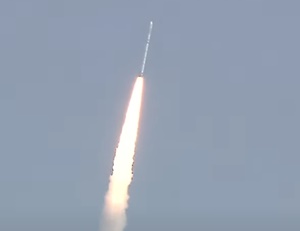
Isro's SSLV-D2 mission successfully places EOS-07 and 2 other satellites into orbit

Indian Space Research Organisation (Isro) on Friday successfully launched the second developmental flight of its Small Satellite Launch Vehicle (SSLV-D2) launching EOS-07, Janus-1 and AzaadiSAT-2 satellites into 450 km circular orbit, in its 15 minutes flight.
SSLV-D2, a 34 metre tall, 2 metre diameter vehicle having a lift-off mass of 120 tonne lift-off mass, lifted off from the first launch pad at SDSC SHAR, Sriharikota at 09:18 hours IST on 10 February with the three satellites and completed the mission in the scheduled 15 minutes.
EOS-07 is 156.3 kg satellite designed, developed and realised by ISRO. New experiments include mm-Wave Humidity Sounder and Spectrum Monitoring Payload. Janus-1, a 10.2 kg satellite belongs to ANTARIS, USA. A 8.7 kg satellite AzaadiSAT-2 is a combined effort of about 750 girl students across India guided by Space Kidz India, Chennai.
SSLV caters to the launch of up to 500 kg satellites to Low Earth Orbits on ‘launch-on-demand’ basis. It provides low-cost access to Space, offers low turn-around time and flexibility in accommodating multiple satellites, and demands minimal launch infrastructure. It is configured with three solid propulsion stages and a velocity terminal module.
SSLV is the new small satellite launch vehicle developed by Isro to cater to the launch of small satellites up to 500 kg to Low Earth Orbits on ‘launch-on-demand’ basis. It is configured with three solid stages 87 tonne, 7.7 ttonne and 4.5 tonne, respectively. SSLV is a 34 metre tall, 2 metre diameter vehicle having a lift-off mass of 120 tonnes. A liquid propulsion-based Velocity Trimming Module (VTM) achieves desired velocity for the insertion of the satellites into the intended orbit. SSLV is capable of launching mini, micro, or nanosatellites (10 to 500 kg mass) to a 500 km orbit. It provides low-cost access to Space, offers low turn-around time, facilitates flexibility in accommodating multiple satellites and demands minimal launch infrastructure.
In its first developmental flight on 7 August 2022, SSLV-D1 had marginally missed to place the satellites. SSLV-D2 implemented the recommendations made by the expert committee that analysed the shortcomings of SSLV-D1 flight.With today’s successful launch Isro has got a new launch vehicle, which aims at commercialising the small satellite launches through industry on demand basis. Isro looks forward for catering to the increasing global need of launching smaller satellites into space. Source: https://www.domain-b.com/

Saturday, 10 July 2021

Indian-origin aeronautical engineer Shirisha Bandla set to fly into space on Virgin Galactic spacecraft


JUL 10, 2021 Sirisha Bandla, a 34-year-old aeronautical engineer, is set to become the third Indian-origin woman to head to space when she flies as part of Virgin Galactic's first fully crewed flight test on Sunday. Bandla, who was born in Guntur district in Andhra Pradesh and brought up in Houston, Texas, will join Sir Richard Branson, the company''s billionaire founder, and five others on board Virgin Galactic's SpaceShipTwo Unity to make a journey to the edge of space from New Mexico. "I am so incredibly honoured to be a part of the amazing crew of #Unity22, and to be a part of a company whose mission is to make space available to all," she tweeted. Bandla will be astronaut no 004 and her flight role will be Researcher Experience, according to her profile on Virgin Galactic. She will become the third Indian-origin woman to fly into space after Kalpana Chawla and Sunita Williams. "When I first heard that I was getting this opportunity, it was just. I think that that probably captured it very well, I was speechless. This is an incredible opportunity to get people from different backgrounds, different geographies and different communities into space," she said in a video posted on Virgin Galactic Twitter on July 6. Bandla, a Purdue University alumna, will be evaluating the human-tended research experience, using an experiment from the University of Florida that requires several handheld fixation tubes that will be activated at various points in the flight profile, a statement on the Galactic website said. Bandla started in her role as the Vice President of Government Affairs and Research Operations at Virgin Galactic in January 2021, the university said in a statement. Bandla grew up in Houston, near NASA's Johnson Space Center, and always wanted to become an astronaut. But poor eyesight meant she could not meet the requirements to become a pilot or an astronaut, derailing her high-school plan to go the Air Force-to-NASA route, she said in the statement. "I've had fond memories of my time at Purdue," Bandla said in 2021, "being part of a group of passionate individuals... Purdue built a strong foundation of technical and programmatic principles we all carried into our successful careers. The flight window for the next rocket-powered test flight of its SpaceShipTwo Unity opens July 11, pending weather and technical checks, Galactic said in a statement. The "Unity 22" mission will be the twenty-second flight test for VSS Unity and the company's fourth crewed spaceflight. It will also be the first to carry a full crew of two pilots and four mission specialists in the cabin, including the company's founder, Sir Branson, who will be testing the private astronaut experience, it said. "I've always been a dreamer. My mum taught me to never give up and to reach for the stars. On July 11, it's time to turn that dream into a reality aboard the next @VirginGalatic spaceflight," Branson tweeted following the announcement on July 2. Building on the success of the company's most recent spaceflight in May, Unity 22 will focus on cabin and customer experience objectives.
Copyright © Jammu Links News Source: Jammu Links News

Thursday, 11 March 2021

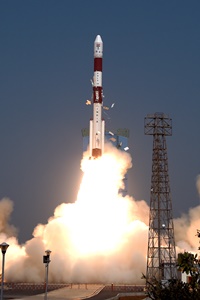
PSLV-C51 successfully launches Amazonia-1 and 18 other satellites

  • Indian Space Research Organisation (Isro) today successfully launched Amazonia-1, a Brazilian satellite for earth observation, and 18 other small satellites, in what is termed as the state-run space agency’s first dedicated commercial mission.
  • Isro’s workhorse Polar Satellite Launch Vehicle (PSLV C-51 lifted off from the first launch pad of Satish Dhawan Space Centre SHAR, Sriharikota, as planned, at 10:24 hours (IST). After a flight of about 17 minutes 23 seconds, the vehicle injected Amazonia-1 into its intended orbit and in the succeeding 1 hour 38 minutes, all the 18 co-passenger satellites successfully separated from the PSLV in a predetermined sequence.
  • Amazonia-1 is the optical earth observation satellite of Brazilian National Institute for Space Research (INPE). This satellite would further strengthen the existing structure by providing remote sensing data to users for monitoring deforestation in the Amazon region and analysis of diversified agriculture across the Brazilian territory.
  • The 18 co-passenger satellites onboard PSLV-C51 included four from IN-SPACe and fourteen from for New Space India Limited (NSIL), both companies under the Department of Space. Out of the four satellites from IN-SPACe, three were UNITYsats designed and built as a joint development by Jeppiaar Institute of Technology, Sriperumbudur (JITsat), G H Raisoni College of Engineering, Nagpur (GHRCEsat) and Sri Shakti Institute of Engineering and Technology, Coimbatore (Sri Shakthi Sat) and one Satish Dhawan Sat (SDSAT) from Space Kidz India. The fourteen satellites from NSIL carried were the commercial satellites from India (1) and USA (13).
  • PSLV-C51 is the 53rd flight of PSLV and third flight of PSLV in 'DL' configuration (with 2 strap-on motors). This was the 78th launch vehicle mission from SDSC SHAR, Sriharikota.With today’s launch, the total number of customer satellites from foreign countries placed in orbit by PSLV adds up to 342 satellites from 34 countries. Source: https://www.domain-b.com

Sunday, 28 February 2021

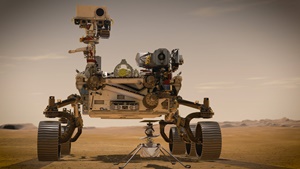
Nasa's Mars Perseverance rover safely lands on the Red Planet

  • Nasa’s Mars 2020 Perseverance mission, the agency’s fifth rover to land on the Red Planet, touched down in Jezero Crater at around 3:55 pm EST (12:55 pm PST) on Thursday (18 February 2021), engineers at Nasa’s Jet Propulsion Laboratory in Southern California, where the mission is managed, have confirmed.
  • The largest, most advanced rover NASA has sent to another world touched down on Mars, after a 203-day journey traversing 472 million kilometres (293 million miles).
  • Packed with groundbreaking technology, the Mars 2020 mission launched on 30 July 2020, from Cape Canaveral Space Force Station in Florida, the Perseverance rover mission marks an ambitious first step in the effort to collect Mars samples and return them to Earth.
  • “This landing is one of those pivotal moments for Nasa, the United States, and space exploration globally – when we know we are on the cusp of discovery and sharpening our pencils, so to speak, to rewrite the textbooks,” said acting Nasa Administrator Steve Jurczyk. “The Mars 2020 Perseverance mission embodies our nation’s spirit of persevering even in the most challenging of situations, inspiring, and advancing science and exploration. The mission itself personifies the human ideal of persevering toward the future and will help us prepare for human exploration of the Red Planet.”
  • About the size of a car, the 2,263-pound (1,026-kilogram) robotic geologist and astrobiologist will undergo several weeks of testing before it begins its two-year science investigation of Mars’ Jezero Crater. While the rover will investigate the rock and sediment of Jezero’s ancient lakebed and river delta to determine the region’s geology and past climate, the sample that is being planned to be brought back to earth by NASA and European Space Agency, will allow scientists to search for definitive signs of past life using instruments too large and complex to send to the Red Planet.
  • “Because of today’s exciting events, the first pristine samples from carefully documented locations on another planet are another step closer to being returned to Earth,” said Thomas Zurbuchen, associate administrator for science at NASA. “Perseverance is the first step in bringing back rock and regolith from Mars. We don’t know what these pristine samples from Mars will tell us. But what they could tell us is monumental – including that life might have once existed beyond Earth.”
  • The spacecraft carries a new suite of scientific instruments to build on the discoveries of Nasa’s Curiosity rover, which has found that parts of Mars could have supported microbial life billions of years ago.
  • Some 45 kilometers (28 miles) wide, Jezero Crater sits on the western edge of Isidis Planitia, a giant impact basin just north of the Martian equator. Scientists have determined that 3.5 billion years ago the crater had its own river delta and was filled with water.
  • The power system that provides electricity and heat for Perseverance through its exploration of Jezero Crater is a Multi-Mission Radioisotope Thermoelectric Generator, or MMRTG, developed bt the US Department of Energy (DOE) for civil space applications.
  • The Planetary Instrument for X-ray Lithochemistry (PIXL) and the Scanning Habitable Environments with Raman & Luminescence for Organics & Chemicals (SHERLOC) instruments, located on a turret at the end of the rover’s robotic arm, will work together to collect data on Mars’ geology close-up.
  • The rover chassis is home to three science instruments, as well. The Radar Imager for Mars’ Subsurface Experiment (RIMFAX) is the first ground-penetrating radar on the surface of Mars and will be used to determine how different layers of the Martian surface formed over time. The data could help pave the way for future sensors that hunt for subsurface water ice deposits.
  • “Landing on Mars is always an incredibly difficult task and we are proud to continue building on our past success,” said JPL Director Michael Watkins. “But, while Perseverance advances that success, this rover is also blazing its own path and daring new challenges in the surface mission. We built the rover not just to land but to find and collect the best scientific samples for return to Earth, and its incredibly complex sampling system and autonomy not only enable that mission, they set the stage for future robotic and crewed missions.”
  • The Mars Entry, Descent, and Landing Instrumentation 2 (MEDLI2) sensor suite collected data about Mars’ atmosphere during entry, and the Terrain-Relative Navigation system autonomously guided the spacecraft during final descent. The data from both are expected to help future human missions land on other worlds more safely and with larger payloads.
  • Project engineers and scientists will now put Perseverance through its paces, testing every instrument, subsystem, and subroutine over the next month or two. Only then will they deploy the helicopter to the surface for the flight test phase. If successful, Ingenuity could add an aerial dimension to exploration of the Red Planet in which such helicopters serve as a scouts or make deliveries for future astronauts away from their base.Once Ingenuity’s test flights are complete, the rover’s search for evidence of ancient microbial life will begin in earnest, says a Nasa release. Source: https://www.domain-b.com

Tuesday, 15 December 2020

India to become manufacturing hub of space assets: PM Modi


Prime Minister Narendra Modi on Monday interacted with key industries, startups and academia from the space sector through video conferencing to encourage their participation in space activities. He also expressed hope that the country would soon become a manufacturing hub of space assets.

The Union Cabinet led by the Prime Minister Modi took the decision in June this year to open up the space sector and enable the participation of the Indian private sector in the entire gamut of space activities. With the creation of Indian National Space Promotion and Authorisation Centre (IN-SPACe), the government believes the reforms will provide a level playing field for private companies and start-ups.

Subsequently, several ventures have submitted proposals with IN-SPACe under the Department of Space. The proposals pertain to a vast range of activities including satellite constellation, small satellite launch vehicles, ground station, geospatial services, propulsion systems and application products.

Modi said that the decision to unlock India's potential in the space sector has heralded a new age of public-private partnership in this sector. He assured the participants of complete and wholehearted support of the government in this endeavour. He noted that the professionalism and transparency in policies, as well as the decision-making process of the government, will prove beneficial for the companies joining the space sector.

Taking note of the plans of companies to make rockets and satellites, Modi remarked that this marks a big change that will further strengthen India's foray into the space sector. He said that private investment in the sector will lead to the creation of hi-tech jobs, which will provide a host of opportunities to the talent pool in IITs/NITs and other technical institutions. He said that it is his firm belief that just like Indian talent has been able to attain worldwide fame in the IT sector, it will be able to do so in the space sector as well.

Underlining that the reforms in the space sector are not limited to ensuring ease of doing business, he said that necessary mechanisms have also been put in place to ensure help for the participants at each stage, including making available testing facilities and launchpads. He added that through these reforms, the endeavour is not only to ensure that India becomes a competitive space market, but also to ensure the benefits of the space programme reach out to the poorest.

Modi also underlined the significance of the space sector in communication and navigation. He assured the participants that they will be co-passengers with ISRO in this age of space research and expressed hope that the country would soon become the manufacturing hub of space assets. Source: https://southasiamonitor.org/

Tuesday, 8 December 2020

Rare ‘Halloween Blue Moon’ sighting in country


Halloween has been celebrating tonight, the last night of October, in the western countries including United States, Australia. Now, the ‘Blue Moon’ is adding extra joy to this festival. A rare Blue Moon can be seen in the sky of the country on Saturday night.

The full moon was seen since Friday afternoon. Even today the sky is clear. Now, the rare cosmic scene ‘Blue Moon’ can be seen – not only in Bangladesh but from different parts of the world.

According to Irish astronomers, for the first time since 1974, Halloween and the full moon will appear together in Ireland and the United Kingdom. This is the second full moon of this month. The full moon usually occurs twice a month, but the second is called the ‘Blue Moon’.

The first full moon appeared on 1 October night and now the second full moon has been appearing on 31 October night. 

Though its’ name is blue moon, it is not completely blue, however, the moon looks brighter and bigger than usual. After 8:45 pm tonight that brightness will begin to diminish.Experts say that the Indonesian volcano erupted in Krakatoa in 1883. Plenty of black ash accumulated in the air. At that time the sky turned black. Through this, the light of the moon fell looked blue. From there, the idea of ‘Blue Moon’ is believed to have originated. Source: https://www.daily-bangladesh.com/

Tuesday, 21 July 2020

Incredible! See 5 planets in naked eyes tomorrow

Five planets can be seen in the sky. Photo: Collected.

The universe is a great mystery. Experts immersed in continuous research to unravel its various mysteries. The world sees all the wonderful things that have happened in the universe at different times through the telescope or with the naked eye. This time on Sunday the world will be able to see a wonder. On that day five planets will be seen in the sky. And everyone can see it with the naked eye.

It is claimed that Mercury, Venus, Mars, Jupiter, and Saturn will be seen with the moon on Sunday. These can be seen with the naked eye without any telescope. You have to wake up a little early to see this wonder.

Researchers say that to see the five planets with the naked eye, one has to look at the sky at least one hour before sunrise. Then this cosmic wonder will be seen.

If you miss the scene this time around, you'll have to wait until June 2022 to see the five planets together again.

Astronomer Jeffrey Hunt told CNET that Mercury, Mars, Saturn, and Jupiter will be seen as bright stars just hours before sunrise. Mercury will be seen in the north-northwest of the sky, Mars will be seen in the south-east, and Jupiter and Saturn will be seen in the south-west. Source: https://www.daily-bangladesh.com

Sunday, 12 July 2020

Nasa's Curiosity rover captures highest-resolution Martian panorama yet

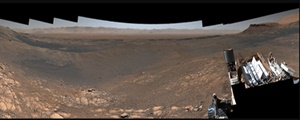
Nasa's Curiosity rover has captured its highest-resolution panorama yet of the Martian surface. Composed of more than 1,000 images taken during the 2019 Thanksgiving holiday and carefully assembled over the ensuing months, the composite contains 1.8 billion pixels of Martian landscape. 
  • The rover's Mast Camera, or Mastcam, used its telephoto lens to produce the panorama; meanwhile, it relied on its medium-angle lens to produce a lower-resolution, nearly 650-million-pixel panorama that includes the rover's deck and robotic arm, says a Nasa release.
  • Curiosity also captured a 650-million-pixel panorama that features the rover itself.
  • Both panoramas showcase "Glen Torridon," a region on the side of Mount Sharp that Curiosity is exploring. They were taken between 24 November and 1 December, when the mission team was out for the Thanksgiving holiday. Sitting still with few tasks to do while awaiting the team to return and provide its next commands, the rover had a rare chance to image its surroundings from the same vantage point several days in a row. 
  • It required more than 6 1/2 hours over the four days for Curiosity to capture the individual shots. Mastcam operators programmed the complex task list, which included pointing the rover's mast and making sure the images were in focus. To ensure consistent lighting, they confined imaging to between noon and 2 p.m. local Mars time each day.
  • "While many on our team were at home enjoying turkey, Curiosity produced this feast for the eyes," said Ashwin Vasavada, Curiosity's project scientist at NASA's Jet Propulsion Laboratory, which leads the Curiosity rover mission. "This is the first time during the mission we've dedicated our operations to a stereo 360-degree panorama." 
  • In 2013, Curiosity produced a 1.3-billion-pixel panorama using both Mastcam cameras; its black-and-white Navigation Cameras, or Navcams, provided images of the rover itself. Imaging specialists carefully assemble Mars panoramas by creating mosaics composed of individual pictures and blending their edges to create a seamless look.
  • Malin Space Science Systems in San Diego built and operates Curiosity's Mastcam. JPL, a division of Caltech in Pasadena, manages the project for NASA's Science Mission Directorate in Washington and built the Navigation Cameras and the rover.
  • Meanwhile, an international team of astrobiologists analysing Martian data sent by Curiosity, believe that the organic molecules discovered by Curiosity rover could be evidence of life on Mars.
  • In a paper published in the journal Astrobiology, the team argues that the presence of “thiophenes,” which are special compounds found in coal, crude oil and white truffles back on Earth, could be a sign of ancient life on the Red Planet.
  • “We identified several biological pathways for thiophenes that seem more likely than chemical ones, but we still need proof,” Washington State University astrobiologist and lead author Dirk Schulze-Makuch said in a statement.
  • The team, however, isn’t jumping to any conclusions just yet.
  • “If you find thiophenes on Earth, then you would think they are biological, but on Mars, of course, the bar to prove that has to be quite a bit higher,” Shulze-Makuch added.
  • While thiophenes are made up of two bio-essential elements, carbon and sulfur, it’s still very possible they could’ve been created during meteor impacts that heat sulfates to high temperatures — a possible explanation the researchers are also considering. 
  • If the compounds were indeed a sign of life, they could’ve been the result of bacteria some three billion years ago breaking down sulfates — or alternatively could have been broken down by the bacteria.
  • But, again, it’s far too early to draw conclusions.
  • The Curiosity rover analyzes compounds by breaking them down into fragments. The upcoming European Space Agency’s Rosalind Franklin rover, however, could fill in the gaps with its Mars Organic Molecule Analyzer (MOMA), which doesn’t use the same destructive technique as Curiosity. Source: https://www.domain-b.com

Glimpse of planets around a multiple star system

  • Astronomers have discovered three proto-planets orbiting around GG Tau A, a multiple-star system, located about 489 light years away from the Earth1. The star system has a massive dust ring surrounded by a shallow disk.
  • The researchers say the proto-planets would eventually form planets and this discovery may shed new light on how planets form around multiple star systems in the universe.
  • Scientists have, so far, detected numerous planets around single stars such as the Sun. However, little is known about planets around multiple-star systems.
  • To better understand such systems, the scientists, including Liton Majumdar, an astronomer from the National Institute of Science Education and Research in Odisha, India, scanned the Taurus star-forming region using an array of radio telescopes parched in the Atacama Desert of Chile. 
  • They have detected that one of the proto-planets, lying at almost 10 times the Sun-Neptune distance from the star system, is sucking in gas and dust from a surrounding disk. This has created a ‘hot spot’ that is much warmer than its surroundings and is rich in carbon monoxide gas.
  • They have also detected a spiral pattern, which is brightest at the hot-spot location, just outside the dust ring. One of the proto-planets probably produced this pattern.
  • The absence of a clear gap in gas or dust at the planet location means that its mass is significantly lower than that of Jupiter, but close to that of Neptune. This suggests that planets with a mass similar to Neptune may form in dense circumbinary disks orbiting binary stars, says Majumdar.
  • Reference: 1. Phoung, N. T. et al. Planet-induced spirals in the circumbinary disk of GG Tauri A. Astron. Astrophys. 635, L9 (2020) Source: https://www.natureasia.com/

Thursday, 8 August 2019

Orion's hotel in orbit may become operational in 4 years

If even the most exclusive hotels on earth are too mundane and humdrum for you, there’s an option coming – in outer space. For a couple million dollars, you might be able to check that off your bucket list in the next four years.
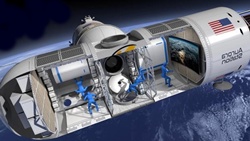
Orion Span, a Houston-based space tech startup, has announced plans to launch the first-ever luxury space hotel into earth's orbit by 2021. The company says the so-called Aurora Station will be ready to accommodate visitors the following year.
The first-ever luxury space hotel was introduced today during the Space 2.0 Summit in San Jose, California last week. Named after the light phenomenon that illuminates the earth's polar skies, Aurora Station is being developed by Orion Span and the company's team of space industry veterans, who according to a company release have over 140 years of human space experience.
The price of a ticket for a 12-day stay will be $9.5 million per person, which comes to $791,666 per night.
Orion Span has yet to contract with a launch provider to put future visitors - and for that matter the station itself - into orbit. In the past, private citizens have been sent to the International Space Station on $20 million to $40 million round-trip tickets, but according to Frank Bunger, the company's founder and chief executive, Orion Span's trips are less expensive because of declining launch prices. Prospective clients can put down an $80,000 refundable deposit right now for future stays.
The exclusive hotel will host six people at a time – including two crew members. Space travellers will enjoy a completely authentic, once-in-a-lifetime astronaut experience with extraordinary adventure during their 12-day journey, the company says.
"Upon launch, Aurora Station goes into service immediately, bringing travellers into space quicker and at a lower price point than ever seen before," Bunger said in a statement. "Our goal is to make space accessible to all, by continuing to drive greater value at a lower cost."
The hotel, which is slated for launch into low Earth orbit (LEO) at around 200 miles from the earth's surface, will be about the size of the cabin of a large private jet. Company representatives say it will be roughly 43 ½ feet long by 14 feet wide, with a pressurized volume of 5,650 cubic feet. By comparison, the ISS is much larger, at 357 feet long, an internal pressurized volume of 32,33 cubic feet, and soars 250 miles above Earth.
"Orion Span has additionally taken what was historically a 24-month training regimen to prepare travellers to visit a space station and streamlined it to three months, at a fraction of the cost,” Bunger adds. “Our goal is to make space accessible to all, by continuing to drive greater value at lower cost."
Completed, Aurora Station will be fully modular and host six people at a time with private, two-person suites. Four of those people will be guests and two will be crewmembers who are most likely former astronauts, the company says.
With the help of engineers who have worked on the ISS, the hotel is currently in construction in Housten, while Orion Span develops software for it in the Bay Area.
Aboard the station, travellers will roam freely in zero gravity, while orbiting the planet every 90 minutes. They can take in the sights, which will include about 16 sunrises and sunsets every 24 hours, through the station's many windows and get a virtual reality experience on the ship's "holodeck". Guests will also get the chance to participate in research experiments like growing edible plants - which can be taken home as souvenirs - and livestream with people back home via high-speed wireless internet.
"We're not selling a hey-let's-go-to-the-beach equivalent in space," Bunger tells Bloomberg. "We're selling the experience of being an astronaut."
The Orion Span Astronaut Certification (OSAC) will include a condensed version of online and in-person training at the company's facility in Houston, with final certification aboard the Aurora Station.
Upon returning to earth, guests "will be treated to a hero's welcome home", the company says.
Orion Span will likely cater to private space tourists as well as government space agencies, Bunger says.
A serial entrepreneur and former software engineer, Bunger has worked on other startups in the past, in addition to the seven-person Orion Span team.
Orion Span isn't the first to look to the skies for entrepreneurial opportunity. Plans were recently announced for a four-room hotel addition to the ISS that would cost $40 million per person. The Texas-based Axiom Space has plans to take tourists to the ISS by next year and launch a commercial space station by 2024.
Virgin Galactic, which said it would start sub-orbital space flights in 2009, is planning to charge $250,000 for future extraterrestrial trips.
If Aurora Station is successful, the company wants to launch identical modules and build a private space station. Long-term, the vision is to sell space.

"We will later sell dedicated modules as the world's first condominiums in space," Bunger adds. "Future Aurora owners can live in, visit, or sublease their space condo."Source: https://www.domain-b.com/

Saturday, 28 April 2018

ESA releases richest star map ever of Milky Way

IANS, Berlin: The European Space Agency (ESA) has released the richest star catalogue to date, revealing previously unseen details of the Milky Way.

The new data released on Wednesday covers the period between July 25, 2014 and May 23, 2016, pins down the positions of nearly 1.7 billion stars, and with a much greater precision, Xinhua news agency reported.

“For some of the brightest stars in the survey, the level of precision equates to Earth-bound observers being able to spot a Euro coin lying on the surface of the Moon,” according to the ESA.

The latest data release is the second of its kind produced by the ESA’s Gaia mission, whose goal is to chart a three-dimensional map of the home galaxy, revealing in the process its composition, formation and evolution.

The first data release was published in 2016, containing distances and motions of only two million stars.

The much awaited second release was expected to usher in a multitude of astronomical discoveries.

An initial examination performed by the data consortium to validate the quality of the catalogue has already unveiled some promising surprises, including new insights on the evolution of stars, according to the ESA.

“Scientists will be busy with this data for many years, and we are ready to be surprised by the avalanche of discoveries that will unlock the secrets of our Galaxy,” Fred Jansen, Gaia mission manager was quoted by the ESA as saying. Source: http://www.navhindtimes.in/

Thursday, 17 November 2016

Mars surface too dry to be habitable, say scientists

London: Mars is a primary target in the search for life outside Earth, and liquid water is the most important pre-requisite for life. But a team of international researchers has found that Mars is incredibly dry, and has been that way for millions of years.

"Evidence shows that more than three billion years ago Mars was wet and habitable. However, this latest research reaffirms just how dry the environment is today," said Christian Schroder, Lecturer at the University of Stirling in Britain

"For life to exist in the areas we investigated, it would need to find pockets far beneath the surface, located away from the dryness and radiation present on the ground," Schroder, who is also science team collaborator for NASA's Mars Exploration Rover Opportunity mission, noted.

The discovery, published in the journal Nature Communications, provides vital insight into the planet's current environment and shows how difficult it would be for life to exist on Mars today.

Using data from the Opportunity mission, the scientists examined a cluster of meteorites at Meridiani Planum -- a plain just south of the planet's equator and at a similar latitude to Gale crater.

The researchers calculated a chemical weathering rate for Mars, in this case how long it takes for rust to form from the metallic iron present in meteorites.

This chemical weathering process depends on the presence of water. It takes at least 10 and possibly up to 10,000 times longer on Mars to reach the same levels of rust formation than in the driest deserts on Earth and points to the present-day extreme aridity that has persisted on Mars for millions of years, the study said.

A study published last year, which used data from the Curiosity Rover investigating Gale crater on Mars, suggested that very salty liquid water might be able to condense in the top layers of Martian soil overnight.

"But, as our data show, this moisture is much less than the moisture present even in the driest places on Earth," Schroder explained. Source: ummid.com

Wednesday, 27 April 2016

Nasa experimenting with next-generation X-planes

The National Aeronautics and Space Administration (Nasa) is in the process of finalising preliminary designs of its new concept, the X-plane, and has test-flown an array of new experimental aircraft known as X-planes that would demonstrate advanced technologies that could push back the frontiers of aviation. The first in the series, the Quiet Supersonic Technology, or QueSST, concept is in the preliminary design phase and on its way to being one of Nasa's first X-planes, says a release. Under the 'New Aviation Horizons' programme, announced as part of the US budget for the fiscal year that begins from 1 October this year, Nasa will design, build and fly the series of X-planes during the next 10 years as the US space agency accelerates the adoption of advanced green aviation technologies by industry, the release stated. The first of the demonstration flight achieved Mach 1 speed - 750 miles an hour – but without breaking the sound barrier. Then they built a small plane, the X-1, to try to break the sound barrier. The demonstration was carried out at the high desert of California. The names of the test pilots are also under wraps. Nasa said, over the past seven decades, some the nation's best minds in aviation have been designing, building and flying a series of experimental airplanes to test the latest fanciful and practical ideas related to flight. These include short wings, long wings, delta-shaped wings, forward swept wings, scissor wings, big tails. no tails, high speed. low speed, jet propulsion, rocket propulsion and even nuclear propulsion – although that technology was never actually flown, Nasa stated. The manufacturing of these X-planes involver several companies and the planes were operated by a different mix of government organisations for a myriad purposes. Together they are known as X-planes – or X-vehicles, since some were missiles or spacecraft – and the very mention of them prompts a warm feeling and a touch of nostalgia among aviation enthusiasts worldwide, Nasa said. ''They certainly are all interesting in their own way. Each one of them has a unique place in aviation that helps them make their mark in history,'' said Bill Barry, Nasa's chief historian. ''And they are really cool.'' The X-plane experiments will showcase how airliners can burn half the fuel and generate 75 per cent less pollution during each flight as compared to now, while also being much quieter than today's jets – perhaps even when flying supersonic. ''If we can build some of these X-planes and demonstrate some of these technologies, we expect that will make it much easier and faster for US industry to pick them up and roll them out into the marketplace'' said Ed Waggoner, Nasa's Integrated Aviation Systems Programme director. In fact, NASA has gone back to the days of its predecessor organisation, the National Advisory Committee for Aeronautics (NACA), and the very first X-plane, fittingly called the X-1, a project the NACA worked on with the then newly formed US Air Force. Built by Bell Aircraft, the X-1 was the first plane to fly faster than the speed of sound, thus breaking the ''sound barrier,'' which, Nasa said, is ''a popular but fundamentally misleading term that spoke more to the romantic notion of the challenges of high speed flight than an insurmountable physical wall in the sky.'' The X-1 also marked the first in what became a long line of experimental aircraft programmes managed by the NACA (and later NASA), the air force, the navy, and other government agencies. The X-52 was skipped altogether because no one wanted to confuse that aircraft with the B-52 bomber. Perhaps of all the X-planes NASA has been associated with, none was more cutting edge and became more famous – rivaling even the X-1 – than the X-15 rocket plane. ''The X-1 was certainly the most historic for being the first and for what it did for supersonic flight. But the X-15 was probably the most productive model of an X-plane,'' Barry said. Flown 199 times between 1959 and 1968, the winged X-15 reached beyond the edge of space at hypersonic speeds, trailblazing design concepts and operational procedures that directly contributed to the development of the Mercury, Gemini, and Apollo piloted spaceflight programs, as well as the space shuttle. Another component of the X-15 success story beyond its contributions to high-speed aviation, Barry explained, is that it was a great example of collaboration between NASA, the rival military services of the Air Force and the Navy. ''This kind of major aeronautical research, which the X-15 represented, often is best done when several organizations contribute to a common goal,'' Barry said. ''We're already seeing that as we prepare to fly this next wave of X-planes.'' Some had multiple models using the same number. And still more experimental vehicles were designed, built and flown but were never given X-numbers. And some X-vehicles received numbers but were never built. Moreover, some X-planes weren't experimental research planes at all, but rather prototypes of production aircraft or spacecraft, further muddying the waters over what is truly considered an X-plane and what isn't, Barry said. The air force has a current list of 56 X-planes that have been assigned numbers by the Air Force, although actual numbers could be less. Source: http://www.domain-b.com/

Tuesday, 18 August 2015

NASA astronauts eat space-grown food

NASA Logo (Meatball) on Goddard B29
Monday on the International Space Station, a batch of romaine lettuce became the first food grown and consumed in space. The leaves were harvested from NASA's experimental plant growth system called Veg-01, a microgravity environment in which plants grow from seed "pillows" under primarily red and blue LED lights. In 2014, an astronaut on NASA Expedition 39 grew and harvested the first plants from Veg-01 and then sent the plants back to Earth for food safety analysis. This time around, the crew members of Expedition 44, including astronaut Scott Kelly, who is four months into a yearlong space mission, got to enjoy the bounty. Kelly activated the seed pillows on July 8, and then tended to the plants for 33 days before harvesting. While this isn't NASA's first experiment designed to test the growth of plants in controlled-environment agriculture settings (scientists previously designed a habitation to grow plants on the moon), this is the first and only experiment to evaluate the effect of plant life on humans in space. Source: ArticleImage: flickr.com

Wednesday, 3 December 2014

Scientists hunt for universe's very first rays of light

Scientists hunt for universe's very first rays of light

WASHINGTON (VOR)— It's a strange thought that some of the rays we bask in have taken millions of years to arrive.
More, that this light has taken a circuitous route, being bent by forces such as gravity. Now, scientists have begun to unravel the path of light, and in doing so may be able to develop a clearer map of the universe. To do so, scientists are attempting to track down a specific type of light which they describes as a primordial B mode. This light wave is believed to have been released less than a second after the very universe was formed. One catch to the search is that scientists don't quite know how powerful the signal may be, or in fact what it might look like. Nonetheless, vast microwave telescopes are being set up at the South Pole because of its arid climate to seek deep into space in an attempt to identify the level of polarization as well as the direction of the light wave. For insight, VOR’s Andrew Hiller spoke with Olivier Doré, a member of the Planck science team at NASA's Jet Propulsion Laboratory in Pasadena, Calif. Dore' speculates that some of that light may have already reached Earth. Though invisible to the naked eye, he says it may exist in the background of the spectrum. To explain, he conjures the analogy of television static picked up using an old fashioned antenna. He says that if you could look through the prism and see every wavelength of light... the distortion you receive or TV-like snow may be where these primordial b modes hide. But scientists aren't just interested in finding ancient light that's made its way to us. They want to trace it back to its origins and pick up other threads deep in space as a way of piecing together the tapestry of the universe. Dore' believes this discovery "…is really opening a new window into the physics of the universe. It's something really, really unique!" Source: Voice of Russia - US Edition

Saturday, 25 October 2014

Google celebrates Mangalyaan's 1 month in Mars orbit

Mars Orbiter Mission Over Mars
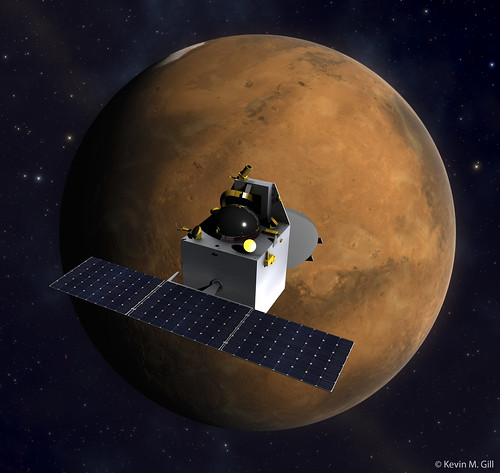
Google on Thursday night put out a unique doodle on its abode page for India, blotching Mangalyaan's one month in Mars orbit. The Mars Orbiter Mission (MOM), also called Mangalyaan is a spacecraft orbiting Mars since 24 September 2014. It was launched on 5 November 2013 by the Indian Space Research Organisation (ISRO) under the guidance of the Project Director Mylswamy Annadurai. The mission is a "technology demonstrator" project to develop the technologies for design, planning, management, and operations of an interplanetary mission. It carries five instruments that will help advance knowledge about Mars to achieve its secondary, scientific, objective. The Mars Orbiter Mission  probe lifted-off
from the First Launch Pad at Satish Dhawan Space Centre (Sriharikota Range SHAR), Andhra Pradesh, using a Polar Satellite Launch Vehicle (PSLV) rocket C25 at 09:08 UTC (14:38 IST) on 5 November 2013. The launch window was approximately 20 days long and started on 28 October 2013. The MOM probe spent about a month in geocentric, low-Earth orbit, where it made a series of seven altitude-raising orbital manoeuvres before trans-Mars injection on 30 November 2013 (UTC). After a 298-day transit to Mars, it was successfully inserted into Mars orbit on 24 September 2014. It is India's first interplanetary mission and ISRO has become the fourth space agency to reach Mars, after the Soviet space programNASA,and the European Space Agency. It is also the first nation to reach Mars orbit on its first attempt, and the first Asian nation to do so. The spacecraft is currently being monitored from the Spacecraft Control Centre at ISRO Telemetry, Tracking and Command Network (ISTRAC) in Bangalore with support from Indian Deep Space Network (IDSN) antennae at ByalaluCourtesy: http://en.wikipedia.org, Image: flickr.com

Saturday, 27 September 2014

Amitabh Bachchan Congralutates ISO on the success of Mangalyaan

Amitabh Bachchan posted message on his twitter account congratulating ISO scientist on the success of the Mars Mission 'Mangalyaan', Today. Today, the 'Mangalyaan' successfully placed in the orbit of Mars, this is the first attempt and India got success in this. Indian become first country in the world to accomplish the Mars Mission in first attempt and this is the big success for the Indian scientist at ISO. Amitabh Bachchan posted "T 1623 - #Mangalyaan ... Our scientists have achieved what others could not .. Badhai, Pyaar, Sneh, Abhinandan, aur Jai jai kaar !! MOM !!" on their account. Another post on the Amitabh Bachchan Twitter account says" T 1623 -#Mangalyaan , India's Mars mission .. Mars is Mangal, Tuesday .. and what timing and planning to have achieved it on a Tuesday !!!"
About Mars Mission: The Mars Orbiter Mission (MOM) also know as 'Mangalyaan' (Hindi for "Mars-craft"), is the project of the Indian Space Research Organisation (ISRO) to the Mars Planet. The 'Mangalyaan' was sent to Mars on 5 November 2013 by the Indian Space Research Organisation (ISRO). Today (24 September 2014 ) it is successfully placed into orbit of Mars. This success is important for India as India become first country in the world to place the spacecraft in first attempt to the Mars orbit. Through this mission India demonstrated the technological capability tot he world. This type of mission requires high level of technology and which requires design, planning, management, and operations. Source: Article

Monday, 31 March 2014

'Hairless' Neutron Stars

Credit: NASA's Marshall Space Flight Center, Illustration of the structure of a neutron star
These objects too can be described as “hairless” For astrophysicists neutron stars are extremely complex astronomical objects. Research conducted with the collaboration of SISSA and published in the journal Physical Review Letters demonstrates that in certain respects these stars can instead be described very simply and that they show similarities with black holes. In how many ways can one describe an object? Take an apple: by just looking at it we can easily estimate its weight, shape and colour but we are unable to describe it at any other level, for example, to evaluate thechemical composition of its flesh. Something similar also applies to astronomical objects: until today one of the challenges facing scientists was to describe neutron stars at the nuclear physics level. The matter these stars are made up of is in fact extremely complex, and several complicated equations of state have been proposed. However, to date there is no agreement as to which is the correct (or the best) one. A theoretical study conducted by SISSA (the International School for Advanced Studies of Trieste), in collaboration with Athens University, has demonstrated that neutron stars can also be described in relatively simple terms, by observing the structure of the space-time surrounding them. “Neutron stars are complex objects owing to the matter that composes them. We can picture them as enormous atomic nuclei with a radius of about ten kilometres”, explains Georgios Pappas, first author of the study carried out at SISSA. “A neutron star is what remains of the collapse of a massive star: the matter inside it is extremely dense and mostly consisting of neutrons”. “The nuclear physics required to understand the nature of the matter contained in these astronomical objects generally makes their description very complicated and difficult to formulate,” continues Pappas. “What we have demonstrated, by using numerical methods, is that there are properties that can provide a description of some aspects of neutron stars and the surrounding space-time in a simple manner, similar to the description used for black holes”. Black holes are truly unique objects: they have lost all matter and are only made up of space and time. Just like neutron stars they are the result of the collapse of a bigger star (in this case much bigger than the stars giving rise to neutron stars) and in the implosion all the matter has been swept away. “They are considered to be the most perfect objects in the Universe and the expression ‘hairless’ that was coined by John Archibald Wheeler to indicate their simplicity has become famous. According to our calculations even neutron stars can be depicted in a very similar manner”. Scientists use “multipole moments” as parameters to describe objects. The moments required to describe a black hole are two, mass and angular momentum (the speed at which it rotates around its axis). For neutron stars three moments are needed: mass, angular momentum and quadrupole moment, that is, a coefficient that describes the deformation of the object produced by its rotation. “Our calculations revealed two unexpected findings. First, we discovered that these three parameters are sufficient since higher levels moments are not independent and can be derived from the first three”, explains Pappas. “The second surprising finding is that the description based on these parameters is independent of the equation of equation of state, or rather: we don’t even need to know which is the equation of state”. In practice, we can have a description of a neutron star that is independent of the matter that forms it. “This has major implications”, concludes Pappas. “In fact, by using the data collected with astrophysical observations – for example, the radiation emitted by a neutron star, or information about objects gravitating around the star or other information – we can reconstruct the features of a neutron star”.Contacts and sources: Sissa Medialab, Effectively universal behavior of rotating neutron stars in general relativity makes them even simpler than their Newtonian counterparts Phys. Rev. Lett. George Pappas and Theocharis A. Apostolatos, http://journals.aps.org/prl/accepted/5507fYb3Ye211849920a70e877850e3cf8b5fbff7#abstract, The paper has just been published in the journal Physical Review Letters, where it also featured as an Editors’ Suggestion, among the most interesting papers of the latest issue. http://www.sissa.it/index.php/about/news/general/2905, Posted in: astronomy , Universe 'Source: Article

Friday, 21 March 2014

Big Bang: does 'extraordinary' discovery prove theory right?

A signal from the dawn of time could be the 'smoking gun' that confirms the Big Bang theory
SCIENTISTS have announced "extraordinary" new evidence that supports a 'Big Bang' theory for the origin of the universe. If it is verified, the discovery will prove the theory that the universe expanded incredibly rapidly in less than a trillionth of a second after it was formed. Max Tegmark, a cosmologist at MIT, told the New York Times: "If this stays true, it will go down as one of the greatest discoveries in the history of science." What has been discovered? Researchers at Harvard University believe they have found a "signal in the sky" that emerged during the first moments of ultra-rapid expansion just after the universe came into existence, the BBC reports. The scientists think they have observed gravitational waves, first postulated in 1916 by Albert Einstein as part of his General Theory of Relativity. Gravitation waves are essentially ripples in space-time that have been described as the "first tremors of the Big Bang", Science Daily explains. How was it discovered? Researchers have been peering into space with a telescope set up at the South Pole where the dry, thin air creates "ideal observing conditions". The telescope, known as Bicep2 – Background Imaging of Cosmic Extragalactic Polarization 2 – allowed scientists to analyse the polarisation of light left over from our universe's early moments. What is Big Bang Theory? Big Bang theory holds that the universe exploded from an infinitesimally small, dense space and expanded rapidly into what we see today 13.8 billion years later. Thirty years ago, an extra element was added to the theory called "inflation", which proposed that less than a trillionth of a second after the Big Bang, the universe went through a sudden period of explosive growth. Scientists now believe that they have seen a particular signal that relates to that moment. The Bicep2 results are the "smoking gun for inflation", Marc Kamionkowski, professor of physics and astronomy, said at a news conference. Why is inflation important? The results are particularly exciting for scientists because they may help to unite the four recognised fundamental forces of the nature (gravity, electromagnetism, and strong and weak nuclear forces) into a unified 'Theory of Everything'. The results will need to be examined closely, but already there is talk of the scientists involved being awarded with the Nobel prize. British scientist Dr Jo Dunkley, told the BBC: "I can't tell you how exciting this is. Inflation sounds like a crazy idea, but everything that is important, everything we see today – the galaxies, the stars, the planets – was imprinted at that moment, in less than a trillionth of a second. If this is confirmed, it's huge."  Source: Article