New York, (IANS) Carlos Alcaraz defeated Jannik Sinner, the game’s premier hard-court player, 6-2, 3-6, 6-1, 6-4, to claim his sixth major title and second at the US Open.
Thursday, 11 September 2025
US Open: Alcaraz beats Sinner to clinch men's singles title and world No. 1 crown
New York, (IANS) Carlos Alcaraz defeated Jannik Sinner, the game’s premier hard-court player, 6-2, 3-6, 6-1, 6-4, to claim his sixth major title and second at the US Open.
Monday, 14 July 2025
Wimbledon: Sinner claims maiden Championship with dominating win over Alcaraz
London, (IANS) Jannik Sinner claimed his maiden Wimbledon title on Sunday, defeating defending champion Carlos Alcaraz 4-6, 6-4, 6-4, 6-4 in a high-octane final to become the first Italian man to lift the singles trophy at The Championships
Tuesday, 21 January 2025
Game, set, debate: why do women only play 3 sets in tennis?
Tennis fans are once again filling Melbourne Park for the 2025 Australian Open, after setting an all-time attendance record in 2024.
The Australian Open is one of four annual Grand Slam events, alongside the French Open, Wimbledon and US Open, which bring together the world’s best men’s and women’s players.
These athletes strive to claim not just the championship trophy, but precious ranking points as well as huge pay cheques: this year’s Australian Open prize pool is $A96.5 million and winners of the men’s and women’s singles events will each take home $3.5 million.
Why though, are the lengths of the men’s (five sets) and women’s (three sets) matches different?
Debating the differences
There has been long-standing debate about the appropriate length of men’s and women’s tennis matches.
In Grand Slam events, men’s matches extend to five sets, while women’s matches remain best-of-three. In most other tournaments, men and women both play best-of-three sets.
This difference is often raised when assessing equal prize money at some events, with some arguing women should not be awarded equal prize money if they play shorter matches.
Women are paid equally at all the Grand Slam tournaments but not all lower-level events.
Luckily, tennis prize money isn’t based on an hourly wage system – that’s why women don’t get less for dominating their opponents in two sets.
But what if the women played best-of-five?
Women’s history with five-set tennis
Women competed in best-of-five matches more than 130 years ago.
The United States’ national championships from 1891 to 1901 featured five set matches for women. The New York Times described the 1891 clash between Mabel Cahill and Ellen Roosevelt as being: “fought to the end with wonderful tenacity”.
But these women’s matches were shortened to best of three sets in 1901 by the United States National Lawn Tennis Association Council – a body made up entirely of men.
The decision was made despite the demonstrated ability for women to play five set matches, and does seem to parallel similar examples of men deciding with no evidence that women are not suited for sport of a particular nature.
This mindset led to the nearly 50-year ban of women playing soccer from 1921 to 1970.
In athletics, women were banned from competing in the 800-metre race from 1928 until 1960, at least partially because the media seemed shocked that in the 1928 Olympic Games in Amsterdam, some women fell to the ground in exhaustion after sprinting for gold in the 800-metre event.
It took until 1967 before the first woman ran the Boston Marathon – and Kathrine Switzer had to do so covertly, battling men trying to push her off the course. But her efforts led to the inclusion of the women’s marathon to the Olympics in 1984.
Back to tennis.
In 1984, the Women’s Tennis Association final featured a best-of-five set format from 1984 to 1998, famously highlighted by the decider between Monica Seles and Gabriela Sabatini in 1990 at Madison Square Garden.
Then in 1994, the Australian Open briefly considered introducing best-of-five finals for women, which would have been the first Grand Slam to do so.
Supporters of the move believed it would provide a more complete test of skill and endurance, and offer a more compelling spectacle. However, the experiment did not go forward.
Women can push the limits of physiology
The preparation and recovery management of women in tennis has improved further from when the Australian Open proposed “the experiment” in 1994.
But it should have never been a question of whether the physiology of women could handle longer events.
In fact, evidence supports women might be built for it. From marathon records continuing to fall to women excelling in ultra-endurance events, the longer the event, the better they perform.
So maybe the stamina needed for a best-of-five sets is ideal for women.
Reframing the question: are best-of-five sets better?
While society debates whether women should play five sets, a better question may be: do five sets achieve the best outcome for all players and fans in the age of shorter format versions of sports?
During five-set matches, evidence shows aspects of performance can plateau in the middle stages – first serve velocity has a parabolic approach, meaning servers hold back during the middle sets.
This is likely the athlete conserving energy, often leading to a less dynamic contest in the middle stages in preparation for the “last set”, raising the question of whether men should actually only play best-of-three sets.
Tennis fans will likely continue to debate the value of those third and fourth sets from the perspective of attention span versus tradition.
What is undeniable is that men have the opportunity to showcase their mental strength and stamina in best-of-five matches.
Why aren’t all players given this opportunity?![]()
Sophia Nimphius, Professor of Human Performance, Edith Cowan University and Caitlin Fox-Harding, Senior Lecturer/Researcher, Edith Cowan University
This article is republished from The Conversation under a Creative Commons license. Read the original article.
Monday, 20 January 2025
Why the Australian Open’s online tennis coverage looks like a Wii sports game
The 2025 Australian Open (AO) broadcast may seem similar to previous years if you’re watching on the television. However, if you’re watching online via the official Australian Open TV YouTube channel you’ll encounter a distinctly different kind of coverage.
The channel’s “AO Animated” coverage looks more like a Wii Sports tennis match than a real one, with players’ physical forms replaced with virtual avatars.
Fans that have viewed the live streams are divided, with comments ranging from “This is the best kinda live” to “What the hell is this? Why can’t we watch normal? This is utterly ridiculous”.
So what’s the answer? Why can’t we watch normal?
How does it work?
The system that creates the AO Animated streams uses 12 cameras that track the silhouette of the players. This data is then fed into a system and stitched to 29 points on an animated character – the player’s graphical reproduction. The result is a live stream with a two-minute delay that includes commentary and sound from the court.
For those who have seen it, you’ll notice the system is far from perfect. There are glitches with the ball, racquets vanishing and reappearing, clothes changing or appearing to have holes, and fingers remaining straight when they should be gripping the racquet. As Tennis Australia’s director of innovation, Machar Reid, notes, “It’s not as seamless as it could be.”
Although AO Animated was introduced last year, it has only recently become a major talking point among tennis fans. Many learned about the animated live streams through an X post by tennis reporter Bastien Fachan, who points them out as a way for the Australian Open to sidestep limits placed by current media rights agreements.
Nine has paid A$425 million for a five year deal (until 2029) that allows the network the domestic linear and digital rights to the Australian Open and lead-in events, including the United Cup.
Internationally, the BeIN media group has the broadcast rights for 24 countries across the Middle East and North Africa, while ESPN has held the broadcast rights for the United States and Canada since 1984 (and will remain these rights until at least 2031).
Yet the AO has found a way to sidestep these exclusive media rights deals by using animated avatars on YouTube – a decision that raises several questions about the future of sports broadcasting and media rights deals.
Future media rights
As of when this article was published, the AO Animated video of Botic van de Zandschulp playing Alex de Minaur had more than 35,000 views. The most viewed match, with more than 160,000 views, was between Andrey Rublev and Joao Fonseca.
But these are paltry numbers compared to the 1.9 million Australians who tuned into Nine’s TV broadcast of the night session on day three (in which Botic van de Zandschulp played Alex de Minaur).
A closer look at the ratings also reveals it is overwhelmingly older Australians who are tuning in, with 838,000 viewers aged 25–54, compared to 414,000 aged 16–39. You might suspect younger Australian are streaming the tennis via Nine’s video-on-demand platform, but even here an older viewership dominates.
It’s possible many young people are turning to other platforms such as YouTube, which reportedly had almost 21 million active users in Australia in 2024 (almost 80% of the population). In this light, what looks like an effort by Tennis Australia to dodge media rights deals could also be viewed as an effort to reach new, younger audiences.
It seems Tennis Australia’s Machar Reid had this in mind. He told The Guardian the AO Animated videos were targeting the “community that engages with animated or virtual or gaming products”.
This strategy makes sense. Millions of young people are already hooked on YouTube’s huge selection of gaming content. For instance, last year videos related to the viral Roblox game Dress to Impress were viewed more than 4 billion times in the US alone, according to YouTube’s data.
Similarly, more than 645 million people in the United Kingdom watched videos related to the video game franchise EA Sports FC in 2024. This number was even greater in the Middle East and North Africa, at 950 million.
AO is not the first
The AO is not the first to live-stream sports matches in which players are animated. Last year, North America’s National Hockey League used player tracking technology to stream a “MultiVersus NHL Face-Off” game. The players of Colorado Avalanche and the Vegas Golden Knights were replaced with Warner Brothers characters including Batman, Bugs Bunny and the Scooby Doo gang.
The National Football League also recreated a simulation of a live game in which players from the Cincinnati Bengals and Dallas Cowboys were replaced by Simpson’s characters. The entire look and feel of the broadcast reflected The Simpsons.
These US-based examples, together with the recent AO Animated coverage, suggest animated simulations could play a larger role in future media rights deals – and could provide media rights holders unique marketing and collaboration opportunities.
In the future we may see an expansion of the AO Animated live streams. It’s possible the Mii-style characters could even be replaced with popular characters, similar to the examples above. Such a change would further enhance Tennis Australia’s ability to collaborate with its media rights holders, both domestically and internationally.![]()
Marc C-Scott, Associate Professor of Screen Media | Deputy Associate Dean of Learning & Teaching, Victoria University
This article is republished from The Conversation under a Creative Commons license. Read the original article.
Monday, 9 September 2024
US Open Tennis: Jannik Sinner wins second Grand Slam victory

Tuesday, 3 September 2024
US Open: Swiatek sets QF clash with Pegula after win in milestone match
Monday, 2 September 2024
US Open: Popyrin stuns Djokovic in third round, forces earliest exit since 2006
Friday, 30 August 2024
US open: Alcaraz suffers shock loss to Botic van de Zandschulp in Rd-2
US Open: Muchova ends two-time champ Osaka's campaign in second round
Thursday, 30 May 2024
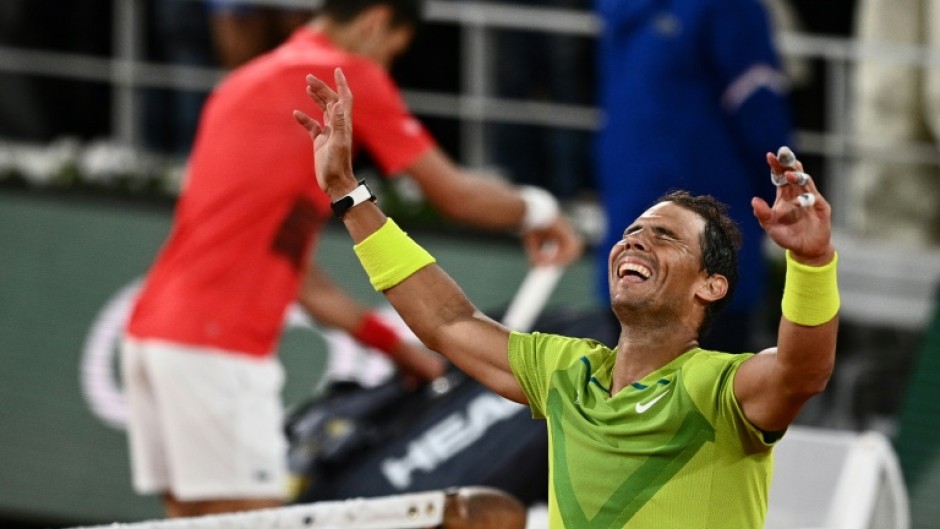
The impossible job: Beating Rafael Nadal at the French Open


Wednesday, 8 July 2015
Steffi Graf appointed brand ambassador of Ayurveda in Kerala
Sunday, 11 May 2014
Sharapova wins Madrid Open title
Thursday, 14 November 2013
Novak Djokovic beats Rafael Nadal to win World Tour Finals

from injury in February, but Djokovic denied him a first ATP Finals title and laid down a marker for battles to come in 2014. Source: SAM Daily Times
Wednesday, 30 January 2013
Djokovic beats Murray, wins Australian Open
to shatter Murray's hopes of a back-to-back second Grand Slam win. After losing the opening set he probably should have won, with five break points to none for Murray, Djokovic turned the tables in the second set by grabbing the tiebreak. Murray then required a medical treatment for blisters at the changeover and failed to capitalise on 0-40 at the start of the third set. He then began to grimace between points, clearly struggling to move freely. It was Djokovic who took the first break of serve after two hours and 52 minutes. A thumping forehand into the corner set him on the way at 4-3, and despite saving two break points from 0-40, Murray could not resist any longer and netted a forehand. Djokovic went on a run of eight out of nine games as he moved two sets to one up and the Scot's serve unravelled, the double-fault count rising to five after just two in his other six matches in Melbourne. Unhappy with the chair umpire for not clamping down on shouts from the crowd, and with his movement hindered, Murray cut a dispirited figure as Djokovic powered towards another major win. With six Grand Slam victories, Djokovic matches the likes of Boris Becker, Stefan Edberg, Don Budge and Jack Crawford in the all-time list, while his rival lost in his all three appearances in the final of the Australian Open. Source: News-Bullet
Saturday, 22 December 2012
Sania, Shoaib on new pitch -Nach Baliye 5
(IANS) Tennis star Sania Mirza and her husband, Pakistani cricketer Shoaib Malik, are set to match steps on the dance reality show "Nach Baliye 5". Rumour mills have been abuzz about their participation in the show, but a formal announcement regarding their inclusion is set to be made here Wednesday. However, if a source is to be believed, the couple will be on the
show just as a special guest for an episode or two. When IANS questioned Nachiket Pant Vaidya, general manager, Star Plus, over Sania-Shoaib's participation, he said: "I met Sania at the BIG Star Entertainment Awards... And well, let's see." Sania and Shoaib got married in 2010. They will join 11 other celebrity couples on "Nach Baliye", which is set to go on air on Star Plus Dec 29. As many as 11 well-known couples from the TV industry have been brought together for the comeback season, to be judged by actress Shilpa Shetty, director Sajid Khan and ace choreographer Terence Lewis. Source: News-Track India, Image: photobucket.com
Monday, 5 November 2012
Bhupathi-Bopanna win Paris Masters
Tuesday, 17 July 2012
Roger Federer: 287 weeks on top

Tuesday, 10 July 2012
Serena beats Radwanska to clinch fifth Wimbledon title

Sunday, 17 June 2012
Maria Sharapova makes Forbes 100 list
Russia’s tennis queen Maria Sharapova has been ranked 71st on Forbes Celebrity 100 list earning $26 million in the past year. Topping the list is US singer Jennifer Lopez with $52 million. The list also features megastars like Oprah Winfrey, Tom Cruise, Steven Spielberg and Britney Spears. RIA, TASS, Tags: Forbes, richest people, Russia, Society, sport, Maria Sharapova , News, World, Читать далее, Source: Voice of Russia. Source: ImageMonday, 11 June 2012
Nadal beats Djokovic to win record 7th French Open title