bloggggg

Home  |  Live  |  Science  |  Lifestyle  |  Entertainment  |  Broadcast  |  Games  |  eBooks  |  Astounds  |  Adbite  |  Cricbell  |  Cyber  |  Idea  |  Digital  |  Privacy  |  Publish  |  ePaper  |  Contact  .Subscribe.Subscribe.Subscribe.Subscribe.Subscribe.Subscribe.Subscribe.Subscribe.Subscribe
Subscribe

Saturday, 25 October 2014

Google celebrates Mangalyaan's 1 month in Mars orbit

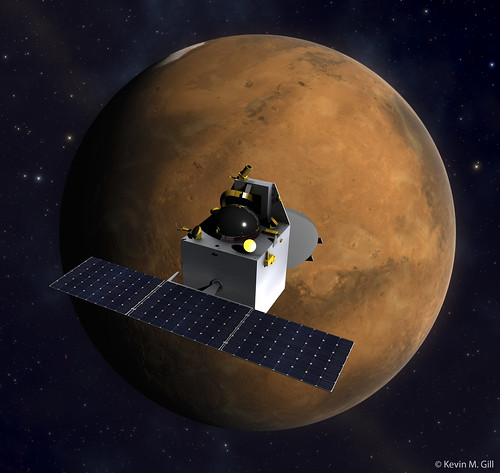
Mars Orbiter Mission Over Mars
Google on Thursday night put out a unique doodle on its abode page for India, blotching Mangalyaan's one month in Mars orbit. The Mars Orbiter Mission (MOM), also called Mangalyaan is a spacecraft orbiting Mars since 24 September 2014. It was launched on 5 November 2013 by the Indian Space Research Organisation (ISRO) under the guidance of the Project Director Mylswamy Annadurai. The mission is a "technology demonstrator" project to develop the technologies for design, planning, management, and operations of an interplanetary mission. It carries five instruments that will help advance knowledge about Mars to achieve its secondary, scientific, objective. The Mars Orbiter Mission  probe lifted-off
from the First Launch Pad at Satish Dhawan Space Centre (Sriharikota Range SHAR), Andhra Pradesh, using a Polar Satellite Launch Vehicle (PSLV) rocket C25 at 09:08 UTC (14:38 IST) on 5 November 2013. The launch window was approximately 20 days long and started on 28 October 2013. The MOM probe spent about a month in geocentric, low-Earth orbit, where it made a series of seven altitude-raising orbital manoeuvres before trans-Mars injection on 30 November 2013 (UTC). After a 298-day transit to Mars, it was successfully inserted into Mars orbit on 24 September 2014. It is India's first interplanetary mission and ISRO has become the fourth space agency to reach Mars, after the Soviet space programNASA,and the European Space Agency. It is also the first nation to reach Mars orbit on its first attempt, and the first Asian nation to do so. The spacecraft is currently being monitored from the Spacecraft Control Centre at ISRO Telemetry, Tracking and Command Network (ISTRAC) in Bangalore with support from Indian Deep Space Network (IDSN) antennae at ByalaluCourtesy: http://en.wikipedia.org, Image: flickr.com

Saturday, 27 September 2014

Amitabh Bachchan Congralutates ISO on the success of Mangalyaan

Amitabh Bachchan posted message on his twitter account congratulating ISO scientist on the success of the Mars Mission 'Mangalyaan', Today. Today, the 'Mangalyaan' successfully placed in the orbit of Mars, this is the first attempt and India got success in this. Indian become first country in the world to accomplish the Mars Mission in first attempt and this is the big success for the Indian scientist at ISO. Amitabh Bachchan posted "T 1623 - #Mangalyaan ... Our scientists have achieved what others could not .. Badhai, Pyaar, Sneh, Abhinandan, aur Jai jai kaar !! MOM !!" on their account. Another post on the Amitabh Bachchan Twitter account says" T 1623 -#Mangalyaan , India's Mars mission .. Mars is Mangal, Tuesday .. and what timing and planning to have achieved it on a Tuesday !!!"
About Mars Mission: The Mars Orbiter Mission (MOM) also know as 'Mangalyaan' (Hindi for "Mars-craft"), is the project of the Indian Space Research Organisation (ISRO) to the Mars Planet. The 'Mangalyaan' was sent to Mars on 5 November 2013 by the Indian Space Research Organisation (ISRO). Today (24 September 2014 ) it is successfully placed into orbit of Mars. This success is important for India as India become first country in the world to place the spacecraft in first attempt to the Mars orbit. Through this mission India demonstrated the technological capability tot he world. This type of mission requires high level of technology and which requires design, planning, management, and operations. Source: Article

Tuesday, 5 November 2013

India successfully launched its Maiden Mars Mission from Sriharikota


.Subscribe
India's premier space agency, ISRO, on 5 November 2013 successfully launched its historic mission to Mars from the Satish Dhawan Space Centre in Sriharikota, about 100 from Chennai. It was India’s first mission to the red planet. The mission follows India’s successful 2008-2009 Chandrayaan-1 moon probe, which discovered water molecules in the lunar soil. The total cost of the Mars mission is 73 million US dollars.
The main features of the Mars mission are as following:
• The main objective of the mission is to develop the technologies required for design, planning, management and operations of an interplanetary mission.
• The main objective of the mission is to explore Mars surface features, morphology, mineralogy and search for methane in the Martian atmosphere using indigenous scientific instruments.
• The satellite carries instruments such as Lyman Alpha Photometer, a methane sensor, a composition analyser, a camera and an imaging spectrometer for studying the atmosphere, particle environment and surface imaging.
• The satellite is scheduled to reach the Mars orbit in September 2014 and is designed to circle the Red Planet in an elliptical orbit of 366 km X 80000 km.
Mission Objectives
one of the main objectives of the first Indian mission to Mars is to develop the technologies required for design, planning, management and operations of an interplanetary mission.
A. Technological Objectives:
• Design and realisation of a Mars orbiter with a capability to survive and perform Earth bound manoeuvres, cruise phase of 300 days, Mars orbit insertion / capture, and on-orbit phase around Mars.
• Deep space communication, navigation, mission planning and management.
• Incorporate autonomous features to handle contingency situations.
B. Scientific Objectives:
• Exploration of Mars surface features, morphology, mineralogy and Martian atmosphere by indigenous scientific instruments.
Payloads
1. Lyman Alpha Photometer (LAP)
2. Methane Sensor for Mars (MSM)
3. Mars Exospheric Neutral Composition Analyser (MENCA)
4. Mars Colour Camera (MCC)
5. Thermal Infrared Imaging Spectrometre (TIS)
About Mars Orbiter Mission (MOM)
Primary objectives of the Mars mission are to demonstrate India’s technological capability to send a satellite to orbit around Mars and conduct meaningful experiments such as looking for signs of life, take pictures of the red planet and study Martian environment. The main aim of MOM to be to seek whether there is methane, considered a precursor chemical for life, on the red planet. Methane sensor, one of the five payloads (scientific instruments) on board the spacecraft, would look to detect the presence of methane. The XL version of the Indian Space Research Organisation's workhorse Polar Satellite Launch Vehicle (PSLV) would be used for launching of the mission. The satellite will carry compact science experiment instruments, totalling a mass of 15 kg. There will be five instruments to study Martian surface, atmosphere and mineralogy. After leaving the earth’s orbit, the spacecraft will cruise in deep space for about ten months using its own propulsion system and will reach Martian transfer trajectory in September 2014. The spacecraft subsequently is planned to enter into a 372 km by 80000 km elliptical orbit around Mars.

Saturday, 22 June 2013

Heavy ions killed Mars probe – Investigators

Russian Mars probe Phobos-Grunt was lost because space radiation disrupted its computer system, a commission investigating the incident said on Friday.The investigation found no faults with the spacecraft’s hardware, the commission said in a summary of its report, released on the website of the Federal Space Agency.Tags: Mars, News, Russia, Phobos-Grunt, space, Sci-Tech, Читать далее, Source: Voice of Russia

Thursday, 11 October 2012

Shiny object spotted near Mars rover

марс планета марсоход Curiosity Кьюриосити
A shiny object spotted near the Mars Curiosity rover on the 52nd day of its work on the Red Planet prompted mission control to suspend the rover’s planned sand-scooping operation as scientists study photographs of the strange object and determine its possible impact on the Curiosity’s work. The Mars Curiosity landed on the Red Plant on August 6. RIA, Source: Voice of Russia

Thursday, 9 August 2012

Searching for life on Mars

By: Boris Pavlishchev, Russia’s space agency Roskosmos intends to join the ExoMars European project aimed at sending two research missions to Mars in 2016 and 2018. It will make an official statement to this end early next month after talks with the European Space Agency on Russia’s role in the mission. The ExoMars mission will be a Russian–European project after the Americans pulled out of it recently owing to NASA budget cuts.As part of the ExoMars project, there are plans to send two
probes, an orbital one and a static lander, to the planet in 2016. In 2018, a multi-purpose Mars Rover will be launched. The European Space Agency planned to launch the probes on board the American Atlas-5 rocket. But, last autumn, NASA made it clear that there will be a problem with the rocket in 2016 and this prompted the head of the EKA Jean-Jacques Dordain to invite Russia to join the ExoMars project. Dordain said that Russia’s involvement would not be limited to the supply of the Proton rocket. In short, Russia will be the third full-fledged partner in the project and will conduct its own experiments and enrich the mission, the head of the EKA assured. A 2018 mission using an American was planned, but NASA decided to completely pull out from the Martian project owing to financial difficulties. Tags: Mars, Roscosmos, Russia, European Space Agency, Commentary, Sci-Tech, NASA, World, Читать далее, Source: Voice of Russia

Monday, 6 August 2012

Nasa's Curiosity rover survives 13,000mph plunge onto Martian surface

By MARK PRIGG: After travelling eight-and-a-half months and 352 million miles, Nasa's rover Curiosity finally landed on Mars at 5.33 GMT (1.33 EDT) this morning. The high-tech craft hit the top of the Martian atmosphere at 13,000mph, and was then slowly lowered by a radical floating 'sky crane' before gently arriving in a massive crater. The news was greeted with cheers and shouts in Nasa's Pasadena Mission Control, and within seconds the craft had sent back the first pictures of its new home. https://blogger.googleusercontent.com/img/b/R29vZ2xl/AVvXsEhyyikW0y9q3J0F8epu-6BQhGdLtOUlLwqgNJKANTPXLLEja8S4NMfOh2yZc5w3xcfqtsmuJprdQ5lk7QqjbHBfG2PEELT45MrKYNrTlB4IcQqinbVAxOjopcFFQU7_1NssW1pawHCpWaI/s1600/Curiosity+Rover+7.jpg
Jubilant scientists hugged, wept and distributed Mars bars to each other as mission controllers confirmed the landing. 'Touchdown confirmed', controllers said. 'We are wheels down on Mars. Oh, my God.' Nasa Administrator Charles Bolden hailed the success as a big step towards sending men to the red planet. 'Today, the wheels of Curiosity have begun to blaze the trail for human footprints on Mars,' he said. https://blogger.googleusercontent.com/img/b/R29vZ2xl/AVvXsEjqMjzpDmfPNRCKUbId7fO6FfgUfuHbQCQoI1ZrdGYq0E4W9mrt2EYOOPE_Tw6Se-TEp1gUxztQW_BXHjhu-rSJ0NiPgiM19Ldl0rqdJhyphenhyphenjYkLK5QkxKdrOz6ol0ptjuCoLtwo31LJsCR3P/s1600/NASA_Mars_Rover+dunya+infocom.jpg
The mission was hailed by President Obama, who said 'Tonight, on the planet Mars, the United States of America made history.' The trickiest moment of the landing came in a truly out of this world gymnastics

routine during Curiosity's 'seven minutes of terror' plummet through the atmosphere. When the rover had safely navigated its landing and touched down on the face of the Red Planet, NASA scientists exploded with delight and some even broke down in tears, overwhelmed at the success of thehttps://blogger.googleusercontent.com/img/b/R29vZ2xl/AVvXsEgDoNKDQGyRzMGKWp9Vb6xZd3JkFgbAPj9UJg2-EtQIVNHumw4lUi1Fh-ydehHNrOuBWsTKVjLm2MJeXcN-R2g0CQDLEzjeSf3MfSu8oSihw4-tquh8qqSRcKF0L7bpgaoPsQEnknMr788/s1600/Curiosity+Rover+2.jpg
decades-long project. Nasa was ready for the 'Super Bowl of planetary exploration,' said Doug McCuistion, head of the Mars exploration program at NASA headquarters. 'We score and win or we don't score and we don't win,' he said. Curiosity's trajectory was so accurate that engineers decided to wave off a last chance to tweak its position before atmosphere entry. 'We're ready to head in,' said mission manager Brian Portock.https://blogger.googleusercontent.com/img/b/R29vZ2xl/AVvXsEjNx9dVWCcGYQu_xHdZem_vioEBrrYTW_z_t_yCcodWh0q-VhVUVNM6WlhhciQv69YFu_8z5Oc0yYMZlkTFbTcnt6PFjo8v_zHfO5I6tD_2_69FKanRw8dvyWwik0BMIXaK4kF9F-zqt7k/s1600/Curiosity+Rover+3.jpg
Not ones to tempt fate, flight controllers broke out the 'good luck' peanuts before Curiosity takes the plunge as part of a long-running tradition. One scientist who could relate to the building anxiety was Cornell University planetary scientist Steve Squyres, who headed NASA's last successful rover mission in 2004.This time around, Squyres has a supporting role and planned to view the landing with other researchers in the 'science bullpen.' 'Landing on Mars is always a nerve-racking thing. You're never going to get relaxed about something like landing a spacecraft on Mars,' he said. Sunday's touchdown attempt was especially intense because NASA is testing a brand new landing technique. Due to the communication delay between Mars and Earth, Curiosity was be on autopilot. There was also extra pressure because budget woes have forced NASA to rejigger its Mars exploration roadmap. 'There's nothing in the pipeline' beyond the planned launch of a Mars orbiter in 2013, said former NASA Mars czar Scott Hubbard, who teaches at Stanford University. Curiosity was launched to study whether the Martian environment ever had conditions suitable for microbial life. The last Mars rovers, twins Spirit and Opportunity, were cocooned in air bags and bounced to a stop in 2004. The plans for Curiosity called for a series of braking tricks, similar to those used by the space shuttle, and a supersonic parachute to slow it down. Next: ditch the heat shield used for the fiery descent. And in a new twist, engineers came up with a way to lower the rover by cable from a hovering rocket-powered backpack. At touchdown, the cords cut and the rocket stage crashes a distance away. The nuclear-powered Curiosity, the size of a small car, is packed with scientific tools, cameras and a weather station. It sports a robotic arm with a power drill, a laser that can zap distant rocks, a chemistry lab to sniff for the chemical building blocks of life and a detector to measure dangerous radiation on the surface. It also tracked radiation levels during the journey to help NASA better understand the risks astronauts could face on a future manned trip. After several weeks of health checkups, the six-wheeled rover could take its first short drive and flex its robotic arm. Source: Travelfwd+

Sunday, 22 July 2012

Flight to Mars possible in the first half of 21st century – academician

A flight to Mars may take place in the first half of the 21st century, Russian Academy of Sciences Vice-President, academic chief of the Institute of Medical and Biological Problems Anatoly Grigoryev said at an international symposium dedicated to the Mars 500 experiment. The symposium was held at the Russian Academy of Sciences on April 23-25.Humanity has long been dreaming about other planets, and the dream of interplanetary flights may soon come true, the academician said. Tags: News, World, Mars, space, Sci-Tech, Mars 500 experiment, Russia, Читать далее, Source: Voice of Russia

Monday, 7 May 2012

The race to Mars: India takes the lead

India aims at sending an orbiter to Mars in 2013. The race for the Red planet unwinds with NASA planning a launch for the same 2013 fiscal year and China somewhat lagging behind. Earlier this month Europe gave a go ahead for a Mars mission with Russia in 2016. Russia and India have also a plan for a joint lunar mission scheduled for 2014. The Moon for Mars? Tags: Mars, Commentary, World, space, Sci-Tech, Читать далее, Source: Voice of Russia

Wednesday, 2 May 2012

What would it be like to live on Mars?

.Subscribe.Subscribe
Perhaps, people could live on Mars. The radiation levels on the planet are as low as in the lower earth orbit where the International Space Station flies. Scientists have arrived at this conclusion after receiving radiation measurement results from the red planet. Nevertheless, experts are not in a hurry to review their approaches towards the protection of people when making preparations for future expeditions to the Mars. Radiation remains to be the major obstacle in carrying out manned flights to Mars. This has been technically expedient since the early 1970s. However, scientists have not developed light materials to protect people from radiation yet, while it’s impossible to take heavy thick lead plates into space. It has been estimated that during the three-year flight one of every four crew members might receive a dose of radiation enough to trigger a fatal cancer disease. These three years include the waiting time for favourable conditions to start the return journey. If radiation has no effect on the crew during this period of time, there is a need to make new assessments, says biologist at Moscow State University, Elena Vorobeova. “Any new information will change our apprehension, and as a result, we will review our approaches towards assuring safety for cosmonauts. However, I believe that overall, this will not affect our general understanding of how to protect cosmonauts on Mars,” Elena Vorobeova said. During the flight, there is nowhere to hide from dangerous cosmic radiation. Moreover, there is no magnetic field around the planet like on Earth that protects living beings from solar flares. Here is an opinion from head of the department at the Institute of Medical and Biological Problems Vladislav Petrov. “I see no reason to review any principles or approaches. The atmosphere on Mars is a sufficient protection from various kinds of comic radiation. However, during strong solar flares, the dose of radiation could be large, and this may cause problems. These problems are quite different from those when we fly around the Earth. One of them is the deterioration of working efficiency under the influence of radiation. We are aware of this even when driving a car. We hope that such a thing never happens during a flight to Mars,” Vladislav Petrov said. The influence of radiation during a stay on Mars is comparable to that during an orbital flight. In fact, a stay on board the ISS for months is also not so safe because cosmonauts are affected by heavy cosmic particles that cause various kinds of defects in the eyes. There have been incidents of growing cataract, says Vladislav Petrov. The issue should be thoroughly studied not only on the basis of what has been observed in cosmonauts but also on the basis of special experiments. Russia is planning to conduct these experiments on board the BION satellite next year,” Vladislav Petrov added. Concerning the chances for discovering life on the Mars, the new information sent by Curiosity Mars rover will have no effect on it since radiation is not the most harmful thing for a living cell. Sometimes bacteria live in the closest proximity to nuclear reactors where radiation is extremely high. Scientists assess the living condition on Mars as not very extreme. Vladislav Petrov believes that new information will lead to the review of the evolution of the biosphere on the planet. However, the search for the constituency of the biosphere on Mars has not ended successfully. If there is no evidence of life on Mars there is no need to review any hypothesis of its development. Still, there is no clear answer to the main question. Scientists cannot answer why Mars has entirely lost its atmosphere and water, and its warm and wet climate has been replaced by cold and dry weather. Voice of Russia.

Saturday, 10 March 2012

Simulated Mars mission complete

Mars 500 simulated mission to the Red Planet has been successfully completed. On November 4, six volunteers were set free after a year-and-a-half isolation experiment in the Moscow-based Institute for Medical and Biological Problems. The crew, featuring three Russians, a Frenchman, an Italian, and a Chinese, was headed by Russia’s Alexei Sityov. Mars 500 simulated mission to the Red Planet has been successfully completed. On November 4, six volunteers were set free after a year-and-a-half isolation experiment in the Moscow-based Institute for Medical and Biological Problems. The crew, featuring three Russians, a Frenchman, an Italian, and a Chinese, was headed by Russia’s Alexei Sityov. It has carried out over 100 experiments during the “mission”. Source: Voice of Russia

Thursday, 8 March 2012

Alien Pyramid Discovered In Mars Rover Photo, NASA Source, March 2012

ScottcWaring, By ScottCWaring : was looking at this photo of mars surface in Bonniville Crater Panoramic and found this pyramid shaped object. Now it
seems to reason that this object from its angles was made by intelligence. Is it a tiny pyramid, which explains the Apollo 20 mission to the moon and finding 5-7 cm skeletons of human-like figures inside glass tunnels along
the walls of the giant ship (Deporte Crater, moon). Or is this a brick from a much larger structure or sculpture from millions of years ago? Source: ScottcWaring

Monday, 6 February 2012

Mars has more water vapor than thought - research

The Martian atmosphere contains 10 times more water vapor than thought, Science reports.A group of Russian and French scientists came to this conclusion after processing data supplied by an infrared spectrometer on board the European Mars Express probe. Tags: Russia, World, Mars, News, Sci-Tech, Читать далее, Source: Voice of Russia.

Saturday, 26 November 2011

NASA set to launch Mars 'dream machine

NASA's Mars rover set for launch
This artist's conception depicts the rover Curiosity, of NASA's Mars Science Laboratory mission, as it uses its Chemistry and Camera (ChemCam) instrument to investigate the composition of a rock surface on Mars is pictured in this NASA publicity photograph released to Reuters November 23, 2011. [Photo/Agencies]
China: As big as a car and as well-equipped as a laboratory, NASA's newest Mars rover blows away its predecessors in size and skill. Nicknamed Curiosity and scheduled for launch on Saturday, the rover has a 2-meter arm tipped with a jackhammer and a laser to break through the Martian red rock. What really makes it stand out: It can analyze rocks and soil with unprecedented accuracy. "This is a Mars scientist's dream machine," said NASA Jet Propulsion Laboratory's Ashwin Vasavada, the deputy project scientist. Once on the red planet, Curiosity will be on the lookout for organic, carbon-containing compounds. While the rover can't actually detect the presence of living organisms, scientists hope to learn from the $2.5 billion, nuclear-powered mission whether Mars has - or ever had - what it takes to nurture microbial life. Curiosity will be "the largest and most complex piece of equipment ever placed on the surface of another planet", said Doug McCuistion, director of NASA's Mars exploration program. Read Full: NASA set to launch Mars 'dream machine' - China.org.cn